Ginger

A warm orange brown named after the spice, now mostly a word for red hair and orange cats.

Overview

Ginger is a warm orange brown. The code used here, #B06500, is strong in red, medium in green and has no blue at all, which gives a deep, toasted orange.

The name comes from the spice. English has used the word for the plant since before the 12th century, from Latin zingiber and Greek zingiberi, which came from an Indo-Aryan language. As a color it is roughly the shade of dried, ground ginger root.

Today ginger mostly describes red hair and orange cats, especially in Britain, where “a ginger” can mean a redhead. Real ginger hair is often redder than this code: the hair in Edvard Munch’s 1902 print of a red-haired woman samples at about #AA4107. The 1955 ISCC-NBS dictionary goes the other way and files Maerz and Paul’s ginger as a darker strong brown.

Ginger is lively but earthy. Black text reads slightly better on it than white, so keep white text large. It pairs well with teal, navy, cream and olive. For red hair with more brown in it, see auburn.

HEX#B06500
RGBrgb(176, 101, 0)
HSLhsl(34, 100%, 35%)
HSV34°, 100%, 69%
CMYK0, 43, 100, 31
OKLCHoklch(57.9% 0.133 62.5)
Every code converts from the HEX value #B06500. No color standard defines ginger. #B06500 is the code most color lists use. Merriam-Webster defines ginger as a light reddish or reddish-brown color, and the 1955 ISCC-NBS dictionary files the ginger of Maerz and Paul’s A Dictionary of Color (1930) as a strong brown, about #80461B. CMYK is a screen-based estimate; print results vary.
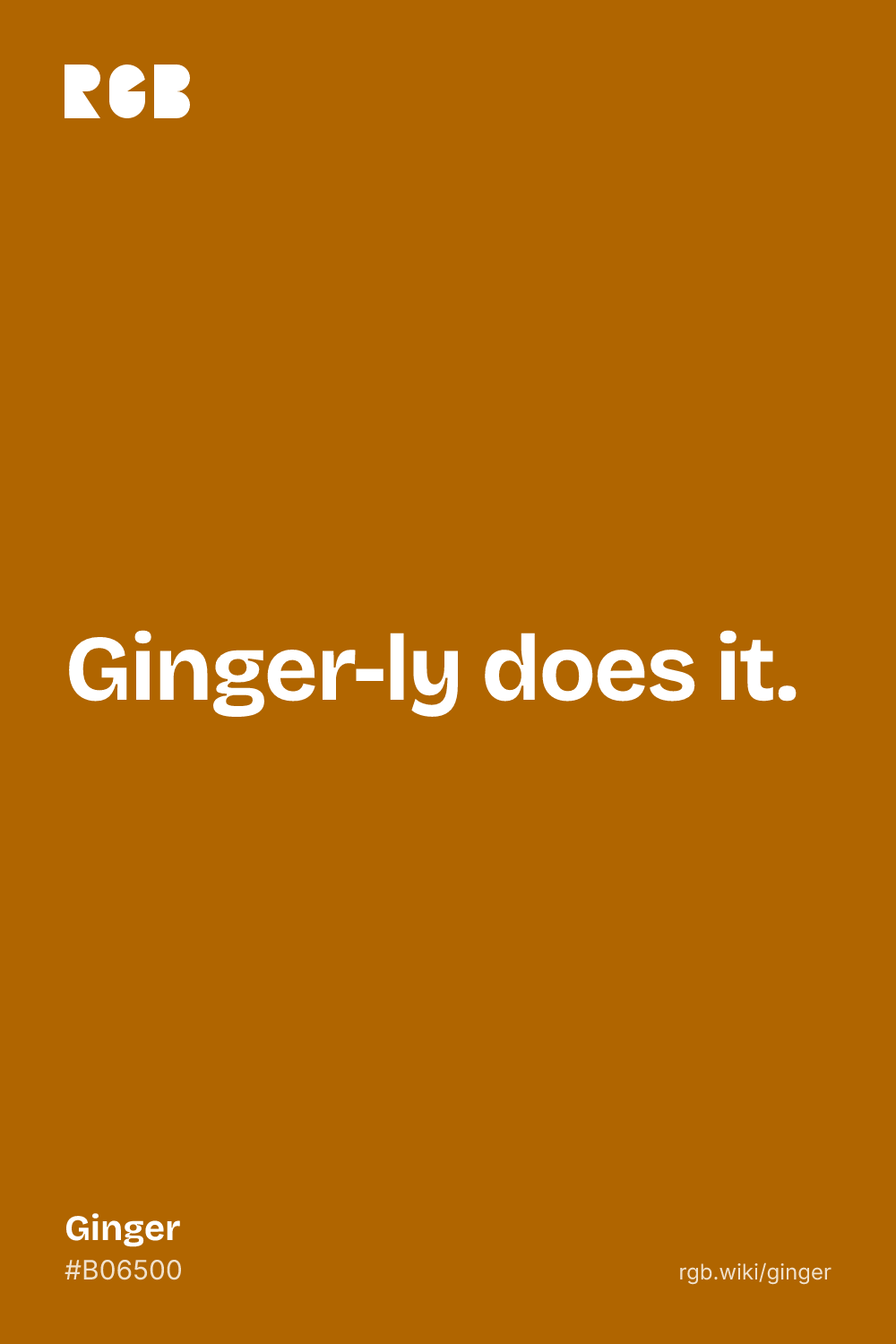
Ginger color card, hex #B06500: “Ginger-ly does it”

Ginger on the color map

The dictionary’s strong brown sits below and to the left of the code, darker and redder, near the edge of the outline. The hair in Munch’s print sits well to the left at a similar lightness: much redder, like bright red hair. The outline is an approximate range, not a measured one.

Shades and tints

Tints with white

Shades with black

Tones with gray

Ginger sits in the middle. Tints add white, shades add black and tones add gray, in 10% steps out from it. Tap any swatch to copy its code.

Light and dark ginger

#E7D1B2
Pale gingerMixed 70% with white. A warm cream for backgrounds.
#D0A366
Light gingerMixed 40% with white. A soft caramel.
#B06500
GingerThe reference color.
#AA4107
Ginger hairSampled from the red hair in Munch’s 1902 print. Redder and more intense.
#80461B
Dictionary gingerThe ISCC-NBS strong brown, where the 1955 dictionary files Maerz and Paul’s ginger.
#6A3D00
Dark gingerMixed 40% with black. A deep brown for text and borders.

Colors that go with ginger

Pairings that work in rooms, outfits and interfaces.

Ginger and teal

Warm orange against cool blue-green. Fresh and bold.

Ginger and navy

A classic warm and cool pair. Confident and sporty.

Ginger and cream

Soft and cozy, like gingerbread and milk.

Ginger and olive

Earthy and calm. Good for food, gardens and outdoor brands.

Spice rack

Ginger with turmeric gold and a deep cinnamon red.

Ginger night

A dark theme with a lighter ginger as the accent.

Color-wheel palettes

Pick a palette to see where its colors sit on the color wheel. The caret marks ginger. Tap a band to copy its code.

Similar colors

Clay70%Burnt orange70%Cinnamon67%Copper79%GingerGolden brown79%Drab74%

Lined up by hue around ginger. Hover a color to see how similar it is.The bar under each name shows how similar it is. Similarity comes from the distance between the two colors in OKLab, a model of how we see color.

Ginger vs auburn

Ginger#B06500 · hue 34°
  • Lighter and more orange
  • Named after a spice
  • Bright red hair and orange cats
Auburn#922724 · hue 2°
  • Darker and redder
  • Red hair with more brown in it
  • Once meant blond

Meaning

  • Spice
  • Red hair
  • Orange cats
  • Genetics

Ginger is a spice first and a color second. As a color it now mostly describes red hair and orange cats, and both have become small classics of genetics: one gene shapes most red hair in people, and a different one, found only in 2025, makes cats orange. Color research tests broad words like orange, not ginger, so the claims here are about the word, hair and fur.

Named after the spice

Dictionary record

English took ginger from Medieval Latin gingiber, from Latin zingiber and Greek zingiberi, a word of Indo-Aryan origin. As a color, Merriam-Webster defines it as a light reddish or reddish brown, as in ginger hair. In British English, a ginger is also a person with red hair.1
Most red hair traces to one gene

Landmark study

In 1995, researchers in Newcastle found variants of the MC1R gene in over 80% of people with red hair or fair skin that tans poorly, but in fewer than 20% of people with brown or black hair. MC1R helps set the balance between red pheomelanin and dark eumelanin in hair and skin.2

Why orange cats are mostly male

Two studies agree

About 80% of orange cats are male. The orange gene sits on the X chromosome, so a male, with one X, needs one copy, while a female needs two. With one copy, a female comes out tortoiseshell or calico, because each of her cells switches off one X at random. In 2025, teams at Stanford and Kyushu University independently traced the gene to the same small deletion, about 5,000 letters of DNA, in a gene called ARHGAP36.3, 4, 5

Redheads may need more anesthetic

One small study

In a 2004 study of 20 women, natural redheads needed about 19% more of the anesthetic desflurane than dark-haired women before they stopped responding to a painful stimulus. Nine of the ten redheads carried two MC1R variants. The study was small, so treat the size of the effect as uncertain.6

Sources (6)
  1. Merriam-Webster, “ginger”, definitions, etymology and first known use.
  2. Valverde, P., Healy, E., Jackson, I., Rees, J. L. & Thody, A. J. (1995). Variants of the melanocyte-stimulating hormone receptor gene are associated with red hair and fair skin in humans. Nature Genetics, 11(3), 328–330. doi:10.1038/ng1195-328
  3. Kaelin, C. B., McGowan, K. A., et al. (2025). Molecular and genetic characterization of sex-linked orange coat color in the domestic cat. Current Biology, 35(12), 2826–2836. doi:10.1016/j.cub.2025.04.055
  4. Toh, H., Au Yeung, W. K., et al. (2025). A deletion at the X-linked ARHGAP36 gene locus is associated with the orange coloration of tortoiseshell and calico cats. Current Biology, 35(12), 2816–2825. doi:10.1016/j.cub.2025.03.075
  5. NPR, Short Wave, “Science says orange cats are special. Here’s why” (May 16, 2025).
  6. Liem, E. B., Lin, C. M., Suleman, M. I., et al. (2004). Anesthetic requirement is increased in redheads. Anesthesiology, 101(2), 279–283. doi:10.1097/00000542-200408000-00006

History

Ginger traveled from India to Europe as a spice long before it was a color word. In the last century it became a test case for the genetics of red hair and orange fur.

  1. Before the 1100s

    “Ginger”, the spice, is in use in English. The word comes through Latin zingiber and Greek zingiberi from an Indo-Aryan language.1

  2. About 1900

    Scientists start using the colors and patterns of cats to study genetics. Orange stands out because it is linked to sex.2

  3. 1902

    Edvard Munch prints Woman with Red Hair and Green Eyes. The Sin in yellow, reddish-brown and green inks.3

  4. 1930

    Maerz and Paul’s A Dictionary of Color includes ginger. The 1955 ISCC-NBS dictionary later files it as a strong brown.4

  5. 1995

    Researchers in Newcastle link variants of the MC1R gene to red hair and fair skin in people.5

  6. 2004

    A small study finds that natural redheads need more of the anesthetic desflurane than dark-haired women.6

  7. 2025

    Teams at Stanford and Kyushu University each find the deletion near the ARHGAP36 gene that makes cats orange, a century after the trait was first noticed.2, 7

Sources (7)
  1. Merriam-Webster, “ginger”, etymology and first known use.
  2. Stanford Medicine News Center, “Scientists track down mutation that makes orange cats orange” (May 15, 2025).
  3. Art Institute of Chicago, “Woman with Red Hair and Green Eyes. The Sin”, Edvard Munch, 1902 (1950.1457).
  4. Jaffer, A. “(M) Dictionary of Color”, the ISCC-NBS placements of Maerz and Paul’s color names (1955 dictionary).
  5. Valverde, P., et al. (1995). Variants of the melanocyte-stimulating hormone receptor gene are associated with red hair and fair skin in humans. Nature Genetics, 11(3), 328–330. doi:10.1038/ng1195-328
  6. Liem, E. B., et al. (2004). Anesthetic requirement is increased in redheads. Anesthesiology, 101(2), 279–283. doi:10.1097/00000542-200408000-00006
  7. Toh, H., et al. (2025) and Kaelin, C. B., et al. (2025), Current Biology, 35(12), 2816–2836. doi:10.1016/j.cub.2025.03.075, doi:10.1016/j.cub.2025.04.055

Ginger in use

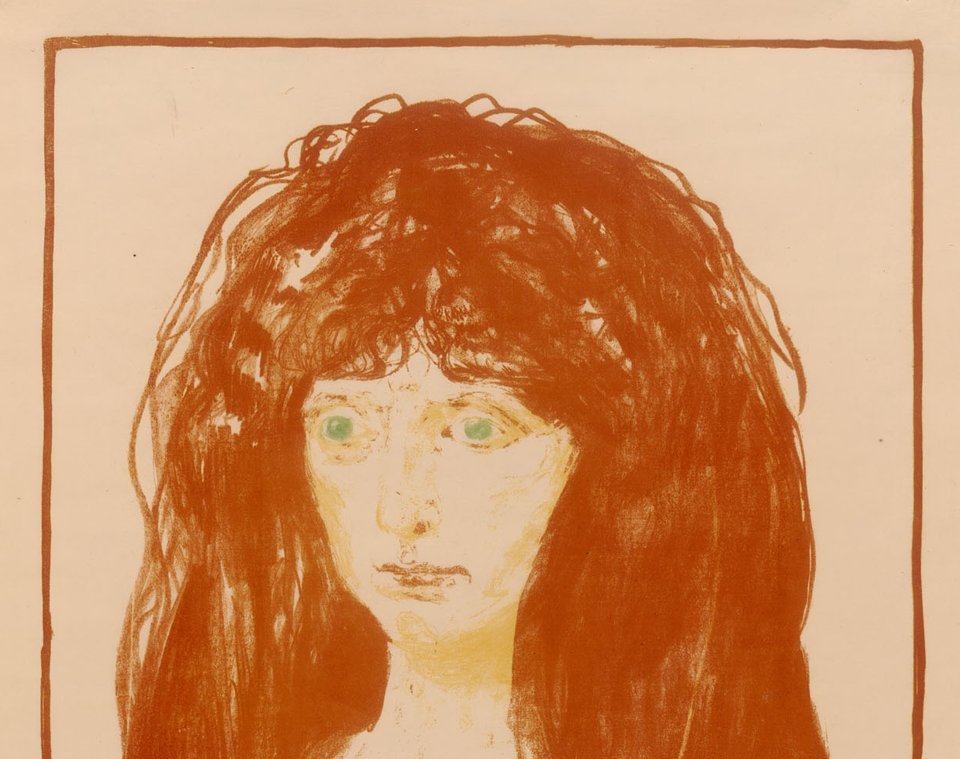
A lithograph of a woman’s face with green eyes, framed by long, tangled, orange-red hair, printed on cream paper
#AA4107#B45820#C67A42#9A9B60
PrintWoman with Red Hair and Green Eyes. The Sin, by Edvard Munch (1902)

Munch printed this portrait from two stones in yellow, reddish-brown and green ink. The hair samples at about #AA4107, with lighter strands near #B45820 and #C67A42: redder and more intense than the ginger code, closer to bright red hair. The eyes are an olive green, about #9A9B60.

#AA4107#B45820#C67A42#9A9B60
Source: Art Institute of Chicago

Palettes are sampled in-house.

Questions

What color is ginger?

A warm orange brown, named after the spice. The code used here is #B06500 (RGB 176, 101, 0).

Is ginger the same as red hair?

In everyday English, mostly yes. Ginger hair is red hair, especially a bright, orange-toned red, and in Britain a ginger is a redhead. The web code is browner than most ginger hair.

Why are most orange cats male?

The main orange gene in cats sits on the X chromosome. Males have one X, so one copy makes them orange. Females have two and need two copies to be fully orange; with one, they come out tortoiseshell or calico. About 80% of orange cats are male.

What gene causes red hair?

Mostly MC1R. Variants that weaken it shift pigment cells from dark eumelanin toward red pheomelanin. A 1995 study found MC1R variants in over 80% of people with red hair or skin that tans poorly.

What is the difference between ginger and auburn?

Ginger (#B06500) is lighter and more orange, like bright red hair. Auburn (#922724) is darker and has more brown in it.

What colors go with ginger?

Teal and navy for contrast, cream for a warm look, and olive for an earthy palette. Black text reads slightly better on ginger than white.