Hunter orange

The fluorescent orange that hunting laws require: blazing to people, dull to deer.

Overview

Hunter orange, also called blaze orange, is the fluorescent orange hunters wear so that other hunters can see them. Its usual screen code is #FF6A13: red at full strength, green at about 42% and a trace of blue, a hot orange with a slight lean toward red.

It is a color set by law. Most US states require gun hunters, at least in deer season, to wear a fixed amount of it: 250 square inches on the head, chest and back in Pennsylvania, 400 in Delaware and on Texas public lands, 500 in Massachusetts. Delaware and Arkansas go further and define the color itself, as a daylight fluorescent orange with a dominant wavelength between 595 and 605 nanometers.

The rule goes back to field tests around 1960, when Massachusetts wildlife officials, the US Army and an optics company found fluorescent orange the easiest color to see and recognize outdoors. It is made for human eyes, not deer. Deer have two kinds of cone instead of three, so they cannot tell orange from green or brown by hue, and hunter orange probably looks dull to them.

On screen, #FF6A13 matches the hue and purity the laws ask for almost exactly, but no screen can make it as bright as the fabric, which glows because fluorescent dyes turn blue and ultraviolet light into extra orange. It sits between neon orange and the slightly yellower safety orange of traffic cones. Dark text reads best on it, and it looks at home with olive, khaki, charcoal and denim blue.
HEX#FF6A13
RGBrgb(255, 106, 19)
HSLhsl(22, 100%, 54%)
HSV22°, 93%, 100%
CMYK0, 58, 93, 0
OKLCHoklch(70.1% 0.200 43.7)
Every code converts from the HEX value #FF6A13. No standard or law gives a screen code for hunter orange. #FF6A13 is the code most color lists use, and we could not trace where it started. Laws define the color by measurement instead: Delaware’s asks for a daylight fluorescent orange with a dominant wavelength of 595 to 605 nm, a purity of at least 85% and a luminance factor of at least 40%. By our calculation, #FF6A13 has a dominant wavelength of about 596 nm and a purity of about 86%, inside that window, but a luminance of about 32%, the most a screen can give an orange of that hue and purity. Wikipedia files hunter orange under safety orange, #FF7900. CMYK is a screen-based estimate; print results vary.
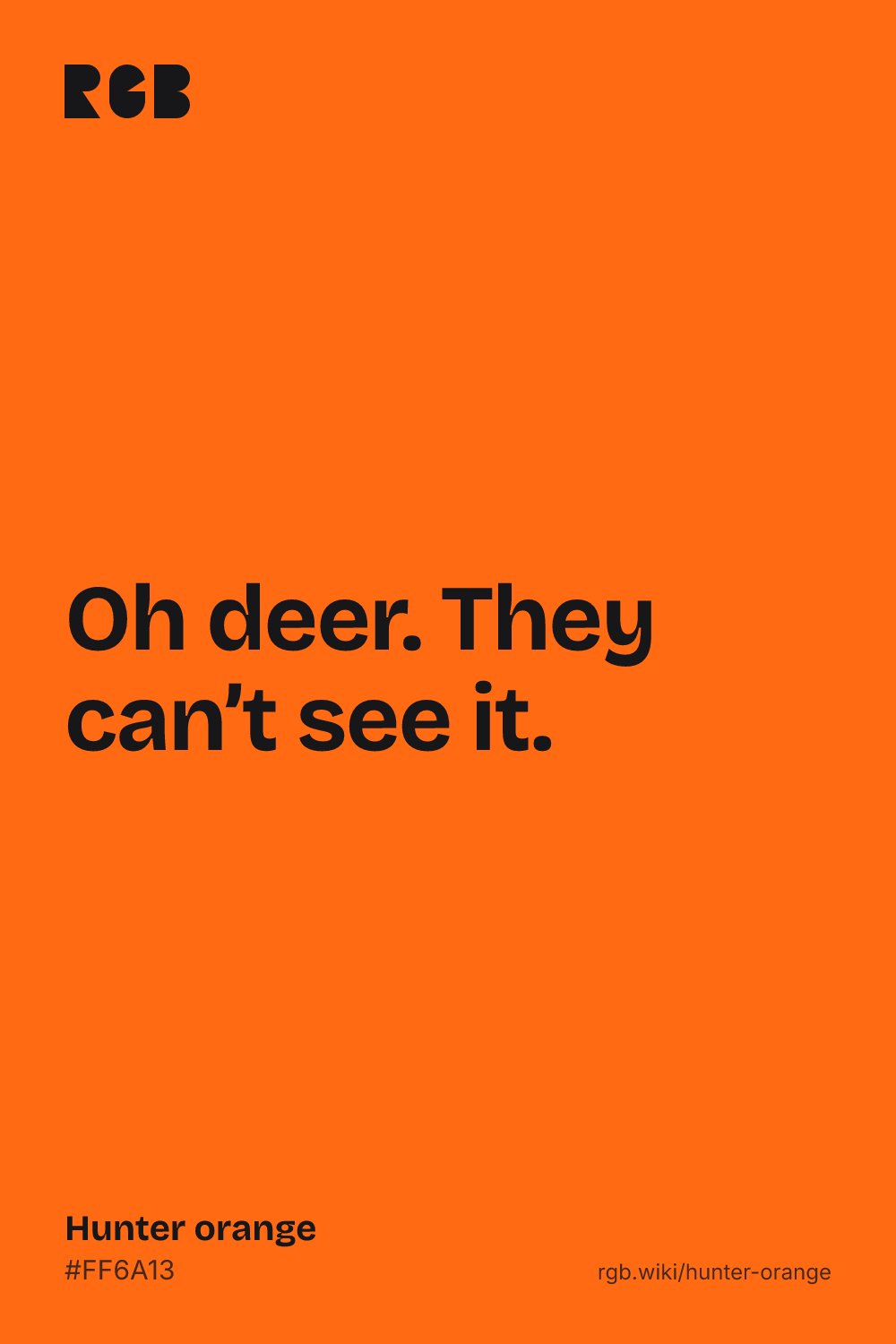
Hunter orange color card, hex #FF6A13: “Oh deer. They can’t see it”

Hunter orange on the color map

The x-axis is hue, from red on the left to yellow on the right. The legal window’s yellow edge sits almost on top of the reference, so the usual code lies at the yellow end of what the laws allow. The window’s middle sits to the left and a little lower, and its red edge further left and lower, on the outline’s left edge: redder and darker, because a screen loses brightness as an orange this pure gets redder. Wikipedia’s safety orange lies to the right and a touch higher, yellower and lighter. The outline is an approximate range, not a measured one.

Shades and tints

Tints with white

Shades with black

Tones with gray

Hunter orange sits in the middle. Tints add white, shades add black and tones add gray, in 10% steps out from it. Tap any swatch to copy its code.

Light and dark hunter orange

#FFC3A1
Pale hunter orangeMixed 60% with white. A soft peach for backgrounds.
#FFA671
Light hunter orangeMixed 40% with white. A warm apricot.
#FF6A13
Hunter orangeThe reference color.
#FF7900
Safety orangeYellower and a little lighter, the orange of traffic cones and warning signs, with a page of its own. See safety orange
#B24A0D
Burnt hunter orangeMixed 30% with black. A rusty orange that holds white text.
#80350A
Dark hunter orangeMixed 50% with black. A deep brown-orange for headings.

Colors that go with hunter orange

Pairings that work in rooms, outfits and interfaces.

Blaze and timber

The classic hunting-gear pairing: orange against the olive and bark browns it is meant to stand out from.

Hunter orange and charcoal

A dark theme with orange as the warning accent. Loud and technical.

Hunter orange and denim

Blue sits opposite orange on the color wheel, so each makes the other look brighter. Casual and sporty.

Snow and blaze

Winter woods: white snow, cool gray shadows and one hot accent.

Orange and pink

The two colors many hunting laws now accept, side by side. Bold and playful.

Autumn field

Dry grass, khaki and leaf brown, with the orange as the only bright note. Warm and earthy.

Color-wheel palettes

Pick a palette to see where its colors sit on the color wheel. The caret marks hunter orange. Tap a band to copy its code.

Similar colors

Tomato80%International orange77%Neon orange89%Coral76%Hunter orangePumpkin89%Safety orange84%

Lined up by hue around hunter orange. Hover a color to see how similar it is.The bar under each name shows how similar it is. Similarity comes from the distance between the two colors in OKLab, a model of how we see color.

Hunter orange vs safety orange

Hunter orange#FF6A13 · hue 22°
  • Redder, a hot fluorescent orange
  • Worn by hunters under state laws
  • Defined in some states as 595–605 nm
Safety orange#FF7900 · hue 28°
  • Yellower and a little lighter
  • On cones, signs and machinery
  • Set by the ANSI Z535 safety-color standard

Meaning

  • Hunting season
  • Seen by people
  • Required by law
  • Safety

Hunter orange has one job: to say “person, not game”. Most US states write it into their hunting laws, a few down to the wavelength. Its meaning rests on human eyes. Deer, with two-color vision, probably see it as dull, and the evidence that it saves lives comes from records of real shootings, not controlled trials.

Defined by law, in nanometers

Law

Delaware’s code defines hunter orange as a daylight fluorescent orange with a dominant wavelength between 595 and 605 nanometers, a purity of at least 85% and a luminance factor of at least 40%, and requires 400 square inches of it on the head, chest and back while deer may be hunted with firearms. Arkansas uses the same 595–605 nm range and also accepts a fluorescent chartreuse it calls hunter safety green.1, 2

Fewer hunters mistaken for game

Injury studies

In New York from 1989 to 1995, 125 hunters were shot after being mistaken for game, and 117 of them (94%) were not wearing hunter orange. In North Carolina, deaths of hunters mistaken for game fell significantly after a hunter orange law took effect in the 1987–88 season, and in Pennsylvania orange rules appeared to cut injuries among fall turkey hunters. These are records of real incidents, not controlled trials.3, 4, 5

“Seven times less likely” is unexplained

Agency claim

New York’s Department of Environmental Conservation tells hunters that those who wear hunter orange are seven times less likely to be shot, and that in ten years no hunter wearing it was mistaken for game and killed in the state. We could not find how the seven-times figure was calculated.6

Deer have two-color vision

Vision research

Electroretinogram tests found that white-tailed deer have two kinds of cone, most sensitive near 450–460 nm and 537 nm, where people have three. With one cone type covering green through red, a deer can tell those colors apart only by brightness, which is why Massachusetts tells hunters that wearing orange “will not matter to the deer”. How orange actually looks to a deer is an inference, and not a settled one: a 2003 review argues that deer can still distinguish orange and red wavelengths in daylight.7, 8, 9

Sources (9)
  1. Delaware Code, Title 7, § 718, “Requiring wearing of hunter orange in the hunting of deer”.
  2. Arkansas Game and Fish Commission, Code of Regulations 05.20, hunter orange and hunter safety green clothing requirement (effective April 25, 2019).
  3. Centers for Disease Control and Prevention (1996). Hunting-associated injuries and wearing “hunter” orange clothing: New York, 1989–1995. Morbidity and Mortality Weekly Report, 45(41), 884–887.
  4. Cina, S. J. et al. (1996). Firearm-related hunting fatalities in North Carolina: impact of the “Hunter Orange” law. Southern Medical Journal, 89(4), 395–396. doi:10.1097/00007611-199604000-00008
  5. Smith, J. L., Wood, G. C. & Lengerich, E. J. (2005). Hunting-related shooting incidents in Pennsylvania, 1987–1999. Journal of Trauma, 58(3), 582–590. doi:10.1097/01.ta.0000151348.91729.b6
  6. New York State Department of Environmental Conservation (2020, October 15). “DEC Reminds New York State Hunters: Be Safe During Hunting Seasons”.
  7. Jacobs, G. H. et al. (1994). Electrophysiological measurements of spectral mechanisms in the retinas of two cervids: white-tailed deer (Odocoileus virginianus) and fallow deer (Dama dama). Journal of Comparative Physiology A, 174(5), 551–557. doi:10.1007/BF00217375
  8. Massachusetts Division of Fisheries and Wildlife, “Wear blaze orange during hunting season”, Mass.gov.
  9. VerCauteren, K. C. & Pipas, M. J. (2003). A review of color vision in white-tailed deer. Wildlife Society Bulletin, 31(3), 684–691.

History

Hunter orange grew out of one problem: hunters shot after being mistaken for deer. Field tests around 1960 picked fluorescent orange, Massachusetts wrote it into law, and most states followed.

  1. 1958

    First known use of “blaze orange”, which Merriam-Webster defines as “a very bright orange used in clothing especially by hunters for visibility”.1

  2. Around 1960

    Worried by deer hunters shot after being mistaken for game, Jack Woolner of the Massachusetts Division of Fisheries and Game leads tests with the US Strategic Army Command and the American Optical Company. They find fluorescent orange the easiest color to see and recognize outdoors.2

  3. 1962

    Massachusetts requires deer hunters to wear 200 square inches of daylight fluorescent color. By 1980, 39 other states have passed similar laws.2

  4. 1987–88

    North Carolina begins enforcing a hunter orange law. A 1996 study finds a significant drop afterward in hunters killed after being mistaken for game.3

  5. 1988–89

    A 1988 federal law requires toy and imitation guns to carry an approved marking. The Commerce Department’s rules, first issued in 1989, accept a blaze orange barrel tip matched to federal color number 12199 or brighter.4

  6. 1994

    Electroretinogram tests show that white-tailed deer have only two kinds of cone, the basis for two-color vision.5

  7. 1996

    A CDC report on New York finds that 94% of hunters shot after being mistaken for game in 1989–1995 wore no hunter orange, and counts 40 states that require it.6

  8. 2016

    Wisconsin’s hunting-clothing law, which accepts colors “commonly referred to as hunter orange, blaze orange, fluorescent orange, flame orange or fluorescent blaze orange”, adds bright or fluorescent pink.7

  9. 2023

    The Consumer Product Safety Commission takes over the toy gun rule and keeps blaze orange color 12199.4

Sources (7)
  1. Merriam-Webster, “blaze orange”, definition and first known use.
  2. Smith, H. J. (1981). “Daylight Fluorescent Color: The Color That Shouts”, in Conspicuity on the Highway, Transportation Research Circular 229, Transportation Research Board, p. 15. Written by a fluorescent pigment maker’s representative.
  3. Cina, S. J. et al. (1996). Firearm-related hunting fatalities in North Carolina: impact of the “Hunter Orange” law. Southern Medical Journal, 89(4), 395–396. doi:10.1097/00007611-199604000-00008
  4. Consumer Product Safety Commission (2023). “Marking of Toy, Look-Alike, and Imitation Firearms”, direct final rule. Federal Register, 88(91), 30226–30229, with the history of the 1988 act and the 1989 rules.
  5. Jacobs, G. H. et al. (1994). Electrophysiological measurements of spectral mechanisms in the retinas of two cervids. Journal of Comparative Physiology A, 174(5), 551–557. doi:10.1007/BF00217375
  6. Centers for Disease Control and Prevention (1996). Hunting-associated injuries and wearing “hunter” orange clothing: New York, 1989–1995. MMWR, 45(41), 884–887.
  7. Wisconsin Legislature, 2015 Wisconsin Act 131, enacted February 4, 2016, amending Wis. Stat. § 29.301(2).

Hunter orange in use

All brand colors

Logos belong to their owners and are shown unaltered, only to show where each palette comes from. Palettes are sampled in-house.

Questions

What color is hunter orange?

A hot, fluorescent reddish orange worn by hunters so other hunters can see them. Its usual screen code is #FF6A13 (RGB 255, 106, 19). Real hunter orange fabric glows and looks brighter than any screen can show.

Is hunter orange the same as blaze orange?

Yes. Hunting laws use hunter orange, blaze orange and fluorescent orange for the same color; Wisconsin’s statute lists them side by side. Merriam-Webster dates the name blaze orange to 1958.

What is the difference between hunter orange and safety orange?

They look alike, and some references treat them as one color. Safety orange (#FF7900) is the slightly yellower orange of the ANSI safety-color standard, used on traffic cones, signs and machinery. Hunter orange is the redder fluorescent fabric that hunting laws require, defined in Delaware and Arkansas as 595 to 605 nanometers.

How much hunter orange do I have to wear?

It depends on the state and the season. Pennsylvania asks for 250 square inches on the head, chest and back, Delaware and Texas public lands 400, and Massachusetts 500 in shotgun deer season. Wisconsin requires half of the clothing above the waist. Check your state wildlife agency’s current rules.

Can deer see hunter orange?

Not as people do. Deer have two kinds of cone instead of three, so they cannot tell orange from green or brown by hue, only by brightness, and hunter orange probably looks dull to them. Massachusetts tells hunters that wearing orange will not matter to the deer.

Does wearing hunter orange prevent hunting accidents?

Incident records suggest it does. In New York from 1989 to 1995, 94% of hunters shot after being mistaken for game were not wearing it, and North Carolina saw fewer such deaths after its law took effect. These are records of real incidents, not controlled trials.

Can hunters wear pink instead of orange?

In some states, yes. Wisconsin added fluorescent pink to its law in 2016, and New York accepts fluorescent orange or pink. The rules differ from state to state, so check before you go.

What colors go with hunter orange?

Olive, khaki and bark brown for an outdoor look, charcoal for a technical one, and denim blue, its near-opposite on the color wheel, to make it pop. Use dark text on it.