The color of an iron-rich earth that people have painted with for 100,000 years.
Overview
Ochre is a warm, earthy orange. Its usual code is #CC7722: strong red, a little over half as much green and very little blue, so it reads as a deep golden orange.
The name comes through Latin from the Greek ōchra, from ōchros, “yellow”. It first named the pigment itself: a natural earth colored by iron. Yellow ochre gets its color from hydrated iron oxide, red ochre from hematite.
People have painted with ochre for a very long time. At Blombos Cave in South Africa, they were mixing ochre paint in abalone shells 100,000 years ago. Because the earth runs from yellow to red, so does the color name. Merriam-Webster defines ochre as the color of yellow ochre, and people’s average ochre in the xkcd color survey is a mustard yellow. The usual web code is much more orange.
Ochre is strong enough for accents and warm enough for walls. White text works on it only at large sizes; dark text is safer. It pairs well with deep blue, olive, cream and charcoal.
HEX
#CC7722
RGB
rgb(204, 119, 34)
HSL
hsl(30, 71%, 47%)
HSV
30°, 83%, 80%
CMYK
0, 42, 83, 20
OKLCH
oklch(65.0% 0.140 59.6)
Every code converts from the HEX value #CC7722. No color standard defines #CC7722: it is the ochre most color sites use, and Wikipedia sources it only to a color website; Merriam-Webster defines ochre as the color of yellow ochre, and the 1955 ISCC-NBS dictionary files the ochre of Maerz and Paul’s A Dictionary of Color (1930) as a moderate orange yellow. CMYK is a screen-based estimate; print results vary.
Ochre on the color map
LighterDarker
People’s average ochre in the xkcd survey is a mustard yellow, just past the edge of the outline on the yellow side. The dictionary’s ochre is lighter and also yellower, above the outline. The outline is an approximate range, not a measured one.
Shades and tints
Tintswith white
Shadeswith black
Toneswith gray
Ochre sits in the middle. Tints add white, shades add black and tones add gray, in 10% steps out from it. Tap any swatch to copy its code.
Light and dark ochre
#E0AD7A
Light ochreMixed 40% with white. A soft apricot tan.
#CB9D06
Yellow ochreWhat people called yellow ochre, on average, in the xkcd survey. A deep mustard yellow.
#CC7722
OchreThe reference color.
#C75B12
Red ochreThe red ochre of the Northern Territory flag, as the territory government gives it.
#8F5318
Dark ochreMixed 30% with black. A deep brown that holds white text.
Colors that go with ochre
Pairings that work in rooms, outfits and interfaces.
Ochre and deep blue
Near-opposites. Warm earth against cool blue.
Ochre and olive
Earthy and Mediterranean, like a hillside village.
Ochre and cream
Soft and warm. Good for kitchens and cafés.
Ochre, black and white
The colors of the Northern Territory flag, with the web’s ochre added. Bold and graphic.
Ochre and teal
Warm and cool in balance. Lively but grown-up.
Ochre and charcoal
Modern and grounded. The gray lets the ochre glow.
Color-wheel palettes
Pick a palette to see where its colors sit on the color wheel. The caret marks ochre. Tap a band to copy its code.
Lined up by hue around ochre. Hover a color to see how similar it is.The bar under each name shows how similar it is. Similarity comes from the distance between the two colors in OKLab, a model of how we see color.
Ochre vs sienna
Ochre#CC7722 · hue 30°
Lighter and more golden
From the Greek word for yellow
No standard web code
Sienna#A0522D · hue 19°
Darker and redder
Closer to brick and rust
The CSS keyword sienna
Meaning
Paint
Prehistory
Australia
Flags
Ochre is less a symbol than a material. People have dug, ground and painted with it for at least 100,000 years, from South Africa to the caves of France to Aboriginal Australia, where it is still used in art and ceremony. Today it flies on the Northern Territory’s flag. Mood research tests broad words such as orange and brown, not ochre itself, so this section sticks to documented uses and one survey.
A 100,000-year-old paint
Archaeological finds
At Blombos Cave in South Africa, archaeologists found a workshop where people mixed an ochre-rich paint and stored it in two abalone shells, 100,000 years ago. The same cave holds pieces of red ochre engraved about 77,000 years ago, and a pattern drawn with an ochre crayon about 73,000 years ago, older by at least 30,000 years than any drawing known before it.1, 2, 3
On a flag
Official document
The Northern Territory of Australia raised its flag on 1 July 1978. Its official colors are black, white and red ochre, and it is the only Australian state or territory flag with no blue. The territory gives the red ochre as #C75B12, redder and a little darker than the web code.4, 5
Yellow to some, orange to others
Dictionary and survey
Merriam-Webster defines ochre as the color of ocher, especially yellow ocher, and people’s average ochre in the xkcd survey is a mustard yellow, #BF9005. The usual web code is far more orange, with no standard behind it.6, 7
Sources (7)
Henshilwood, C. S., d’Errico, F., van Niekerk, K. L. et al. (2011). A 100,000-year-old ochre-processing workshop at Blombos Cave, South Africa. Science, 334(6053), 219–222. doi:10.1126/science.1211535
Henshilwood, C. S., d’Errico, F., Yates, R. et al. (2002). Emergence of modern human behavior: Middle Stone Age engravings from South Africa. Science, 295(5558), 1278–1280. doi:10.1126/science.1067575
Henshilwood, C. S., d’Errico, F., van Niekerk, K. L. et al. (2018). An abstract drawing from the 73,000-year-old levels at Blombos Cave, South Africa. Nature, 562(7725), 115–118. doi:10.1038/s41586-018-0514-3
Merriam-Webster, “ocher”, definitions and etymology.
Munroe, R. (2010). “Color survey results”. xkcd blog. The survey’s color averages are released as CC0 data.
History
Ochre was a paint for tens of thousands of years before it was a word, and a word for centuries before it was a web code.
100,000 years ago
At Blombos Cave, South Africa, people mix an ochre-rich paint and store it in abalone shells.1
About 73,000 years ago
Someone at Blombos draws a cross-hatched pattern on a stone flake with an ochre crayon.2
About 40,000 years ago
The dead are buried with red ochre in Australia. Aboriginal Australians have painted with ochre ever since.3
17,000–22,000 years ago
Painters in the Lascaux cave, France, color a horse with yellow ochre.3, 4
1300s
First known use of ocher in English, for the pigment.5
1780s
Jean-Étienne Astier of Roussillon, France, develops an industrial process for making ochre pigment from the region’s red and yellow clay.3
1978
The Northern Territory raises its new flag, in black, white and red ochre, on 1 July.6
Sources (6)
Henshilwood, C. S., d’Errico, F., van Niekerk, K. L. et al. (2011). A 100,000-year-old ochre-processing workshop at Blombos Cave, South Africa. Science, 334(6053), 219–222. doi:10.1126/science.1211535
Henshilwood, C. S., d’Errico, F., van Niekerk, K. L. et al. (2018). An abstract drawing from the 73,000-year-old levels at Blombos Cave, South Africa. Nature, 562(7725), 115–118. doi:10.1038/s41586-018-0514-3
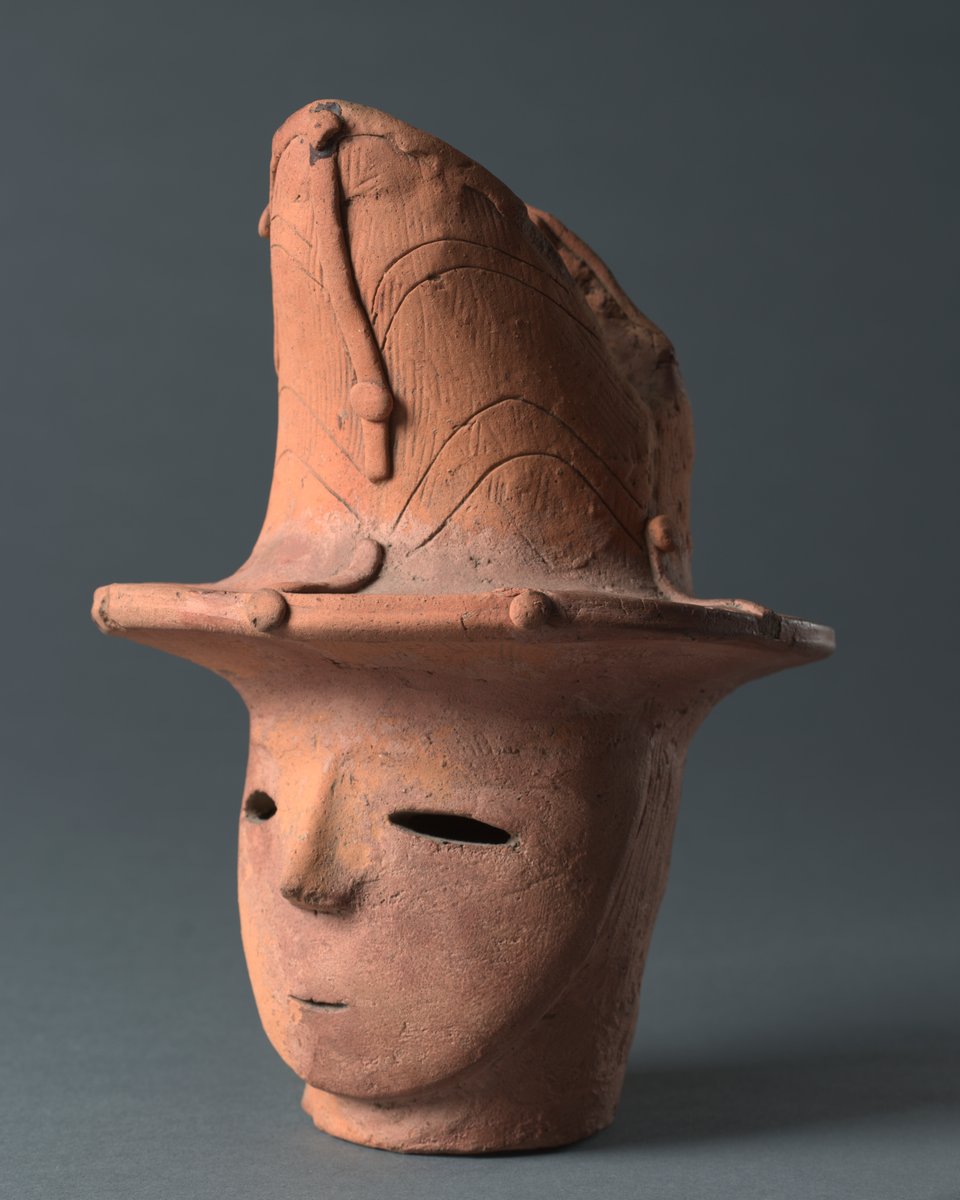
A clay head from Japan’s Kofun period, made about 500–600 and now at the Cleveland Museum of Art. The museum lists an ochre wash over the earthenware. In the photo it reads as a soft, pinkish orange, paler and redder than the web code.
#E09C80#A77560#6F4A3B
Source: Cleveland Museum of Art
Source
Sampled from the Cleveland Museum of Art’s photograph (1977.206), released as CC0 (public domain). The medium, earthenware with ochre wash, comes from the museum’s record. Colors in a photo shift with the lighting, so read the codes as close, not exact.
#C75B12#000000#FFFFFF
FlagFlag of the Northern Territory
Adopted in 1978, the flag sets a black panel with the stars of the Southern Cross beside a field of red ochre bearing a white desert rose. Its official ochre, #C75B12, is redder and a little darker than the web code.
#C75B12#000000#FFFFFF
Source: NT Government
Source
The flag’s colors, black, white and red ochre, and the code for red ochre come from the Northern Territory Government. The 1978 adoption comes from Wikipedia. No flag image is shown.
Palettes are sampled in-house.
Questions
What color is ochre?
A warm, earthy orange. The usual web code is #CC7722 (RGB 204, 119, 34), though real ochre pigments run from yellow to red-brown.
Is it ochre or ocher?
Both are correct. Ochre is the British spelling and is also common in American English; Merriam-Webster lists ocher first.
Is ochre yellow or orange?
It depends on whom you ask. Merriam-Webster defines it as the color of yellow ochre, and people picture a mustard yellow on average. The usual web code, #CC7722, is a clear orange.
What is ochre made of?
Natural earth colored by iron. Yellow ochre gets its color from hydrated iron oxide, red ochre from hematite. Many modern ochre paints use synthetic iron oxide instead.
How old is ochre paint?
At least 100,000 years old. At Blombos Cave in South Africa, people mixed an ochre-rich paint and stored it in abalone shells that long ago.
What is the difference between ochre and sienna?
Sienna (#A0522D) is darker and redder. Ochre (#CC7722) is lighter and more golden. Both are also the names of natural earth pigments.
What colors go with ochre?
Deep blue for contrast, olive and cream for an earthy look, and charcoal or teal for something modern.