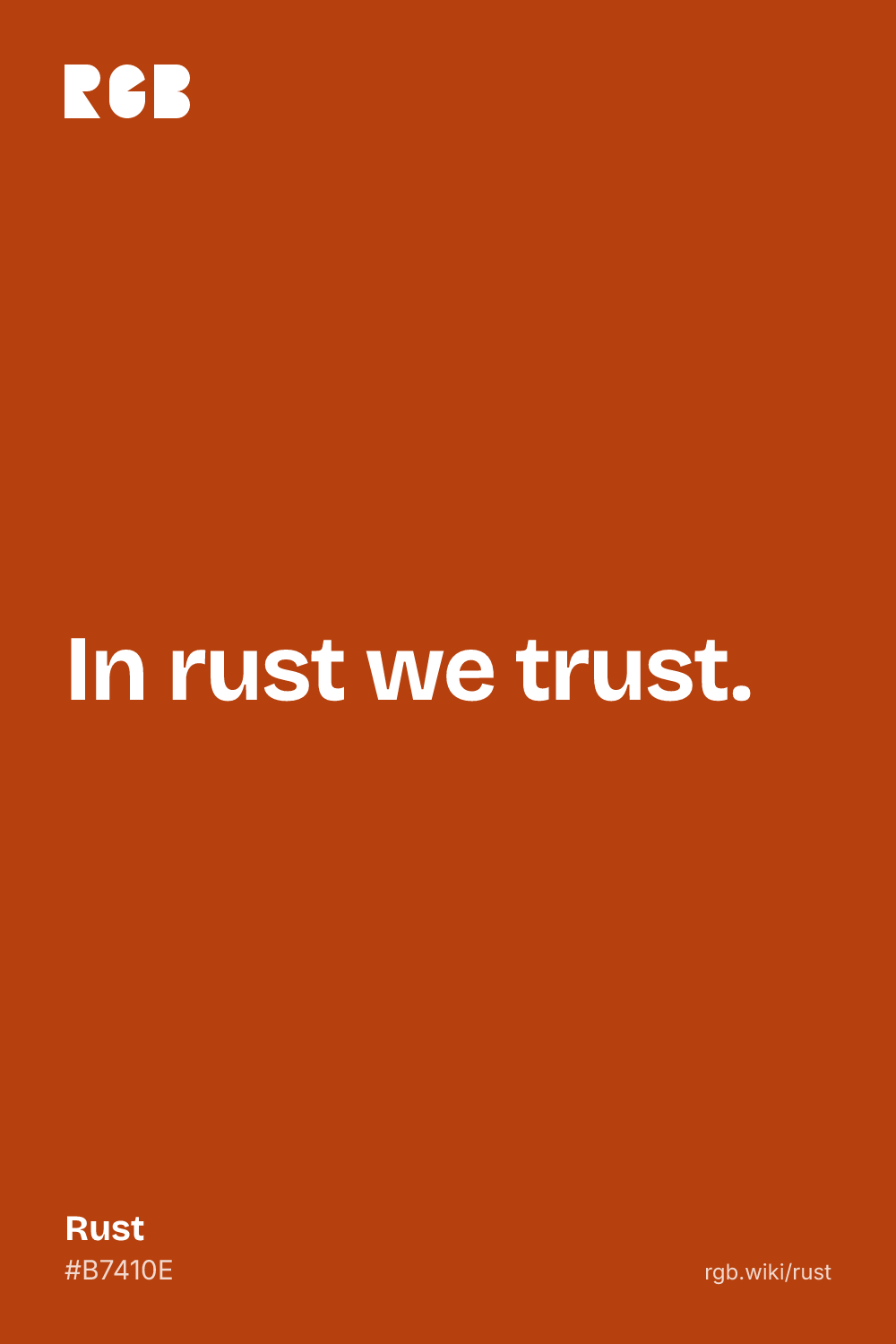
A deep reddish orange, the color of iron left out in the rain.
Overview
Rust is a deep reddish orange with a brown edge. The code most color lists use is #B7410E: strong red, about a third as much green and very little blue.
The name comes from the flaky coating that forms on iron. The word goes back to Old English rūst and is related to “red”. As a color name, rust has been used in English since 1692.
Real rust is a mix of iron oxides, and it ranges from red-orange to a dark reddish brown. The web code sits at the bright end. People’s average rust in the xkcd color survey, #A83C09, is almost the same, just a shade darker, while dictionaries describe rust as a strong reddish brown.
Rust is an earthy, warm color. It pairs well with sage, cream, mustard and navy, and it is dark enough to carry white text.
HEX
#B7410E
RGB
rgb(183, 65, 14)
HSL
hsl(18, 86%, 39%)
HSV
18°, 92%, 72%
CMYK
0, 64, 92, 28
OKLCH
oklch(53.5% 0.163 39.5)
Every code converts from the HEX value #B7410E. #B7410E is the code most references use, but no standard defines it. Wikipedia takes it from a color website. The 1955 ISCC-NBS dictionary files the rust of Maerz and Paul’s A Dictionary of Color (1930) as a strong brown, about #80461B, and Merriam-Webster defines rust as a strong reddish brown. CMYK is a screen-based estimate; print results vary.
Rust on the color map
LighterDarker
People’s average rust in the xkcd survey sits right beside the code, a little darker. Their “rust orange” and “rusty orange” are lighter and more orange, up and to the right. The ISCC-NBS strong brown sits low and to the right: browner, darker and much less vivid. The outline is an approximate range, not a measured one.
Shades and tints
Tintswith white
Shadeswith black
Toneswith gray
Rust sits in the middle. Tints add white, shades add black and tones add gray, in 10% steps out from it. Tap any swatch to copy its code.
Light and dark rust
#D48D6E
Light rustMixed 40% with white. A soft, dusty terracotta.
#C45508
Rust orangeWhat people called rust orange in the xkcd survey. Lighter and more orange.
#B7410E
RustThe reference color.
#C04000
MahoganyAlmost the same on screen, a touch brighter, with a page of its own. See mahogany
#6E2708
Dark rustMixed 40% with black. A deep reddish brown, like heavy rust on old iron.
Colors that go with rust
Pairings that work in rooms, outfits and interfaces.
Rust and sage
Earthy and calm. A favorite for living rooms and gardens.
Rust and navy
Warm against cool. Strong and confident.
Rust and mustard
Retro and autumnal, with a 1970s feel.
Rust and concrete
Industrial: weathering steel against gray concrete.
Rust and teal
Near-opposites. Bold, with the teal as the cool accent.
Rust and cream
Warm and simple. Good for packaging and long text.
Color-wheel palettes
Pick a palette to see where its colors sit on the color wheel. The caret marks rust. Tap a band to copy its code.
Fire brick72%Cognac67%Blood orange69%RustMahogany91%Sienna75%Burnt orange69%
Lined up by hue around rust. Hover a color to see how similar it is.The bar under each name shows how similar it is. Similarity comes from the distance between the two colors in OKLab, a model of how we see color.
Rust vs terracotta
Rust#B7410E · hue 18°
Darker and more saturated
Leans toward orange-brown
Named after rusted iron
Terracotta#E2725B · hue 10°
Lighter and softer
Leans a little toward pink
Named after fired clay
Meaning
Chemistry
Water and air
Mars
Architecture
Age
Rust is the color of time and weather: old tools, barn roofs, shipwrecks and railroad bridges. It can stand for decline, as in the Rust Belt, the name for the old industrial heartland of the United States. Since the 1960s, though, architects and sculptors have used steel that rusts on purpose, and rust has become a warm, earthy color in its own right. As with most named colors, color research tests broad hues, not rust itself.
Iron, oxygen and water
Well established
Rust forms when iron reacts with oxygen in the presence of water or moist air. It is a mix of iron oxides and hydroxides, ranging from red-orange to reddish brown. Salt speeds it up, and because rust takes up more room than the metal it replaces, it flakes and cracks.1, 2
Mars is red for the same reason
NASA
The surface of Mars is really brown, gold and tan. It looks red because iron in its rocks and dust has oxidized, or rusted, and the dust kicked up into the air makes the planet look mostly red from far away.3
Rust on purpose
Historical record
Weathering steel, first sold by U.S. Steel in 1933, forms a stable layer of rust that does away with paint. Eero Saarinen’s John Deere headquarters (1964) was its first use in architecture, and sculptors such as Richard Serra have used it for decades.4, 5
Wikipedia, “Weathering steel”, use in architecture, citing Architectural Record on the Barclays Center.
History
Rust is one of the oldest color words in English, and one of the few named after a chemical reaction. In the 20th century it turned from a problem into a building material.
Before 1100
Old English rūst, a word related to “red”, names the coating that forms on iron.1
1692
First recorded use of “rust” as a color name in English.2
1933
U.S. Steel introduces COR-TEN, a weathering steel that rusts to a stable, protective brown and needs no paint.3
1964
Eero Saarinen’s John Deere World Headquarters in Moline, Illinois, is the first building to use weathering steel.4
1971
U.S. Steel builds its Pittsburgh headquarters, the U.S. Steel Tower, in part to show off its COR-TEN.3, 4
1985
Richard Serra’s Carnegie, a 40-foot tower of COR-TEN plates, goes up outside the Carnegie Museum of Art in Pittsburgh and shares first prize at the Carnegie International.3
2012
The Barclays Center arena opens in Brooklyn, wrapped in a lattice of 12,000 pre-rusted weathering steel panels.5
Sources (5)
Merriam-Webster, “rust”, definition, etymology and first known use.
Wikipedia, “Rust (color)”, citing Maerz and Paul’s A Dictionary of Color (1930), page 203.
A deep reddish orange with a brown edge, the color of rusted iron. The usual code is #B7410E (RGB 183, 65, 14).
Is rust orange or brown?
Between the two. The web code reads as a deep orange, while Merriam-Webster defines rust as a strong reddish brown. Real rust ranges from red-orange to dark brown.
Why is rust red?
Rust is iron oxide. When iron reacts with oxygen and water, it forms iron oxides and hydroxides, which range from red-orange to brown. Iron oxides also color red clay, earth pigments such as ochre and sienna, and the surface of Mars.
What is the difference between rust and terracotta?
Rust (#B7410E) is darker and more saturated. Terracotta (#E2725B) is lighter and softer, with a pinkish lean. Both get their color from iron oxide: rust on metal, terracotta in fired clay.
What colors go with rust?
Sage green, cream and mustard for a warm, earthy look, navy or teal for contrast, and concrete gray for an industrial one.
Are rust orange and rust the same color?
They name the same family. In the xkcd survey, people’s average rust orange (#C45508) came out a little lighter and more orange than their average rust (#A83C09).