Blood orange

A deep red-orange named after an orange that needs cold nights to turn red.

Overview

Blood orange is a deep red-orange named after the red-fleshed orange. The code used here, #D63B1F, is strong red with a little green and very little blue. It sits just on the orange side of red, a little darker than vermilion and much redder than tangerine.

The fruit is a sweet orange with a natural mutation. Its red comes from anthocyanins, the pigments of purple grapes and pomegranates, and they build up only in the cold: on the tree, after cold nights. That is why the reddest blood oranges grow around Mount Etna in Sicily, where the temperature swings widely between day and night. The main varieties there are Tarocco, Moro and Sanguinello.

No single code can match the fruit. Tarocco and Sanguinello flesh is amber orange flecked with red, more or less depending on where and when the fruit is picked, while Moro is dark wine red all through. In a 2022 study of eleven varieties, Moro’s juice measured darkest. #D63B1F is one point on that range: a bright red-orange, redder than a Tarocco and far lighter than a Moro.

On screen, blood orange is warm and strong. It is one of the few bright colors that passes the 4.5:1 contrast guideline for normal text with both white (4.7:1) and black (4.5:1) type. It pairs well with deep leaf green, cream, charcoal and teal.
HEX#D63B1F
RGBrgb(214, 59, 31)
HSLhsl(9, 75%, 48%)
HSV9°, 86%, 84%
CMYK0, 72, 86, 16
OKLCHoklch(58.2% 0.196 32.5)
Every code converts from the HEX value #D63B1F. No color standard defines blood orange, and we found no published list that gives #D63B1F. Many color sites list a redder #D1001C, also without a source, and people’s average blood orange in the xkcd color survey is a brighter #FE4B03. The nearest ISCC-NBS name for #D63B1F is vivid reddish orange. CMYK is a screen-based estimate; print results vary.
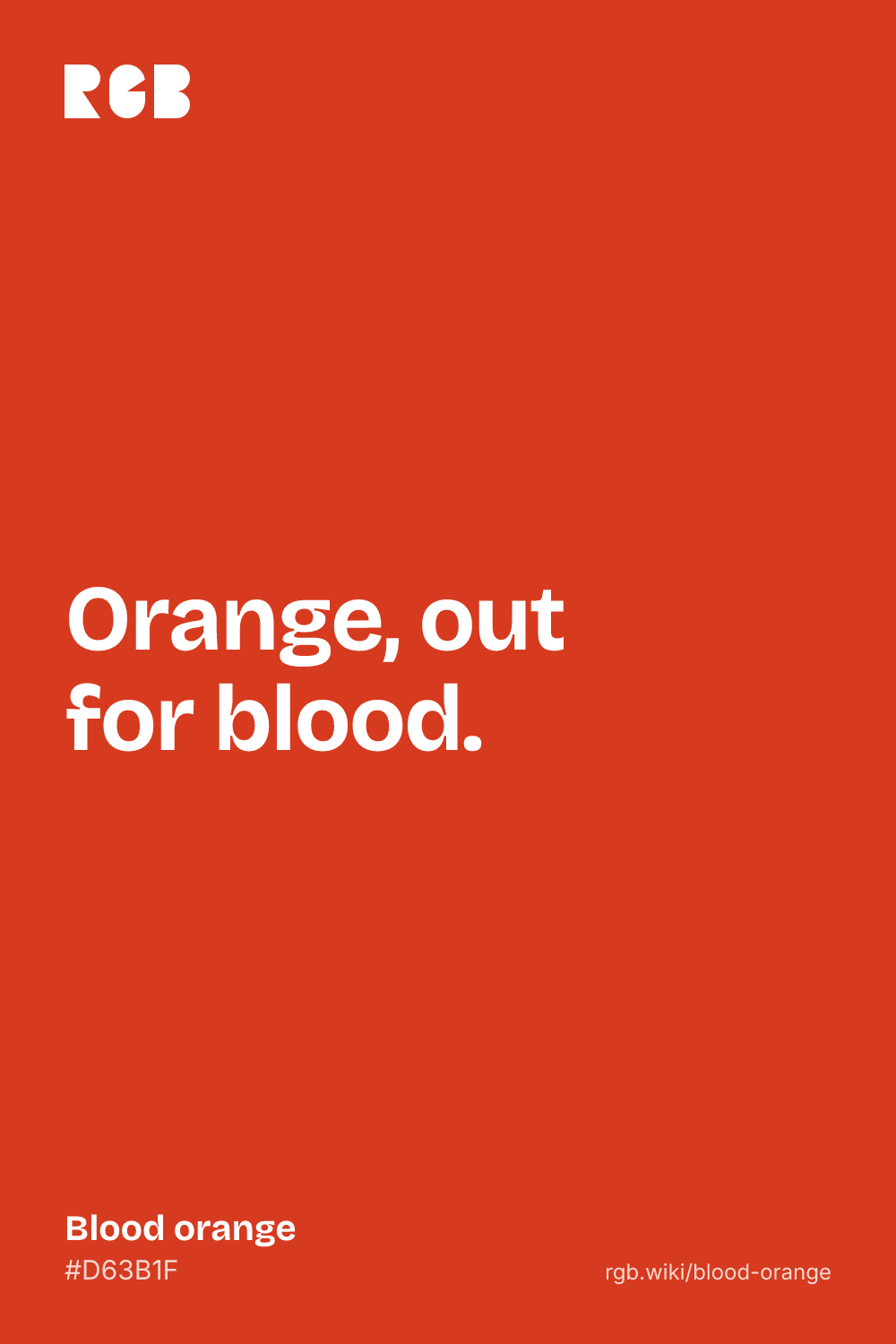
Blood orange color card, hex #D63B1F: “Orange, out for blood”

Blood orange on the color map

The xkcd average sits up and to the right of the code: lighter and more orange. The common web code #D1001C sits to the left and a little lower, redder and darker. The ISCC-NBS center and the measured Moro peel are a little lighter and more orange, inside the outline. The measured Moro juice falls well below it, far darker than the code. This map shows hue and lightness only, so it can’t show how much duller the measured fruit is. The outline is an approximate range, not a measured one.

Shades and tints

Tints with white

Shades with black

Tones with gray

Blood orange sits in the middle. Tints add white, shades add black and tones add gray, in 10% steps out from it. Tap any swatch to copy its code.

Light and dark blood orange

#F3C4BC
Pale blood orangeMixed 70% with white. A soft peachy pink for backgrounds.
#E68979
Light blood orangeMixed 40% with white. A warm coral pink.
#FE4B03
Survey blood orangeWhat people called blood orange in the xkcd color survey, on average. Brighter and more orange.
#D63B1F
Blood orangeThe reference color.
#802313
Dark blood orangeMixed 40% with black. A deep brick red for text and borders.

Colors that go with blood orange

Pairings that work in rooms, outfits and interfaces.

Etna winter

Bright fruit against dark volcanic stone and ash. Bold and modern.

Citrus grove

The fruit with the deep green of citrus leaves. Fresh and natural.

Amber to wine

From amber orange to deep wine red, the range inside the fruit.

Blood orange and teal

Opposites on the color wheel. Lively and confident.

Blood orange and blush

Its own pale tint softens it. Warm and friendly.

Blood orange and navy

Warm red-orange on deep blue. Sporty and sure of itself.

Color-wheel palettes

Pick a palette to see where its colors sit on the color wheel. The caret marks blood orange. Tap a band to copy its code.

Similar colors

Alizarin crimson80%Cadmium red77%Vermilion83%Ferrari red90%Blood orangeCinnabar78%Mahogany77%

Lined up by hue around blood orange. Hover a color to see how similar it is.The bar under each name shows how similar it is. Similarity comes from the distance between the two colors in OKLab, a model of how we see color.

Blood orange vs vermilion

Blood orange#D63B1F · hue 9°
  • A little darker, a shade more orange
  • Named after a red-fleshed orange
  • Takes white text at any size (4.7:1)
Vermilion#E34234 · hue 5°
  • Lighter and a shade redder
  • Named after a mercury pigment
  • White text only at large sizes (4.1:1)

Meaning

  • Winter citrus
  • Cold nights
  • Mount Etna
  • Ruby gene

Blood orange is a winter fruit, and its color is the story. The red appears only after cold nights, it is strongest around Mount Etna in Sicily, and it depends on a gene called Ruby. Studies of color and emotion test broad words like red and orange, not blood orange, so the claims here are about the fruit.

Red from the pigment of grapes

Well established

Blood oranges owe their red to a natural mutation that lets them make anthocyanins, the same pigments that color purple grapes and pomegranates. The pigment builds up in the flesh and often blushes the rind too. In a 2022 study of eleven varieties, Moro had the most of the main pigments and the darkest juice.1, 2, 3

Cold switches the color on

Peer-reviewed study

In 2012, researchers at the John Innes Centre in England found out why the fruit needs cold. Next to a gene called Ruby, which turns on anthocyanin production, Sicilian blood oranges carry a retrotransposon, a stretch of DNA that can copy itself into new places. Cold stress wakes the retrotransposon up, and it switches Ruby on. A blood orange from China arose from a separate, similar insertion, and it also needs cold to color.4

Why Etna grows the reddest

Well established

Most blood oranges need a wide swing between day and night temperatures to color fully. A 2015 review from the University of Catania says that limits the deepest-colored crops to a few regions, above all the area around Mount Etna. Sicily’s official rules for its protected blood oranges make the same link, and say the same varieties grown in other climates lack that color. In California, the Moro’s rind stays orange on the southern coast, and the fruit colors best in warm inland valleys.5, 6, 1

They keep reddening after picking

Two studies agree

Cold storage deepens the color. In a 2001 study, Tarocco and Moro oranges kept at 8 °C gained anthocyanins. In a 2017 study, Moro oranges stored at 9 °C turned a darker purple than those kept at 4 °C, while the cold did not make ordinary blond oranges build up any.7, 8

Even one fruit is uneven

One study

Blood orange flesh is often patchy, with deep red segments beside paler ones in the same fruit. A 2020 study of cold-stored oranges found that the red segments had switched on their pigment genes far more strongly, and linked the difference to chemical marks on the DNA that controls those genes.9

Sources (9)
  1. Givaudan Citrus Variety Collection at UC Riverside, “Moro blood orange (CRC 3811)”, with the description from The Citrus Industry, vol. 1 (University of California, 1967).
  2. Givaudan Citrus Variety Collection at UC Riverside, “Tarocco #7 blood orange (CRC 3596)”.
  3. Legua, P., Modica, G., Porras, I., Conesa, A. and Continella, A. (2022). “Bioactive compounds, antioxidant activity and fruit quality evaluation of eleven blood orange cultivars”. Journal of the Science of Food and Agriculture 102(7), 2960–2971.
  4. Butelli, E., Licciardello, C., Zhang, Y., et al. (2012). “Retrotransposons control fruit-specific, cold-dependent accumulation of anthocyanins in blood oranges”. The Plant Cell 24(3), 1242–1255.
  5. Lo Piero, A. R. (2015). “The state of the art in biosynthesis of anthocyanins and its regulation in pigmented sweet oranges”. Journal of Agricultural and Food Chemistry 63(16), 4031–4041.
  6. Italian Ministry of Agricultural, Food and Forestry Policies, “Disciplinare di produzione della IGP Arancia Rossa di Sicilia”, the production rules for the protected name, articles 6 and 8 (in Italian).
  7. Rapisarda, P., Bellomo, S. E. and Intelisano, S. (2001). “Storage temperature effects on blood orange fruit quality”. Journal of Agricultural and Food Chemistry 49(7), 3230–3235.
  8. Carmona, L., Alquézar, B., Marques, V. V. and Peña, L. (2017). “Anthocyanin biosynthesis and accumulation in blood oranges during postharvest storage at different low temperatures”. Food Chemistry 237, 7–14.
  9. Sicilia, A., Scialò, E., Puglisi, I. and Lo Piero, A. R. (2020). “Anthocyanin biosynthesis and DNA methylation dynamics in sweet orange fruit under cold stress”. Journal of Agricultural and Food Chemistry 68(26), 7024–7031.

History

Red-fleshed oranges were a curiosity in Europe by the 1600s. The fruit got its English name in the early 1800s, its own protected name in Sicily in 1996, and an explanation for its color only in 2012.

  1. 1646

    Giovanni Battista Ferrari’s book on citrus, Hesperides, gives the first known report of a blood orange: a fruit a missionary had seen in the Philippines, with flesh “of a purple color” that tasted of grapes.1

  2. 1700s

    A painting by the Italian artist Bartolomeo Bimbi shows a blood orange.1

  3. 1806

    First known use of “blood orange” in English, as the name of the fruit.2

  4. Early 1900s

    The Tarocco is found near Pedagaggi, in Sicily’s province of Syracuse. It has since become the “King of Oranges” in Sicily, grown in more than twenty clones.1

  5. About 1950

    The Spanish Sanguinelli appears as a limb sport, a natural mutation on one branch, of the Doblefina variety.3

  6. 1967

    The University of California’s The Citrus Industry describes Moro flesh as “almost violet-red”, and notes that the rind stays orange on the southern California coast.4

  7. 1996

    The European Union registers Arancia Rossa di Sicilia, “red orange of Sicily”, as a protected geographical indication.5 Its rules cover Tarocco, Moro and Sanguinello from eastern Sicily and credit their color to the wide temperature swings around Mount Etna.6

  8. 2012

    Researchers at the John Innes Centre show that a retrotransposon beside the Ruby gene makes the blood orange’s color depend on cold.7

Sources (7)
  1. Catara, A., Continella, G. and Reforgiato Recupero, G. (2015). “History of Blood Oranges”. Talk abstract, American Society for Horticultural Science annual conference, New Orleans.
  2. Merriam-Webster, “blood orange”, definition and first known use.
  3. Givaudan Citrus Variety Collection at UC Riverside, “Sanguinelli blood orange (CRC 3828)”, with the description from The Citrus Industry, vol. 1 (1967).
  4. Givaudan Citrus Variety Collection at UC Riverside, “Moro blood orange (CRC 3811)”, quoting The Citrus Industry, vol. 1 (University of California, 1967).
  5. Commission Regulation (EC) No 1107/96 of 12 June 1996, annex, Italy: “Arancia Rossa di Sicilia (PGI)”. EUR-Lex.
  6. Italian Ministry of Agricultural, Food and Forestry Policies, “Disciplinare di produzione della IGP Arancia Rossa di Sicilia”, articles 2, 3 and 8 (in Italian).
  7. Butelli, E., Licciardello, C., Zhang, Y., et al. (2012). “Retrotransposons control fruit-specific, cold-dependent accumulation of anthocyanins in blood oranges”. The Plant Cell 24(3), 1242–1255.

Questions

What color is blood orange?

A deep red-orange, on the red side of orange. The code used here is #D63B1F (RGB 214, 59, 31).

What is the hex code for blood orange?

No standard defines one. This page uses #D63B1F. Many color sites list a redder #D1001C, and people’s average blood orange in the xkcd color survey was a brighter, more orange #FE4B03.

Why are blood oranges red inside?

They make anthocyanins, the red and purple pigments of grapes and pomegranates, which ordinary oranges don’t make in their flesh. A gene called Ruby turns the pigment on, and in blood oranges it switches on only after cold.

Why are Sicilian blood oranges so red?

Most blood oranges need a wide swing between day and night temperatures to color fully, and the plains and hills around Mount Etna have it. Sicily’s rules for its protected blood oranges say the same varieties grown in other climates lack that color.

What are the main kinds of blood orange?

Tarocco, Moro and Sanguinello in Sicily, and Sanguinelli in Spain. Tarocco and Sanguinello have amber orange flesh flecked with red. Moro is the darkest, dark wine red all through.

What is the difference between blood orange and vermilion?

Blood orange (#D63B1F) is a little darker and a shade more orange. Vermilion (#E34234) is lighter and redder, and is named after a mercury pigment rather than a fruit.

Can I use white or black text on blood orange?

Both. White text reaches 4.7:1 and black text 4.5:1, so both pass the usual guideline for normal-size text. Few colors manage that with both, because their lightness has to sit in a narrow middle band.

What colors go with blood orange?

Deep leaf green or olive for a fresh, natural look, charcoal for something bold, cream or blush to soften it, and teal or navy for contrast.