Named after Córdoba
Word historyCordovan came into English from 16th-century Spanish cordován (now usually cordobán), from Córdoba, the city in southern Spain where the leather was made. Merriam-Webster dates the English word to 1591.1
A dark rosy red named after the fine leather of Córdoba, Spain.
Cordovan is a dark red with a rosy, slightly brown cast, named after a leather. Its usual code, #893F45, has red at 54% and green and blue at about a quarter each, which softens the red toward rose and brown. It reads clearly as red, not black, and carries white text easily.
The name comes from Córdoba, in southern Spain. Under Moorish rule the city was known for its leather, and fine goatskin from there came to be called cordovan, or in older English cordwain. English shoemakers who worked it became cordwainers, a word London’s Cordwainers’ Company still uses. Today cordovan usually means shell cordovan, a dense, glossy leather cut from a horse’s rump and prized for dress shoes.
As a color word, cordovan is young and unsettled. Maerz and Paul’s A Dictionary of Color (1930) dates it to 1925, and the 1955 ISCC-NBS dictionary files their sample as a very dark grayish brown, close to black. A 1950 dictionary placed cordovan among dark grayish reds and reddish browns. The lighter, rosier web code comes from a 2007 fashion color forecast, by way of Wikipedia.
In everyday use cordovan is a shoe and leather color, and the name often overlaps with oxblood. On screens, #893F45 is a warm accent for cream, navy, khaki and gold, and white text on it has a 7.3:1 contrast.
| HEX | #893F45 | |
|---|---|---|
| RGB | rgb(137, 63, 69) | |
| HSL | hsl(355, 37%, 39%) | |
| HSV | 355°, 54%, 54% | |
| CMYK | 0, 54, 50, 46 | |
| OKLCH | oklch(46.6% 0.101 16.8) |

Taylor, Knoche and Granville’s cordovan sits inside the outline near its bottom edge: darker and much grayer. Maerz and Paul’s cordova lies just right of the outline, browner but about as light. Their cordovan is darker and so much yellower that it falls off the right of this view and is pinned to the edge. The outline is an approximate range, not a measured one.
Tints with white
Shades with black
Tones with gray
Pairings that work in rooms, outfits and interfaces.
Polished shoes and pale linen. Classic, and safe for long text.
The loafer and the blazer. Smart and dependable.
Shoes and chinos. Relaxed, warm and earthy.
Whitewash, cobalt pots and a little gold, inspired by the courtyards of Córdoba.
The gold and dark teal of a 1600s “cordovan” wall hanging at the Met, with today’s cordovan as the accent.
Cordovan as the background, with cream text and a tan button. Rich and warm.
Pick a palette to see where its colors sit on the color wheel. The caret marks cordovan. Tap a band to copy its code.
Lined up by hue around cordovan. Hover a color to see how similar it is.The bar under each name shows how similar it is. Similarity comes from the distance between the two colors in OKLab, a model of how we see color.
Cordovan means leather. The word named a city, then the fine goatskin made there, then the shoemakers who worked it, and only in the 1920s a color. Today it brings to mind polished dress shoes and horsehide. Studies of color and emotion test broad words such as red or brown, not cordovan, so there is no research on what cordovan itself makes people feel.
Cordovan came into English from 16th-century Spanish cordován (now usually cordobán), from Córdoba, the city in southern Spain where the leather was made. Merriam-Webster dates the English word to 1591.1
A cordwainer was first a worker in cordwain, the older English word for cordovan leather, and later any shoemaker. The word turns up as a byname around 1100, and London’s Cordwainers’ Company, which won the right to regulate the trade in 1272, still carries it.2, 3, 4
Medieval Spain called soft goat leather cordobanes, as distinct from guadamecí, its painted and gilded leather hangings. Today cordovan usually means shell cordovan, a dense layer from under the hide of a horse’s rump that is smooth and does not crease, used for fine shoes.1, 5, 6
The 1955 ISCC-NBS dictionary files Maerz and Paul’s 1930 cordovan as a dark grayish yellowish brown or black, and Taylor, Knoche and Granville’s 1950 cordovan as dark grayish red or dark reddish brown. The lighter, rosier web code #893F45 comes from a 2007 fashion forecast.7, 8
Wikipedia notes that cordovan has come to describe the color of leather in particular, and that in this sense it overlaps with oxblood. The article gives no source for this, so read it as common usage, not a rule.8
Cordovan was a place, then a leather, then a trade, and only lately a color. The leather traveled from Moorish Spain to London’s shoemakers and Chicago’s tanneries, while the color dictionaries never agreed on what shade the name should be.
Córdoba, seat of the Umayyad rulers of al-Andalus, has a prosperous economy whose manufactured goods include leather.1 Spain’s leatherworkers make soft goat leather, cordobanes, and painted, gilded hangings called guadamecí, a craft that reached Spain from North Africa as early as the 800s.2
“Randolf se cordewan[ere]” is the earliest known English use of cordwainer, a worker in cordwain, as English then called cordovan leather.3
London’s cordwainers receive the right to regulate their trade in the City. Their company gains a royal charter in 1439.4
First known use of cordovan in English, borrowed from 16th-century Spanish cordován.5
Gilt-leather making flourishes in the Dutch Republic, which exports it across Europe. Such hangings, often of calfskin, are known as cuir de Cordoue, cordwain or cordovan, after Córdoba.2 A set at the Met from these years is silvered, painted and varnished in gold and dark teal.6
Isadore Horween founds a tannery in Chicago that becomes known for shell cordovan, the glossy leather from a horse’s rump.7, 8
Maerz and Paul’s A Dictionary of Color prints a cordovan sample and dates cordovan as a color name to 1925.9
Taylor, Knoche and Granville’s Descriptive Color Names Dictionary includes a cordovan.10
The ISCC-NBS dictionary of color names files Maerz and Paul’s cordovan as a dark grayish yellowish brown or black, and Taylor, Knoche and Granville’s as dark grayish red or dark reddish brown.10
A fashion color forecast for summer 2007 gives cordovan as #893F45, the code Wikipedia cites and most color lists now use.9
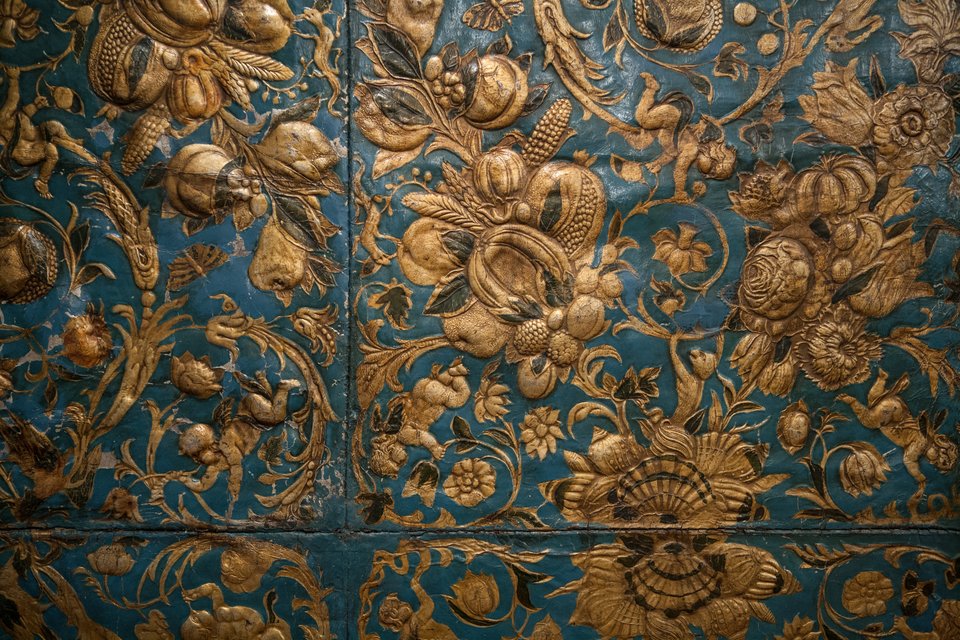
Painted and gilded leather hangings like these are known as cuir de Cordoue, cordwain or cordovan, after the Spanish city where the craft had flourished, even when Dutch workshops made them, often from calfskin. This set may come from the workshop De Gecroonde Son. In the photograph the raised fruit and flowers read gold, about #BF9B6E to #96734A, over a dark teal ground near #273E40. In the 1600s cordovan named the leather, not a color.
Sampled from a detail in the Metropolitan Museum of Art’s photographs of the set (2012.332), released as CC0 (public domain). The name history comes from Wikipedia’s “Leather wallpaper”. Colors in a photo shift with the lighting, so read the codes as close, not exact.
Palettes are sampled in-house.
A dark red with a rosy, slightly brown cast. Its usual code is #893F45 (RGB 137, 63, 69), though no standard defines it. Older color dictionaries make cordovan much darker, down to a blackish brown.
After Córdoba in southern Spain, known in the Middle Ages for its leather. Cordovan first meant leather from there, and became a color name only in the 1920s.
Cordovan (#893F45) is lighter and rosier, a color that clearly reads as red. Oxblood (#4A0000) is almost black. For shoes and leather the two names are often used for similar burgundy-brown shades.
No. Burgundy (#800020) is a purer, wine-like red that leans toward purple. Cordovan is softer and browner, with some gray in it.
It depends on the source. The web code is a dark rosy red, but color dictionaries file cordovan as dark grayish red, dark reddish brown or even a blackish brown.
A leather made from the shell, a dense layer under the hide on a horse’s rump. It is smooth, glossy and does not crease like ordinary leather, so it is prized for dress shoes, watch straps and wallets.
A shoemaker. The word first meant a worker in cordwain, the old English word for cordovan leather, and it survives in the name of London’s Cordwainers’ Company.
Cream and khaki for a classic look, navy for contrast, gold for warmth, and the gold and dark teal of old gilt-leather hangings for something richer.