Mahogany

A strong reddish brown named after a prized tropical wood.

Overview

Mahogany is a strong reddish brown, named after one of the most valued furniture woods in the world. Its usual web code is #C04000: red at three-quarters strength, a little green and no blue. On screen that reads as a deep red-orange, close to rust.

The wood comes from Swietenia trees of the Caribbean and Central and South America. Where the word comes from is uncertain. It has been in English since the 1600s, and a color name since 1737.

Real mahogany is much darker than the code. The polished doors of an 18th-century mahogany desk at the Cleveland Museum of Art sample at about #6B2D0F, and in the xkcd color survey people’s average mahogany was #4A0100, almost black. Merriam-Webster defines the color as a moderate reddish brown.

Use the code as a bold, warm accent: it is dark enough to carry white text. For the look of the wood, use the darker shades below with cream, brass or forest green.

HEX#C04000
RGBrgb(192, 64, 0)
HSLhsl(20, 100%, 38%)
HSV20°, 100%, 75%
CMYK0, 67, 100, 25
OKLCHoklch(54.9% 0.174 39.5)
Every code converts from the HEX value #C04000. #C04000 is the code most references use. Wikipedia gives it as the screen match for the mahogany sample in Maerz and Paul’s A Dictionary of Color (1930), but no standard defines it, and the match looks doubtful: the 1955 ISCC-NBS dictionary files Maerz and Paul’s mahogany as a moderate reddish brown, about #79443B. CMYK is a screen-based estimate; print results vary.
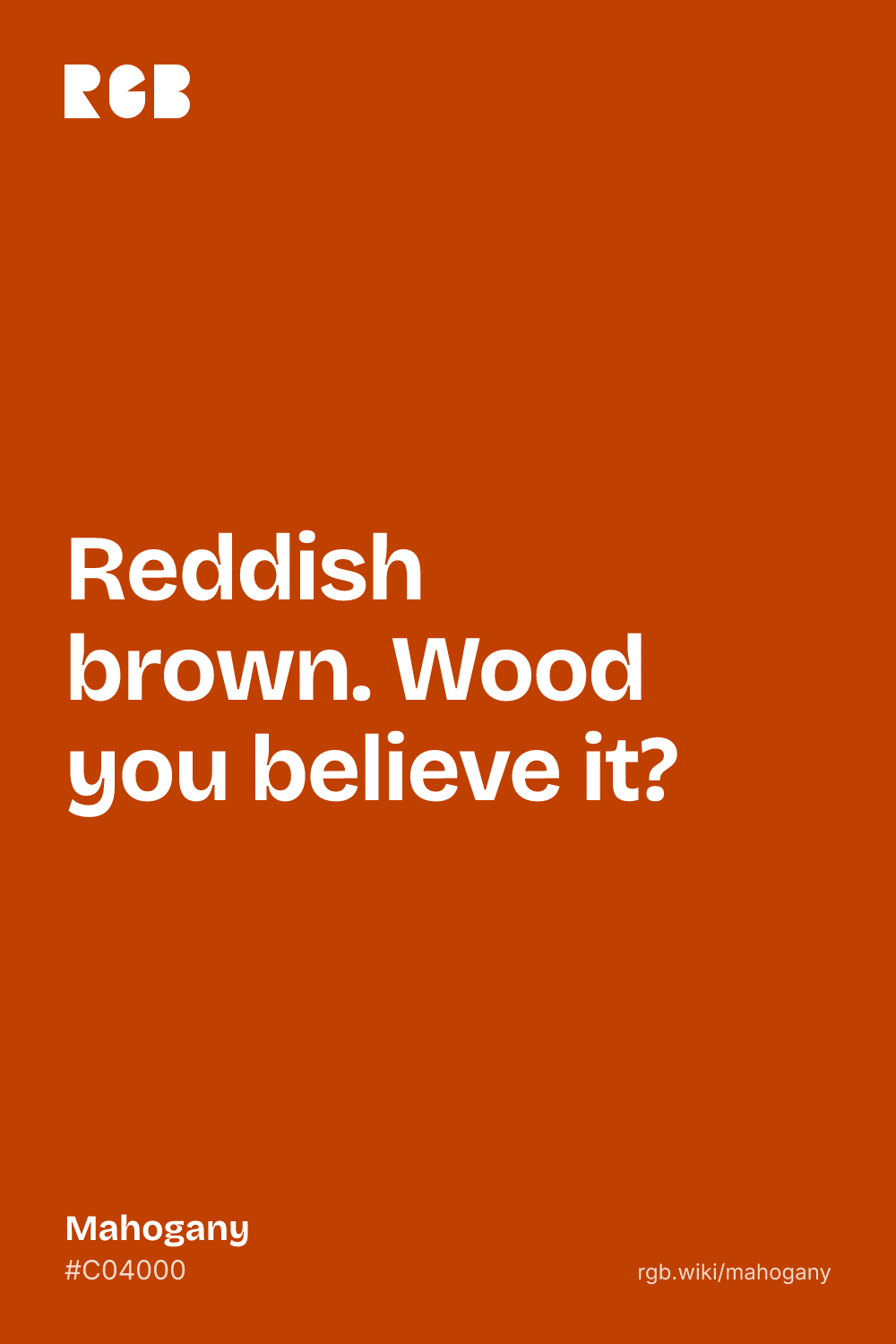
Mahogany color card, hex #C04000: “Reddish brown. Wood you believe it”

Mahogany on the color map

Every real-world mahogany here is darker than the reference value. The ISCC-NBS color sits on the lower edge of the outline, the Townsend desk well below it, and people’s average mahogany in the xkcd survey, a near-black red-brown, falls off the bottom of this view. The outline is an approximate range, not a measured one.

Shades and tints

Tints with white

Shades with black

Tones with gray

Mahogany sits in the middle. Tints add white, shades add black and tones add gray, in 10% steps out from it. Tap any swatch to copy its code.

Light and dark mahogany

#D98C66
Light mahoganyMixed 40% with white. A warm, soft tan.
#C04000
MahoganyThe reference color.
#B7410E
RustAlmost the same on screen, a touch duller, with a page of its own. See rust
#732600
Dark mahoganyMixed 40% with black. A deep red-brown, nearer the wood.
#6B2D0F
Mahogany woodSampled from an 18th-century mahogany desk. Browner and darker still.

Colors that go with mahogany

Pairings that work in rooms, outfits and interfaces.

Mahogany and cream

Warm and bookish, like an old library. Easy to read.

Mahogany and brass

The furniture look: dark wood with gold hardware.

Mahogany and forest green

Classic and clubby. Suits studies, bars and heritage brands.

Mahogany and navy

Warm against cool. Serious and grown-up.

Mahogany and teal

Near-opposites on screen. Keep the teal small and bright.

Mahogany and blush

Soft and warm. Good for stationery and beauty brands.

Color-wheel palettes

Pick a palette to see where its colors sit on the color wheel. The caret marks mahogany. Tap a band to copy its code.

Similar colors

Fire brick67%Ferrari red71%Blood orange77%Rust91%MahoganySienna68%Burnt orange75%

Lined up by hue around mahogany. Hover a color to see how similar it is.The bar under each name shows how similar it is. Similarity comes from the distance between the two colors in OKLab, a model of how we see color.

Mahogany vs auburn

Mahogany#C04000 · hue 20°
  • Brighter, with an orange lean
  • Named after a tropical wood
  • The wood is far darker than the code
Auburn#922724 · hue 2°
  • Darker and redder
  • Best known as a hair color
  • Once meant blond, from Latin for whitish

Meaning

  • Tropical wood
  • Fine furniture
  • Logging
  • Colonial trade
  • Belize

Mahogany means fine old furniture: polished desks, dining tables and paneled libraries, and the wealth that paid for them. That luxury had a cost. For about three centuries the wood was cut in the Caribbean and Central America mostly by enslaved Africans. Today a mahogany tree stands on the coat of arms of Belize, and the trees are protected. As with most named colors, color research tests broad hues, not mahogany itself.

Cut by enslaved people

Historical record

For about 300 years, mahogany was harvested mainly by enslaved Africans. In Jamaica, Britain’s main source in the 1700s, they felled and hauled trees in gangs of 30 to 40, moving to remote hills as the coastal forests ran out. Clearing the forests also made room for sugar plantations.1, 2, 3
On Belize’s coat of arms

Official symbol

Belize’s coat of arms, at the center of its flag, shows a mahogany tree above a shield with woodcutters’ tools and a sailing ship, held up by two woodcutters. The motto, Sub umbra floreo, means “Under the shade I flourish”. Mahogany logging was the base of the colony’s economy in the 1700s and 1800s.4, 5

In speech, almost black

Online survey

In the xkcd color survey, where people named over five million colors online, the average mahogany came out as #4A0100, a near-black red-brown. That is far darker than the web code, and darker even than polished antique mahogany.6

Sources (6)
  1. Osborne, D. A. (2021). “Facing Our Past: the difficult history of mahogany”. National Trust for Scotland.
  2. London Museum, “Frances Burney’s mahogany desk: a symbol of slavery”.
  3. Walker, G. & Crawford, B. “Mahogany: a historical geography of a lasting and still valued commodity of 18th century enslavement” (PDF). Lancaster University.
  4. Wikipedia, “Coat of arms of Belize”, citing the Government of Belize, “The National Symbols”.
  5. Belize National Library Service and Information System, “National Symbols of Belize”.
  6. Munroe, R. (2010). “Color survey results”. xkcd blog. The survey’s color averages are released as CC0 data.

History

Mahogany was a Caribbean timber long before it was a color. Its story runs from a Spanish palace through the British colonial trade to a protected species.

  1. 1584

    Philip II of Spain completes El Escorial, near Madrid, the earliest recorded European use of mahogany.1

  2. 1655

    England captures Jamaica from Spain. The British mahogany trade grows from there, worked by enslaved Africans.1

  3. 1737

    First recorded use of “mahogany” as a color name in English.2

  4. 1754

    The London cabinetmaker Thomas Chippendale publishes his design book, The Gentleman and Cabinet-Maker’s Director. His favorite wood is mahogany.3, 1

  5. 1765

    The British settlement in Belize depends entirely on logging. Its mahogany is shipped out through Jamaica.1

  6. About 1780–95

    John Townsend of Newport, Rhode Island, makes a mahogany desk and bookcase, probably for Oliver Wolcott Sr., a signer of the Declaration of Independence.4

  7. 1981

    Belize becomes independent and keeps the mahogany tree and woodcutters on its coat of arms.5

  8. 2003

    Big-leaf mahogany, the main commercial species, is listed on CITES Appendix II, which controls its international trade.6

Sources (6)
  1. Osborne, D. A. (2021). “Facing Our Past: the difficult history of mahogany”. National Trust for Scotland.
  2. Wikipedia, “Mahogany (color)”, citing Maerz and Paul’s A Dictionary of Color (1930), page 198 and plate 7.
  3. Wikipedia, “Thomas Chippendale”, citing the Victoria and Albert Museum.
  4. Cleveland Museum of Art, “Desk and Bookcase”, attributed to John Townsend, Newport, Rhode Island, about 1780–95 (2012.43).
  5. Wikipedia, “Coat of arms of Belize”, citing the Government of Belize, “The National Symbols”.
  6. Wikipedia, “Mahogany”, history and conservation.

Mahogany in use

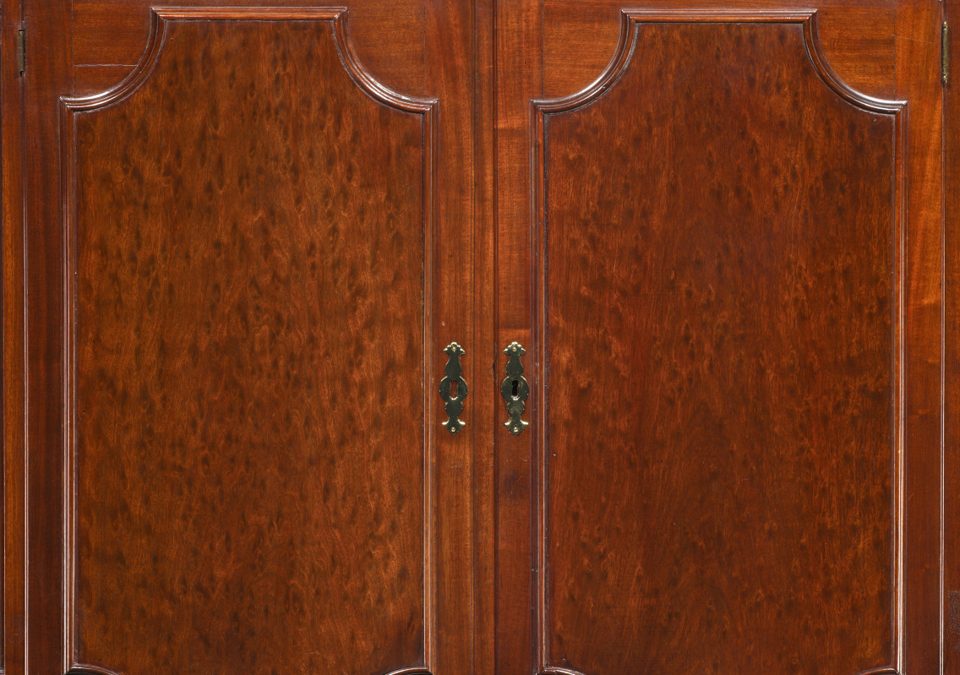
Detail of two paneled mahogany doors with a mottled reddish-brown grain and small brass keyhole plates
#6B2D0F#7A3717#5B2811#90441F
FurnitureDesk and bookcase by John Townsend (about 1780–95)

Attributed to John Townsend of Newport, Rhode Island, and probably made for Oliver Wolcott Sr., a signer of the Declaration of Independence. Its figured “plum pudding” mahogany samples at about #6B2D0F: much darker and browner than the web code.

#6B2D0F#7A3717#5B2811#90441F
Source: Cleveland Museum of Art

Palettes are sampled in-house.

Questions

What color is mahogany?

A strong reddish brown, named after the wood. The usual web code is #C04000 (RGB 192, 64, 0). Real mahogany wood is much darker and browner.

Why does the mahogany code look orange?

No standard defines it. It is a screen conversion of a 1930 color dictionary sample, and it came out bright. The 1955 ISCC-NBS dictionary files the same sample as a moderate reddish brown, and polished mahogany furniture samples around #6B2D0F.

Is mahogany red or brown?

Brown with a strong red lean. Merriam-Webster defines the color as a moderate reddish brown. The web code is redder and brighter than that.

What colors go with mahogany?

Cream and brass for a classic furniture look, forest green or navy for depth, and teal for contrast. Blush pink softens it.

What is the difference between mahogany and auburn?

Auburn (#922724) is darker and redder, and is best known as a hair color. Mahogany (#C04000) is brighter and leans orange on screen, though the wood itself is a deep brown.

Where does mahogany wood come from?

Genuine mahogany comes from three species of Swietenia trees native to the Americas, from Florida and the Caribbean to the Amazon. All three are now listed by CITES because of overharvesting and illegal logging.