Melon

A pale pink-orange named after cantaloupe flesh, though the fruit and the dictionaries run deeper.

Overview

Melon is a pale pink-orange, named after the flesh of a ripe cantaloupe. Its usual code is #FDBCB4: red at full strength, green and blue at about 74% and 71%, which tints white toward a warm, slightly rosy pastel. It sits close to apricot, but pinker.

The word goes back through French and Latin to a Greek name for an “apple-gourd”. Melon has been a color name in English since 1892, and Maerz and Paul’s A Dictionary of Color printed a sample of it in 1930. That sample was far stronger than the web code: the 1955 ISCC-NBS dictionary files it as a strong yellowish pink, about #F88379. People in the xkcd color survey went deeper still, picking #FF7855, almost exactly coral.

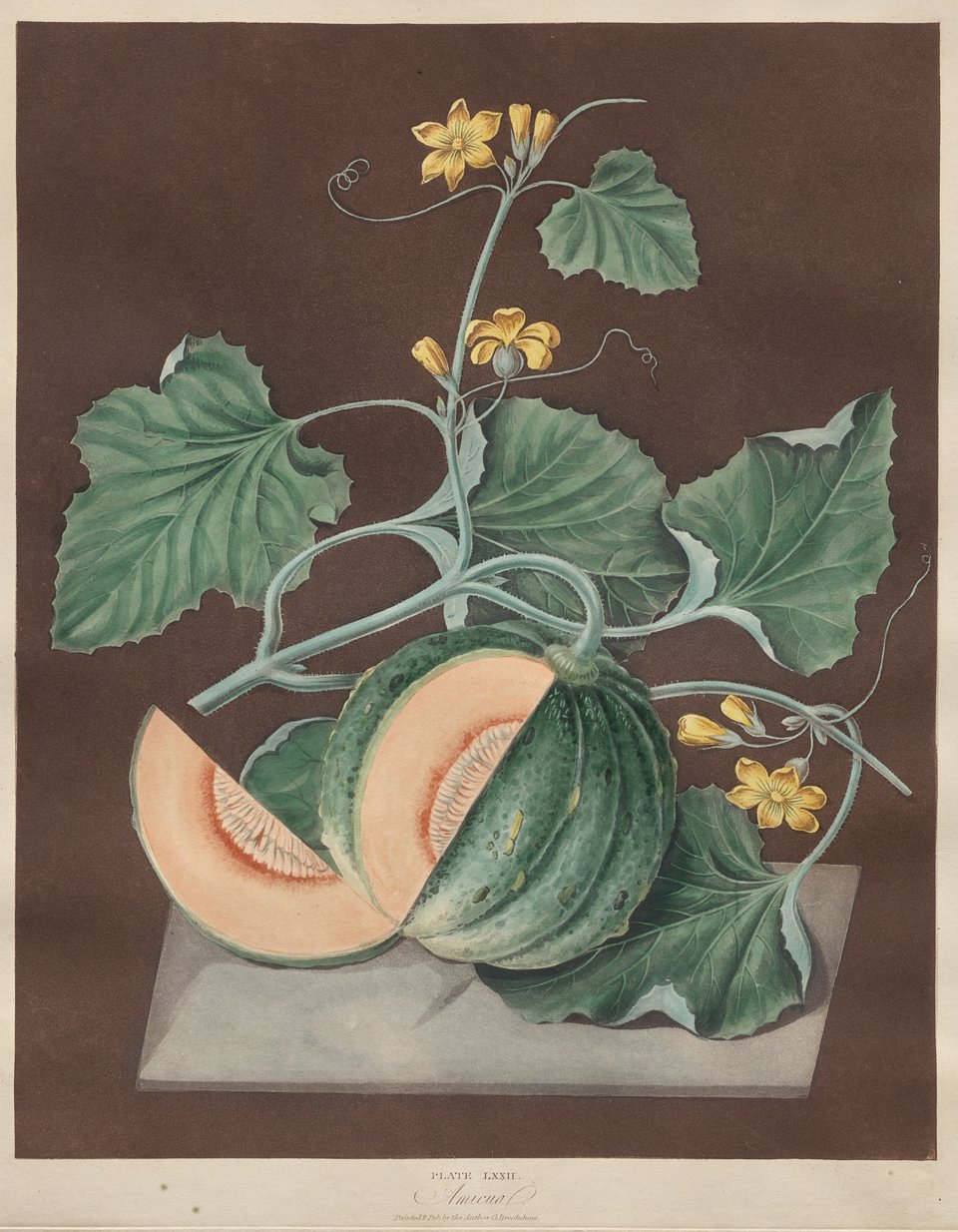
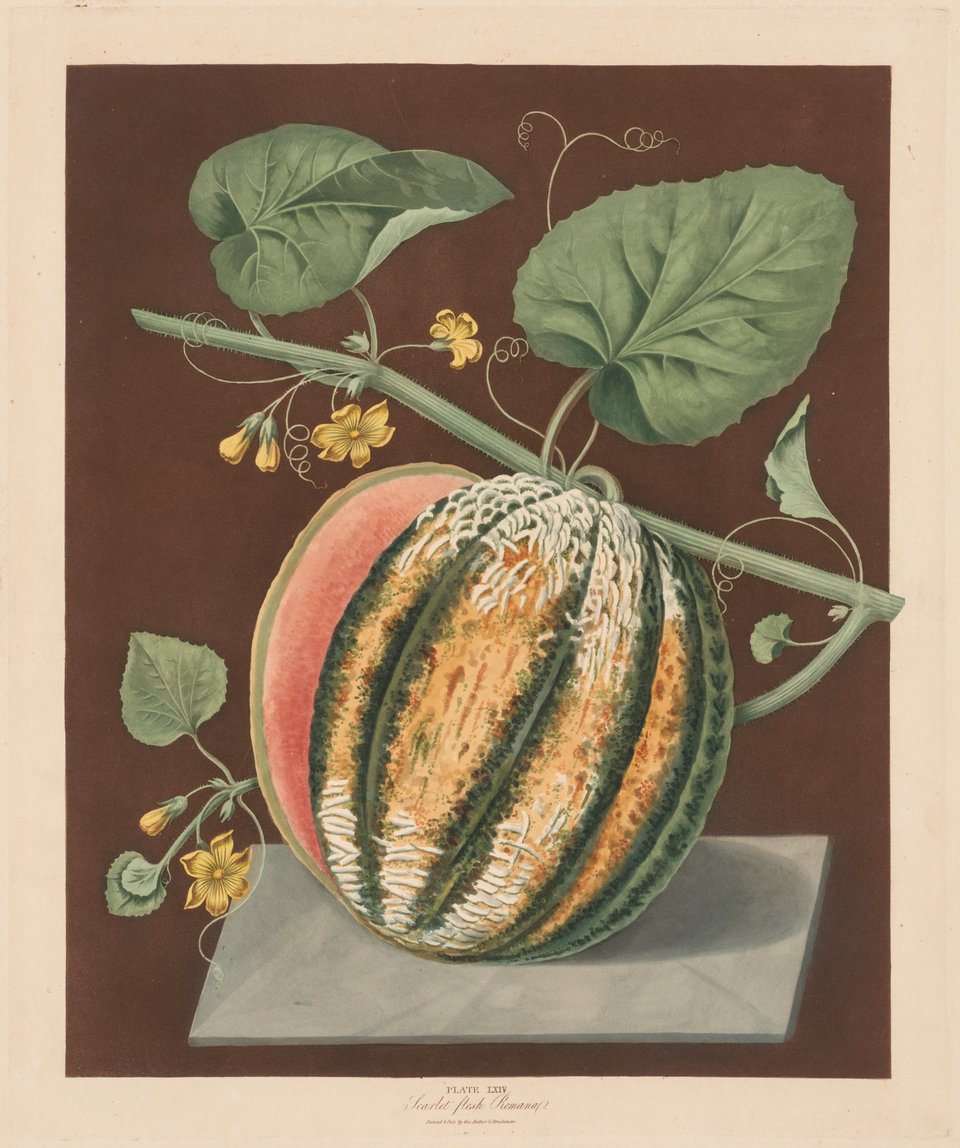
The pale code comes from a crayon color of 1949, not from a dictionary or the fruit. Real melons vary even more: their flesh can be white, green or orange, and a 2015 study traced the difference to a single change in one gene. In orange melons such as the cantaloupe, the pigment is beta-carotene. An 1812 book of English fruit shows both a pale, peach-fleshed melon and a scarlet-fleshed one.

Melon needs dark text: black on #FDBCB4 has a contrast of 13:1, white only 1.6:1. It pairs well with honeydew green, plum, slate blue and terracotta. The only melon among the CSS color keywords is honeydew, a near-white green.

HEX#FDBCB4
RGBrgb(253, 188, 180)
HSLhsl(7, 95%, 85%)
HSV7°, 29%, 99%
CMYK0, 26, 29, 1
OKLCHoklch(85.3% 0.076 26.7)
Every code converts from the HEX value #FDBCB4. No color standard defines melon. #FDBCB4 is the code most color lists use, and Wikipedia ties it to a crayon color introduced in 1949, not to a color dictionary. The value Wikipedia’s list of crayon colors now gives for that crayon, #FEBAAD, is practically the same. The 1955 ISCC-NBS dictionary files the melon of Maerz and Paul’s A Dictionary of Color (1930) as a strong yellowish pink, about #F88379, and the xkcd color survey average is #FF7855. CMYK is a screen-based estimate; print results vary.
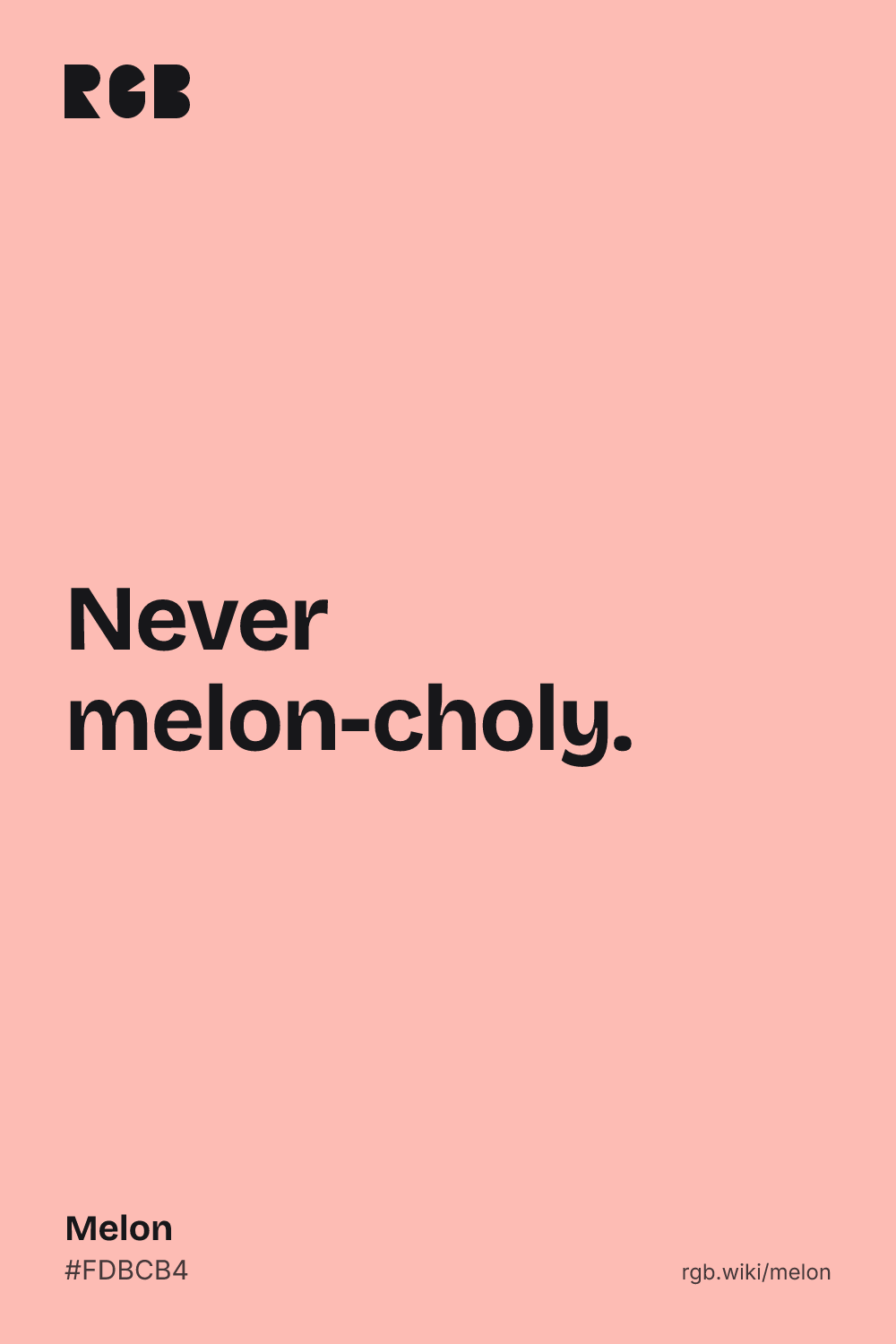
Melon color card, hex #FDBCB4: “Never melon-choly”

Melon on the color map

Today’s crayon value sits right on the reference. People’s average melon in the xkcd survey and the dictionary’s strong yellowish pink both fall just below the outline, much deeper and more intense, with the survey’s color a little to the right, toward orange. The outline is an approximate range, not a measured one.

Shades and tints

Tints with white

Shades with black

Tones with gray

Melon sits in the middle. Tints add white, shades add black and tones add gray, in 10% steps out from it. Tap any swatch to copy its code.

Light and dark melon

#FEE4E1
Pale melonMixed 60% with white. Practically the CSS keyword mistyrose (#FFE4E1). See misty rose
#FDBCB4
MelonThe reference color.
#FBC97F
Melon yellowA 1950 color dictionary’s melon yellow, shown at the ISCC-NBS center for light orange yellow. Closer to cantaloupe flesh.
#F88379
Dictionary melonThe ISCC-NBS strong yellowish pink, where the 1955 dictionary files Maerz and Paul’s 1930 melon.
#B4745E
MuskmelonMaerz and Paul’s Persian melon, and one of two groups for its muskmelon: the ISCC-NBS grayish reddish orange, shown at its center.
#7E5E5A
Dark melonMixed 50% with black. A dusky rose-brown that carries white text.

Colors that go with melon

Pairings that work in rooms, outfits and interfaces.

Fruit cup

Melon and honeydew, as in a bowl of cut fruit. Fresh for cafés and summer menus.

Brookshaw plate

From the 1812 melon prints below: pale flesh, rind green and a deep brown ground. Rich and botanical.

Melon and plum

A warm pastel with a deep berry. Good for packaging and invitations.

Melon and terracotta

Tonal and sun-warmed, from pale melon to baked clay. Suits ceramics and home goods.

Melon and slate blue

Cool blue-gray calms the pink. Quiet and modern for interfaces.

Melon on espresso

A dark theme where melon glows as the accent. Cozy and grown-up.

Color-wheel palettes

Pick a palette to see where its colors sit on the color wheel. The caret marks melon. Tap a band to copy its code.

Similar colors

Carnation pink65%Pastel pink69%MelonApricot76%Nude72%Oatmeal68%Oyster65%

Lined up by hue around melon. Hover a color to see how similar it is.The bar under each name shows how similar it is. Similarity comes from the distance between the two colors in OKLab, a model of how we see color.

Melon vs apricot

Melon#FDBCB4 · hue 7°
  • Pinker, with a rosy cast
  • Code from a 1949 crayon color
  • Named after cantaloupe flesh
Apricot#FBCEB1 · hue 24°
  • More orange, a little lighter
  • Code from a 1930 dictionary sample
  • Named after the apricot

Meaning

  • Cantaloupe flesh
  • An “apple-gourd”
  • Set by one gene
  • Vivacity, unproven

Melon feels fresh, sweet and summery, after the cut flesh of a cantaloupe. Its name is an old word for the fruit, and whether that fruit is orange inside comes down to one gene. A 1921 book tied melon to vivacity and magnetism, but it offered no evidence, and research on color and emotion tests broad words such as orange or pink, not melon itself.

Named for an “apple-gourd”

Word history

Melon came into English in the 1300s, through French and Late Latin, from Greek mēlopepōn: mēlon, apple, and pepōn, a kind of gourd. Cantaloupe, first recorded in 1739, is named after Cantalupo, a former papal villa near Rome.1, 2
One gene decides if it is orange

Genetics study

Melon flesh can be white, light green or orange, and in orange melons beta-carotene is the main pigment. A 2015 study found that a single change in one gene, CmOr, which swaps one building block of its protein, separates orange-fleshed melons from green and white ones across a broad collection of varieties. US government measurements put raw cantaloupe at about 2,780 micrograms of beta-carotene per 100 grams.3, 4

Domesticated more than once

Genetics study

A 2019 study that sequenced 1,175 melons from around the world suggests the fruit was domesticated three separate times, twice in India and once in Africa. Older accounts placed its origin in Africa or southwest Asia, so the story is not fully settled.5, 6

Vivacity, by one 1921 account

Historical claim

A 1921 book called Psychology of Color, by J. C. F. Grumbine, founder of an esoteric spiritualist order, linked melon with fullness of life, vivacity, magnetism and impressibility. It reported no tests. Modern studies of color and emotion ask about basic color words such as orange and pink, not named shades like melon.7, 8, 9

Sources (9)
  1. Merriam-Webster, “melon”, etymology and first known use.
  2. Merriam-Webster, “cantaloupe”, etymology and first known use.
  3. Tzuri, G. et al. (2015). A “golden” SNP in CmOr governs the fruit flesh color of melon (Cucumis melo). The Plant Journal, 82(2), 267–279. PubMed 25754094
  4. US Department of Agriculture, FoodData Central, “Melons, cantaloupe, raw” (Foundation 746770).
  5. Zhao, G. et al. (2019). A comprehensive genome variation map of melon identifies multiple domestication events and loci influencing agronomic traits. Nature Genetics, 51(11), 1607–1615. doi:10.1038/s41588-019-0522-8
  6. Wikipedia, “Melon”, history section.
  7. Wikipedia, “Shades of orange: Melon”, citing Grumbine, J. C. F. (1921), Psychology of Color, Cleveland: The Order of the White Rose, p. 30.
  8. Encyclopedia of Occultism and Parapsychology, “Order of the White Rose”, via Encyclopedia.com.
  9. Jonauskaite, D. et al. (2020). Universal patterns in color-emotion associations are further shaped by linguistic and geographic proximity. Psychological Science, 31(10). doi:10.1177/0956797620948810

History

People grew melons for thousands of years before anyone named a color after them, and the code on screens today came from a crayon box, not from the fruit.

  1. Prehistory

    Melons are domesticated at least three separate times, twice in India and once in Africa, according to a 2019 study of 1,175 melons from around the world.1

  2. 1300s

    Melon enters English, through French and Late Latin, from Greek mēlopepōn, “apple-gourd”.2

  3. 1739

    First known use of cantaloupe in English, named after Cantalupo, a former papal villa near Rome.3

  4. 1812

    George Brookshaw’s Pomona Britannica prints hand-colored plates of melons grown in English gardens, from the pale-fleshed Amicua to the Scarlet Flesh Romana.4

  5. 1892

    First recorded use of melon as a color name in English.5

  6. 1930

    Maerz and Paul’s A Dictionary of Color prints a melon sample on plate 2.5

  7. 1949

    Melon becomes a crayon color, a pale pink-orange. It is the source of today’s web code, #FDBCB4.5

  8. 1955

    The ISCC-NBS dictionary files Maerz and Paul’s melon as a strong yellowish pink, centered on #F88379.6

  9. 2010

    In the xkcd color survey, people’s average melon is #FF7855, a strong orange-pink almost identical to coral.7

  10. 2015

    Plant scientists trace orange melon flesh to a single change in the gene CmOr.8

Sources (8)
  1. Zhao, G. et al. (2019). A comprehensive genome variation map of melon identifies multiple domestication events and loci influencing agronomic traits. Nature Genetics, 51(11), 1607–1615. doi:10.1038/s41588-019-0522-8
  2. Merriam-Webster, “melon”, etymology and first known use.
  3. Merriam-Webster, “cantaloupe”, etymology and first known use.
  4. Cleveland Museum of Art, George Brookshaw, Pomona Britannica (1812): No. 72, Amicua (Melon) (2020.167) and No. 64, Scarlet Flesh Romana Melon (1955.312).
  5. Wikipedia, “Shades of orange: Melon”, citing Maerz, A. & Paul, M. R. (1930), A Dictionary of Color, p. 199 and plate 2.
  6. Kelly, K. L. & Judd, D. B. (1955). The ISCC-NBS Method of Designating Colors and a Dictionary of Color Names. National Bureau of Standards Circular 553. Maerz and Paul entries as listed by Jaffer, A., “(M) Dictionary of Color”.
  7. Munroe, R. (2010). “Color survey results”. xkcd blog. The survey’s color averages are released as CC0 data.
  8. Tzuri, G. et al. (2015). A “golden” SNP in CmOr governs the fruit flesh color of melon (Cucumis melo). The Plant Journal, 82(2), 267–279. PubMed 25754094

Melon in use

A botanical print of a ribbed green melon cut open beside a loose slice, both with pale peach flesh and a reddish ring around the seeds, under a vine with yellow flowers on a dark brown ground
#DEB693#B36043#5B6E5B#55473E
PrintAmicua melon, Pomona Britannica (1812)

A hand-colored aquatint by George Brookshaw, from a book of the fruit grown in England’s finest gardens, now at the Cleveland Museum of Art. The cut flesh reads about #DEB693, a soft peach, with a rust-red ring (#B36043) around the seeds. That is nearer the pale web code than the dictionary’s melon, though yellower.

#DEB693#B36043#5B6E5B#55473E
Source: Cleveland Museum of Art
A botanical print of a large round melon with deep green ribs and an orange, white-netted rind, one side cut away to show coral-red flesh, under a vine with broad leaves and yellow flowers on a dark brown ground
#DE9174#D1725C#DDAA77#4E4635
PrintScarlet Flesh Romana melon (1812)

Another plate from Brookshaw’s Pomona Britannica, also at the Cleveland Museum of Art. The melon has deep green ribs and an orange, white-netted rind, with one side cut away to show coral-red flesh, about #DE9174 to #D1725C. That is much nearer the 1930 dictionary’s strong yellowish pink than the pale web code.

#DE9174#D1725C#DDAA77#4E4635
Source: Cleveland Museum of Art

Palettes are sampled in-house.

Questions

What color is melon?

A pale pink-orange, named after the flesh of a cantaloupe. The usual code is #FDBCB4 (RGB 253, 188, 180).

Where does the code #FDBCB4 come from?

From a crayon color introduced in 1949. No color standard defines melon. The melon sample in Maerz and Paul’s 1930 A Dictionary of Color is much stronger, a strong yellowish pink of about #F88379.

Is melon pink or orange?

In between. The web code is a pale pink with a warm, orange tint, and the 1930 dictionary called its melon a strong yellowish pink. People in the xkcd survey picked a deeper orange-pink, #FF7855, close to coral.

What is the difference between melon and apricot?

Melon (#FDBCB4) is pinker. Apricot (#FBCEB1) is a little lighter and more orange. Both are pale pastels named after fruit.

Why are some melons orange inside and others green?

Orange melons such as cantaloupes store beta-carotene in their flesh. A 2015 study found that a single change in one gene, CmOr, decides whether a melon’s flesh turns orange or stays green or white.

Where does the word melon come from?

Through French and Late Latin from Greek mēlopepōn, from mēlon, apple, and pepōn, a kind of gourd. Cantaloupe is named after Cantalupo, a former papal villa near Rome.

What colors go with melon?

Honeydew green for a fresh look, plum or slate blue for contrast, terracotta for a warm tonal pairing, and a deep espresso brown for a dark theme. Use dark text on melon.

Is melon a CSS color?

No. Its nearest CSS keywords are pink (#FFC0CB) and lightpink (#FFB6C1), which are cooler pinks. The only melon in CSS is honeydew (#F0FFF0), a near-white green.