Moccasin

A pale peach cream named after a leather shoe, though real moccasins and a 1930 dictionary are far browner.

Overview

Moccasin is a pale, warm peach cream. Its code is #FFE4B5: red at full strength, green a little lower and blue lower again, which tints white toward peach. It is practically the same color as peach, #FFE5B4: the same digits with the 4 and 5 swapped, a difference no eye can see. Beside navajo white it looks a touch paler and yellower.

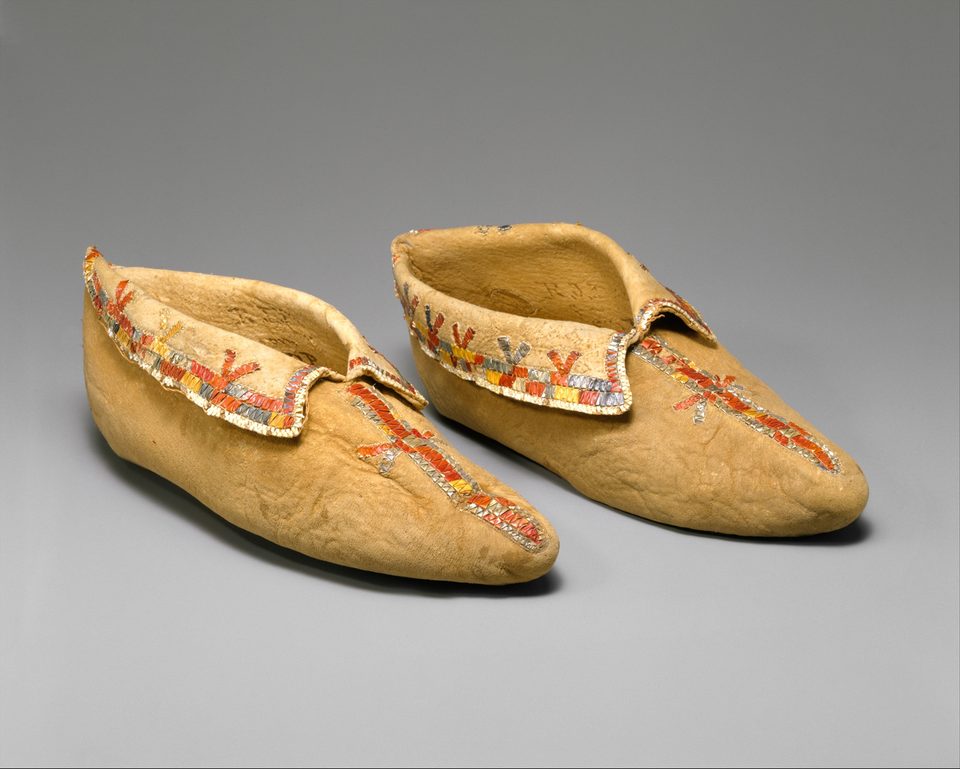
The name is the CSS keyword moccasin. A moccasin is a soft leather shoe, historically the footwear of many Indigenous peoples of North America. English took the word from Virginia Algonquian, the language of the Powhatan people, and John Smith printed it in 1612 as “Mockasins. Shooes.” The web color is far paler than most moccasins. In a museum photo, the native-tanned leather of a Seneca pair from about 1808 reads about #D6A360, a golden tan, and Maerz and Paul’s 1930 A Dictionary of Color used moccasin for a brown, centered around #6F4E37.

The code reached screens in 1989, when Paul Raveling added a set of light colors to the X Window System’s color list, copied from a paint maker’s samples to give better window backgrounds. No record says why this one was called moccasin. The web adopted the list in 2001. In 2020, a request asked the CSS Working Group to rename it “Peach”. The group kept the name, since renaming would break existing sites, and added a note that discourages named colors in general.

On screens, moccasin needs dark text: black on it has a contrast of about 17:1, white only about 1.2:1. It pairs well with navy, deep teal, terracotta and warm browns, and works as warm text on charcoal.
HEX#FFE4B5
RGBrgb(255, 228, 181)
HSLhsl(38, 100%, 85%)
HSV38°, 29%, 100%
CMYK0, 11, 29, 0
OKLCHoklch(93.0% 0.068 81.4)
Every code converts from the HEX value #FFE4B5. #FFE4B5 is the CSS keyword moccasin, rgb(255, 228, 181), defined in the CSS Color Module Level 4 and first listed among the web’s color names in SVG 1.0 (2001). It comes from Paul Raveling’s revision of the X Window System’s color list, shipped in X11 Release 4 in December 1989 (rgb.txt, 255 228 181), from its section of light colors copied from paint samples; the color lists of Release 1 (1987) and Release 3 (1988) have no moccasin. The moccasin of Maerz and Paul’s 1930 dictionary is a different color: the ISCC-NBS dictionary files it as a moderate brown. CMYK is a screen-based estimate; print results vary.
Moccasin color card, hex #FFE4B5: “Peach with the 4 and 5 swapped”

Moccasin on the color map

No survey measures moccasin, and the xkcd color survey has no entry for it, but the survey’s “pale peach”, #FFE5AD, is almost exactly the code. The museum leather sits below the outline and a little to the left: much darker and slightly more orange. The 1930 dictionary’s moccasin lies far below and to the left, a brown. Colors in photos shift with the lighting, so read the leather as close, not exact. The outline is an approximate range, not a measured one.

Shades and tints

Tints with white

Shades with black

Tones with gray

Moccasin sits in the middle. Tints add white, shades add black and tones add gray, in 10% steps out from it. Tap any swatch to copy its code.

Light and dark moccasin

#FFEFD3
Pale moccasinMixed 40% with white. Almost exactly papaya whip, #FFEFD5, from the same 1989 list. See papaya whip
#FFE5B4
PeachThis site’s peach: the same digits with the 4 and 5 swapped. One step greener and one step less blue, too little to see. See peach
#FFE4B5
MoccasinThe reference color. Unlike navajo white and cornsilk on either side of it in the 1989 list, it has no numbered X11 steps.
#CCB691
Deep moccasinMixed 20% with black: a light tan, close to tan, #D2B48C. See tan
#99896D
Dark moccasinMixed 40% with black: a grayish brown.
#6F4E37
Dictionary moccasinModerate brown, the ISCC-NBS center where the 1955 dictionary files Maerz and Paul’s 1930 moccasin. The same code is used for coffee. See coffee

Colors that go with moccasin

Pairings that work in rooms, outfits and interfaces.

Moccasin and navy

Crisp and classic. Navy, close to the color’s complement, gives the soft peach a sharp edge.

Moccasin and the leather browns

The web’s pale moccasin with the golden tan of a museum pair and the 1930 dictionary’s brown moccasin, which is dark enough to read as text on it.

Moccasin and terracotta

Warm and earthy. Suits kitchens, pottery and autumn designs.

Moccasin and teal

Fresh and bright. Deep teal cools the warm cream.

Its 1989 neighbors

Moccasin with navajo white, peach puff and cornsilk, from the same section of paint-sample colors. Soft and tonal, so give it dark text.

Moccasin on charcoal

A dark theme where moccasin text glows warm. Good for headings and buttons.

Color-wheel palettes

Pick a palette to see where its colors sit on the color wheel. The caret marks moccasin. Tap a band to copy its code.

Similar colors

Peach puff86%Bisque90%Navajo white92%MoccasinWheat89%Peach98%Vanilla89%

Lined up by hue around moccasin. Hover a color to see how similar it is.The bar under each name shows how similar it is. Similarity comes from the distance between the two colors in OKLab, a model of how we see color.

Moccasin vs peach

Moccasin#FFE4B5 · hue 38°
  • One step bluer, too little to see
  • A CSS keyword since 2001
  • Named after a soft leather shoe
Peach#FFE5B4 · hue 39°
  • One step greener: the 4 and 5 swap
  • Not a CSS keyword
  • Named after the fruit

Meaning

  • Named for a shoe
  • From Virginia Algonquian
  • A brown in 1930
  • A 2020 rename request

Moccasin is known less for any mood than for its name, which comes from an Indigenous language and names an Indigenous craft. Color research tests broad words such as peach or yellow, never moccasin, so the claims below are about the word, the shoes it names and how the code came about.

A word from Virginia Algonquian

Dictionary record

English took the word from Virginia Algonquian, also called Powhatan, the Algonquian language of the Powhatan people of tidewater Virginia. John Smith printed it in 1612 in a short list of words from the region: “Mockasins. Shooes.” Merriam-Webster dates the English word to about 1612 and defines it first as a soft leather heelless shoe, its sole brought up the sides of the foot. Raccoon, opossum and hickory came into English from the same language.1, 2, 3

Real moccasins are darker

Museum photos

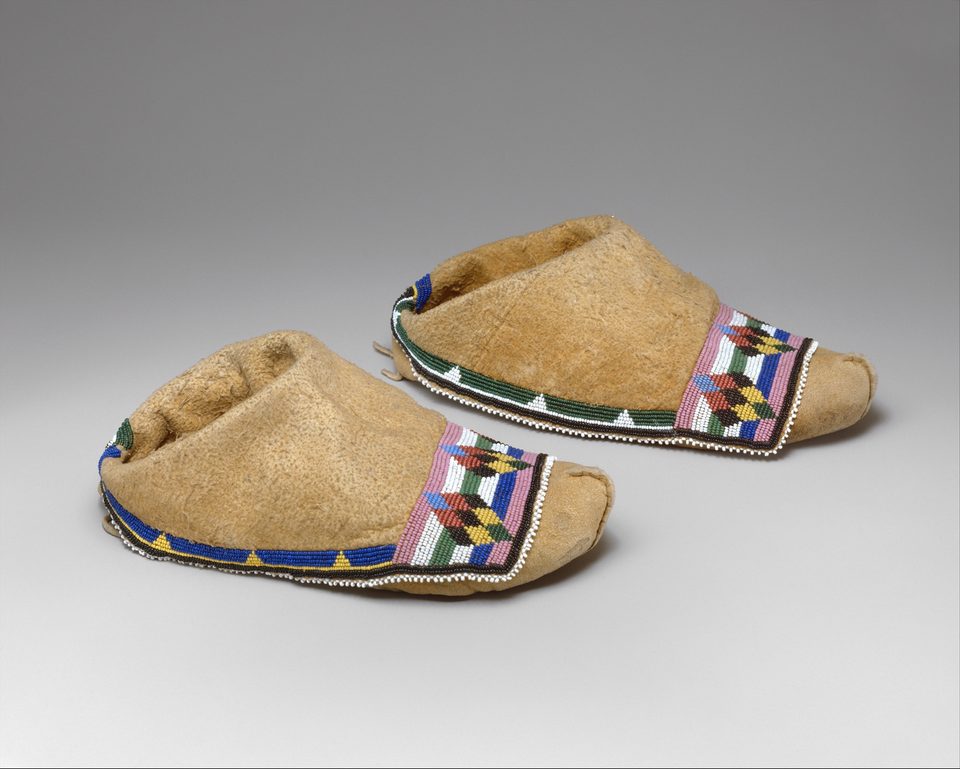
Moccasins are traditionally made of deerskin or other soft leather. In the Met’s photos, the native-tanned leather of a Seneca pair from about 1808 reads about #D6A360, a golden tan, and that of a Ho-Chunk pair from 1880–1900 about #C8A46F. Both share the code’s warm hue but are far darker. In traditional tanning, as one museum record describes it, the hide is finally smoked, which gives it a golden brown color and keeps it from stiffening when wet.4, 5, 6

A brown in the 1930 dictionary

Color dictionary

Maerz and Paul’s A Dictionary of Color (1930) gives moccasin as another name for the sample it calls cochin, on plate 7, along with argus brown and mars brown. The 1955 ISCC-NBS dictionary files that sample as a moderate brown, centered around #6F4E37, the code this site uses for coffee. That is much closer to the leather than the web’s pale moccasin, and dark enough to read as text on it, at about 6:1.7

Copied from paint samples

Historical record

Moccasin isn’t in the color lists of X11 Release 1 (1987) or Release 3 (1988). It came with Paul Raveling’s retuned list, which opens with light and off-white colors “copied from several Sinclair Paints color samples”, meant “to provide a better choice for light-colored window backgrounds.” X11 Release 4 shipped it in December 1989, at 255 228 181, between navajo white and cornsilk. No surviving note says whether the name came with the paint samples or why it was chosen.8, 9

Kept after a 2020 request

Standards record

In July 2020, a request asked the CSS Working Group to rename moccasin “Peach”, along with navajowhite and indianred. Views differed. Some members backed a change as a sign of sensitivity, and one added that the name says little about the color, which is closer to buff. Others saw nothing offensive in it: one called moccasin “just the name of a type of shoe”, the color of “pale leather, which moccasins were made from”. Another presumed any objection came from its being a historically Native American shoe and an Algonquian loanword. A count found moccasin on 371 of about 98 million mobile pages. The group kept every name, because sites depend on them, and added a note that discourages named colors, giving only indianred as an example of a name found offensive.10, 11

Sources (11)
  1. Merriam-Webster, “moccasin”, definition, etymology (Virginia Algonquian mockasin) and first known use (circa 1612).
  2. John Smith (1612), A Map of Virginia, word list “The maner of their language”, at Encyclopedia Virginia, Virginia Humanities.
  3. Wikipedia, “Powhatan language”, citing Frank Siebert (1975).
  4. Wikipedia, “Moccasin”, citing the Encyclopædia Britannica (1911).
  5. The Metropolitan Museum of Art, Ralph T. Coe Collection: Pair of Moccasins, Seneca, ca. 1808 (2011.154.188a, b; native-tanned skin, porcupine quill) and Pair of Moccasins, Ho-Chunk, 1880–1900 (2011.154.71a, b; native-tanned skin, glass). Photographs released as CC0; colors sampled for this page.
  6. Wisconsin Historical Society, “Deer Hide Jacket”, on a hide tanned in the traditional way: soaked, softened with deer brains, stretched and finally smoked.
  7. Kelly, K. L. & Judd, D. B. (1955). The ISCC-NBS Method of Designating Colors and a Dictionary of Color Names. National Bureau of Standards Circular 553, entries “Moccasin (same as Cochin)” and “Cochin” (Maerz and Paul, plate 7, A12; moderate brown, 58). PDF at NIST. Also tabulated in Jaffer’s “Maerz and Paul color names”.
  8. The X11 color list’s README and Paul Raveling’s notes, quoted in Aubrey Jaffer, “Color-Name Dictionaries”, MIT CSAIL, with Raveling’s list, raveling.txt, which opens with the light colors, moccasin at 255 228 181 among them.
  9. The X Consortium’s X11 release archives at X.Org: Release 1 (September 1987) and Release 3 (1988), whose color lists have no moccasin, and Release 4 (December 1989), whose mit/rgb/rgb.txt lists moccasin at 255 228 181 and whose mit/rgb/CHANGES notes “new color spectrum entries from Paul Raveling”.
  10. CSS Working Group, issue #5284, “Change three color names” (July to October 2020), read in the W3C mirror: the request, replies (1, 2, 3, 4), the usage count and the resolution.
  11. W3C, CSS Color Module Level 4, named colors: moccasin, #ffe4b5, 255 228 181, and the note on why the names are kept.

History

The word moccasin is more than three centuries older than the color. Its story runs from a 1612 word list in Virginia to a brown in a 1930 color dictionary, a paint sample in a 1989 computer list and a 2020 request to rename it.

  1. 1612

    John Smith’s A Map of Virginia prints a list of Algonquian words from the Virginia Indians of Tsenacomoco. One entry reads “Mockasins. Shooes.” Merriam-Webster dates the English word to about 1612.1, 2

  2. 1930

    Maerz and Paul’s A Dictionary of Color prints moccasin as another name for its cochin sample, on plate 7, along with argus brown and mars brown. The 1955 ISCC-NBS dictionary files that sample as a moderate brown, around #6F4E37.3

  3. 1987

    X11 Release 1 ships in September with a short color list. It has no off-white colors apart from white, and no moccasin. Release 3, in 1988, has none either.4

  4. 1989

    Paul Raveling at USC’s Information Sciences Institute retunes the list and opens it with light and off-white colors “copied from several Sinclair Paints color samples”. X11 Release 4 ships them in December, with moccasin at 255 228 181, between navajo white and cornsilk. Unlike them, it gets no numbered darker steps.4, 5

  5. 2001

    SVG 1.0 lists “moccasin”, rgb(255, 228, 181), among the web’s color keywords.6

  6. 2011

    CSS Color Module Level 3 becomes a W3C Recommendation on June 7 and makes moccasin, #ffe4b5, an official CSS keyword. Level 4 keeps it.7, 9

  7. July 2020

    A request asks the CSS Working Group to rename moccasin “Peach”, along with navajowhite and indianred. Members disagree about whether the name is a problem.8

  8. October 2020

    A count finds moccasin on 371 of about 98 million mobile web pages. The group adds a note discouraging named colors and closes the request. Moccasin keeps its name and its code.8, 9

Sources (9)
  1. Merriam-Webster, “moccasin”, definition, etymology and first known use.
  2. John Smith (1612), A Map of Virginia, word list “The maner of their language”, at Encyclopedia Virginia, Virginia Humanities.
  3. Kelly, K. L. & Judd, D. B. (1955). The ISCC-NBS Method of Designating Colors and a Dictionary of Color Names. National Bureau of Standards Circular 553, entries “Moccasin (same as Cochin)” and “Cochin” (Maerz and Paul, plate 7, A12; moderate brown, 58). PDF at NIST. Also tabulated in Jaffer’s “Maerz and Paul color names”.
  4. The X Consortium’s X11 release archives at X.Org: Release 1 (September 1987) and Release 3 (1988), whose color lists have no moccasin, and Release 4 (December 1989), whose mit/rgb/rgb.txt lists moccasin at 255 228 181. Paul Raveling’s own draft, raveling.txt, is hosted by Aubrey Jaffer, MIT CSAIL.
  5. The X11 color list’s README and Paul Raveling’s notes, quoted in Aubrey Jaffer, “Color-Name Dictionaries”, MIT CSAIL.
  6. W3C (2001). Scalable Vector Graphics (SVG) 1.0, recognized color keyword names.
  7. W3C (2011). CSS Color Module Level 3, extended color keywords, W3C Recommendation, June 7, 2011.
  8. CSS Working Group, issue #5284, “Change three color names” (July to October 2020), read in the W3C mirror: the request, replies (1, 2, 3, 4), the usage count and the resolution.
  9. W3C, CSS Color Module Level 4, named colors: moccasin, #ffe4b5, 255 228 181, and the note on why the names are kept.

Moccasin in use

A pair of golden tan leather moccasins with folded-down cuffs, trimmed with lines of red, orange, yellow and white quillwork along the cuffs and down the front, on a gray background
#D6A360#C49755#997841#D5652E
FootwearSeneca moccasins (about 1808)

A pair of Seneca moccasins from about 1808, decorated with dyed porcupine quills, now in the Met’s Ralph T. Coe Collection. The native-tanned leather reads about #D6A360 in the light and #997841 in shadow: a golden tan with the code’s warm hue, but far darker. The orange red is the quillwork.

#D6A360#C49755#997841#D5652E
Source: The Met
A pair of pale tan leather moccasins with beaded bands in pink, white, blue, green, yellow and dark brown along the sides and over the toes, on a gray background
#CDAE80#C8A46F#B39160#31435F
FootwearHo-Chunk moccasins (1880–1900)

A Ho-Chunk pair from the late 1800s, with bands of glass beads in pink, white, blue, green and yellow. Its leather is paler than the Seneca pair’s, about #CDAE80 to #C8A46F, and grayer, yet still much darker than the web’s moccasin, #FFE4B5.

#CDAE80#C8A46F#B39160#31435F
Source: The Met

Palettes are sampled in-house.

Questions

What color is moccasin?

A pale, warm peach cream. Its code is #FFE4B5 (RGB 255, 228, 181), the CSS keyword moccasin.

Why is the color called moccasin?

No record says why. The name entered the X Window System’s color list in 1989, in a section of light colors copied from a paint maker’s samples, and the web adopted that list in 2001. A moccasin is a soft leather shoe; the word comes from Virginia Algonquian, the language of the Powhatan people, and has been used in English since about 1612.

Is moccasin the same as peach?

Practically. Moccasin is #FFE4B5 and this site’s peach is #FFE5B4: the same digits with the 4 and 5 swapped, a difference no one can see. CSS has no peach keyword; its peachpuff, #FFDAB9, is pinker. A 2020 request to rename moccasin proposed calling it Peach.

Do real moccasins look like this color?

Mostly not. Moccasins are traditionally made of deerskin or other soft leather, and in museum photos old pairs read golden tan, around #D6A360 or #C8A46F, much darker than the code. Smoking a tanned hide gives it a golden brown color. The moccasin in Maerz and Paul’s 1930 color dictionary is a moderate brown, around #6F4E37.

Was there a request to rename moccasin?

Yes. In July 2020 a request asked the CSS Working Group to rename moccasin, navajowhite and indianred. Members disagreed about whether moccasin, the name of a shoe and an Algonquian loanword, was a problem. The group kept all three names, because sites depend on them, and added a note to the standard that discourages named colors in general.

Can I use a code instead of moccasin in CSS?

Yes. moccasin, #FFE4B5 and rgb(255, 228, 181) all give exactly the same color. The CSS standard discourages named colors in general.

What text color works on moccasin?

Dark text. Black on moccasin has a contrast of about 17:1. White reaches only about 1.2:1, too low for any text.

What colors go with moccasin?

Navy and deep teal for contrast, terracotta and leather browns for warmth, and charcoal for a dark theme with moccasin as the text or accent color.