Lemon

A vivid yellow named after the fruit, and once the name of a greenish chromate paint.

Overview

Lemon is a vivid yellow named after the fruit. Its usual web code is #FFF700: red at full strength, green at 97% and no blue, just short of pure screen yellow. That makes it a touch greener and lighter than canary yellow.

The name is old. Merriam-Webster dates lemon as a color word to 1598 and lemon yellow to 1807. In the 1800s lemon yellow was also a pigment: paint makers sold barium chromate, and sometimes strontium chromate, under that name, as a paler, greener cousin of chrome yellow. Renoir and Monet both painted with it.

The web code and the name pull in slightly different directions. Dictionaries call lemon yellow a greenish yellow, and people in the xkcd color survey picked a yellow a hair greener than pure yellow. #FFF700 sits a hair on the warm side instead. On screen the gap is tiny. The bigger gap is with real lemons, and with the lemons painters made of them, which are deeper and warmer than any of these codes.

Lemon is one of the lightest colors there is: white text on it reaches only 1.13:1, while black reaches 18.6:1. Use it for highlights, buttons on dark backgrounds and summery accents, and pair it with navy, charcoal or cobalt blue. Lilac makes a softer contrast, the yellow and purple pairing Van Gogh used for his lemons.

HEX#FFF700
RGBrgb(255, 247, 0)
HSLhsl(58, 100%, 50%)
HSV58°, 100%, 100%
CMYK0, 3, 100, 0
OKLCHoklch(95.1% 0.204 107.3)
Every code converts from the HEX value #FFF700. #FFF700 is the lemon that Wikipedia shows, credited to a crayon color; no color standard defines it. Older references make lemon yellow greener: the ISCC-NBS dictionary files Ridgway’s lemon yellow (1912) as brilliant greenish yellow, #E9E450, and Merriam-Webster defines lemon yellow as “a brilliant greenish yellow color.” CMYK is a screen-based estimate; print results vary.
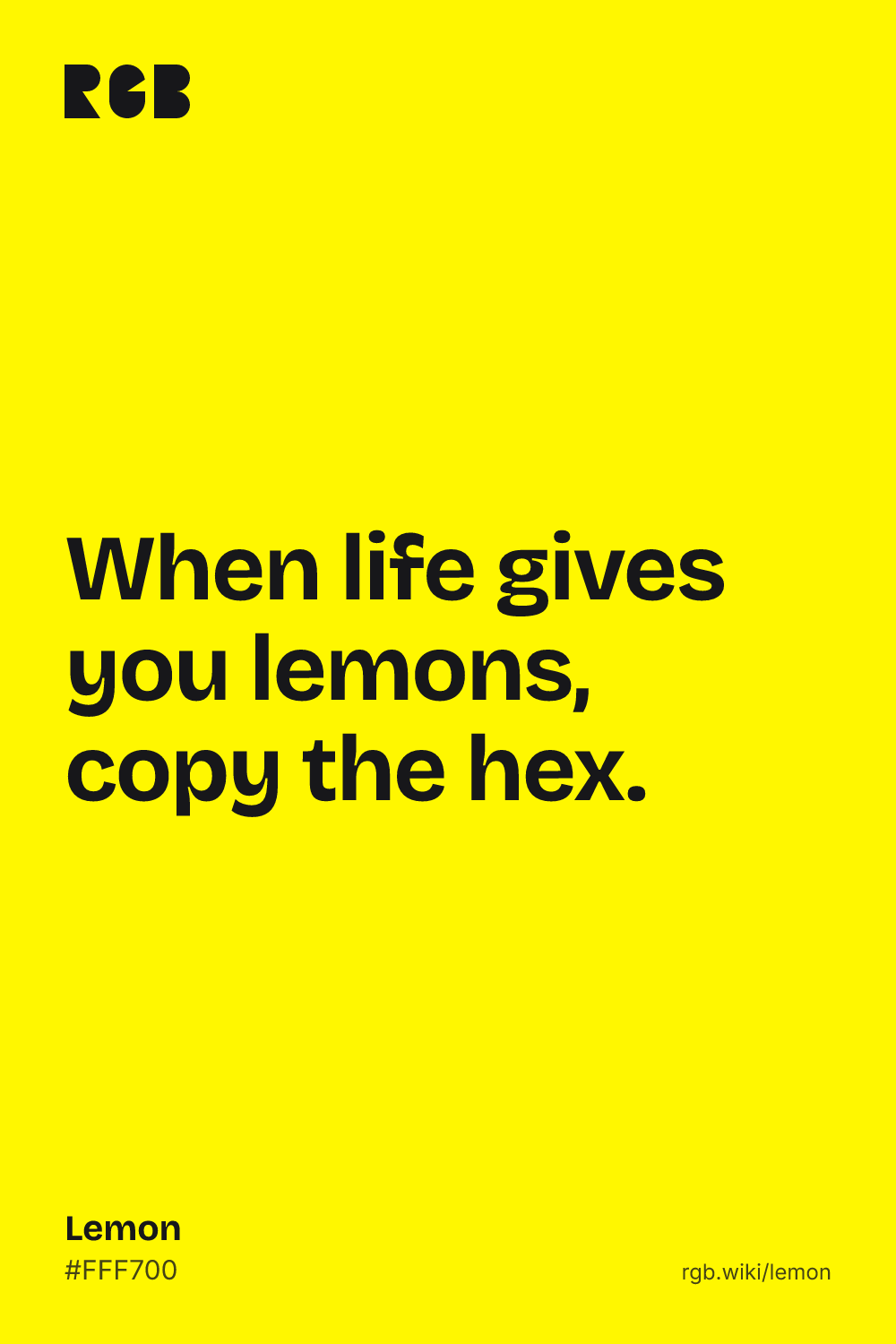
Lemon color card, hex #FFF700: “When life gives you lemons, copy the hex”

Lemon on the color map

People’s average lemon and lemon yellow in the xkcd survey sit inside the outline, just above the code and a little to the right: a hair lighter and greener. Ridgway’s lemon yellow sits straight below, inside the outline: darker and duller at the same hue. The 1950 lemon yellow is lower still, just under the outline. Maerz and Paul’s lemon yellow sits outside the outline at the lower left: deeper and warmer, toward gold. The outline is an approximate range, not a measured one.

Shades and tints

Tints with white

Shades with black

Tones with gray

Lemon sits in the middle. Tints add white, shades add black and tones add gray, in 10% steps out from it. Tap any swatch to copy its code.

Light and dark lemon

#FFFC99
Pale lemonMixed 60% with white. A soft, sunny tint for backgrounds.
#FFF700
LemonThe reference color.
#FFF600
Cadmium yellowThe usual web code for cadmium yellow, practically the same color. The pigment itself runs warmer. See cadmium yellow
#FFFACD
Lemon chiffonThe CSS keyword lemonchiffon: a pale cream with a lemon tint. See lemon chiffon
#E9E450
Ridgway’s lemon yellowThe ISCC-NBS brilliant greenish yellow, where the 1955 dictionary files Ridgway’s lemon yellow of 1912.
#DCD300
Cadmium lemonThe ISCC-NBS vivid greenish yellow, where the same dictionary files Maerz and Paul’s cadmium lemon of 1930.
#999400
Dark lemonMixed 40% with black. It turns olive, not gold.

Colors that go with lemon

Pairings that work in rooms, outfits and interfaces.

Lemon and navy

The safest strong pairing: lemon glows on deep blue. Good for buttons and highlights on a dark site.

Lemon and lilac

Yellow against its complement, as in Van Gogh’s 1887 still life of lemons on a lilac cloth. Bright but gentle.

Lemonade stand

Lemon, mint and leaf green on white. Fresh and summery, for food, drinks and kids’ designs.

Dutch still life

A lemon against dark wood, pewter and linen, the look of a 1600s banquet piece. Dramatic and rich.

Lemon and cobalt

Two pure, primary colors. Bold and graphic, for posters and sport.

Citrus

Lemon, lime and orange. Loud and cheerful, so let one color lead and keep text dark.

Color-wheel palettes

Pick a palette to see where its colors sit on the color wheel. The caret marks lemon. Tap a band to copy its code.

Similar colors

Banana yellow70%Maize75%Canary yellow90%Cadmium yellow99%LemonButter yellow75%Sunshine yellow92%

Lined up by hue around lemon. Hover a color to see how similar it is.The bar under each name shows how similar it is. Similarity comes from the distance between the two colors in OKLab, a model of how we see color.

Lemon vs canary yellow

Lemon#FFF700 · hue 58°
  • A touch greener and lighter
  • Named after the fruit
  • Also an old name for barium chromate paint
Canary yellow#FFEF00 · hue 56°
  • A hair warmer
  • Named after a songbird
  • Also a name for printer’s yellow

Meaning

  • The fruit
  • Chromate pigment
  • Library science
  • Joy

Lemon takes its meaning from the fruit: bright, sour and fresh. The name has been a color word since the 1500s, a paint name since the 1800s, and in American academic dress it marks library science. Research on color and emotion tests the word yellow, not lemon, so what it says about mood is borrowed.

A word from Persian

Word history

Lemon came into English in the 1400s, through French and Medieval Latin, from Arabic laymūn and Persian līmū. Merriam-Webster dates lemon as a color word to 1598, and lemon yellow, which it defines as a brilliant greenish yellow, to 1807.1, 2
Once a paint, not just a fruit

Conservation science

In the 1800s, lemon yellow was a trade name for barium chromate and sometimes strontium chromate, both greener than the zinc chromate sold as citron yellow. A London color maker listed lemon yellow by about 1835, and in 1892 it rated it the only one of these three chromate yellows that was permanent in oil. Renoir and Monet painted with it, and Merriam-Webster still defines lemon chrome as barium chromate used as a pigment.3, 4, 5

The color of library science

Tradition

In American academic dress, the velvet trim on a hood shows the wearer’s field of study, and lemon stands for library science.6, 7

Yellow means joy, more where it rains

Tested on yellow only

A 2019 study of 6,625 people in 55 countries found that people who live further from the equator, and in rainier countries, are more likely to link yellow with joy. The authors suggest yellow recalls sunshine, which is welcome where it is scarce. The study tested the word yellow, not lemon.8

Sources (8)
  1. Merriam-Webster, “lemon”, definitions, etymology and first known use.
  2. Merriam-Webster, “lemon yellow”, definition and first known use.
  3. Otero, V., Campos, M. F., Pinto, J. V., Vilarigues, M., Carlyle, L. & Melo, M. J. (2017). Barium, zinc and strontium yellows in late 19th–early 20th century oil paintings. Heritage Science, 5, 46.
  4. Merriam-Webster, “lemon chrome”, definition.
  5. ColourLex, “Lemon yellow”, composition, names and examples of use.
  6. Valdosta State University, “Regalia Wear: The Code of Academic Costume”, colors of the fields of study.
  7. Wikipedia, “Academic dress in the United States”, colors of the fields of study, citing Sullivan, Academic Costume Code and Ceremony Guide.
  8. Jonauskaite, D. et al. (2019). The sun is no fun without rain: Physical environments affect how we feel about yellow across 55 countries. Journal of Environmental Psychology. doi:10.1016/j.jenvp.2019.101350

History

The lemon traveled from Asia to the Mediterranean long before its name became a color. The color word arrived in 1598, the paint in the 1830s, and painters from Claesz to Van Gogh put the fruit itself on canvas.

  1. By the 100s CE

    Lemons reach southern Italy in Roman times. They spread across the Arab world and the Mediterranean between 1000 and 1150, and the first large-scale growing in Europe begins in Genoa in the mid-1400s.1

  2. 1400s

    The word reaches English as lymon, through French and Medieval Latin, from Arabic laymūn and Persian līmū.2

  3. 1598

    First known use of lemon as a color word in English, the date given by both Merriam-Webster and Maerz and Paul’s A Dictionary of Color (1930).2, 3

  4. About 1625

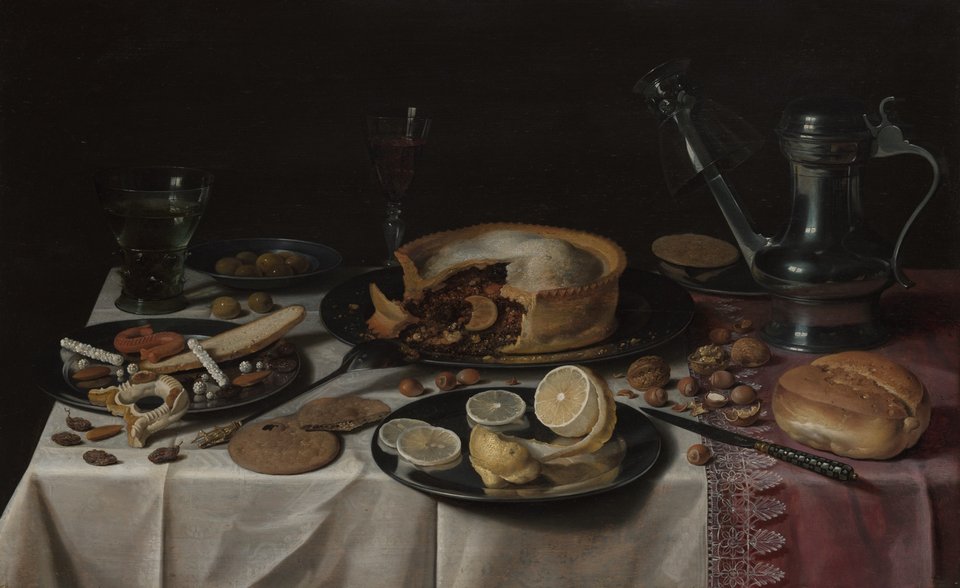
    Pieter Claesz paints a Dutch banquet piece with a half-peeled lemon at its center. The Art Institute of Chicago counts the lemon among the costly goods on show.4

  5. 1807

    First known use of “lemon yellow,” which Merriam-Webster defines as a brilliant greenish yellow.5

  6. About 1835

    A London artists’ color maker lists Lemon Yellow, a barium chromate, in its catalog. Its production records for the pigment run from 1838 to 1880.6

  7. About 1879

    Renoir paints Boating on the Seine (La Yole). The boat is a mix of chrome yellow and lemon yellow.7

  8. 1887

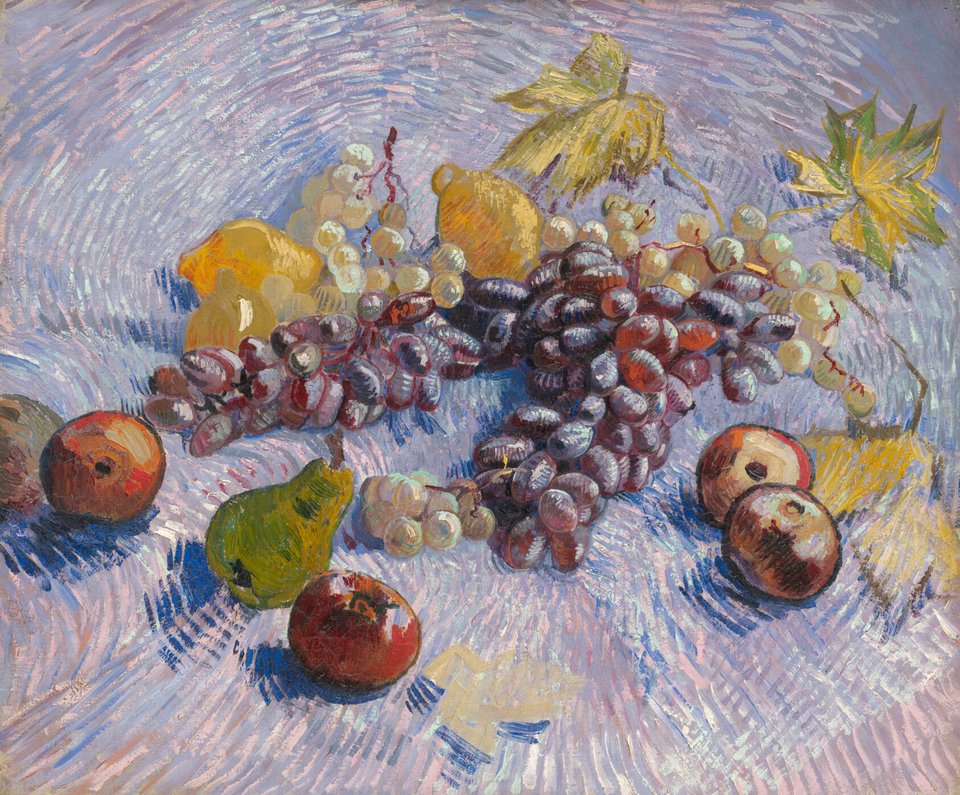
    In the fall, Van Gogh paints Grapes, Lemons, Pears, and Apples, setting the yellow fruit against a lilac cloth to play complementary colors off each other.8

  9. 1912

    Robert Ridgway’s Color Standards and Color Nomenclature includes a lemon yellow. The ISCC-NBS dictionary later files it as brilliant greenish yellow, #E9E450.9

  10. 2010

    In the xkcd color survey, people’s average lemon is #FDFF52 and their lemon yellow #FDFF38, both a hair greener than the web code.10

Sources (10)
  1. Wikipedia, “Lemon”, origins section, citing Morton, J. F. (1987), Fruits of Warm Climates, pp. 160–168.
  2. Merriam-Webster, “lemon”, etymology and first known use.
  3. Wikipedia, “Lemon (color)”, citing Maerz, A. & Paul, M. R. (1930), A Dictionary of Color, p. 197 and plate 10.
  4. Art Institute of Chicago, “Still Life”, Pieter Claesz, about 1625 (1935.300).
  5. Merriam-Webster, “lemon yellow”, definition and first known use.
  6. Otero, V., Campos, M. F., Pinto, J. V., Vilarigues, M., Carlyle, L. & Melo, M. J. (2017). Barium, zinc and strontium yellows in late 19th–early 20th century oil paintings. Heritage Science, 5, 46.
  7. ColourLex, “Lemon yellow”, examples of use.
  8. Art Institute of Chicago, “Grapes, Lemons, Pears, and Apples”, Vincent van Gogh, 1887 (1949.215).
  9. Jaffer, A. “(R) Color Standards and Color Nomenclature”, the ISCC-NBS placements of Ridgway’s color names (1955 dictionary).
  10. Munroe, R. (2010). “Color survey results”. xkcd blog. The survey’s color averages are released as CC0 data.

Lemon in use

A still life painted in swirling strokes: two yellow lemons, bunches of purple and pale green grapes, a green pear and red apples on a lilac and blue tablecloth, with yellow vine leaves at the upper right
#C88812#A8823A#DCC69C#9B98AB
PaintingGrapes, Lemons, Pears, and Apples, Vincent van Gogh (1887)

Van Gogh set two lemons against a lilac tablecloth, playing yellow against purple, its complement. In the photograph his lemons are a deep, warm yellow, about #C88812 in the strongest strokes and #A8823A in the body, far from the electric web code. The cloth sits near #9B98AB.

#C88812#A8823A#DCC69C#9B98AB
Source: Art Institute of Chicago
A dark still life of a table laid with a white cloth: a half-peeled lemon and lemon slices on a pewter plate, a cut meat pie, wine glasses, olives, nuts, a bread roll and a tall pewter jug
#AB9362#897043#A48E67#24221E
PaintingStill Life, Pieter Claesz (about 1625)

A Dutch banquet piece with a half-peeled lemon on a pewter plate, its rind hanging in a spiral, among foods the museum describes as costly goods. The lit rind samples around #AB9362 and the cut face near #A48E67. The whole photograph is dim: even the white tablecloth reads as a warm gray, about #7C7367.

#AB9362#897043#A48E67#24221E
Source: Art Institute of Chicago

Palettes are sampled in-house.

Questions

What color is lemon?

A vivid yellow named after the fruit. The usual web code is #FFF700 (RGB 255, 247, 0), a hair short of pure screen yellow.

Where does the code #FFF700 come from?

It is the lemon Wikipedia shows, taken from a crayon color. No color standard defines it, and older color dictionaries make lemon yellow greener and duller.

Is lemon the same as lemon yellow?

Yes. As color names they mean the same thing. In the xkcd color survey, people’s average lemon (#FDFF52) and lemon yellow (#FDFF38) were almost identical.

Is lemon a warm or a cool yellow?

As a paint and dictionary name, lemon yellow is the cool, greenish end of the yellows. The web code #FFF700 is a hair warmer than pure yellow, so on screen it reads as a plain, bright yellow.

What was lemon yellow paint made of?

In the 1800s, mostly barium chromate and sometimes strontium chromate. Both are chromates, which are toxic, and barium chromate can turn gray-green over time.

What is the difference between lemon and canary yellow?

Very little. Canary yellow (#FFEF00) is a hair warmer. Lemon (#FFF700) is a touch greener and lighter.

What does lemon mean in academic dress?

In American academic dress, lemon is the color for library science, shown in the velvet trim of the hood.

What colors go with lemon?

Navy, charcoal and cobalt blue for contrast, lilac for a soft complement, and mint with white for something fresh. Always use dark text on lemon.