Watermelon

A bright, warm pink named after a fruit that was not always red inside.

Overview

Watermelon is a bright, warm pink. The code used here, #FC6C85, has red almost at full strength, green at about 42% and blue at about 52%. That makes a pink with a little red in it, deeper than flamingo pink and lighter than the fruit itself.

Cut a ripe watermelon and the flesh is redder than the code. When the xkcd color survey asked people to name colors, their average watermelon was #FD4659, a strong pinkish red. The 1930 A Dictionary of Color also lists watermelon, and the 1955 ISCC-NBS dictionary files it as a deep pink, about #E4717A, or a moderate red.

The red comes from lycopene, the pigment that colors tomatoes. Wild watermelons from northeastern Africa have pale, often bitter flesh. Red flesh became fixed only as people grew the fruit, through a change in one enzyme that normally turns red lycopene into orange beta-carotene. Some watermelons are still yellow, orange or white inside.

The name is used for other things that are pink inside and green outside, such as watermelon tourmaline, a gemstone. Black text reads well on watermelon; white text does not.

HEX#FC6C85
RGBrgb(252, 108, 133)
HSLhsl(350, 96%, 71%)
HSV350°, 57%, 99%
CMYK0, 57, 47, 1
OKLCHoklch(71.4% 0.176 12.1)
Every code converts from the HEX value #FC6C85. No color standard defines watermelon. #FC6C85 is the code most color lists use, and color websites tie it to a crayon shade, not to a dictionary. The 1955 ISCC-NBS dictionary files the watermelon of Maerz and Paul’s A Dictionary of Color (1930) as deep pink, about #E4717A, or moderate red, about #AB4E52. In the xkcd color survey, people’s watermelon averaged #FD4659. CMYK is a screen-based estimate; print results vary.
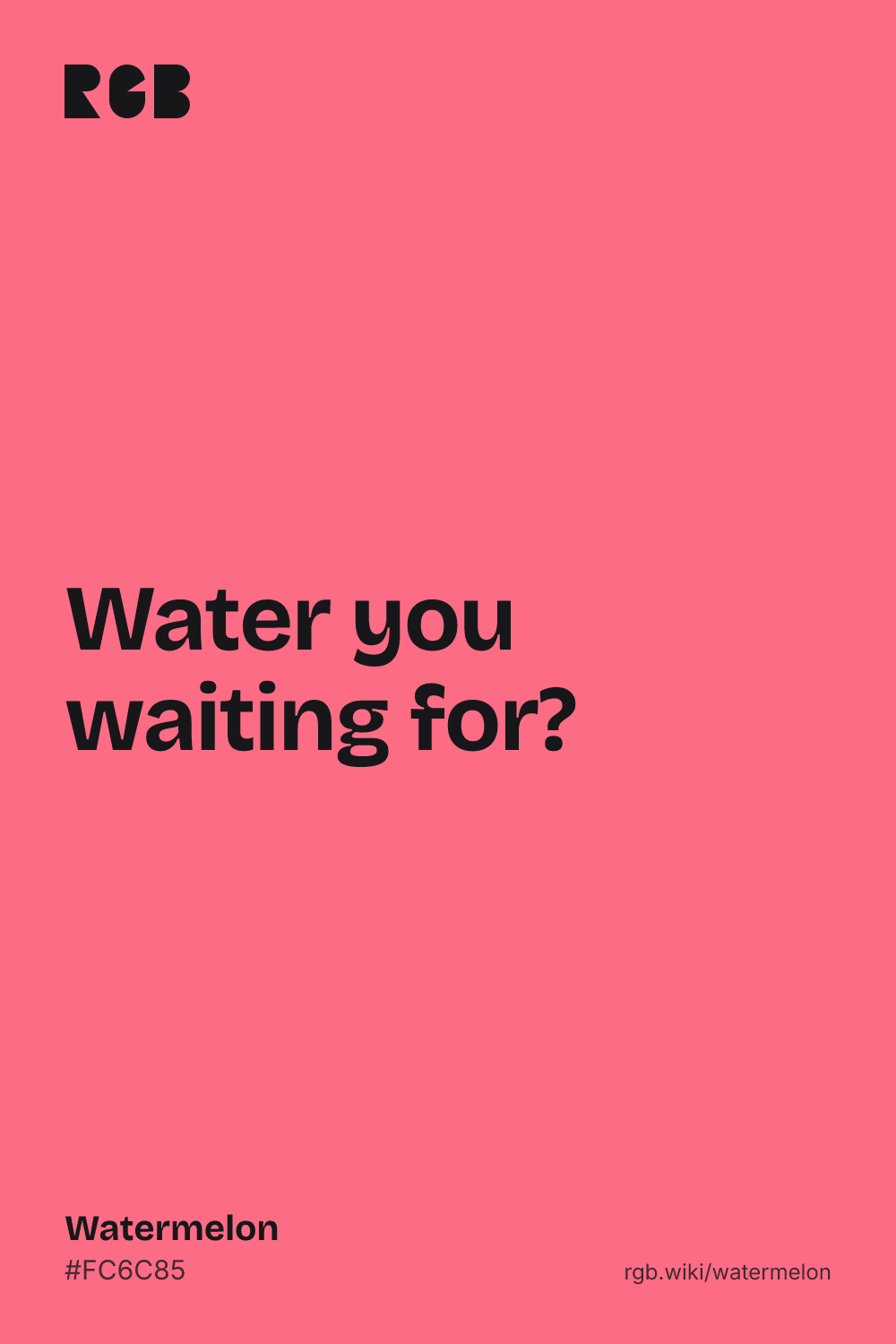
Watermelon color card, hex #FC6C85: “Water you waiting for”

Watermelon on the color map

The survey watermelon and the dictionary’s deep pink both sit inside the outline, a little lower and to the right: slightly darker and closer to red, the survey value far more vivid and the dictionary value duller. The dictionary’s moderate red sits straight below the outline. Porter’s painted flesh sits below and to the right, a deep brownish red, and the Suzhou print sits out to the right, a softer coral. The outline is an approximate range, not a measured one.

Shades and tints

Tints with white

Shades with black

Tones with gray

Watermelon sits in the middle. Tints add white, shades add black and tones add gray, in 10% steps out from it. Tap any swatch to copy its code.

Light and dark watermelon

#FEC4CE
Pale watermelonMixed 60% with white. A soft pink for backgrounds.
#FC6C85
WatermelonThe reference color.
#FD4659
Survey watermelonThe average watermelon in the xkcd color survey. Redder and more vivid, closer to the cut fruit.
#E4717A
Dictionary watermelonThe ISCC-NBS deep pink, where the 1955 dictionary files Maerz and Paul’s watermelon.
#9A4740
Porter’s watermelonSampled from the lit flesh in Charles Ethan Porter’s Untitled (Cracked Watermelon), about 1890.
#974150
Dark watermelonMixed 40% with black. A deep raspberry rose that holds white text.

Colors that go with watermelon

Pairings that work in rooms, outfits and interfaces.

Slice of summer

Pink flesh, dark green rind, pale inner rind and black seeds. The whole fruit in four colors.

Porter’s watermelon, about 1890

Sampled from the painting: brownish red flesh, dark vine leaves and a warm highlight.

Suzhou print, 1700s

Sampled from the woodblock print: coral slices, a gold rind and a yellow dish on old paper.

Watermelon and mint

Pink and soft green, light and fresh. Good for summer menus and drinks.

Watermelon and navy

Bright pink on deep blue. Bold but easy to read.

Tonal watermelon

A set from pale pink to deep rose, for an all-pink look.

Color-wheel palettes

Pick a palette to see where its colors sit on the color wheel. The caret marks watermelon. Tap a band to copy its code.

Similar colors

Pale violet red69%Blush66%Strawberry80%WatermelonLight coral77%Grapefruit71%Salmon72%

Lined up by hue around watermelon. Hover a color to see how similar it is.The bar under each name shows how similar it is. Similarity comes from the distance between the two colors in OKLab, a model of how we see color.

Watermelon vs flamingo pink

Watermelon#FC6C85 · hue 350°
  • Deeper and stronger
  • A little closer to red
  • Named after a fruit
Flamingo pink#FC8EAC · hue 344°
  • Lighter and softer
  • Leans a little toward purple
  • Named after a bird

Meaning

  • Lycopene red
  • Bred to be red
  • Palestinian symbol
  • A racist trope, resisted

Watermelon brings to mind summer, picnics and a cold slice on a hot day. Its color has a history of its own. The red is a pigment the fruit was bred to keep, and the fruit itself has carried heavy meanings, from a racist caricature in the United States to a sign of Palestinian identity. Research on color and emotion tests basic words like pink or red, not watermelon, so the claims below are about the fruit and how people have used it.

Red from lycopene

Well established

The red in watermelon is lycopene, the same carotenoid pigment that colors tomatoes. In a USDA study of 50 red-fleshed cultivars, lycopene made up 84 to 97% of the fruit’s carotenoids, and the amount ranged from 33 to 100 mg per kilogram. Whole melons kept at room temperature for two weeks gained 11 to 40% more lycopene.1, 2
Red because an enzyme slowed down

Lab studies

Watermelons make lycopene and then turn it into orange beta-carotene with an enzyme called lycopene beta-cyclase. In red watermelons, small changes in this enzyme mean less of it survives in the fruit, so red lycopene piles up. When researchers boosted the enzyme in a red-fleshed line, the flesh turned orange. Pale yellow and red flesh map to the same gene.3, 4

Wild watermelons were pale

Genetic and historical evidence

Wild watermelons have watery but hard, pale and bland or bitter flesh. The Kordofan melon of Sudan, the closest wild relative found so far, has whitish pulp that is not bitter. Its genome already carries the change that removed bitterness, but red flesh became fixed only in the domesticated watermelon.5, 6

Lycopene that the body takes up

Small trials

In a USDA feeding study, fresh-frozen watermelon juice raised blood lycopene as much as canned tomato juice did. A small follow-up with ten adults found no change in cholesterol or antioxidant markers after three weeks of either juice, so a health effect from the color is not shown.7, 8

A stand-in for the Palestinian flag

News reporting

A watermelon’s red, white, black and green match the Palestinian flag, and the fruit grows in Gaza and the West Bank. The artist Sliman Mansour told NPR that in the 1980s an Israeli official barred artists from painting in those four colors and said even a painted watermelon would be confiscated. The watermelon became a protest symbol, and its image and emoji are widely used in support of Palestinians.9

A racist trope that began after emancipation

Historical record

In the United States, the watermelon became a racist caricature of Black Americans after the Civil War. The historian William R. Black writes that freed Black people grew, ate and sold watermelons, making the fruit a symbol of their freedom, and that white Southerners turned it into a symbol of supposed laziness and uncleanliness. The trope was less than fifty years old by 1900.10

Sources (10)
  1. Perkins-Veazie, P., Collins, J. K., Davis, A. R. & Roberts, W. (2006). Carotenoid content of 50 watermelon cultivars. Journal of Agricultural and Food Chemistry, 54(7), 2593–2597. doi:10.1021/jf052066p
  2. Perkins-Veazie, P. & Collins, J. K. (2006). Carotenoid changes of intact watermelons after storage. Journal of Agricultural and Food Chemistry, 54(16), 5868–5874. doi:10.1021/jf0532664
  3. Zhang, J., Sun, H., Guo, S. et al. (2020). Decreased protein abundance of lycopene β-cyclase contributes to red flesh in domesticated watermelon. Plant Physiology, 183(3), 1171–1183. doi:10.1104/pp.19.01409
  4. Wang, C., Qiao, A., Fang, X. et al. (2019). Fine mapping of lycopene content and flesh color related gene and development of molecular marker-assisted selection for flesh color in watermelon (Citrullus lanatus). Frontiers in Plant Science, 10, 1240. doi:10.3389/fpls.2019.01240
  5. Paris, H. S. (2015). Origin and emergence of the sweet dessert watermelon, Citrullus lanatus. Annals of Botany, 116(2), 133–148. doi:10.1093/aob/mcv077
  6. Renner, S. S., Wu, S., Pérez-Escobar, O. A., Silber, M. V., Fei, Z. & Chomicki, G. (2021). A chromosome-level genome of a Kordofan melon illuminates the origin of domesticated watermelons. PNAS, 118(23), e2101486118. doi:10.1073/pnas.2101486118
  7. Edwards, A. J., Vinyard, B. T., Wiley, E. R. et al. (2003). Consumption of watermelon juice increases plasma concentrations of lycopene and β-carotene in humans. Journal of Nutrition, 133(4), 1043–1050. doi:10.1093/jn/133.4.1043
  8. Collins, J. K., Arjmandi, B. H., Claypool, P. L. et al. (2004). Lycopene from two food sources does not affect antioxidant or cholesterol status of middle-aged adults. Nutrition Journal, 3, 15. doi:10.1186/1475-2891-3-15
  9. Morning Edition (2023, December 19). “How the watermelon became a symbol of Palestinian resistance”. NPR.
  10. Black, W. R. (2014, December 8). “How Watermelons Became a Racist Trope”. History News Network, first published in The Atlantic.

History

People grew watermelons for water and food long before the flesh was reliably sweet or red. The color name came much later, and the screen code later still.

  1. About 3000 BCE

    Watermelon seeds about 5,000 years old are among the archaeological finds from northeastern Africa, where the fruit was first grown.1

  2. By about 2400 BCE

    An Egyptian tomb painting shows a large, striped, oblong fruit on a tray. Researchers read it as a watermelon, which suggests it was eaten as a dessert in the Nile Valley.1, 2

  3. About 2,000 years ago

    Sweet dessert watermelons have emerged around the Mediterranean. Hebrew and Latin writers list them with figs, grapes and pomegranates.1

  4. About 1300

    The Tractatus de herbis, made in southern Italy, has the oldest accurate medieval European picture of a watermelon. Manuscripts of the next two centuries show both red-fleshed sweet watermelons and white-fleshed citron melons.3

  5. 1598

    First known use of the word watermelon in English, according to Merriam-Webster.4

  6. After 1865

    After emancipation, white Southerners turn the watermelon, a symbol of Black self-sufficiency, into a racist caricature.5

  7. About 1890

    Charles Ethan Porter, a Black still-life painter from Connecticut, paints Untitled (Cracked Watermelon). The Metropolitan Museum of Art says that by painting the fruit as a serious subject, he challenged the trope.6

  8. 1930

    Maerz and Paul’s A Dictionary of Color lists watermelon as a color name. In 1955 the ISCC-NBS dictionary files it as deep pink or moderate red.7

  9. 1980s

    Palestinian artists, barred from painting in the colors of their flag, take up the watermelon as a symbol, the painter Sliman Mansour told NPR.8

  10. 2020–2021

    Researchers in Beijing trace red flesh to reduced amounts of the enzyme lycopene beta-cyclase. A year later, the genome of Sudan’s pale-fleshed Kordofan melon shows red flesh became fixed only during domestication.9, 2

Sources (9)
  1. Paris, H. S. (2015). Origin and emergence of the sweet dessert watermelon, Citrullus lanatus. Annals of Botany, 116(2), 133–148. doi:10.1093/aob/mcv077
  2. Renner, S. S., Wu, S., Pérez-Escobar, O. A., Silber, M. V., Fei, Z. & Chomicki, G. (2021). A chromosome-level genome of a Kordofan melon illuminates the origin of domesticated watermelons. PNAS, 118(23), e2101486118. doi:10.1073/pnas.2101486118
  3. Paris, H. S., Daunay, M.-C. & Janick, J. (2013). Medieval iconography of watermelons in Mediterranean Europe. Annals of Botany, 112(5), 867–879. doi:10.1093/aob/mct151
  4. Merriam-Webster, “watermelon”, definition and first known use.
  5. Black, W. R. (2014, December 8). “How Watermelons Became a Racist Trope”. History News Network, first published in The Atlantic.
  6. The Metropolitan Museum of Art, “Untitled (Cracked Watermelon)”, Charles Ethan Porter, about 1890 (2015.118), object record and museum guide text.
  7. Jaffer, A. “(M) Dictionary of Color”, the ISCC-NBS placements of Maerz and Paul’s color names (1955 dictionary), with centroids from “Color-Name Dictionaries”, MIT CSAIL.
  8. Morning Edition (2023, December 19). “How the watermelon became a symbol of Palestinian resistance”. NPR.
  9. Zhang, J., Sun, H., Guo, S. et al. (2020). Decreased protein abundance of lycopene β-cyclase contributes to red flesh in domesticated watermelon. Plant Physiology, 183(3), 1171–1183. doi:10.1104/pp.19.01409

Watermelon in use

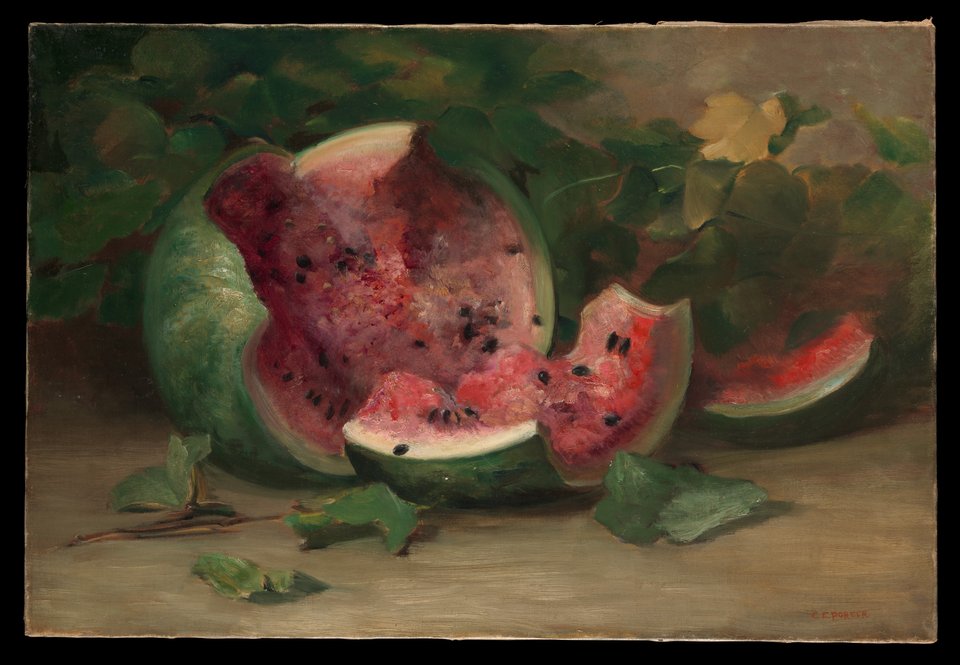
An oil painting of a watermelon split open on a table, its red flesh full of black seeds, with broken slices in front and green vine leaves behind
#AF685A#9A4740#703D37#4C5939
PaintingUntitled (Cracked Watermelon), Charles Ethan Porter (about 1890)

One of the most ambitious paintings by Porter, who was among the first Black American artists to exhibit nationally and the only one of them to specialize in still life. The Met notes he painted the fruit when it was “increasingly and virulently stereotyped”, and that by taking it seriously as art he challenged the trope. The lit flesh samples at about #AF685A and #9A4740, with #703D37 in shadow and #4C5939 leaves: a deep, brownish red, far from the bright web code.

#AF685A#9A4740#703D37#4C5939
Source: The Met
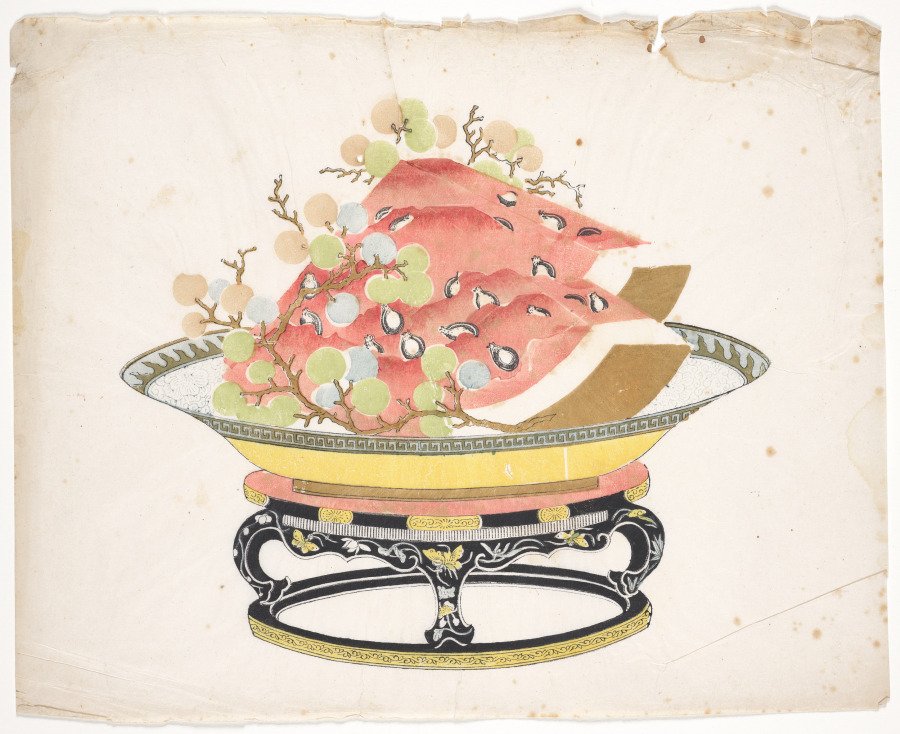
A Chinese woodblock print of coral-pink watermelon slices with dark seeds and pale rinds, piled in a yellow dish on a black stand with branches of green and blue grapes
#EEA692#C87567#B79361#F7DD84
PrintWatermelon and Grapes, Suzhou, China (1700–1750)

A single-sheet color woodblock print from Suzhou, one of the Jiangnan cities where commercial color printing flourished. Stacked slices of watermelon sit in a yellow dish with bunches of grapes. The slices sample at about #EEA692 and #C87567, a soft coral, with a gold rind at #B79361.

#EEA692#C87567#B79361#F7DD84
Source: Cleveland Museum of Art

Palettes are sampled in-house.

Questions

What color is watermelon?

A bright, warm pink with a little red in it. The code used here is #FC6C85 (RGB 252, 108, 133). No color standard defines it, but it is the code most color lists use.

Why is watermelon red inside?

Because of lycopene, the red pigment also found in tomatoes. Red watermelons have less of an enzyme that would turn lycopene into orange beta-carotene, so the red builds up in the flesh.

Were watermelons always red?

No. Wild watermelons from northeastern Africa have pale flesh, and the closest wild relative, Sudan’s Kordofan melon, is whitish inside. Red flesh became fixed as people grew and selected the fruit. Yellow, orange and white watermelons still exist.

Is watermelon pink or red?

The web code is a pink. The fruit is usually redder: in the xkcd color survey, people’s average watermelon was #FD4659, and the 1955 color dictionary files watermelon as deep pink or moderate red.

Why is the watermelon a Palestinian symbol?

Its red, white, black and green match the Palestinian flag. When showing the flag and its colors was restricted, artists and protesters used the watermelon instead.

What is the difference between watermelon and flamingo pink?

Flamingo pink (#FC8EAC) is lighter and softer and leans a little toward purple. Watermelon (#FC6C85) is deeper and stronger, a little closer to red.

What colors go with watermelon?

Dark rind green and black for the classic fruit look, mint for something fresh, navy for contrast, and paler pinks for a tonal palette. Use dark text on watermelon; white text is hard to read.