Tomato

A bright red with an orange edge, named after the fruit and lighter on screen than on the vine.

Overview

Tomato is a bright red with an orange edge. Its code is #FF6347, the CSS keyword tomato: red at full strength, green at about two fifths and blue at a little over a quarter. The green warms it toward orange and the blue lightens it, so it sits about 9 degrees from pure red on the screen color wheel, close to red but softer.

A ripe tomato is usually darker. Its red comes from lycopene, a pigment that absorbs blue and green light. In the xkcd color survey, people’s average tomato was #EF4026, deeper and redder than the code, and Maerz and Paul’s 1930 A Dictionary of Color printed a tomato sample that the 1955 ISCC-NBS dictionary files as a dark reddish orange, about #9E4732. The web code is the fruit as a bright, cheerful screen color, not as it looks on the vine.

The code is younger than many CSS names. Tomato is not in the first X Window System color list of 1987; Paul Raveling added it in his 1989 revision, as 255 99 71, between coral and orange red, together with four darker steps, tomato1 to tomato4. The web adopted that list in 2001.

On screen, tomato makes a warm, appetizing accent for food, cooking and calls to action. White text on it reaches only about 3:1, enough for large bold type but not for body text, while black text reaches about 7:1. It pairs naturally with basil green and cream, and with navy or deep teal for contrast.
HEX#FF6347
RGBrgb(255, 99, 71)
HSLhsl(9, 100%, 64%)
HSV9°, 72%, 100%
CMYK0, 61, 72, 0
OKLCHoklch(69.6% 0.196 32.3)
Every code converts from the HEX value #FF6347. #FF6347 is the CSS keyword tomato, defined in the CSS Color Module Level 4 as 255 99 71. It comes from Paul Raveling’s 1989 revision of the X11 color list and first became a web color keyword in SVG 1.0 (2001). Maerz and Paul’s 1930 tomato sample is much darker: the ISCC-NBS dictionary files it as dark reddish orange, centered near #9E4732. CMYK is a screen-based estimate; print results vary.
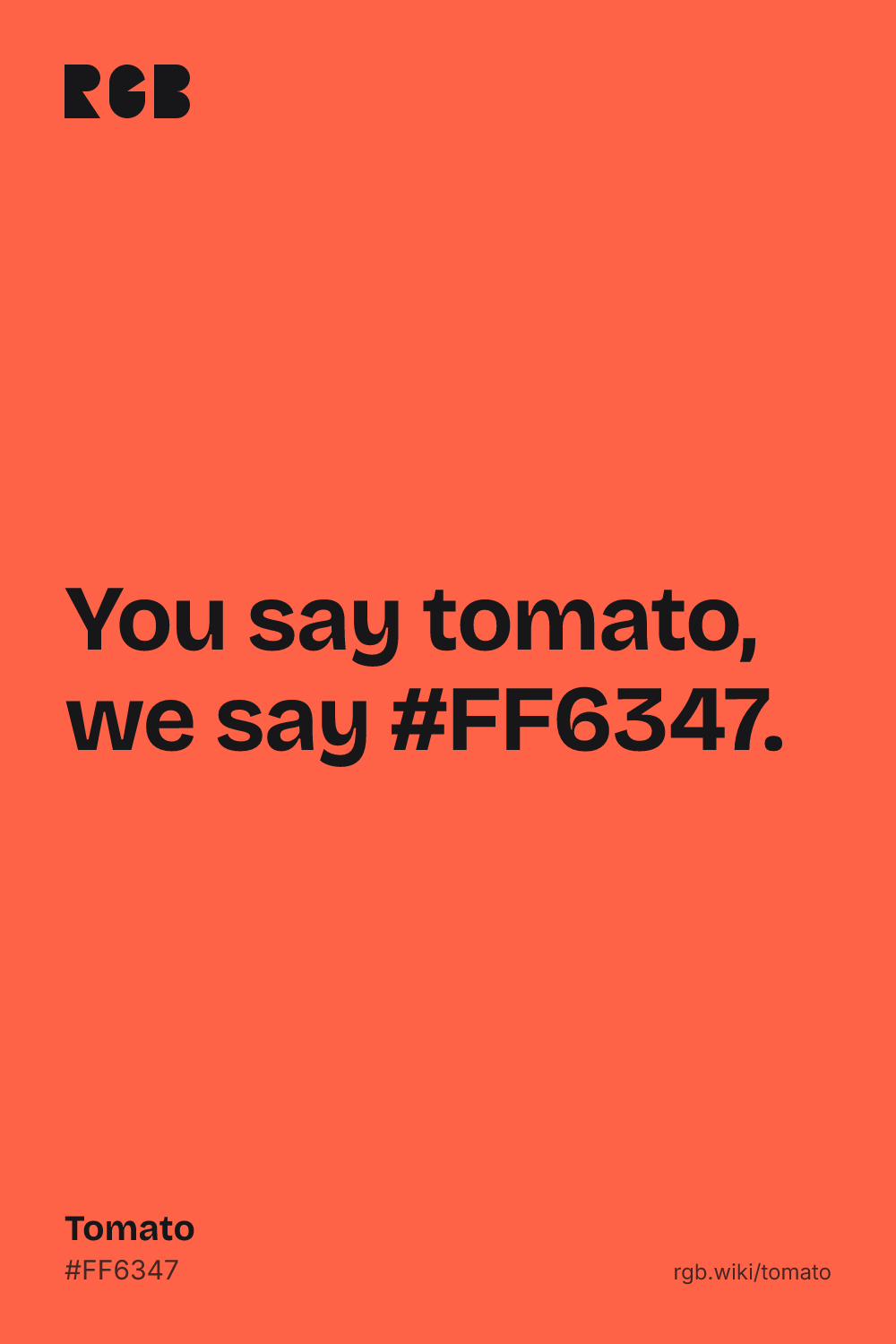
Tomato color card, hex #FF6347: “You say tomato, we say #FF6347”

Tomato on the color map

People’s average tomato and tomato red sit below the reference at almost the same hue: darker and more intense. The ISCC-NBS vivid reddish orange sits below and to the right, a little more orange. Maerz and Paul’s 1930 tomato sits far below, outside the outline: a much darker, duller reddish orange. The outline is an approximate range, not a measured one.

Shades and tints

Tints with white

Shades with black

Tones with gray

Tomato sits in the middle. Tints add white, shades add black and tones add gray, in 10% steps out from it. Tap any swatch to copy its code.

Light and dark tomato

#FFC1B5
Pale tomatoMixed 60% with white. A soft salmon pink.
#FFA191
Light tomatoMixed 40% with white. A light coral pink.
#FF6347
TomatoThe reference color. The X11 list also calls it tomato1.
#EE5C42
Tomato 2The X11 list’s first darker step, the reference at about 93% strength. Not a CSS keyword.
#CD4F39
Tomato 3X11’s step at about 80% strength: a brick red. Not a CSS keyword.
#8B3626
Tomato 4X11’s darkest step, at about 55% strength: a deep reddish brown, close to the painted tomatoes in the still life below. Not a CSS keyword.

Colors that go with tomato

Pairings that work in rooms, outfits and interfaces.

Tomato and basil

The colors of a caprese salad: tomato, basil green and mozzarella white. Fresh and appetizing.

Heirloom mix

Tomato with the gold, green and dusky purple of heirloom varieties. Lively for markets and menus.

Ripening

From green through tannish yellow to tomato and a deep ripe red, like the grading stages. Good for progress bars and seasonal designs.

Tomato and navy

Confident and sporty. Navy makes the warm red stand out.

Tomato and teal

Near opposites on the color wheel. Bold, good for dark themes and posters.

Trattoria

Tomato with olive, terracotta and cream. Warm and homey, for restaurants and recipes.

Color-wheel palettes

Pick a palette to see where its colors sit on the color wheel. The caret marks tomato. Tap a band to copy its code.

Similar colors

Grapefruit86%Red-orange86%TomatoOrange red75%International orange79%Neon orange86%Hunter orange80%

Lined up by hue around tomato. Hover a color to see how similar it is.The bar under each name shows how similar it is. Similarity comes from the distance between the two colors in OKLab, a model of how we see color.

Tomato vs coral

Tomato#FF6347 · hue 9°
  • Redder, closer to pure red
  • Added to the X11 list in 1989
  • Named after a fruit colored by lycopene
Coral#FF7F50 · hue 16°
  • More orange and a little lighter
  • Already in the first X11 list of 1987
  • Named after the red skeleton of a sea animal

Meaning

  • Lycopene red
  • Bred to ripen evenly
  • Six ripeness stages
  • Lighter on screen

Tomato is named after a fruit, and most of what it means is about that fruit: the pigment that makes it red, the colors it comes in, and how breeders and graders read its color. Studies of color and emotion test basic words like red, never tomato, so there is no measured mood for this color.

Lycopene makes tomatoes red

Chemistry

Lycopene is a long carbon chain with alternating single and double bonds. It absorbs blue and green light and reflects red, so the fruit looks red. It does not dissolve in water, which is why tomato stains are hard to wash out.1

Not every tomato is red

Plant science

Tomatoes also ripen yellow, orange and other colors. Yellow ones carry more delta-carotene and lutein than lycopene, and orange ones more beta-carotene and prolycopene. In the 1500s, the friar Bernardino de Sahagún saw tomatoes in the market of Tenochtitlan in every color “from the brightest red to the deepest yellow”.2

Bred to ripen evenly red

Study

Older tomatoes ripen with dark green shoulders near the stem. Breeders favored a mutation, called uniform ripening, that gives evenly red fruit. A 2012 study in Science found that the same gene lowers the chlorophyll in the young fruit, and that selecting for it gave up some sugar and carotenoids in the ripe fruit.3

Graded by color

Government standard

The US standards for fresh tomatoes name six color stages for red-fleshed varieties: green, breakers, turning, pink, light red and red. Each is set by how much of the surface has changed color, from a break on up to 10% to red on more than 90%.4

“Tomato red” covers many colors

Color dictionary

Color dictionaries do not agree on tomato. The 1955 ISCC-NBS dictionary files Maerz and Paul’s tomato as dark reddish orange and spreads Taylor, Knoche and Granville’s tomato red over eight groups, from vivid red to strong reddish brown. The European RAL standard’s Tomato red (RAL 3013) is a deep red too. The bright web code is the light end of the range.5

Sources (5)
  1. May, P. (January 2020). “Lycopene: the red colour of tomatoes”, Molecule of the Month, University of Bristol School of Chemistry.
  2. Wikipedia, “Tomato”, sections on the fruit and its history, citing Woodward, P. (2021), “Why is a red tomato red?”, Organic Gardener, and Silvertown, J. (2017), Dinner with Darwin (University of Chicago Press), p. 102.
  3. Powell, A. L. T. et al. (2012). “Uniform ripening encodes a Golden 2-like transcription factor regulating tomato fruit chloroplast development.” Science 336(6089), 1711–1715. PubMed 22745430.
  4. US Department of Agriculture, Agricultural Marketing Service (1991). United States Standards for Grades of Fresh Tomatoes, effective October 1, 1991, §51.1860 Color classification.
  5. Jaffer, A., “Maerz and Paul color names” (tomato: group 38) and “Descriptive Color Names Dictionary” (tomato red: groups 11, 13, 15, 34, 35, 36, 38 and 40), MIT CSAIL, from Kelly, K. L. & Judd, D. B. (1955), NBS Circular 553; Wikipedia, “List of RAL colours”, RAL 3013 Tomato red.

History

The tomato was a color long before it was a code. Its story runs from Aztec markets to a color dictionary of 1930, a programmer’s color list in 1989 and a grading chart for growers.

  1. 1500s

    The Aztecs call red tomatoes xitomatl. In 1544 the Italian herbalist Pietro Andrea Mattioli describes the new fruit as blood red or golden when ripe, and later calls it pomi d’oro, golden apples.1

  2. 1604

    First known use of the word tomato in English, an alteration of earlier tomate, from Spanish, from Nahuatl tomatl.2

  3. 1891

    First recorded use of tomato as a color name in English, according to Maerz and Paul’s A Dictionary of Color.3

  4. 1930

    Maerz and Paul print tomato on plate 3 (sample I12). The 1955 ISCC-NBS dictionary files it as dark reddish orange, centered near #9E4732.3, 4

  5. 1950

    Taylor, Knoche and Granville’s Descriptive Color Names Dictionary lists tomato red and light tomato red. ISCC-NBS spreads their tomato red over eight groups, from vivid red to strong reddish brown.5

  6. 1989

    Paul Raveling’s revised X11 color list adds tomato, 255 99 71, between coral and orange red, with four darker steps, tomato1 to tomato4. The first X11 list of 1987 had no tomato.6

  7. 1991

    The US standards for grades of fresh tomatoes take effect on October 1, with six color stages from green to red and a visual aid of twelve color photographs to match them.7

  8. 2001

    SVG 1.0 lists “tomato”, rgb(255, 99, 71), among the web’s color keywords. CSS later adopts the same list.8

  9. 2010

    In the xkcd color survey, the average color people call tomato is #EF4026, and tomato red #EC2D01: both darker and redder than the code.9

  10. 2012

    Plant scientists find the gene behind uniform ripening, the trait bred into most modern tomatoes to make them evenly red, and show that it costs the fruit some sugar.10

Sources (10)
  1. Wikipedia, “Tomato”, History, citing Townsend, R. F. (2000), The Aztecs, pp. 180–181, and Smith, A. F. (1994), The Tomato in America, p. 13.
  2. Merriam-Webster, “tomato”, etymology and first known use.
  3. Wikipedia, “Shades of red”, Tomato, citing Maerz, A. & Paul, M. R. (1930), A Dictionary of Color, McGraw-Hill, p. 205, and plate 3, sample I12.
  4. Kelly, K. L. & Judd, D. B. (1955). The ISCC-NBS Method of Designating Colors and a Dictionary of Color Names, NBS Circular 553, tabulated in Jaffer’s “Maerz and Paul color names” (tomato: group 38, dark reddish orange).
  5. Jaffer, A. “Descriptive Color Names Dictionary” (Taylor, Knoche & Granville, 1950), with ISCC-NBS groups and centroids from “Color-Name Dictionaries”, MIT CSAIL.
  6. The original X list, old-rgb.txt (no tomato), and Paul Raveling’s list, raveling.txt (tomato 255 99 71, tomato1 to tomato4), with his notes quoted in Aubrey Jaffer, “Color-Name Dictionaries”, MIT CSAIL.
  7. US Department of Agriculture, Agricultural Marketing Service (1991). United States Standards for Grades of Fresh Tomatoes, §51.1860 Color classification, including Visual Aid TM-L-1.
  8. W3C (2001). Scalable Vector Graphics (SVG) 1.0, recognized color keyword names.
  9. “The 954 most common RGB monitor colors”, xkcd color survey (CC0), tomato #ef4026 and tomato red #ec2d01; results published May 3, 2010.
  10. Powell, A. L. T. et al. (2012). “Uniform ripening encodes a Golden 2-like transcription factor regulating tomato fruit chloroplast development.” Science 336(6089), 1711–1715. PubMed 22745430.

Tomato in use

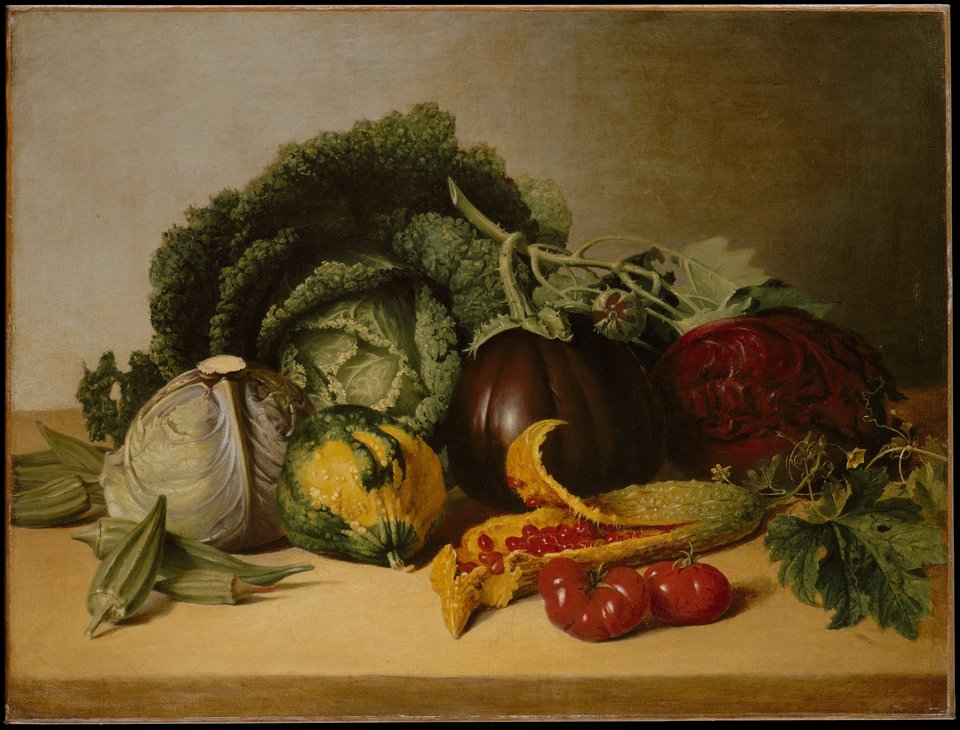
A still life of vegetables on a tan tabletop: a curly green cabbage, a pale cabbage, okra, a green and yellow gourd, a dark purple eggplant, a red cabbage, a split orange balsam apple with red seeds, and two ripe red tomatoes in front
#852C11#661A0B#9C5E3F#B3884E
PaintingStill Life: Balsam Apple and Vegetables, James Peale (1820s)

Two ripe tomatoes sit at the front of Peale’s table, beside a split balsam apple full of red seeds. In the museum’s photograph their red is deep and brownish, about #852C11, with shadows near #661A0B and soft highlights near #9C5E3F: much darker than the web code, and close to the dictionaries’ tomato.

#852C11#661A0B#9C5E3F#B3884E
Source: The Met

Palettes are sampled in-house.

Questions

What color is tomato?

A bright red with an orange edge. Its code is #FF6347 (RGB 255, 99, 71), the CSS keyword tomato. It is lighter and softer than most ripe tomatoes.

Is tomato red the same as tomato?

Usually. Maerz and Paul’s 1930 color dictionary gives one sample the name tomato or tomato red, and most people use the two names for the same color. Some standards use tomato red for darker colors, though: the European RAL 3013 Tomato red is a deep red, and the xkcd survey’s tomato red (#EC2D01) is redder and darker than the web code.

Is tomato red or orange?

Mostly red. Its hue is about 9 degrees on the screen color wheel, where pure red is 0 and orange is about 39. Color dictionaries place colors like it among the reddish oranges.

What is the difference between tomato and coral?

Tomato (#FF6347) is redder. Coral (#FF7F50) is more orange and a little lighter. Both are CSS color keywords, and both sit next to each other in the X11 color list they come from.

Why are tomatoes red?

Ripe red tomatoes are full of lycopene, a pigment that absorbs blue and green light and reflects red. Yellow and orange tomatoes have less lycopene and more of other carotenoids, such as lutein and beta-carotene.

Can you put white text on tomato?

Only for large, bold type. White on #FF6347 has a contrast ratio of about 3 to 1 (2.95), below the 4.5 to 1 that normal text needs. Black text reaches about 7.1 to 1.

What colors go with tomato?

Basil green and cream for a fresh, food-friendly look, navy or deep teal for strong contrast, and olive with terracotta for something warm and rustic.

Where does the CSS color tomato come from?

From the X Window System’s color list. Paul Raveling added tomato, 255 99 71, in his 1989 revision, and the web adopted the list as color keywords in SVG 1.0 in 2001. CSS keeps it today.