Light coral

A soft pink red that sounds like a paler coral, but leans the other way.

Overview

Light coral is a soft, warm pink red, like a watermelon’s flesh in shade or a faded rose petal. Its code is #F08080: red nearly full, green and blue equal at half strength. Because green and blue are equal, the hue sits exactly on red, at 0°, and the white mixed in makes it pink.

The name promises a paler coral, but the color doesn’t keep that promise. The web’s coral, #FF7F50, leans toward orange, at a hue of 16°. Mix coral with white and you get a peach, about #FFB296, not light coral. Its nearest neighbor is salmon, #FA8072, which looks almost the same and is only a touch more orange.

Light coral is a CSS keyword, lightcoral. It isn’t in the X Window System’s first color list, from 1986, in Paul Raveling’s 1989 revision or in John Thomas’s list matched to crayons. It first appears in the merged list that shipped with X11 Release 4 in December 1989, right after coral, and the web adopted that list in 2001. Nobody recorded who added it or why.

On screens, light coral needs dark text: black on it has a contrast of about 8:1, white only about 2.6:1, too low even for large headings. It pairs well with deep teal, navy, warm cream and charcoal.
HEX#F08080
RGBrgb(240, 128, 128)
HSLhsl(0, 79%, 72%)
HSV0°, 47%, 94%
CMYK0, 47, 47, 6
OKLCHoklch(72.5% 0.138 21.0)
Every code converts from the HEX value #F08080. #F08080 is the CSS keyword lightcoral, rgb(240, 128, 128), defined in the CSS Color Module Level 4 and first listed among the web’s color names in SVG 1.0 (2001). It comes from the X Window System’s color list as shipped in X11 Release 4, December 1989 (mit/rgb/rgb.txt in the X11 Release 4 archive, 240 128 128). No color dictionary defines this exact value. CMYK is a screen-based estimate; print results vary.
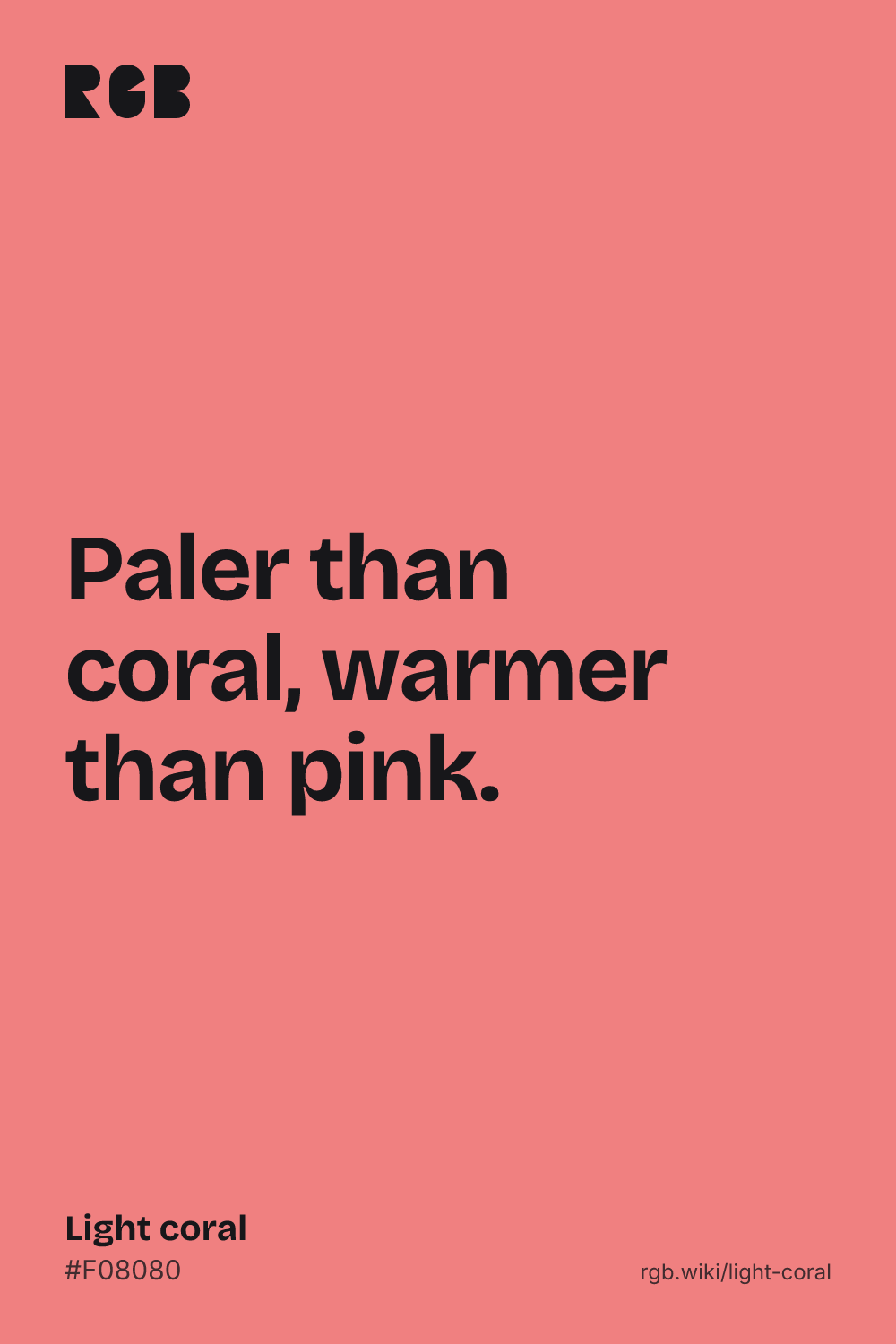
Light coral color card, hex #F08080: “Paler than coral, warmer than pink”

Light coral on the color map

No survey measures light coral itself, and the xkcd color survey has no entry for it. The older corals sit around it: the 1930 dictionary coral a little darker and pinker, the 1989 crayon coral slightly more orange. The outline is an approximate range, not a measured one.

Shades and tints

Tints with white

Shades with black

Tones with gray

Light coral sits in the middle. Tints add white, shades add black and tones add gray, in 10% steps out from it. Tap any swatch to copy its code.

Light and dark light coral

#F6B3B3
Pale light coralMixed 40% with white: a soft blush pink.
#F39999
Soft light coralMixed 20% with white.
#F08080
Light coralThe reference color. Unlike coral, it has no numbered steps in the X11 list.
#C06666
Deep light coralMixed 20% with black. Close to the CSS keyword indian red, #CD5C5C, which lies on the same hue. See indian red
#E4717A
Dictionary coralThe deep pink center the 1955 ISCC-NBS dictionary gives for Maerz and Paul’s 1930 coral.
#904D4D
Dark light coralMixed 40% with black: a dusty brick brown.

Colors that go with light coral

Pairings that work in rooms, outfits and interfaces.

Light coral and teal

The complementary pair. Deep teal text and buttons stay crisp next to the pink red.

Light coral and navy

Crisp and classic, like a summer dress. Navy carries the text; light coral is the accent.

The X11 pinks and reds

Light coral with three neighbors from the same list: salmon, indian red and rosy brown. Warm and tonal.

Light coral and cream

Soft and friendly, for a bakery or a stationery shop. Light coral as the background with deep brown text.

Light coral and sage

Garden colors. Muted green calms the pink, with dark slate gray for text.

Light coral on charcoal

A dark theme where light coral glows. Good for headings, links and buttons.

Color-wheel palettes

Pick a palette to see where its colors sit on the color wheel. The caret marks light coral. Tap a band to copy its code.

Similar colors

Watermelon77%Light coralSalmon88%Terracotta72%Dark salmon72%Coral70%Papaya69%

Lined up by hue around light coral. Hover a color to see how similar it is.The bar under each name shows how similar it is. Similarity comes from the distance between the two colors in OKLab, a model of how we see color.

Light coral vs salmon

Light coral#F08080 · hue 0°
  • Exactly on red, slightly pinker
  • Green and blue equal
  • Added to the X11 list in late 1989
Salmon#FA8072 · hue 6°
  • A touch more orange
  • A little less blue than green
  • In the X11 list since 1986, then much darker

Meaning

  • CSS keyword
  • Not a paler coral
  • Near the 1930 coral
  • Origin unrecorded

No study has looked at what light coral means to people. Color research tests broad words such as pink or red, never light coral, so the claims below are about the name and where the color came from.

Added in 1989, by an unknown hand

Historical record

Light coral isn’t in the X Window System’s first color list of 1986, in Paul Raveling’s 1989 revision, or in John Thomas’s 1989 list tuned to a box of crayons. It first appears in the merged list that shipped with X11 Release 4 in December 1989, as 240 128 128, right after coral. The release notes say only that old values were tuned to common monitors and that new colors came from Raveling; none of the surviving notes say who added light coral.1, 2

Not a lighter version of coral

Color math

Light coral’s hue is 0°, pure red, because its green and blue are equal. The web’s coral, #FF7F50, sits at 16°, toward orange. Mixing coral with white keeps that orange lean and gives a peach, about #FFB296. Light coral is a tint of red, closer to salmon than to coral.3

Closer to the older corals

Color dictionary

Maerz and Paul’s 1930 A Dictionary of Color prints a coral that the 1955 ISCC-NBS dictionary files as a deep pink, centered around #E4717A. John Thomas’s 1989 X11 list, matched to a crayon, set coral at 248 137 117. Both are much nearer light coral than the orange-leaning #FF7F50 that coral became. The first X list of 1986 had coral as pure orange, 255 127 0.1, 4

People’s coral is redder too

Online survey

In Randall Munroe’s 2010 color survey, where people named colors shown on their own screens, the average coral was #FC5A50, a red with only a little orange in it. The survey has no light coral, but its coral sits between the web’s coral and light coral.5

Sources (5)
  1. The X Window System’s color lists: the first list (1986–88), old-rgb.txt (coral 255 127 0); Paul Raveling’s revision, raveling.txt; and John Thomas’s thomas.txt (coral 248 137 117), hosted by Aubrey Jaffer, MIT CSAIL. The merged list that shipped with X11 Release 4, mit/rgb/rgb.txt dated 7 December 1989 (light coral 240 128 128), and its CHANGES notes are in the X11 Release 4 archive.
  2. Aubrey Jaffer, “Color-Name Dictionaries”, MIT CSAIL, quoting the X11 README and the notes of Paul Raveling and John Thomas.
  3. W3C, CSS Color Module Level 4, named colors: lightcoral #f08080, coral #ff7f50, salmon #fa8072.
  4. Kelly, K. L. & Judd, D. B. (1955). The ISCC-NBS Method of Designating Colors and a Dictionary of Color Names, NBS Circular 553, tabulated in Jaffer’s “Maerz and Paul color names” (coral: group 3, deep pink).
  5. Randall Munroe (2010), “Color Survey Results”, and the survey’s 954 most common color names (coral #fc5a50), CC0.

History

Coral has been a color name for five centuries, but the color it names keeps moving. Light coral’s story is how the computer lists started coral as a pure orange, softened it in 1989, and added a second, pinker coral beside it.

  1. 1513

    First recorded use of “coral” as a color name in English, after the red precious coral of the Mediterranean.1

  2. 1930

    Maerz and Paul’s A Dictionary of Color prints coral. The 1955 ISCC-NBS dictionary files the sample as a deep pink, around #E4717A.2

  3. 1986

    The X Window System’s first color list, shipped with X10 Release 3 in 1986 and kept through 1988, has coral as pure orange, 255 127 0, and salmon as a dark brown, 111 66 66. There is no light coral.3

  4. 1989

    Two programmers retune the list. John Thomas at Tektronix matches it to a box of crayons and makes coral a pinkish 248 137 117. Paul Raveling at USC’s Information Sciences Institute sets coral to 255 114 86 on his HP monitor and notes that reddish colors were “VERY hard to reproduce”. Neither adds a light coral.3, 4

  5. Dec 1989

    X11 Release 4 ships a merged list, dated 7 December, with coral moved to 255 127 80 and, directly after it, a new light coral, 240 128 128.3

  6. 2001

    SVG 1.0 lists “lightcoral”, rgb(240, 128, 128), among the web’s color keywords.5

  7. 2011

    CSS Color Module Level 3 becomes a W3C Recommendation on June 7 and makes lightcoral, #f08080, an official CSS keyword. Level 4 keeps it.6, 7

Sources (7)
  1. Wikipedia, “Coral (color)”, citing Maerz and Paul’s A Dictionary of Color (1930).
  2. Kelly, K. L. & Judd, D. B. (1955). The ISCC-NBS Method of Designating Colors and a Dictionary of Color Names, NBS Circular 553, tabulated in Jaffer’s “Maerz and Paul color names” (coral: group 3).
  3. The X Window System’s color lists, hosted by Aubrey Jaffer, MIT CSAIL: old-rgb.txt, thomas.txt and raveling.txt; the 1986 list in the X10 Release 3 archive; and the merged mit/rgb/rgb.txt (7 December 1989) in the X11 Release 4 archive.
  4. Aubrey Jaffer, “Color-Name Dictionaries”, MIT CSAIL, quoting the notes of John Thomas (Tektronix) and Paul Raveling (ISI).
  5. W3C (2001). Scalable Vector Graphics (SVG) 1.0, recognized color keyword names.
  6. W3C (2011). CSS Color Module Level 3, extended color keywords, W3C Recommendation, June 7, 2011.
  7. W3C, CSS Color Module Level 4, named colors: lightcoral, #f08080, 240 128 128.

Questions

What color is light coral?

A soft, warm pink red. Its code is #F08080 (RGB 240, 128, 128), the CSS keyword lightcoral. It sits exactly on the red hue, lightened toward pink.

Is light coral a lighter version of coral?

No, despite the name. The web’s coral, #FF7F50, leans toward orange; mixing it with white gives a peach. Light coral has no orange in it at all: its green and blue are equal, which makes it a pure tint of red.

What is the difference between light coral and salmon?

Very little. Salmon (#FA8072) is a touch more orange than light coral (#F08080), at a hue of 6° instead of 0°. Side by side, light coral looks slightly pinker.

Is light coral pink or red?

Both. Its hue is red, but it is light and softened with white, so most people see a pink red or a coral pink. On this site it belongs to the reds.

Is light coral a CSS color?

Yes. lightcoral is one of the CSS named colors. lightcoral, #F08080 and rgb(240, 128, 128) all give exactly the same color.

Where does the name light coral come from?

From the X Window System’s color list, which the web adopted in 2001. Light coral first appears in the list that shipped with X11 Release 4 in December 1989, right after coral. No record says who named it.

What text color works on light coral?

Dark text. Black on light coral has a contrast of about 8:1. White reaches only about 2.6:1, too low for reading, even in large headings.

What colors go with light coral?

Deep teal and navy for contrast, cream for a soft look, sage green for a garden palette, and charcoal for a dark theme where light coral is the accent.