A bright pinkish red, much pinker than the fruit it is named after.
Overview
Strawberry is a bright red with a strong pink lean. The code used here, #FC5A8D, has red at full strength, green at about 35% and blue at about 55%. Next to watermelon it looks a little cooler and stronger; next to hot pink, redder.
The code is much pinker than the fruit. No color standard defines it: color websites tie it to a scented crayon shade. When the xkcd color survey asked people to name colors, their average strawberry was #FB2943, a strong red. Older color dictionaries go darker still: the 1955 ISCC-NBS dictionary files the strawberry of Maerz and Paul’s 1930 A Dictionary of Color as a grayish red, about #905D5D, and a 1950 dictionary’s strawberry as deep or moderate red.
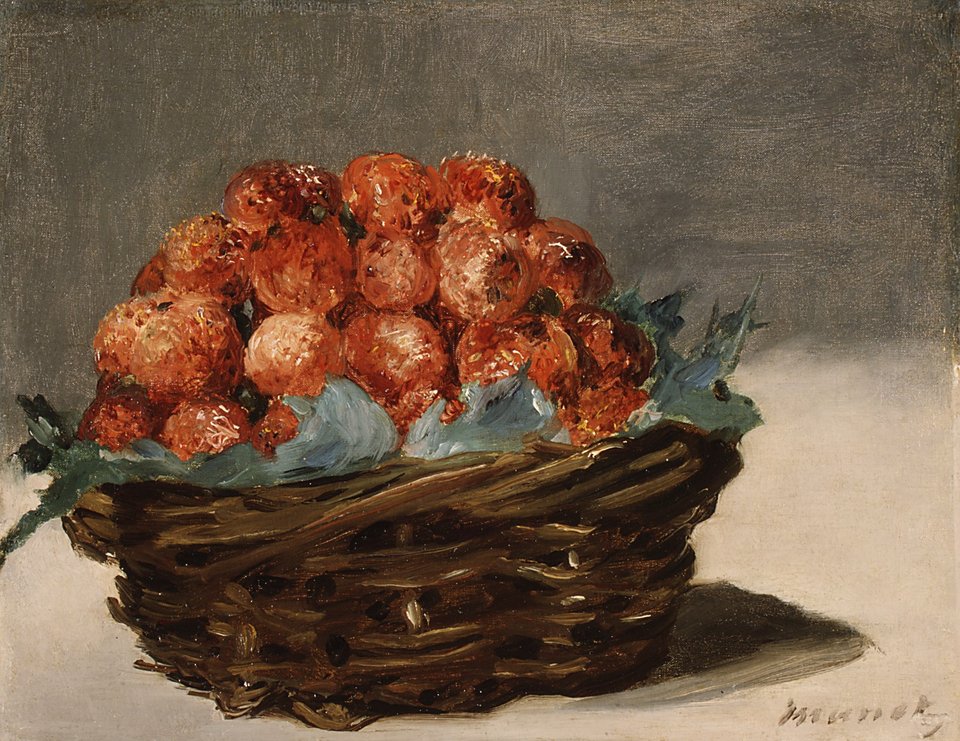
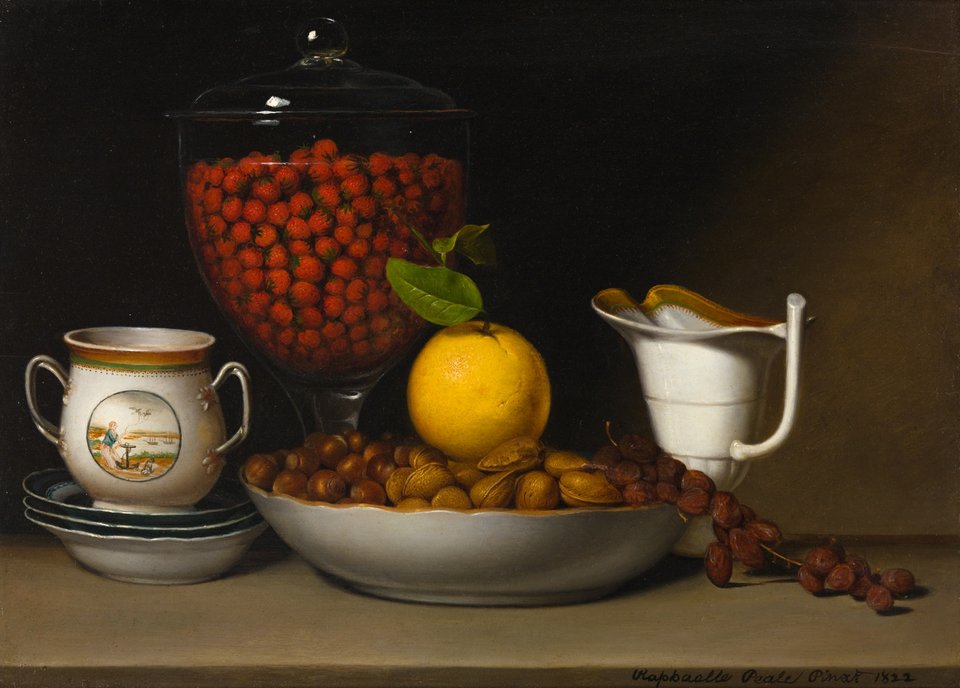
A ripe strawberry gets its red from anthocyanins, water-soluble plant pigments, and mostly from one of them, pelargonidin 3-glucoside. A single gene, MYB10, switches them on in the fruit, and strawberries with a broken copy stay white. Painters saw a warmer red than the web code: Manet’s and Raphaelle Peale’s strawberries sample as orange-reds and deep brick reds.
Strawberry is light enough for black text (about 7:1) but holds white text only at large sizes (about 3:1). It pairs naturally with leaf green and cream, and looks bold against navy.
HEX
#FC5A8D
RGB
rgb(252, 90, 141)
HSL
hsl(341, 96%, 67%)
HSV
341°, 64%, 99%
CMYK
0, 64, 44, 1
OKLCH
oklch(69.5% 0.200 4.6)
Every code converts from the HEX value #FC5A8D. No color standard defines strawberry. #FC5A8D is the code most color lists use, and color websites tie it to a scented crayon shade, not to a dictionary. The 1955 ISCC-NBS dictionary files the strawberry of Maerz and Paul’s A Dictionary of Color (1930) as grayish red, about #905D5D, and the strawberry of the 1950 Descriptive Color Names Dictionary as deep red, about #841B2D, or moderate red. In the xkcd color survey, people’s strawberry averaged #FB2943. CMYK is a screen-based estimate; print results vary.
Strawberry on the color map
LighterDarker
The survey strawberry sits inside the outline, to the right and a little lower: redder, slightly darker and far more vivid. Maerz and Paul’s crushed strawberry sits to the right at the same lightness, redder and much softer. Their strawberry sits below the outline and to the right, a dark, grayish red, and the 1950 strawberry is darker still, off the bottom of this view, so it is pinned to the edge. Manet’s painted fruit sits far to the right and below: a darker orange-red. The outline is an approximate range, not a measured one.
Shades and tints
Tintswith white
Shadeswith black
Toneswith gray
Strawberry sits in the middle. Tints add white, shades add black and tones add gray, in 10% steps out from it. Tap any swatch to copy its code.
Light and dark strawberry
#FEBDD1
Pale strawberryMixed 60% with white. A strawberry-milk pink for backgrounds.
#FC5A8D
StrawberryThe reference color.
#FB2943
Survey strawberryThe average strawberry in the xkcd color survey. Redder and stronger, closer to the fruit.
#E4717A
Crushed strawberryThe ISCC-NBS deep pink, where the 1955 dictionary files Maerz and Paul’s crushed strawberry (1930).
#905D5D
Dictionary strawberryThe ISCC-NBS grayish red, where the 1955 dictionary files Maerz and Paul’s strawberry (1930).
#973655
Dark strawberryMixed 40% with black. A deep berry rose that holds white text.
Colors that go with strawberry
Pairings that work in rooms, outfits and interfaces.
Strawberries and cream
The summer dessert in four colors: berry, cream, a pale pink and a dark jam red for text.
Strawberry and leaf
Fruit and foliage, as on the plant. Fresh and cheerful.
Peale’s strawberries, 1822
Sampled from the painting: brick-red berries, a gold-rimmed cup and a near-black background.
Manet’s basket, about 1882
Sampled from the painting: orange-red fruit, a brown basket and a warm gray wall.
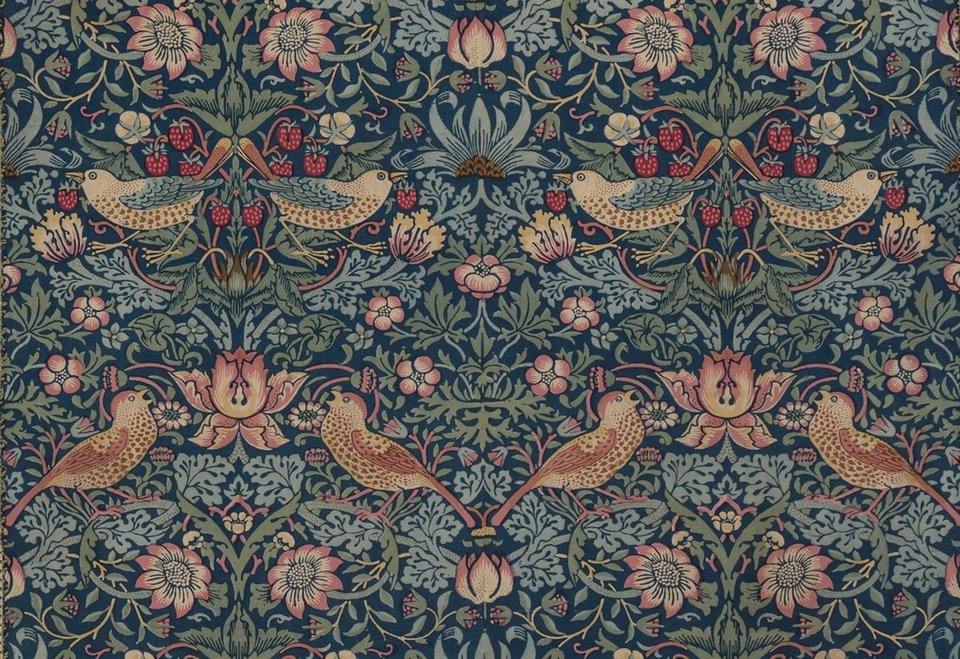
Strawberry Thief, 1883
Sampled from Morris’s printed cotton: dusky red berries and buff birds on indigo.
Strawberry milkshake
A tonal set from pale pink to deep berry, sweet and easy to read.
Color-wheel palettes
Pick a palette to see where its colors sit on the color wheel. The caret marks strawberry. Tap a band to copy its code.
Hot pink72%Pale violet red67%Rose61%Blush72%StrawberryWatermelon80%Grapefruit64%
Lined up by hue around strawberry. Hover a color to see how similar it is.The bar under each name shows how similar it is. Similarity comes from the distance between the two colors in OKLab, a model of how we see color.
Strawberry vs watermelon
Strawberry#FC5A8D · hue 341°
Cooler, leaning toward hot pink
A little stronger and darker
Pinker than the fruit
Watermelon#FC6C85 · hue 350°
Warmer, a little closer to red
Lighter and softer
Also pinker than the fruit
Meaning
Anthocyanin red
Some are white
Fades in jam
Virtue, then temptation
Strawberry brings to mind summer, desserts and sweetness. The fruit’s red is a pigment that one gene switches on, that cooking breaks down, and that painters for centuries read as a sign of virtue or of passing pleasure. Research on color and emotion tests basic words like red or pink, not strawberry, so the claims below are about the fruit and how people have used it.
Red from one main pigment
Lab studies
A strawberry’s red comes from anthocyanins, and the main one is pelargonidin 3-glucoside. In a lab study, giving ripening strawberries extra red or blue LED light raised the amount of this pigment, and of anthocyanins overall.1
One gene decides red or white
Genetic study
A gene called MYB10 switches on anthocyanin making in the fruit. A 2020 study found that changes in this one gene explain most of the natural variation in fruit color, in wild woodland strawberries and in the garden strawberry, and that broken copies give white-fruited strawberries.2
Jam loses much of the red
Food study
In a Croatian study of four varieties, cooking purée into low-sugar jam cut total anthocyanins by about 28% on average, and pelargonidin 3-glucoside by about 53%. The jams lost lightness and redness with it. It is one study, but it matches why jam looks darker and duller than fresh fruit.3
Virtue, then fleeting pleasure
Art history
In religious art from the late 1300s, the strawberry appears near the blessed and in the Virgin’s garden, read as a symbol of perfect righteousness. In 1605 a Spanish friar read the giant strawberries in Bosch’s Garden of Earthly Delights the other way, as the vanity of pleasures whose taste is soon forgotten. Scholars still disagree about Bosch.4, 5
Not really a berry
Word history
Botanically, a strawberry is an enlarged, fleshy receptacle with the true fruits, the tiny achenes, on its surface. Merriam-Webster suggests the Old English name strēawberige, straw plus berry, may come from how those achenes look, but the origin is uncertain.6
Sources (6)
Zhang, Y. et al. (2018). Effect of red and blue light on anthocyanin accumulation and differential gene expression in strawberry (Fragaria × ananassa). Molecules, 23(4), 820. doi:10.3390/molecules23040820
Castillejo, C. et al. (2020). Allelic variation of MYB10 is the major force controlling natural variation in skin and flesh color in strawberry (Fragaria spp.) fruit. The Plant Cell, 32(12), 3723–3749. doi:10.1105/tpc.20.00474
Bursać Kovačević, D., Putnik, P., Dragović-Uzelac, V., Vahčić, N., Babojelić, M. S. & Levaj, B. (2015). Influences of organically and conventionally grown strawberry cultivars on anthocyanins content and color in purees and low-sugar jams. Food Chemistry, 181, 94–100. doi:10.1016/j.foodchem.2015.02.063
Ross, L. J. (1960). The meaning of strawberries in Shakespeare. Studies in the Renaissance, 7, 225–240. doi:10.2307/2857136
Gibson, W. S. (2003). The strawberries of Hieronymus Bosch. Cleveland Studies in the History of Art, 8, 24–33. JSTOR 20079728
Merriam-Webster, “strawberry”, definition and etymology.
History
The fruit has a thousand-year-old English name and a long life in art, while the garden strawberry we eat is less than 300 years old. As a color, strawberry has been printed in shades from deep red to grayish red, all darker than the web code.
Before 1100s
First known use of “strawberry” in English, from Old English strēawberige, straw plus berry.1
About 1410
A Master of the Upper Rhine paints strawberries in the Garden of Paradise. In religious art of this era the fruit stands for perfect righteousness and is often linked to the Virgin Mary.2
1605
Fray José de Sigüenza, librarian of El Escorial, writes that Bosch’s Garden of Earthly Delights shows the vanity of pleasures like the passing taste of strawberries.3
1714–1766
Amédée-François Frézier brings the Chilean strawberry to France in 1714. In 1766 Antoine Nicolas Duchesne shows that the large garden strawberry is a hybrid of the Chilean and the Virginia strawberry.4, 5
1822
Raphaelle Peale, one of the first American painters to specialize in still life, paints a glass urn of strawberries, perhaps grown in a hothouse on his family’s farm.6
1880
First known use of “strawberry blonde” for reddish-blond hair, according to Merriam-Webster.7
About 1882
Édouard Manet, kept by illness to small canvases at the end of his life, paints a basket of strawberries.8
1883
William Morris supervises the first printing of Strawberry Thief, his pattern of thrushes raiding the fruit, with red from alizarin dye added to indigo.9
1930–1955
Maerz and Paul’s A Dictionary of Color (1930) lists strawberry, crushed strawberry and wild strawberry. The 1955 ISCC-NBS dictionary files their strawberry as grayish red and the 1950 Descriptive Color Names Dictionary’s as deep or moderate red.10
2010
In the xkcd color survey, the average color people call strawberry is #FB2943, a strong red far from the pinkish web code.11
Sources (11)
Merriam-Webster, “strawberry”, etymology and first known use.
Ross, L. J. (1960). The meaning of strawberries in Shakespeare. Studies in the Renaissance, 7, 225–240. doi:10.2307/2857136
Gibson, W. S. (2003). The strawberries of Hieronymus Bosch. Cleveland Studies in the History of Art, 8, 24–33. JSTOR 20079728
Hardigan, M. A. et al. (2021). Unraveling the complex hybrid ancestry and domestication history of cultivated strawberry. Molecular Biology and Evolution, 38(6), 2285–2305. doi:10.1093/molbev/msab024
A small canvas from near the end of Manet’s life, when, the Met notes, illness kept him to small still lifes and views of his garden. The strawberries are dabs of orange-red, about #B46037 where lit and #8C351B in shadow, heaped on blue-green leaves in a brown basket (#5A331F) on a pale table (#C8B197). Much warmer than the web code.
#B46037#8C351B#5A331F#C8B197
Source: The Met
Source
Sampled from the fruit, basket and table in The Metropolitan Museum of Art’s photograph (56.230.1), released as CC0 (public domain) through the Met’s Open Access program. Colors in a photo shift with lighting and old varnish, so read the codes as close, not exact.
#91300C#6C230E#B6882A#291811
PaintingStill Life—Strawberries, Nuts, &c., Raphaelle Peale (1822)
Peale was one of the first painters in the United States to specialize in still life. Here a lidded glass urn of strawberries, perhaps grown out of season in a hothouse, stands beside nuts, a citrus fruit and Chinese porcelain made for the American market. The berries sample at about #91300C and #6C230E, a deep brick red, with gold rims at #B6882A on a near-black ground (#291811).
#91300C#6C230E#B6882A#291811
Source: Art Institute of Chicago
Source
Sampled from the strawberries and the background in the Art Institute of Chicago’s photograph (1991.100), released as CC0 (public domain). Colors in a photo shift with lighting and old varnish, so read the codes as close, not exact.
#8A4147#233340#7C776B#A68C77
TextileStrawberry Thief, William Morris (designed 1883)
Morris’s pattern of thrushes stealing strawberries from his garden at Kelmscott Manor, printed on cotton by the slow indigo discharge method, with red from alizarin and yellow from weld. It became one of his best-selling designs. On this curtain the berries sample at about #8A4147, a dusky red, on an indigo ground (#233340) with sage leaves (#7C776B) and buff birds (#A68C77).
#8A4147#233340#7C776B#A68C77
Source: Art Institute of Chicago
Source
Sampled from a detail of the Art Institute of Chicago’s photograph of a curtain in the pattern (1992.396, made 1883–1917), released as CC0 (public domain). The berry color is the mean of the red pixels in two repeats. Printed dyes fade with light and washing, so read the codes as close, not exact. The pattern’s history is from the Victoria and Albert Museum’s “William Morris textiles”.
Palettes are sampled in-house.
Questions
What color is strawberry?
A bright pinkish red. Its usual code is #FC5A8D (RGB 252, 90, 141).
Why is the strawberry color code pinker than real strawberries?
No standard defines the code; color websites tie it to a scented crayon shade. Ripe strawberries are a deeper red, and when people named colors online, their average strawberry was #FB2943, a strong red. Older color dictionaries put strawberry darker still, at grayish, deep or moderate reds.
What makes strawberries red?
Anthocyanins, water-soluble plant pigments. The main one in strawberries is pelargonidin 3-glucoside. A gene called MYB10 switches pigment making on in the fruit, and strawberries with broken copies of it stay white.
What is the difference between strawberry and watermelon?
They are close. Strawberry (#FC5A8D) is a little cooler and stronger, leaning toward hot pink. Watermelon (#FC6C85) is a little warmer, lighter and softer.
What color is strawberry blonde?
A reddish blond, a hair color rather than a fruit color. Merriam-Webster dates the phrase to 1880. It is much lighter and more golden than the strawberry color code.
Can you use white text on strawberry?
Only for large text. White on #FC5A8D has a contrast of about 3:1, while black reaches about 7:1. For buttons with white text, use a darker strawberry such as #973655.
What colors go with strawberry?
Leaf green and cream for a fresh, natural look, navy or charcoal for contrast, and pale pinks for a soft, tonal set.