Prussian blue

A deep, inky blue named after the first modern synthetic pigment.

Overview

Prussian blue is a deep, dark blue with a slight green lean, usually shown on screen as #003153. It is named after a pigment, an iron and cyanide compound made by accident in Berlin around 1706. It was the first modern synthetic pigment, and the first strong blue that painters could buy cheaply.

Within a few years painters across Europe were using it, and by the early 1800s it had reached Japan, where Hokusai and other print designers used it for skies and water. The same chemistry later gave the world cyanotypes and blueprints, and today Prussian blue is also a medicine that clears radioactive cesium and thallium from the body.

The real pigment is hard to pin to one code. At full strength it looks almost black; thinned or mixed with white it turns a clear, slightly greenish blue. That is why the deep wave in Hokusai’s Great Wave and the light ground of a cyanotype can both be Prussian blue.

As a design color, #003153 is a dark, serious blue that holds white text easily. It pairs well with gold, cream and warm orange.

HEX#003153
RGBrgb(0, 49, 83)
HSLhsl(205, 100%, 16%)
HSV205°, 100%, 33%
CMYK100, 41, 0, 67
OKLCHoklch(30.4% 0.078 245.9)
Every code converts from the HEX value #003153. #003153 is the code most color references use for Prussian blue, but no standard defines it. Maerz and Paul’s A Dictionary of Color (1930) left Prussian blue off its color plates on purpose, because the pigment changes so much with strength: nearly black when strong, violet when slightly reduced, greenish when lightened. Treat this code as typical, not official. CMYK is a screen-based estimate; print results vary.
Prussian blue color card, hex #003153: “Under Prussian”

Prussian blue on the color map

The xkcd average sits inside the outline, a little lighter and brighter than the code. The wave in the Great Wave also sits inside, slightly grayer and more violet; Hokusai used indigo as well, so not all of it need be Prussian blue. The cyanotype, a thin layer of the pigment in paper, is much lighter and sits well above the outline. The outline is an approximate range, not a measured one.

Shades and tints

Tints with white

Shades with black

Tones with gray

Prussian blue sits in the middle. Tints add white, shades add black and tones add gray, in 10% steps out from it. Tap any swatch to copy its code.

Light and dark prussian blue

#B2C1CB
Pale Prussian blueMixed 70% with white. A cool, misty blue-gray.
#668398
Light Prussian blueMixed 40% with white. Close to a faded blueprint.
#003153
Prussian blueThe reference color.
#001D32
Dark Prussian blueMixed 40% with black. Nearly black, like the pigment straight from the tube.

Colors that go with prussian blue

Pairings that work in rooms, outfits and interfaces.

Prussian blue and gold

The colors of Big Ben’s restored clock dials. Formal and rich.

Blueprint

White lines on deep blue, like an architect’s plan.

Great Wave

Deep blue, foam and paper cream, after Hokusai’s print.

Prussian blue and orange

Its opposite on the color wheel. Bold and energetic.

Prussian blue and blush

Dark blue softened with pale pink. Good for weddings and stationery.

Prussian blue and ice

Dark and pale blues together. Crisp and wintry.

Color-wheel palettes

Pick a palette to see where its colors sit on the color wheel. The caret marks prussian blue. Tap a band to copy its code.

Similar colors

Gunmetal68%Prussian blueJet black60%Onyx59%Yale blue78%Oxford blue73%Midnight purple59%

Lined up by hue around prussian blue. Hover a color to see how similar it is.The bar under each name shows how similar it is. Similarity comes from the distance between the two colors in OKLab, a model of how we see color.

Prussian blue vs navy blue

Prussian blue#003153 · hue 205°
  • Named after a pigment first made in Berlin
  • Leans slightly green
  • No standard code
Navy blue#000080 · hue 240°
  • Named after naval uniforms
  • A pure, slightly violet blue
  • Defined as the CSS keyword navy

Meaning

  • Synthetic pigment
  • The Great Wave
  • Cyanotypes
  • Blueprints
  • Medicine

Prussian blue stands for chemistry put to work: a laboratory accident that became the painter’s cheap strong blue, the blue of Japanese prints and of architects’ blueprints, and a drug on the World Health Organization’s list of essential medicines. Color research tests basic hues such as blue, not Prussian blue, so there is no evidence about its mood.

The first modern synthetic pigment

Technical studies

Johann Jacob Diesbach made it by accident in Berlin around 1706. By 1709 it had a name, and a painting by Pieter van der Werff from that year is the oldest known to use it. Painters in Paris, among them Watteau, had it by 1710.1
Hokusai’s blue

Museum research

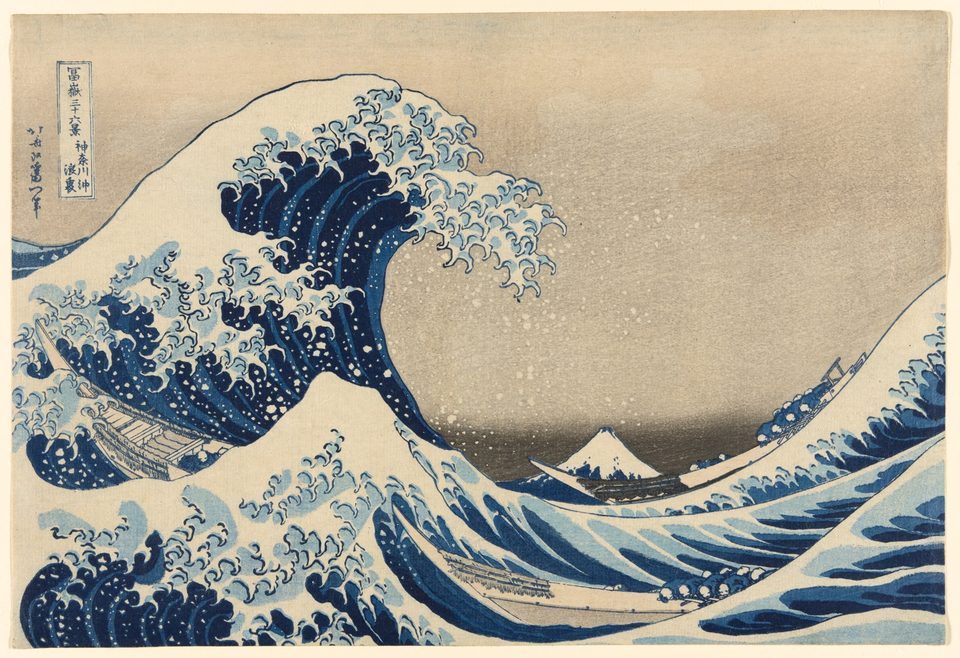
The Art Institute of Chicago says Hokusai’s Thirty-Six Views of Mount Fuji make “copious use of the newly affordable Berlin blue pigment” for sky and water. The Metropolitan Museum of Art notes that he worked with indigo too, so not every blue in the series is Prussian blue.2, 3

A medicine for poisoning

Clinical use

Taken as capsules, Prussian blue binds thallium and radioactive cesium in the gut so the body can pass them out. After the 1987 cesium-137 accident in Goiânia, Brazil, it was given to 46 people, and the US Food and Drug Administration approved it as a drug in 2003.4, 5, 6

Sources (6)
  1. Bartoll, J. (2008). “The early use of Prussian blue in paintings”. 9th International Conference on Non-Destructive Testing of Art, Jerusalem.
  2. Art Institute of Chicago, “Under the Wave off Kanagawa (Kanagawa oki nami ura), also known as The Great Wave, from the series Thirty-Six Views of Mount Fuji”, Katsushika Hokusai, 1830/33 (1925.3245).
  3. Metropolitan Museum of Art, “Under the Wave off Kanagawa (Kanagawa oki nami ura), also known as The Great Wave”, Katsushika Hokusai, about 1830–32 (JP1847).
  4. Farina, R., Brandão-Mello, C. E., and Oliveira, A. R. (1991). “Medical aspects of 137Cs decorporation: the Goiânia radiological accident.” Health Physics 60(1): 63–66. doi:10.1097/00004032-199101000-00009.
  5. US Food and Drug Administration (2003). “FDA Approves First New Drug Application for Treatment of Radiation Contamination Due to Cesium or Thallium”.
  6. Wikipedia, “Prussian blue (medical use)”, citing the WHO Model List of Essential Medicines, 21st list (2019).

History

Prussian blue went from a Berlin color maker’s accident to the palettes of Europe and Japan, then into photography, engineering offices and hospitals.

  1. About 1706

    In Berlin, the color maker Johann Jacob Diesbach makes a deep blue by accident: the first modern synthetic pigment.1

  2. 1709

    Letters call the new color “Preussisch blau” in August and “Berlinisch Blau” in November. Pieter van der Werff’s Entombment, painted that year, is the oldest known painting to use it.1

  3. 1724

    John Woodward publishes the recipe in the Royal Society’s Philosophical Transactions, ending the secret. The English name “Prussian blue” is first recorded the same year.2, 3

  4. 1782

    Carl Wilhelm Scheele isolates hydrogen cyanide from Prussian blue. Its old name, prussic acid, comes from the pigment.2

  5. 1830–33

    Hokusai’s Thirty-Six Views of Mount Fuji, including the Great Wave, make generous use of the newly affordable Berlin blue for sky and water.4

  6. 1842

    John Herschel publishes the cyanotype, a photographic process that forms Prussian blue in paper. From 1843 his friend Anna Atkins prints albums of algae and ferns with it, the first books illustrated with photographs.5, 6

  7. 1872

    Marion and Company of Paris start selling cyanotype paper for copying plans and technical drawings. Blueprints stay the main way to copy drawings until the 1940s.5

  8. 1987

    After an abandoned radiotherapy source is broken open in Goiânia, Brazil, doctors give Prussian blue to 46 people contaminated with cesium-137. The US Food and Drug Administration approves it as a drug in 2003.7, 8

  9. 2022

    The clock dials of the Elizabeth Tower in London, home of Big Ben, are restored to their original Prussian blue and gold, after decades under black paint, probably added in the 1930s to hide pollution.9

Sources (9)
  1. Bartoll, J. (2008). “The early use of Prussian blue in paintings”. 9th International Conference on Non-Destructive Testing of Art, Jerusalem.
  2. Wikipedia, “Prussian blue”, citing J. Woodward, Philosophical Transactions of the Royal Society 33 (1724), and Scheele (1782).
  3. Merriam-Webster, “Prussian blue”, first known use.
  4. Art Institute of Chicago, “Under the Wave off Kanagawa (The Great Wave)”, Katsushika Hokusai, 1830/33 (1925.3245).
  5. Wikipedia, “Cyanotype”, citing Mike Ware, “John Herschel’s Cyanotype: Invention or Discovery?”, History of Photography (1998).
  6. Cleveland Museum of Art, “Scolopendrium Vulgare”, Anna Atkins (1995.26).
  7. Farina, R., Brandão-Mello, C. E., and Oliveira, A. R. (1991). “Medical aspects of 137Cs decorporation: the Goiânia radiological accident.” Health Physics 60(1): 63–66. doi:10.1097/00004032-199101000-00009.
  8. US Food and Drug Administration (2003). “FDA Approves First New Drug Application for Treatment of Radiation Contamination Due to Cesium or Thallium”.
  9. UK Parliament, “Turning Big Ben’s clock dials blue”.

Prussian blue in use

A huge deep blue wave with clawing white foam curls over three narrow boats, with snow-capped Mount Fuji small in the distance
#243852#5E6C75#CBBBA0#ECDDC1
PrintUnder the Wave off Kanagawa (The Great Wave) by Katsushika Hokusai (1830/33)

A color woodblock print at the Art Institute of Chicago. The museum says the series made generous use of the newly affordable Berlin blue, another name for Prussian blue, for sky and water; Hokusai also used indigo. The deep blue of the wave photographs as about #243852, close to the web code but grayer.

#243852#5E6C75#CBBBA0#ECDDC1
Source: Art Institute of Chicago
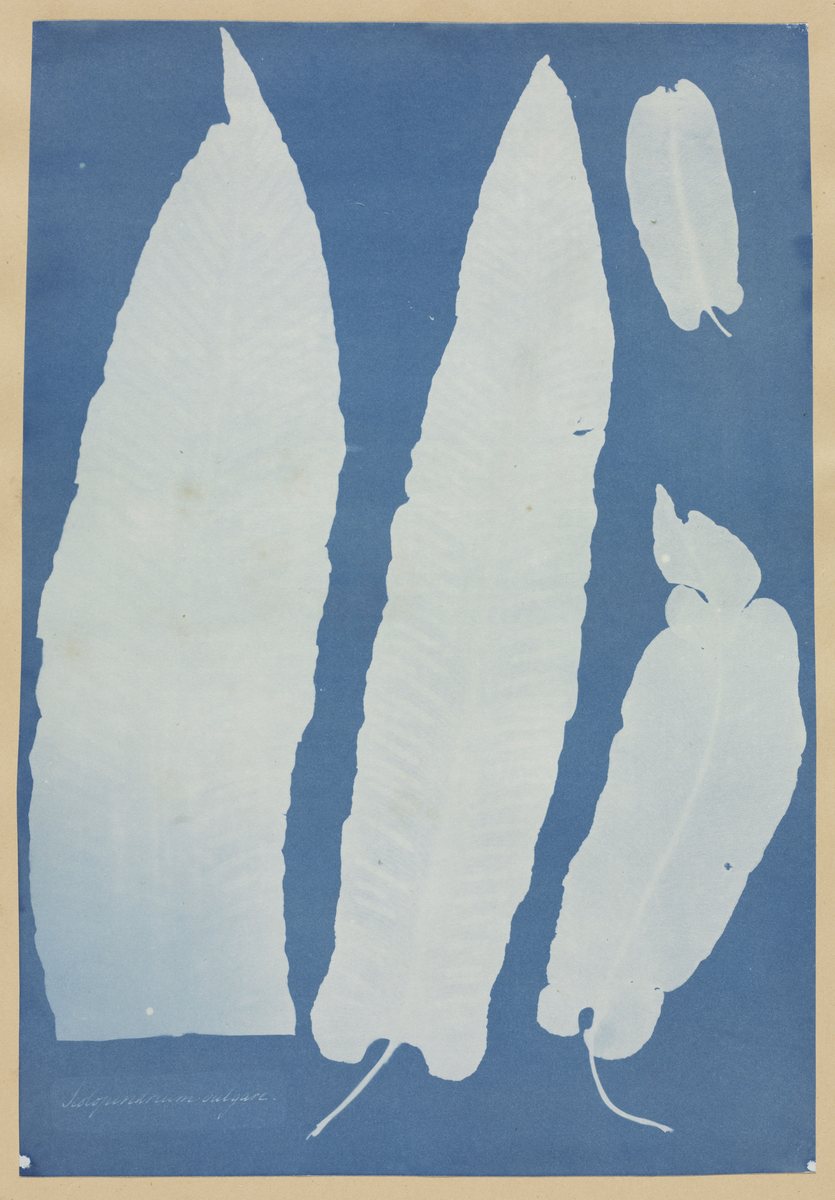
Four long, pale fern leaves printed as white silhouettes on a mid blue ground, with the Latin name handwritten in the lower corner
#557495#7C93A8#A8B7BE#C5CCC8
PhotographScolopendrium Vulgare by Anna Atkins (1852–54)

A cyanotype of hart’s-tongue fern leaves at the Cleveland Museum of Art. In a cyanotype, light turns iron salts in the paper into Prussian blue, and the leaves laid on top stay white. This thin layer of pigment reads as a mid blue, about #557495, far lighter than the web code.

#557495#7C93A8#A8B7BE#C5CCC8
Source: Cleveland Museum of Art

Palettes are sampled in-house.

Questions

What color is Prussian blue?

A deep, dark blue with a slight green lean. The usual code is #003153 (RGB 0, 49, 83). The pigment itself looks almost black when strong and turns a clear blue when thinned.

Why is it called Prussian blue?

It was first made in Berlin, the capital of Prussia, around 1706. German letters from 1709 already call it Prussian blue and Berlin blue.

Is Prussian blue toxic?

No, not in ordinary use. It contains cyanide, but bound so tightly to iron that it is not released in the body. It is even given as a medicine for thallium and cesium poisoning.

What is the difference between Prussian blue and navy blue?

Prussian blue leans slightly green and comes from a pigment. Navy blue, #000080, is a purer blue with a slight violet lean, named after naval uniforms.

Why are blueprints blue?

Blueprints were cyanotypes: light turned iron salts in the paper into Prussian blue, leaving the lines of the drawing white. The process was cheap and needed only water to develop.

What colors go with Prussian blue?

Gold or brass for a classic look, cream and soft gray-blue for something calm, and orange or coral for a bold contrast.