A deep holiday red named after the tart berry that floats on flooded bogs every fall.
Overview
Cranberry is a deep red named after the fruit. Its usual code is #9F000F: red at 62%, no green and a trace of blue. That makes it almost the same as carmine, and a little brighter and less purple than burgundy.
The fruit behind the name is the North American cranberry, which grows on low vines in sandy, acidic bogs and turns red as it ripens in the fall. For the harvest, growers flood the beds and knock the berries loose, and the berries float, so a bog turns into a sheet of red. North Americans have served cranberry sauce with turkey since at least the 1790s, and today it belongs to Thanksgiving and Christmas dinners.
No standard defines the code. #9F000F comes from a long-running web list of color names, and color references see cranberry a little differently. People in the xkcd color survey picked a pinker red, a 1950 color dictionary files cranberry among deep and moderate reds, and Merriam-Webster simply calls it “a dark red.”
The name also belongs to cranberry glass, the red to pink glass colored by tiny particles of gold that filled Victorian sideboards. The deepest pieces come close to the web code. On screens, #9F000F carries white text easily and looks at home with cream, pine green and pumpkin orange.
HEX
#9F000F
RGB
rgb(159, 0, 15)
HSL
hsl(354, 100%, 31%)
HSV
354°, 100%, 62%
CMYK
0, 100, 91, 38
OKLCH
oklch(44.2% 0.180 26.8)
Every code converts from the HEX value #9F000F. No color standard defines cranberry. #9F000F comes from Computer Hope’s list of HTML color names, a long-running color-name website that most color lists copy. People in the xkcd color survey (2010) picked a pinker cranberry, #9E003A, and the ISCC-NBS dictionary files the cranberry of a 1950 color names dictionary under deep red and moderate red; see the range below. CMYK is a screen-based estimate; print results vary.
Cranberry on the color map
LighterDarker
People’s average cranberry in the xkcd survey sits at the same lightness as the code, just left of the outline: pinker and cooler. The dictionary’s deep red sits inside the outline, a little below and to the left, darker and duller. Its moderate red sits on the top edge, lighter and much grayer, and Merriam-Webster’s dark red sits on the left edge, slightly below. The outline is an approximate range, not a measured one.
Shades and tints
Tintswith white
Shadeswith black
Toneswith gray
Cranberry sits in the middle. Tints add white, shades add black and tones add gray, in 10% steps out from it. Tap any swatch to copy its code.
Light and dark cranberry
#D9999F
Pale cranberryMixed 60% with white. A dusty pink for backgrounds.
#C5666F
Light cranberryMixed 40% with white. Light enough to stand out on dark backgrounds.
#9F000F
CranberryThe reference color.
#841B2D
Dictionary cranberryThe ISCC-NBS deep red, where the 1955 dictionary files the cranberry of Taylor, Knoche and Granville’s 1950 dictionary.
#722F37
Dark redThe ISCC-NBS dark red, used here for Merriam-Webster’s “a dark red”. The same code as wine. See wine
#5F0009
Dark cranberryMixed 40% with black. A near-black red for borders and text accents.
Colors that go with cranberry
Pairings that work in rooms, outfits and interfaces.
Thanksgiving table
Cranberry sauce, pumpkin and sage on a cream cloth. Warm and familiar.
Bog at harvest
Floating berries on dark water, green vines and a pale autumn sky.
Cranberry glass
Ruby glass, its pink thin edges, milk-white glass and a gilded rim. Victorian and delicate.
Cranberry and pine
The Christmas pairing: berry red, evergreen and a touch of gold.
Cranberry and charcoal
A dark theme. Plain cranberry is too dark to read on charcoal, so the light tint does the work.
Cranberry and navy
Deep red against deep blue, with cool gray between. Crisp and wintry.
Color-wheel palettes
Pick a palette to see where its colors sit on the color wheel. The caret marks cranberry. Tap a band to copy its code.
Lined up by hue around cranberry. Hover a color to see how similar it is.The bar under each name shows how similar it is. Similarity comes from the distance between the two colors in OKLab, a model of how we see color.
Cranberry vs burgundy
Cranberry#9F000F · hue 354°
Brighter, a truer red
Named after a North American berry
The red of holiday cranberry sauce
Burgundy#800020 · hue 345°
Darker, leaning toward purple
Named after the red wines of Burgundy
Reads more like wine than fruit
Meaning
Thanksgiving
Christmas
Bog harvest
Cranberry glass
Cranberry is a color of the table and the season. The berry ripens in the fall, North Americans have served its sauce with turkey since at least the 1790s, and it is now part of Thanksgiving and Christmas dinners. The name means crane berry, the juice once served as a dye, and the red comes from plant pigments. Research on color and emotion tests broad words such as red, not cranberry itself.
Named after the crane
Word history
The name is a partial translation of Low German kraanbere, from kraan, crane, and bere, berry; its first known use in English dates from 1647. A popular story says the flower, before it opens, looks like a crane’s neck, head and bill. A National Park Service history calls this folklore, and a Colonial Williamsburg historian calls the version that credits the Pilgrims fictional.1, 2, 3
A holiday red
Historical record
Amelia Simmons’s American Cookery (1796), the first American cookbook, says to serve turkey “with boiled onions and cranberry-sauce.” No record puts cranberries at the 1621 harvest feast now called the first Thanksgiving. Today jellied cranberries are a traditional part of Thanksgiving and Christmas meals.4, 3
A dye before a color name
Historical record
Native peoples of the Northeast ate cranberries and also used them as medicine and as a red dye. Park Service and New Jersey Pinelands histories say the juice dyed clothing, rugs and blankets. These are secondary accounts, and they say nothing about how well the color lasted.2, 5, 3
Red from plant pigments
Plant science
The berry’s red comes from anthocyanins. In a 2022 study of American cranberry cultivars, four of these pigments, two cyanidin and two peonidin compounds, made up about 92% of the anthocyanins measured.6
Red stirs love and anger
Study of basic color words
Across 30 countries, people link the word red with both love and anger. The study tested basic color words, so it says little about cranberry itself.7
Sources (7)
Merriam-Webster, “cranberry”, definitions (sense 3, “a dark red”), etymology and first known use.
National Park Service, “Chapter 7: Cranberries”, in From Marsh to Farm: The Landscape Transformation of Coastal New Jersey.
New Jersey Pinelands Commission, “The Cranberry Story”. Pinelands education curriculum.
Urbstaite, R., Raudone, L. & Janulis, V. (2022). Phytogenotypic anthocyanin profiles and antioxidant activity variation in fruit samples of the American cranberry (Vaccinium macrocarpon Aiton). Antioxidants, 11(2), 250. doi:10.3390/antiox11020250
Jonauskaite, D. et al. (2020). Universal patterns in color-emotion associations are further shaped by linguistic and geographic proximity. Psychological Science, 31(10). doi:10.1177/0956797620948810
History
Cranberry was a fruit, a dye and a sauce long before it was a color name. Its other namesake, cranberry glass, goes back to the gold ruby glass of the late 1600s.
1647
First known use of “cranberry” in English. The word is a partial translation of Low German kraanbere, crane berry.1
Late 1600s
Johann Kunckel becomes the first glassmaker to make gold ruby glass on a large scale. He dissolves gold in aqua regia and turns it into red glass by adding tin to the melt.2
1695–1700
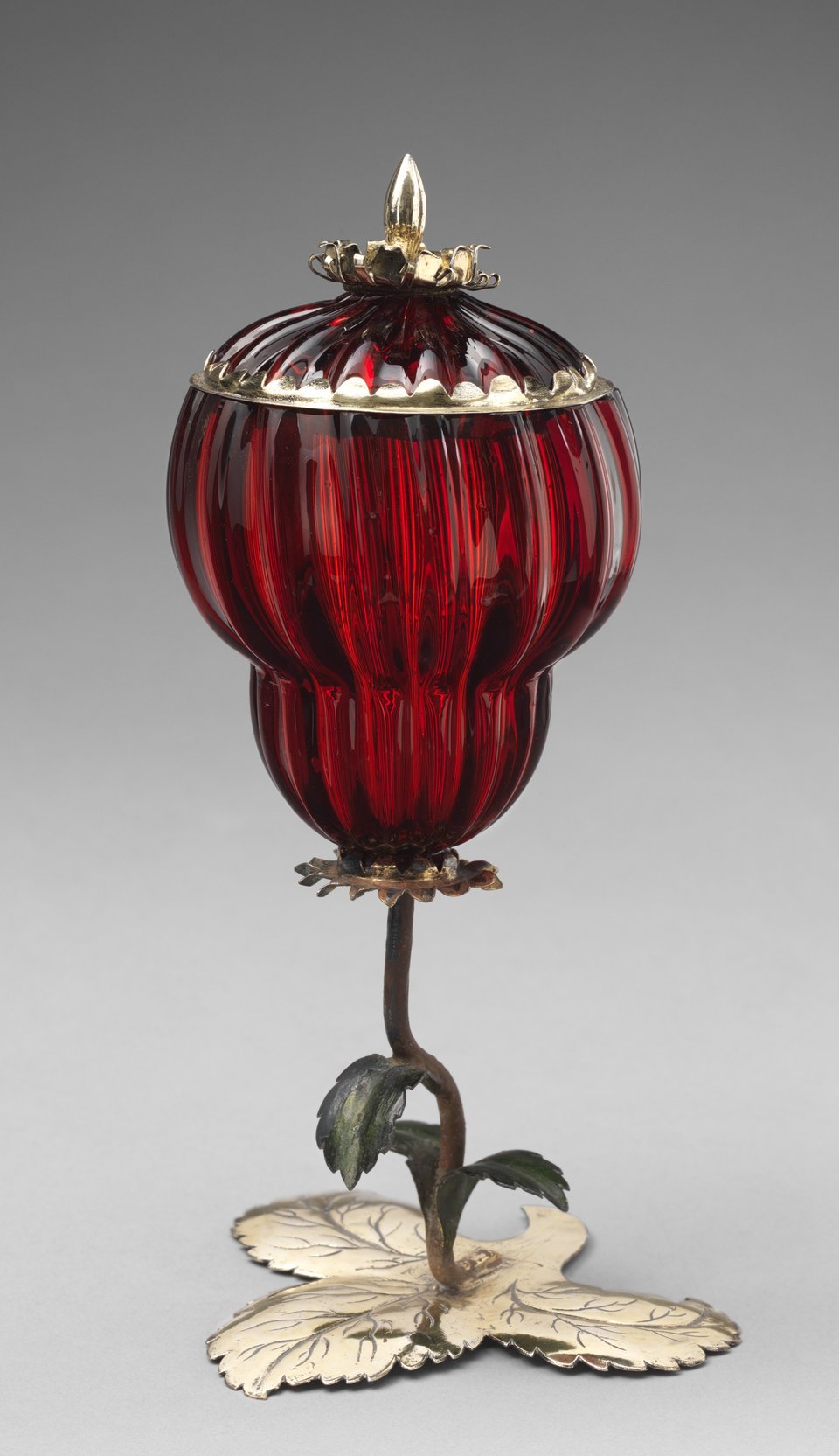
A ribbed, bud-shaped cup of gold-ruby glass is mounted in silver gilt by the silversmith Matthäus Baur II. Now at the Met, its brightest glass samples close to #9F000F.3
1796
Amelia Simmons’s American Cookery, the first American cookbook, says to serve turkey “with boiled onions and cranberry-sauce,” the first time the two are linked in print.4
1810
In Dennis, on Cape Cod, Henry Hall transplants wild vines into a drained, sanded bog and gets a good crop. By 1820 he is shipping berries to New York, and cranberry farming spreads.5
After 1886
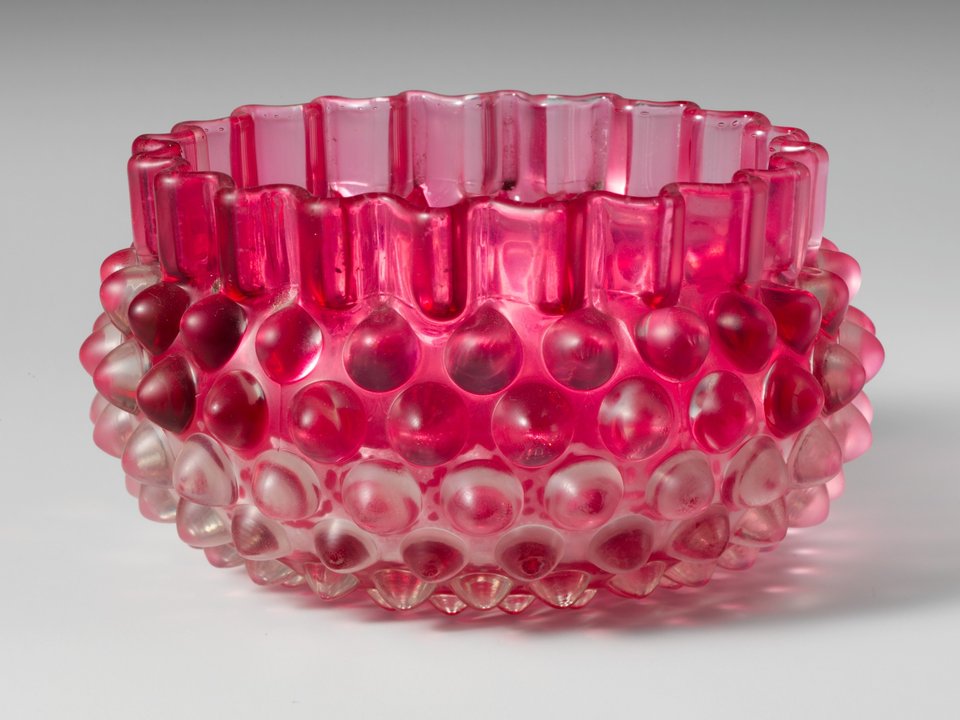
Hobbs, Brockunier and Company of Wheeling, West Virginia, presses hobnail table glass in cranberry: finger bowls, tumblers, pitchers and cruets, dozens of which are now at the Met.6
1925
Richard Zsigmondy wins the Nobel Prize in Chemistry for his work on colloids, which showed that the gold in Purple of Cassius, the red preparation behind gold ruby, is made of tiny particles.2
1950
Taylor, Knoche and Granville’s Descriptive Color Names Dictionary lists cranberry. The 1955 ISCC-NBS dictionary files it under deep red and moderate red, both duller than today’s web code.7
1960s
Growers switch to wet picking: they flood the bogs, knock the berries loose with water reels and gather them as they float.8
2010
In the xkcd color survey, the average color people call cranberry is #9E003A, a little pinker than the web code.9
Sources (9)
Merriam-Webster, “cranberry”, etymology and first known use.
Montanarella, F. & Kovalenko, M. V. (2022). Three millennia of nanocrystals. ACS Nano, 16(4), 5085–5102. doi:10.1021/acsnano.1c11159 (open access).
The Metropolitan Museum of Art, “Standing cup with cover”, Matthäus Baur II, 1695–1700, gold-ruby glass with silver-gilt mounts (27.185.309a, b).
National Park Service, “Chapter 7: Cranberries”, in From Marsh to Farm: The Landscape Transformation of Coastal New Jersey.
The Metropolitan Museum of Art, “Hobnail Finger Bowl”, Hobbs, Brockunier and Company, Wheeling, after 1886, pressed cranberry glass (46.140.430), and related records in the Met’s collection.
New Jersey Pinelands Commission, “The Cranberry Story”. Pinelands education curriculum.
Munroe, R. (2010). “Color survey results”. xkcd blog. The survey’s color averages are released as CC0 data.
Cranberry in use
#A0111B#621017#361416#7C4F4A
GlassCovered cup in gold-ruby glass, Matthäus Baur II (1695–1700)
A ribbed cup of gold-ruby glass on a silver-gilt stem and leafy foot. Where light passes through the glass it samples about #A0111B, almost exactly the web code, and the folds deepen to #621017 and #361416.
#A0111B#621017#361416#7C4F4A
Source: The Met
Source
Sampled from the Metropolitan Museum of Art’s photograph (27.185.309a, b), released as CC0 (public domain). The picture shown is a detail. The codes were measured on the glass only. Colors in a photo shift with the lighting, so read the codes as close, not exact.
#9F0C35#CA1B51#D1506E#D98B99
GlassHobnail finger bowl, Hobbs, Brockunier and Company (after 1886)
Pressed in Wheeling, West Virginia, this small bowl is what most people picture as cranberry glass: a clear, pinkish red. Its thick knobs sample near #9F0C35, close to the web code but bluer, and the thinner glass shows pinks around #CA1B51 and #D1506E.
#9F0C35#CA1B51#D1506E#D98B99
Source: The Met
Source
Sampled from the Metropolitan Museum of Art’s photograph (46.140.430), released as CC0 (public domain). The picture shown is a detail. The maker, place and date come from the museum’s record. Colors in a photo shift with the lighting, so read the codes as close, not exact.
#EA102E#8E040A#CF929F#E0C1CC
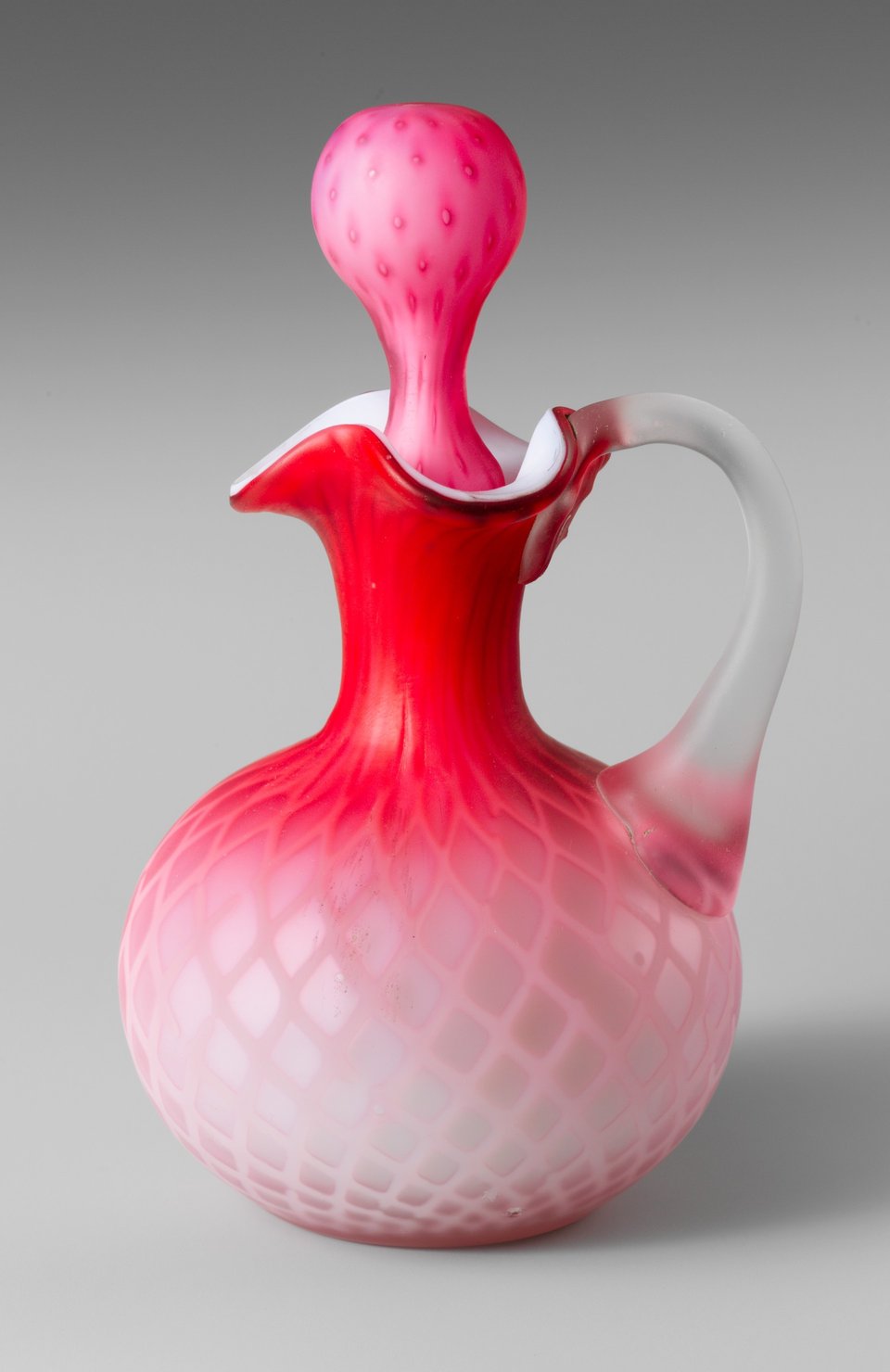
GlassSatin glass cruet, Pittsburgh (about 1885)
Blown cranberry glass with a white lining, a matte satin finish and a quilted diamond pattern. The red is strongest at the neck, near #EA102E with shadows of #8E040A, and fades to rose pinks such as #CF929F over the body.
#EA102E#8E040A#CF929F#E0C1CC
Source: The Met
Source
Sampled from the Metropolitan Museum of Art’s photograph (46.140.244a, b), released as CC0 (public domain). The picture shown is a detail. The neck and the body were measured separately. Colors in a photo shift with the lighting, so read the codes as close, not exact.
Palettes are sampled in-house.
Questions
What color is cranberry?
A deep red named after the cranberry fruit. The usual code is #9F000F (RGB 159, 0, 15). It is almost the same as carmine, and a little brighter and less purple than burgundy.
Where does the cranberry hex code come from?
No standard defines it. #9F000F comes from a long-running web list of color names and has been copied widely. The xkcd color survey’s average cranberry, #9E003A, is pinker, and a 1950 color dictionary files cranberry among deep and moderate reds.
What is the difference between cranberry and burgundy?
Cranberry (#9F000F) is a brighter, truer red. Burgundy (#800020) is darker and leans toward purple, like red wine.
Why is it called cranberry?
The name is a partial translation of Low German kraanbere, crane berry. A popular story says the flower looks like a crane’s head and bill before it opens; historians treat that as folklore.
Why are cranberries harvested in water?
Most cranberries are wet-picked. Growers flood the beds, a machine knocks the berries off the vines, and the berries float, so they can be gathered from the surface. The vines do not grow underwater; the beds are flooded for the harvest.
What is cranberry glass?
A red to pink glass colored by tiny particles of gold, also called gold ruby glass. Glassmakers first made it on a large scale in the late 1600s, and it was popular for Victorian table glass. Museum pieces range from deep red to clear pink.
What colors go with cranberry?
Cream and warm white for a classic holiday look, pine green for Christmas, pumpkin orange and sage for Thanksgiving, and navy or charcoal for a crisper, modern palette.
Can you put text on cranberry?
White text, yes: #9F000F has a contrast of 8.5:1 with white. Black text on it is hard to read, at about 2.5:1.