Iris

A strong blue-violet named after the flower, and the flower after the rainbow.

Overview

Iris is a strong blue-violet, the color of the most familiar garden irises. Its usual code is #5A4FCF: blue at about four-fifths strength, with red and green low and nearly equal, so it reads as a deep periwinkle with a violet glow. No color standard defines it, and it sits very close to the CSS color slate blue.

The color is named after the flower, and the flower after the rainbow. Greek îris meant rainbow, and Iris was the goddess of the rainbow. Some botanists think the plant earned the name for its many colors: irises come in blue, purple, white and yellow, but breeders have never managed a truly red one. The colored ring of the eye takes its name from the same Greek word.

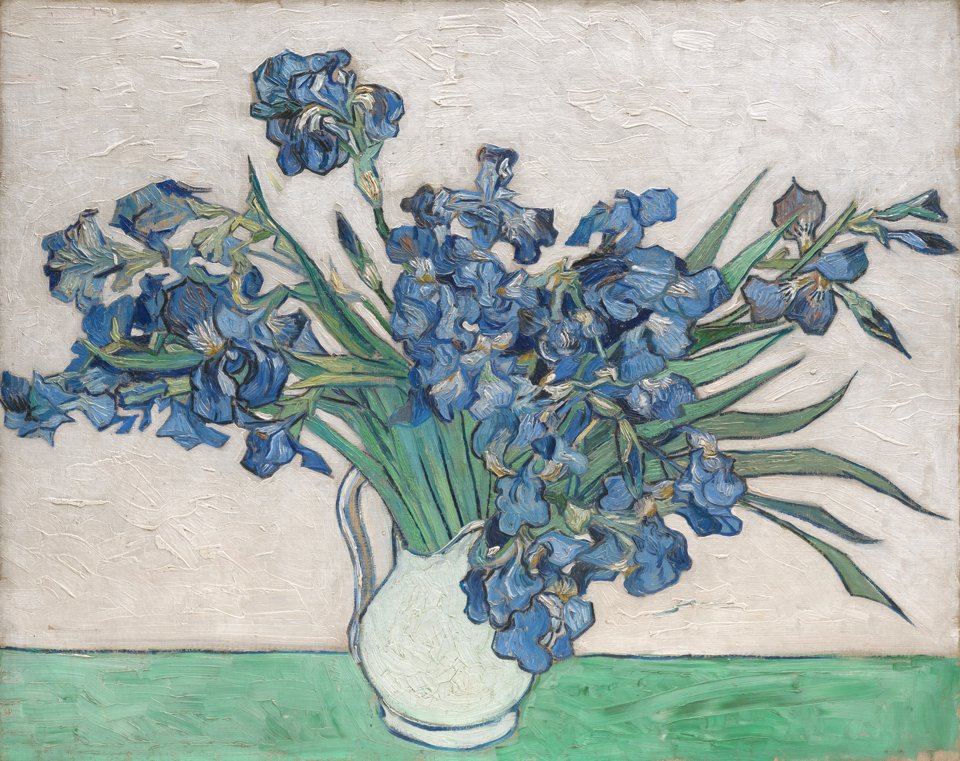
As a color word, iris has moved. A 1930 color dictionary showed it as a pale mauve-lavender, which a later dictionary filed as pale blue and pale purple. Today people mean something much stronger: the average iris in the xkcd color survey, #6258C4, sits almost on the web code. Painted irises tell another story. Van Gogh painted violet irises in 1890, but his red pigment has faded, and they now look blue.

On screens, #5A4FCF carries white text at a contrast of 6.1 to 1. It glows next to yellow, the color at the heart of many iris flowers, and sits calmly with leaf green, silver gray and cream.

HEX#5A4FCF
RGBrgb(90, 79, 207)
HSLhsl(245, 57%, 56%)
HSV245°, 62%, 81%
CMYK57, 62, 0, 19
OKLCHoklch(51.4% 0.190 281.2)
Every code converts from the HEX value #5A4FCF. No color standard defines iris. #5A4FCF is the code most color lists use, and Wikipedia takes it from a color website. It agrees with what people call iris: the xkcd survey average is #6258C4. Maerz and Paul’s A Dictionary of Color (1930) shows iris as a pale mauve-lavender, which the ISCC-NBS dictionary (1955) files as pale blue and pale purple. CMYK is a screen-based estimate; print results vary.
Iris color card, hex #5A4FCF: “Iris my case”

Iris on the color map

People’s average iris sits almost on the reference, a touch lighter and grayer. The two dictionary placements fall far outside the outline, up and to either side: much lighter and nearly gray. Van Gogh’s faded irises sit to the left, bluer than the code and much grayer. The outline is an approximate range, not a measured one.

Shades and tints

Tints with white

Shades with black

Tones with gray

Iris sits in the middle. Tints add white, shades add black and tones add gray, in 10% steps out from it. Tap any swatch to copy its code.

Light and dark iris

#CECAF1
Pale irisMixed 70% with white. A cool lavender for backgrounds.
#9C95E2
Light irisMixed 40% with white. A soft periwinkle.
#5A4FCF
IrisThe reference color.
#443B9B
Deep irisMixed 25% with black. A rich blue-violet for text and borders.
#2D2868
Dark irisMixed 50% with black. A deep indigo.
#AA98A9
Dictionary irisThe pale purple where a 1930 dictionary’s iris sample sits. Grayish and soft.

Colors that go with iris

Pairings that work in rooms, outfits and interfaces.

Iris and yellow

Violet and its complement, as in the flower itself. Bright and spring-like.

Iris garden

Blue-violet with sword-leaf green. Fresh and natural.

Gold-leaf screen

After Kōrin’s irises: gold, deep green and blue. Rich and formal.

Van Gogh’s vase

Violet, soft pink and green, the harmony Van Gogh described before the colors faded.

Iris and silver

Cool and clean. Good for tech and interface design.

Iris night

A dark theme with a lighter iris as the accent.

Color-wheel palettes

Pick a palette to see where its colors sit on the color wheel. The caret marks iris. Tap a band to copy its code.

Similar colors

Denim blue60%Sapphire58%Royal blue66%Blurple64%IrisSlate blue81%Royal purple60%

Lined up by hue around iris. Hover a color to see how similar it is.The bar under each name shows how similar it is. Similarity comes from the distance between the two colors in OKLab, a model of how we see color.

Iris vs slate blue

Iris#5A4FCF · hue 245°
  • A little deeper and more vivid
  • Named after the iris flower
  • No standard code
Slate blue#6A5ACD · hue 248°
  • A touch lighter and softer
  • Named after slate, a gray stone
  • The CSS keyword slateblue

Meaning

  • Rainbow
  • Iris flower
  • The eye’s iris
  • Painters

Iris’s meanings come from the flower and its name, not from studies of the color. The word has meant rainbow since ancient Greek, and painters from Ogata Kōrin to Van Gogh have made the flower famous. Research on color and emotion tests basic words like blue and purple, not iris.

The rainbow’s word

Dictionary record

In Greek, îris meant the rainbow, a halo around the moon, the iris of the eye and the iris plant. English borrowed the word in the 15th century, and in Greek myth Iris is the goddess of the rainbow and a messenger of the gods.1
Many colors, but no true red

Well established

The iris genus has about 310 species, with flowers in blue, purple, white and yellow, and some botanists say the rainbow name refers to that range. A truly red bearded iris, like a truly blue rose, has never been bred.2

Violet irises that turned blue

Museum research

Van Gogh described his 1890 bouquet as violet irises on a pink background. He used red lake pigments that fade in light, and the Metropolitan Museum of Art says the violet irises are now nearly blue.3, 4

Sources (4)
  1. Merriam-Webster, “iris”, definitions, etymology and first known use.
  2. Wikipedia, “Iris (plant)”, citing Manning, J. & Goldblatt, P. (2008), The Iris Family, and Grosvenor, G. (1997), Iris: Flower of the Rainbow, p. 82.
  3. Van Gogh, V. Letter to Theo van Gogh, Saint-Rémy, 11 or 12 May 1890 (letter 633), in Van Gogh’s Letters, WebExhibits.
  4. The Metropolitan Museum of Art (2015), “Van Gogh: Irises and Roses”, exhibition announcement.

History

Iris was a word for the rainbow long before it was a color name. The flower’s history in art runs from Japanese gold screens to Van Gogh, and the color word itself only settled in the age of screens.

  1. 1400s

    “Iris” enters English. Middle English used it for the colored part of the eye and for the iris plant.1

  2. After 1709

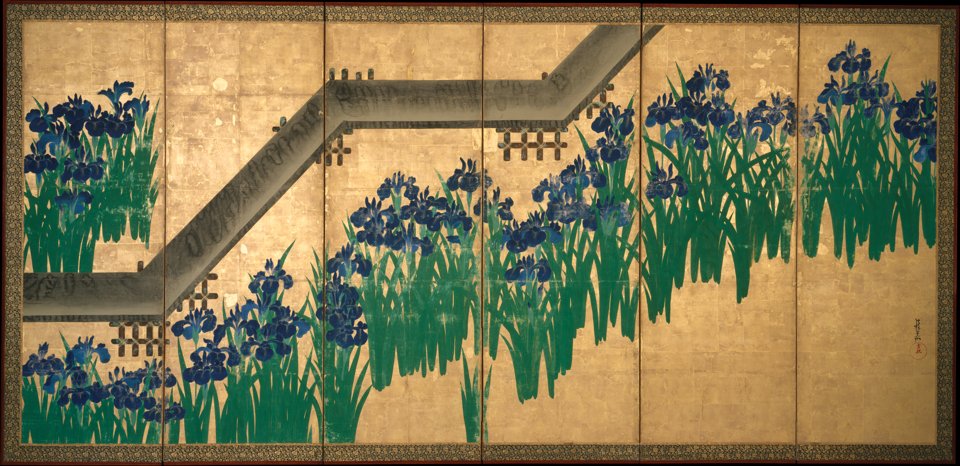
    Ogata Kōrin paints a pair of folding screens of irises at Yatsuhashi, the eight bridges of a famous episode in The Ise Stories.2

  3. May 1890

    In his last days at Saint-Rémy, Van Gogh paints two big bouquets of violet irises, one against a pink background “soft and harmonious”, the other against a “startling citron” yellow.3

  4. 1916

    First recorded use of “iris” as a color name in English.4

  5. 1930

    Maerz and Paul’s A Dictionary of Color shows iris as a pale mauve-lavender. The 1955 ISCC-NBS dictionary files it as pale blue and pale purple.4, 5

  6. 2010

    In the xkcd color survey, the average color people call iris is #6258C4, a strong blue-violet very close to today’s web code.6

  7. 2015

    The Met brings together Van Gogh’s four flower paintings of May 1890 and explains that his violet irises are now nearly blue, because his red lake pigments have faded.7

Sources (7)
  1. Merriam-Webster, “iris”, etymology and first known use.
  2. The Metropolitan Museum of Art, “Irises at Yatsuhashi (Eight Bridges)”, Ogata Kōrin, after 1709 (53.7.1, .2).
  3. Van Gogh, V. Letter to Theo van Gogh, Saint-Rémy, 11 or 12 May 1890 (letter 633), in Van Gogh’s Letters, WebExhibits.
  4. Wikipedia, “Iris (color)”, citing Maerz, A. & Paul, M. R. (1930), A Dictionary of Color, p. 195 and plate 43.
  5. Jaffer, A. “(M) Dictionary of Color”, the ISCC-NBS placements of Maerz and Paul’s color names (1955 dictionary).
  6. Munroe, R. (2010). “Color survey results”. xkcd blog. The survey’s color averages are released as CC0 data.
  7. The Metropolitan Museum of Art (2015), “Van Gogh: Irises and Roses”, exhibition announcement.

Iris in use

A painting of a large bouquet of blue irises with long green leaves in a white jug, on a green table against a pale off-white background
#466382#334359#D2CCC5#88B79B
PaintingIrises, Vincent van Gogh (1890)

Van Gogh called these “violet irises” on a pink background. His red lake pigments have faded since: the flowers now sample as a muted blue, about #466382, and the background as an off-white, #D2CCC5. The web code is far more violet than anything left in the painting.

#466382#334359#D2CCC5#88B79B
Source: The Met
A Japanese six-panel folding screen with clumps of dark blue irises and green leaves on a gold background, crossed by a gray plank bridge that zigzags from left to right
#233A52#2E4961#256643#E8BF82
PaintingIrises at Yatsuhashi, Ogata Kōrin (after 1709)

One of a pair of folding screens: clumps of irises on gold leaf, crossed by a zigzag bridge. They recall an episode in The Ise Stories where a traveler at Yatsuhashi, where a stream splits into eight channels, writes a poem whose first syllables spell kakitsubata, “irises”. In the photo the flowers are a deep blue, about #233A52, much darker than the web code.

#233A52#2E4961#256643#E8BF82
Source: The Met

Palettes are sampled in-house.

Questions

What color is iris?

A strong blue-violet. The code most color lists use is #5A4FCF (RGB 90, 79, 207). The average iris in the xkcd color survey, #6258C4, is almost the same.

Is iris blue or purple?

Both, which is why the name is hard to pin down. #5A4FCF is a blue with a strong violet lean, and real irises run from sky blue to deep purple.

Is iris the same as slate blue?

Very nearly. Slate blue (#6A5ACD) is a touch lighter and softer, and it is a CSS keyword. Iris (#5A4FCF) has no standard code.

Is the color iris named after the eye?

No, after the flower. But the flower, the colored part of the eye and the Greek goddess of the rainbow all share one Greek word, îris, which meant rainbow.

Why do Van Gogh’s irises look blue?

Because they faded. Van Gogh painted violet irises in 1890, mixing in red lake pigments that fade in light. The red has largely gone, so the Met’s irises now look nearly blue.

What colors go with iris?

Yellow for a bright, spring-like contrast, leaf green for a garden look, gold for something rich, and silver gray or cream for a calm, clean design.