Thistle

A pale, grayish purple, much softer than the flower, and unchanged on screens since 1985.

Overview

Thistle is a very pale, grayish purple. Its code is #D8BFD8: red and blue equal and fairly high, green a little lower, which tints a light gray toward purple. It is the CSS keyword thistle. Next to lilac it looks paler and grayer, almost a purple-tinted silver.

The code is older than the web. Thistle was in the first color list of the X Window System, checked in on 19 August 1985, with exactly the numbers it has today, 216 191 216. Almost every other color in that list was later retuned, including wheat (216 216 191) and light blue (191 216 216), which shared thistle’s three numbers in a different order. Thistle never changed, and in 2001 the web adopted the list as its color keywords.

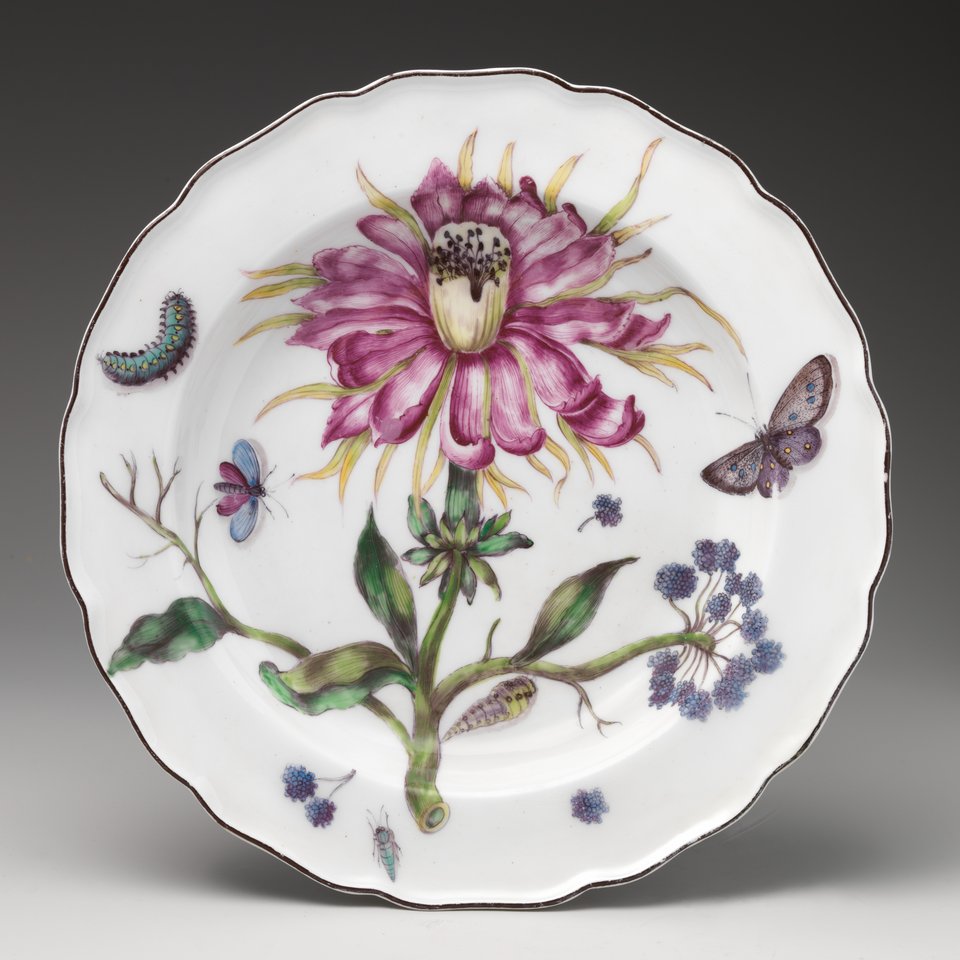
The flower is much stronger. Spear thistle heads are pink-purple, and painters have shown thistles in deep rosy magenta, like the 1750s porcelain plate below. Maerz and Paul’s 1930 A Dictionary of Color has a thistle that the ISCC-NBS dictionary files as a moderate purple, near #86608E, and a version of the X list matched to a box of crayons in the 1980s set thistle to a deep reddish purple, #923E70. The web’s thistle is the palest of them all, and no source we found says why the 1985 list chose it.

The thistle is Scotland’s national flower, a royal badge since the 1400s and the emblem of the Order of the Thistle, whose knights wear green, not purple. On screens, thistle makes a soft background for charcoal, plum or deep green text, and pairs well with sage, heather and gold.
HEX#D8BFD8
RGBrgb(216, 191, 216)
HSLhsl(300, 24%, 80%)
HSV300°, 12%, 85%
CMYK0, 12, 0, 15
OKLCHoklch(83.3% 0.044 326.0)
Every code converts from the HEX value #D8BFD8. #D8BFD8 is the CSS keyword thistle, defined in the CSS Color Module Level 4 and first listed among the web’s color names in SVG 1.0 (2001). It has the same value, 216 191 216, in the X Window System’s first color list, from 1985. Maerz and Paul’s 1930 dictionary has a much darker thistle, which the ISCC-NBS dictionary files as a moderate purple. CMYK is a screen-based estimate; print results vary.
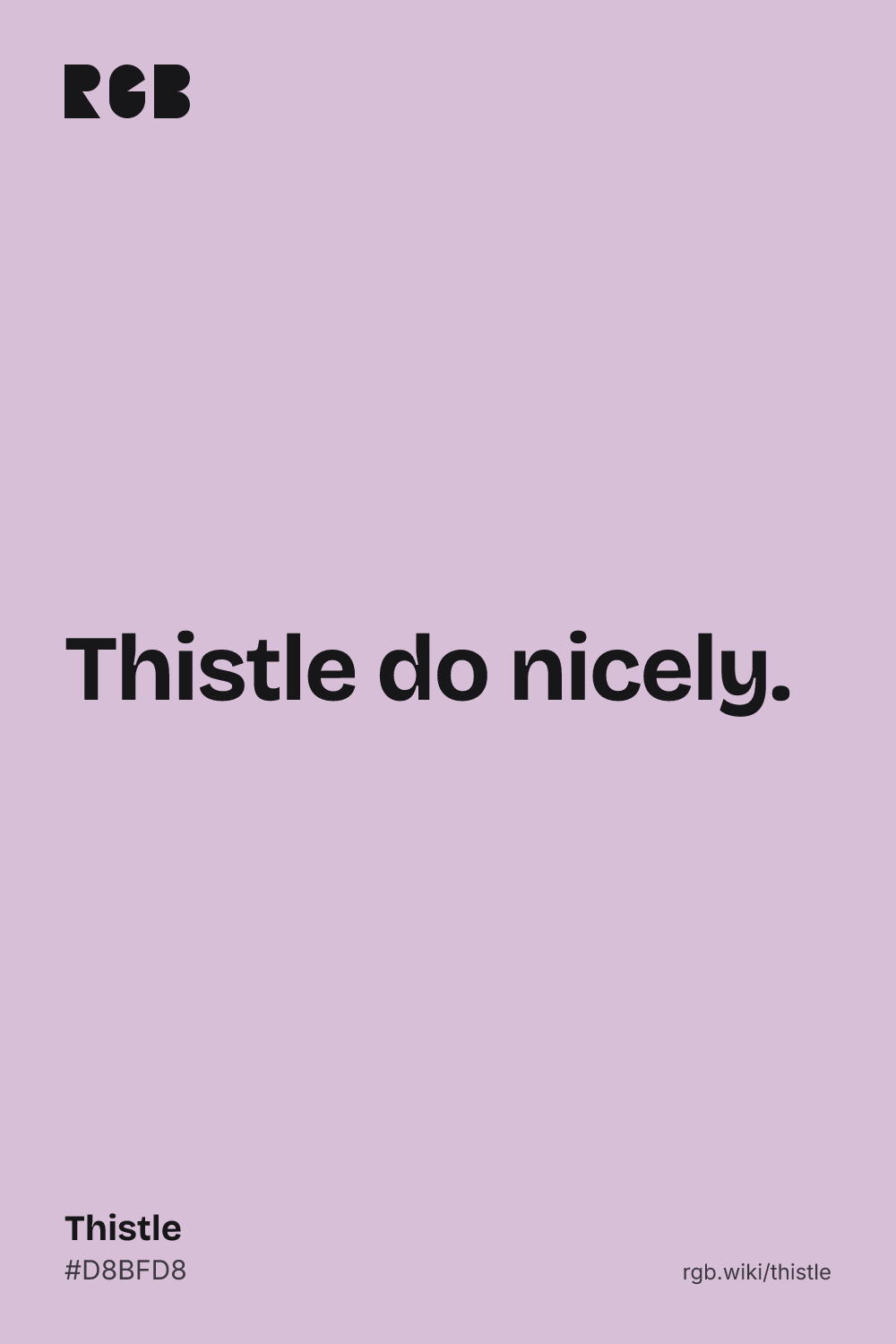
Thistle color card, hex #D8BFD8: “Thistle do nicely”

Thistle on the color map

No survey measures thistle, and the xkcd color survey has no entry for it. Plochere’s thistle down sits at the right edge of the outline, a little lighter and pinker than the code. Maerz and Paul’s thistle and the crayon-matched thistle are far darker, off the bottom of this view, so they are pinned to the edge; the crayon one also lies well to the right, redder. The outline is an approximate range, not a measured one.

Shades and tints

Tints with white

Shades with black

Tones with gray

Thistle sits in the middle. Tints add white, shades add black and tones add gray, in 10% steps out from it. Tap any swatch to copy its code.

Light and dark thistle

#FFE1FF
Thistle 1The X11 list’s top step: thistle’s tint at full brightness. Not a CSS keyword.
#EED2EE
Thistle 2X11’s next step, at about 93% of thistle 1. Not a CSS keyword.
#D8BFD8
ThistleThe reference color.
#CDB5CD
Thistle 3X11’s step at about 80%: a slightly darker, grayer thistle. Not a CSS keyword.
#B39EB5
Pastel purpleA darker, grayer neighbor, close to thistle mixed 20% with black (#AD99AD). See pastel purple
#8B7B8B
Thistle 4X11’s darkest step, at about 55%: a purple-gray. Dark enough for large text on thistle, not for body text.
#86608E
Dictionary thistleModerate purple, the ISCC-NBS center for the thistle in Maerz and Paul’s 1930 dictionary.

Colors that go with thistle

Pairings that work in rooms, outfits and interfaces.

Thistle and heather

A Scottish hillside: heather purple, moss green and slate. Natural and calm.

The real flower

From the 1750s Chelsea plate: rosy magenta petals and muted leaf green, with thistle as the pale ground.

The X11 steps

Thistle with the numbered steps the X11 list gave it. Quiet and tonal.

Thistle and sage

Soft and botanical. Suits wedding stationery and garden designs.

Thistle and charcoal

Modern and muted. Thistle text and accents read softly on a dark background.

Green and gold

Deep green and gold, after the Order of the Thistle’s green robes and gold insignia, with thistle as the accent. Not official codes.

Color-wheel palettes

Pick a palette to see where its colors sit on the color wheel. The caret marks thistle. Tap a band to copy its code.

Similar colors

Pastel blue69%Periwinkle72%ThistleSilver75%Light gray72%Oatmeal65%Oyster70%

Lined up by hue around thistle. Hover a color to see how similar it is.The bar under each name shows how similar it is. Similarity comes from the distance between the two colors in OKLab, a model of how we see color.

Thistle vs lilac

Thistle#D8BFD8 · hue 300°
  • Paler and grayer
  • Reads as a purple-tinted silver
  • A CSS keyword, unchanged since 1985
Lilac#C8A2C8 · hue 300°
  • Deeper and more colorful
  • Reads as a soft, clear purple
  • Not a CSS keyword; no standard

Meaning

  • Scotland’s flower
  • Royal badge
  • Order of the Thistle
  • Unchanged since 1985

Thistle’s meanings come from the plant: Scotland’s national flower, a prickly royal badge whose motto, Nemo me impune lacessit, warns that no one provokes it unpunished. The web color adds a quieter story of its own, as one of the very few codes that have not changed since 1985. Studies of color and emotion test basic words such as purple, never thistle, so the claims below are about history.

Scotland’s royal badge since the 1400s

Historical record

The British royal household credits James III, king of Scots from 1460 to 1488, with adopting the thistle as the royal plant badge. It appeared on Scottish silver coins in his reign and stayed on Scottish and then British coins until 2008, when the last 5p showing a crowned thistle was minted.1, 2

The Norse legend is unproven

Legend

The best-known story says a barefoot Norse raider stepped on a thistle and cried out, waking a sleeping Scottish camp, perhaps around the Battle of Largs in 1263. It survives as legend, with no record from the time. Even the species is disputed: the cotton thistle often pictured today is probably not native to Scotland, and the common spear thistle is a likelier candidate.2

The Order of the Thistle wears green

Historical record

Scotland’s highest order of chivalry, founded in its present form by James VII in 1687, takes the thistle as its emblem. Its 1687 statutes gave the knights a purple-blue ribbon; Queen Anne changed it to green when she refounded the order in 1703, and the knights still process in green velvet robes.1, 3

A web color older than the web

Software record

Thistle was in the first color list of the X Window System, checked in on 19 August 1985 as 216 191 216, and it kept those numbers through every revision. Of the 68 names in that first list, only thistle, dark orchid, dark slate gray, spring green and the pure colors (black, red, green, blue, cyan, magenta and yellow) still have their 1985 values. When the list was rebuilt in 1989, a crayon-matched version of it offered a deep reddish purple instead; the final list kept the pale original.4, 5

The flower is far stronger

Botanical description

Botanical descriptions give the spear thistle pink-purple flower heads and the cotton thistle flowers from dark pink to lavender. The 1930 Dictionary of Color placed its thistle accordingly, as a moderate purple, and its “thistle bloom” as a strong reddish purple. The web’s thistle is much paler than any of them.6, 7

Sources (7)
  1. The Royal Family, “The Order of the Thistle”, on James III and the thistle as royal plant badge, the 1687 foundation and the knights’ green velvet robes.
  2. Wikipedia, “Thistle”, section “Scottish thistle”, on the coins, the legend and the disputed species, with its cited sources.
  3. Wikipedia, “Order of the Thistle”, on the 1687 letters patent (London Gazette, 13 June 1687) and the riband, purple-blue in the 1687 statutes and green from Queen Anne’s 1703 statutes.
  4. X Consortium historical source, rgb.txt, initial revision of 19 August 1985, compared with the file’s later revisions to 1994.
  5. X.Org, rgb “others” README and thomas.txt, John Thomas’s list tuned at Tektronix to match a box of crayons, with thistle at 146 62 112. Also discussed in Aubrey Jaffer, “Color-Name Dictionaries”, MIT CSAIL.
  6. Wikipedia, “Cirsium vulgare” (spear thistle) and “Onopordum acanthium” (cotton thistle), descriptions of the flower heads.
  7. Kelly, K. L. & Judd, D. B. (1955). The ISCC-NBS Method of Designating Colors and a Dictionary of Color Names. National Bureau of Standards Circular 553, entries “Thistle” and “Thistle bloom” (Maerz and Paul). Tabulated in Jaffer’s “Maerz and Paul color names”.

History

The plant’s name is more than a thousand years old and its royal story more than five hundred. As a color, thistle has two lives: a darker purple in the color dictionaries, and the pale code that has sat unchanged in computer color lists since 1985.

  1. Before 1100

    First known use of “thistle” in English. It comes from Old English thistel, related to Old High German distil.1

  2. 1460–1488

    James III, king of Scots, adopts the thistle as the royal plant badge. Thistles appear on Scottish silver coins in his reign.2, 3

  3. 1687

    James VII founds the Order of the Thistle in its present form, with the thistle as its emblem and a purple-blue ribbon.2, 4

  4. 1703

    Queen Anne refounds the order and changes its ribbon to green, the color its knights still wear.4

  5. 1892

    First recorded use of thistle as a color name in English, according to Maerz and Paul.5

  6. 1930

    Maerz and Paul’s A Dictionary of Color prints a thistle sample (plate 42, J7). The 1955 ISCC-NBS dictionary files it as a moderate purple, far darker than today’s code.5, 6

  7. 19 August 1985

    The first color list of the X Window System is checked in with thistle at 216 191 216, beside wheat at 216 216 191 and light blue at 191 216 216. That early list was tuned for Digital’s VT240 terminals.7, 8

  8. 1989

    The X list is rebuilt from new versions by Paul Raveling and by John Thomas, whose crayon-matched list makes thistle a deep reddish purple, 146 62 112. The final list keeps thistle at 216 191 216 and adds four numbered steps, thistle 1 to 4, while wheat and light blue are retuned.7, 9

  9. 2001

    SVG 1.0 makes thistle a web color keyword, as rgb(216, 191, 216). CSS later adopts the same list.10, 11

Sources (11)
  1. Merriam-Webster, “thistle”, etymology and first known use.
  2. The Royal Family, “The Order of the Thistle”.
  3. Wikipedia, “Thistle”, section “Scottish thistle”, with its cited sources on Scottish coinage.
  4. Wikipedia, “Order of the Thistle”, citing the 1687 letters patent and the 1687 and 1703 statutes.
  5. Wikipedia, “Shades of purple: Thistle”, citing Maerz, A. & Paul, M. R. (1930). A Dictionary of Color. New York: McGraw-Hill, p. 196 and plate 42, J7.
  6. Kelly, K. L. & Judd, D. B. (1955). The ISCC-NBS Method of Designating Colors and a Dictionary of Color Names. National Bureau of Standards Circular 553. Tabulated in Jaffer’s “Maerz and Paul color names”.
  7. X Consortium historical source, rgb.txt, initial revision of 19 August 1985, and the file’s revisions from 1988 to 1994.
  8. X.Org, rgb “others” README, on the old list “originally ‘tuned’ for the Digital VT240 series terminals”, and Wikipedia, “X11 color names”, on its 1985 check-in by Jim Gettys.
  9. X.Org, thomas.txt and raveling.txt, with the notes of both authors in the same README; also Aubrey Jaffer, “Color-Name Dictionaries”, MIT CSAIL.
  10. W3C (2001). Scalable Vector Graphics (SVG) 1.0, recognized color keyword names.
  11. W3C, CSS Color Module Level 4, named colors.

Thistle in use

A white porcelain plate with a scalloped rim, painted with a large rosy magenta thistle flower on a green stem, a spray of small blue flowers, two butterflies and a caterpillar
#C89CAE#A55D7D#7F364E#647460
PorcelainBotanical plate with thistle, Chelsea (about 1755)

Chelsea’s painters copied several of these “Hans Sloane” plants from botanical illustrations published by Philip Miller. Here the thistle’s petals run from about #C89CAE in the light to #7F364E in the folds, most near #A55D7D, with leaves near #647460: a rosy magenta far stronger and pinker than the web’s thistle.

#C89CAE#A55D7D#7F364E#647460
Source: The Met

Palettes are sampled in-house.

Questions

What color is thistle?

Thistle is a very pale, grayish purple. Its code is #D8BFD8 (RGB 216, 191, 216), the CSS keyword thistle. It looks like a light gray tinted toward purple.

Is thistle a CSS color?

Yes. thistle, #D8BFD8 and rgb(216, 191, 216) all give exactly the same color. The name came to the web in 2001 from the X Window System’s color list, where thistle has had the same value since 1985.

Why is the thistle color so much paler than a thistle flower?

No source we found explains it. The value comes from the first X Window System color list of 1985, which gives no reasons. Thistle flowers are pink-purple to deep magenta, and the 1930 Dictionary of Color’s thistle is a moderate purple, close to #86608E. The web’s thistle is far lighter and grayer than either.

What is the difference between thistle and lilac?

They share a hue, but lilac (#C8A2C8) is deeper and more colorful, while thistle (#D8BFD8) is paler and grayer. Thistle is a CSS keyword; lilac is not.

What is the difference between thistle and plum in CSS?

The two keywords share a hue. The CSS keyword plum (#DDA0DD) is about as light as thistle but far more colorful, a clear pinkish lilac, while thistle is grayer and softer. Both are much lighter than the dark plum most color lists use, #8E4585.

Is thistle the same as lavender?

No. The CSS keyword lavender (#E6E6FA) is a very pale blue-white, and the lavender most color lists use (#B57EDC) is a much stronger purple. Thistle sits between them in lightness and is pinker than both.

Why is the thistle the national flower of Scotland?

It has been a Scottish royal badge since the reign of James III in the 1400s, and it appeared on Scottish coins from then on. A popular legend says a barefoot Norse raider stepped on a thistle and woke a Scottish camp, perhaps in 1263, but no record from the time confirms it.

What colors go with thistle?

Sage and moss green for a natural look, heather purple and slate for a Scottish palette, deep green and gold for a formal one, and charcoal for a dark background with thistle text.