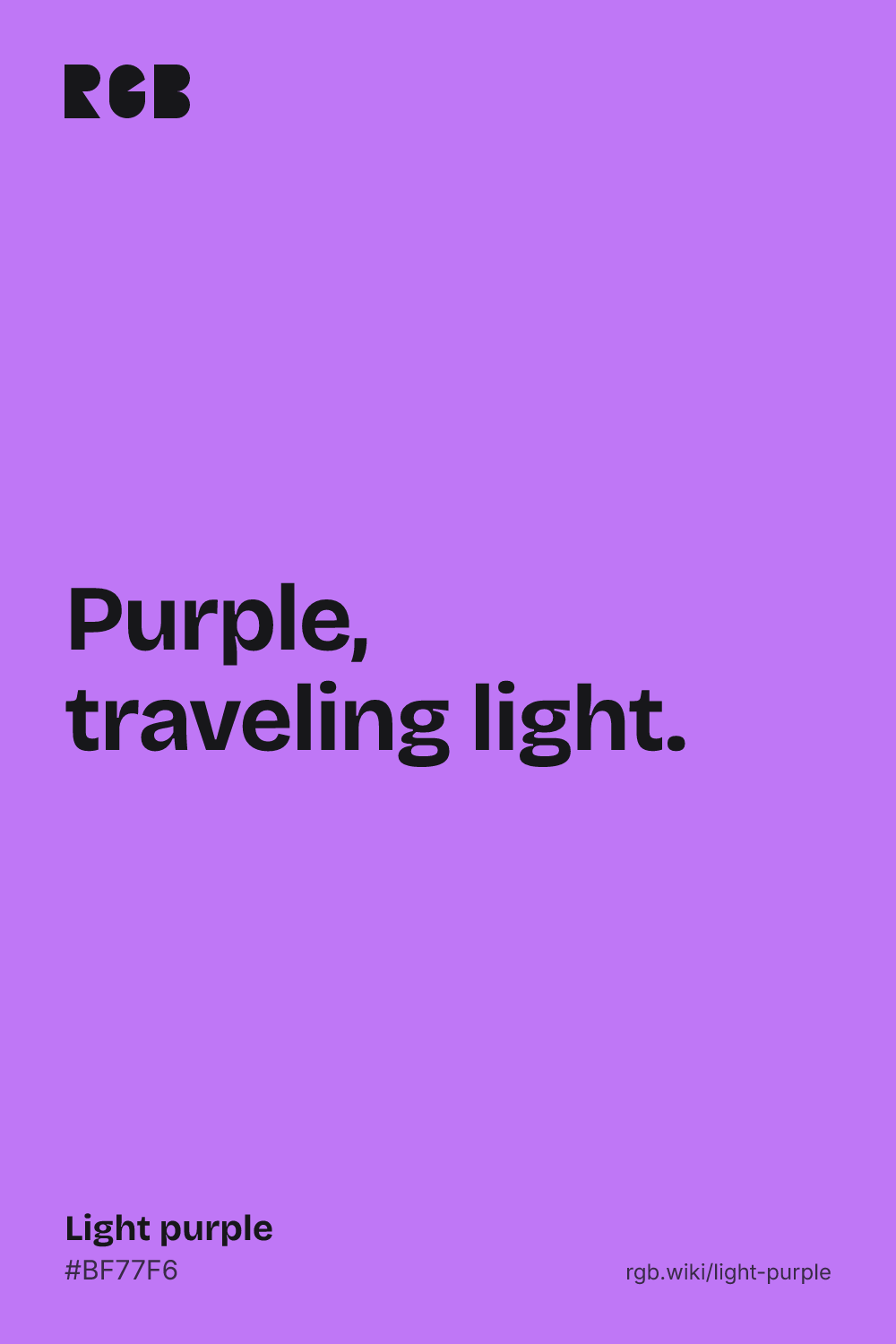
Light purple is a bright, soft purple, like wisteria blossom in the sun. Its code is #BF77F6: blue at 96%, red at 75% and green at 47%. With more blue than red, it leans toward violet, at a hue of 274°.
Light purple has no official code. It isn’t a CSS keyword: the web’s color list has medium purple, #9370DB, which is darker and bluer, and flower names such as orchid, plum and thistle, but no light purple. The code used here is the average of what people called light purple in Randall Munroe’s 2010 xkcd color survey, where it was one of the most used names of all.
Most light purples go by other names. Lavender, lilac, mauve and wisteria are all light purples named after flowers, each with its own code. Periwinkle is a light purple on the blue side and orchid one on the pink side. Light purple is the plain description they share. Color dictionaries use it too: the 1955 ISCC-NBS system has a group called light purple, centered around #B695C0, far grayer than the survey’s.
On screens, light purple takes dark text: black on it has a contrast of about 7.2:1. White reaches only about 2.9:1, just under the 3:1 usually asked of large headings. It pairs well with deep purple and navy, with mint green and soft yellow, and with cool grays.