Light green

A soft, fresh green, and the last line of the color list the web inherited.

Overview

Light green is a soft, bright green, the color of new spring leaves with the sun behind them. Its code is #90EE90: green at 93%, with red and blue equal at 56%. Because red and blue are equal, the hue is exactly green, 120°, the same as a screen’s pure green, lightened with white.

It was the last name added to the X Window System’s color list, the list the web later adopted. Light green isn’t in the first list of 1986 or in the lists of 1989 and 1991. It appears in February 1994 as the final line of the file, after five new “dark” names: dark gray, dark blue, dark cyan, dark magenta and dark red. Its value wasn’t new. 144 238 144 had been in the list since 1989 as PaleGreen2, the second of four numbered steps of pale green.

That makes light green a slightly dimmed pale green. The CSS keyword palegreen, #98FB98, is a touch lighter and brighter, and mint green, #98FF98, is brighter still. All three share the same hue. In everyday use the names overlap: in the xkcd color survey, people’s average light green was #96F97B, a little yellower and more vivid than the keyword.

On screens, light green needs dark text: black on it has a contrast of about 14.8:1, white only about 1.4:1. It pairs well with navy, forest green and charcoal, and with soft pink or sand for a spring palette.
HEX#90EE90
RGBrgb(144, 238, 144)
HSLhsl(120, 73%, 75%)
HSV120°, 39%, 93%
CMYK39, 0, 39, 7
OKLCHoklch(86.8% 0.156 144.1)
Every code converts from the HEX value #90EE90. #90EE90 is the CSS keyword lightgreen, rgb(144, 238, 144), defined in the CSS Color Module Level 4 and first listed among the web’s color names in SVG 1.0 (2001). It comes from the X Window System’s color list as shipped in X11 Release 6, 1994 (xc/programs/rgb/rgb.txt, revision 10.41 of 20 February 1994, in the X11 Release 6 archive, 144 238 144), where the same value had been PaleGreen2 since 1989. CMYK is a screen-based estimate; print results vary.
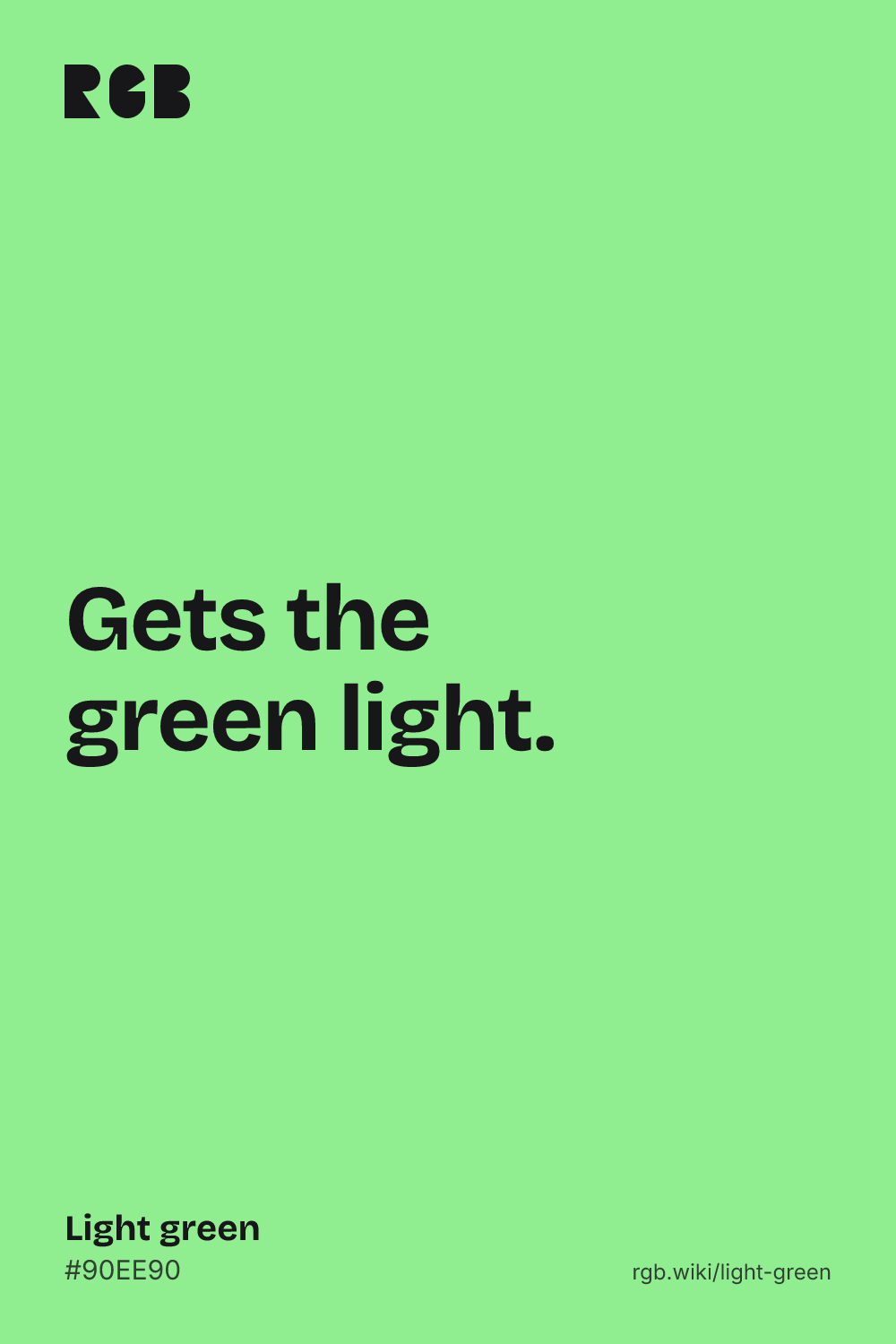
Light green color card, hex #90EE90: “Gets the green light”

Light green on the color map

CSS pale green sits just above the code: the same hue, a touch lighter. People’s average light green in the xkcd survey is a little yellower and brighter. The 1955 dictionary’s light green is a different color, lower and far to the right: darker, grayer and bluer. The outline is an approximate range, not a measured one.

Shades and tints

Tints with white

Shades with black

Tones with gray

Light green sits in the middle. Tints add white, shades add black and tones add gray, in 10% steps out from it. Tap any swatch to copy its code.

Light and dark light green

#D3F8D3
Pale light greenMixed 60% with white. A soft tint for backgrounds.
#98FF98
Mint greenThe same hue with green at full strength: lighter and brighter. See mint green
#98FB98
Pale greenThe CSS keyword palegreen. A touch lighter and brighter than light green.
#90EE90
Light greenThe reference color, the CSS keyword lightgreen. In the X11 list it is also PaleGreen2.
#77DD77
Pastel greenA little darker and deeper, despite the name. See pastel green
#548B54
PaleGreen4The darkest numbered step: a muted fern green.

Colors that go with light green

Pairings that work in rooms, outfits and interfaces.

Light green and navy

Fresh against deep blue. Navy carries the text; light green is the accent.

Light green and forest

Tonal greens, from new leaf to deep shade. Calm and natural.

Light green and light pink

Two soft CSS colors on warm white, for spring cards and sweets.

Light green and light purple

Near opposites that stay gentle. Deep purple anchors the text.

Light green and sand

Earthy and quiet, for garden, food and wellness pages.

Light green on charcoal

A dark theme with a hint of the old green terminal. Light green for headings, links and buttons.

Color-wheel palettes

Pick a palette to see where its colors sit on the color wheel. The caret marks light green. Tap a band to copy its code.

Similar colors

Kiwi64%Pastel green71%Mint green77%Light greenCeladon66%Medium spring green68%Seafoam green68%

Lined up by hue around light green. Hover a color to see how similar it is.The bar under each name shows how similar it is. Similarity comes from the distance between the two colors in OKLab, a model of how we see color.

Light green vs pale green

Light green#90EE90 · hue 120°
  • Slightly darker and softer
  • Added to the X11 list in 1994
  • The same value as PaleGreen2
Pale green#98FB98 · hue 120°
  • A touch lighter and brighter
  • This value since 1989
  • The base of four numbered steps

Meaning

  • CSS keyword
  • Added in 1994
  • Once PaleGreen2
  • Pleasant

Light green reads as fresh, young and mild, the green of new growth. No study has tested light green by name: research on color and feeling works with broad hues and with lightness. What can be documented is where the code came from, and that story is an odd one. Light green was the last name added to the list, for a color that was already in it.

The last name on the list

Historical record

Light green isn’t in any X color list before 1994: not the 1986 list, not Paul Raveling’s or John Thomas’s 1989 revisions, and not the lists of X11 Release 4 (1989) or Release 5 (1991). It first appears in the Release 6 list, dated 20 February 1994, as the final line of the file, after five other new names: dark gray, dark blue, dark cyan, dark magenta and dark red. The release notes don’t mention them.1

An old value under a new name

Historical record

Most of the newcomers of 1994 reused values that were already in the list. Dark red, 139 0 0, had been red4; dark blue was blue4, dark cyan was cyan4 and dark magenta was magenta4. Light green’s 144 238 144 had been PaleGreen2 since 1989: the second of four numbered steps of pale green, about 93% as bright as the first, PaleGreen1 (154 255 154). So light green is, by construction, a slightly dimmed pale green.1

Probably filling a gap

Inferred from the lists

Before 1994 the list already had light blue, light cyan, light yellow and light gray, and a dark green. The 1994 additions supplied dark versions of blue, cyan, magenta, red and gray, and a light green. That looks like someone completing a set, but no surviving note says who added the names or why.1

People picture it a little yellower

Online survey

In Randall Munroe’s 2010 color survey, where people named colors shown on their own screens, the average light green was #96F97B: brighter than the keyword and leaning slightly toward yellow, at a hue of 107° instead of 120°. On the survey’s results page, which lists the 954 most common names starting with purple, green and blue, light green comes 10th.2

A different color in the dictionary

Calculated

The ISCC-NBS system of 1955 sorts all colors into 267 named groups. Its light green is centered around #6AAB8E, which is darker, grayer and bluer than the web’s. The keyword #90EE90 falls between two other groups, very light yellowish green (#B6E5AF) and brilliant yellowish green (#83D37D).3

Light and bright feels pleasant

One lab study

In a 1994 lab study with color chips, brighter colors were rated more pleasant, and green and blue-green were among the most pleasant hues. The study tested chips by hue, brightness and saturation, not light green by name.4

Sources (4)
  1. The X Window System’s color lists: the first list (1986–88), old-rgb.txt, Paul Raveling’s raveling.txt (PaleGreen2 144 238 144) and John Thomas’s thomas.txt, hosted by Aubrey Jaffer, MIT CSAIL; mit/rgb/rgb.txt in the X11 Release 4 and Release 5 archives; and xc/programs/rgb/rgb.txt (revision 10.41, 20 February 1994) with the release notes of May 16, 1994, in the X11 Release 6 archive, also at Jaffer’s rgb.txt.
  2. Randall Munroe (2010), “Color Survey Results”, and “The 954 most common RGB monitor colors” (light green #96f97b), xkcd color survey, CC0.
  3. Kelly, K. L. & Judd, D. B. (1955). The ISCC-NBS Method of Designating Colors and a Dictionary of Color Names, NBS Circular 553. Group centers as sRGB, converted by John Foster, in Aubrey Jaffer’s “Color-Name Dictionaries”, MIT CSAIL (light green, very light yellowish green, brilliant yellowish green).
  4. Valdez, P. & Mehrabian, A. (1994). Effects of color on emotions. Journal of Experimental Psychology: General, 123(4), 394–409. doi:10.1037/0096-3445.123.4.394

History

Green is one of the oldest color words in English, but light green as a fixed code is young. Its story runs through three versions of one computer file: a pale green that wasn’t pale, a numbered step, and a name added on the last line.

  1. 1986

    The X Window System’s first color list has a pale green, 143 188 143, that is really a grayish mid green. There is no light green.1

  2. 1989

    Paul Raveling’s revised list makes pale green a bright 152 251 152 and adds four numbered steps under it. The second, PaleGreen2, is 144 238 144. X11 Release 4 ships these in December and keeps the old value as dark sea green.1, 2

  3. 1991

    The X11 Release 5 list, dated 13 May, still has no light green.3

  4. 1994

    The X11 Release 6 list, revision 10.41 of 20 February, ends with six new names. The last line gives light green the value of PaleGreen2, 144 238 144. The release notes, dated May 16, don’t mention it.4

  5. 2001

    SVG 1.0 lists “lightgreen”, rgb(144, 238, 144), among the web’s color keywords, next to palegreen at rgb(152, 251, 152).5

  6. 2010

    In the xkcd color survey, people’s average light green is #96F97B, a little yellower and brighter than the keyword.6

  7. 2011

    CSS Color Module Level 3 becomes a W3C Recommendation on June 7 and makes lightgreen, #90ee90, an official CSS keyword. Level 4 keeps it.7, 8

Sources (8)
  1. The X Window System’s color lists, hosted by Aubrey Jaffer, MIT CSAIL: old-rgb.txt (pale green 143 188 143), raveling.txt (pale green 152 251 152, PaleGreen2 144 238 144) and thomas.txt (pale green 152 255 152); and the merged mit/rgb/rgb.txt (7 December 1989; dark sea green 143 188 143) in the X11 Release 4 archive.
  2. Aubrey Jaffer, “Color-Name Dictionaries”, MIT CSAIL, quoting the X11 README and the notes of Paul Raveling (ISI) and John Thomas (Tektronix).
  3. X Consortium, X11 Release 5: mit/rgb/rgb.txt (dated 13 May 1991) in mit-2.tar.Z, in the X11 Release 5 archive.
  4. X Consortium, X11 Release 6: xc/programs/rgb/rgb.txt, revision 10.41 of 20 February 1994, in xc-1.tar.gz, and the release notes of May 16, 1994, in the X11 Release 6 archive; the same file is at Jaffer’s rgb.txt.
  5. W3C (2001). Scalable Vector Graphics (SVG) 1.0, recognized color keyword names.
  6. Randall Munroe (2010), “Color Survey Results”, and “The 954 most common RGB monitor colors” (light green #96f97b), xkcd color survey, CC0.
  7. W3C (2011). CSS Color Module Level 3, extended color keywords, W3C Recommendation, June 7, 2011.
  8. W3C, CSS Color Module Level 4, named colors: lightgreen, #90ee90, 144 238 144.

Questions

What color is light green?

A soft, bright green. Its code is #90EE90 (RGB 144, 238, 144), the CSS keyword lightgreen: a pure green hue, lightened with white.

What is the hex code for light green?

#90EE90, the CSS keyword lightgreen. People’s average light green in the xkcd color survey was #96F97B, a little yellower and brighter.

What is the difference between light green and pale green?

Very little. In CSS, pale green (#98FB98) is a touch lighter and brighter than light green (#90EE90), and both have the same hue. In the X11 color list, light green is the second numbered step of pale green.

Is light green the same as mint green?

They are close and often used for each other. Mint green (#98FF98) has green at full strength, so it is lighter and brighter. Light green (#90EE90) is slightly softer.

What is the difference between light green and lime green?

Lime green (#32CD32) is much stronger and darker, a vivid mid green. Light green has far more white in it.

Is light green a CSS color?

Yes. lightgreen is one of the CSS named colors. It joined the X11 color list in 1994, the last name added, and has been a web keyword since 2001.

How do you make light green?

With paint, mix green with white, or mix yellow and blue and then lighten the result with white. On a screen, light green is green at 93% with red and blue both at 56%.

What colors go with light green?

Navy, forest green and charcoal for contrast, soft pink or light purple for a spring palette, and sand or cream for a natural look.

What text color works on light green?

Dark text. Black on light green has a contrast of about 14.8:1. White reaches only about 1.4:1, far too low for reading.

Color guides