Light pink

A soft, sweet pink that the web’s color list made a little darker than plain pink.

Overview

Light pink is a soft, clear pink, the color of cherry blossom or strawberry ice cream. Its code is #FFB6C1: red at full strength, green at 71% and blue at 76%. That is red with a lot of white mixed in, and slightly more blue than green, which gives it a faint rosy lean.

The name is a little misleading. In CSS, lightpink is slightly darker and stronger than plain pink, #FFC0CB: the same full red, with green and blue each ten steps lower. The CSS specification points this out itself, noting that “lightpink is darker than pink”. In everyday speech light pink means something paler. When people named colors in the xkcd color survey, their average light pink was #FFD1DF, almost the same as pastel pink.

Both names come from the X Window System’s color list. Its first version, from 1986, had only pink, and that pink was a dusty brownish rose now called rosy brown. Light pink arrived in 1989, in a revised list by Paul Raveling, already a shade deeper than the new pink beside it. The web took over the list in 2001 and has kept the order ever since.

On screens, light pink needs dark text: black on it has a contrast of about 12.7:1, white only about 1.7:1. It pairs well with navy, charcoal and gray, with sage green and mint, and with burgundy when it needs weight.
HEX#FFB6C1
RGBrgb(255, 182, 193)
HSLhsl(351, 100%, 86%)
HSV351°, 29%, 100%
CMYK0, 29, 24, 0
OKLCHoklch(84.7% 0.086 9.1)
Every code converts from the HEX value #FFB6C1. #FFB6C1 is the CSS keyword lightpink, rgb(255, 182, 193), defined in the CSS Color Module Level 4 and first listed among the web’s color names in SVG 1.0 (2001). It comes from the X Window System’s color list as shipped in X11 Release 4, December 1989 (mit/rgb/rgb.txt in the X11 Release 4 archive, 255 182 193). CMYK is a screen-based estimate; print results vary.
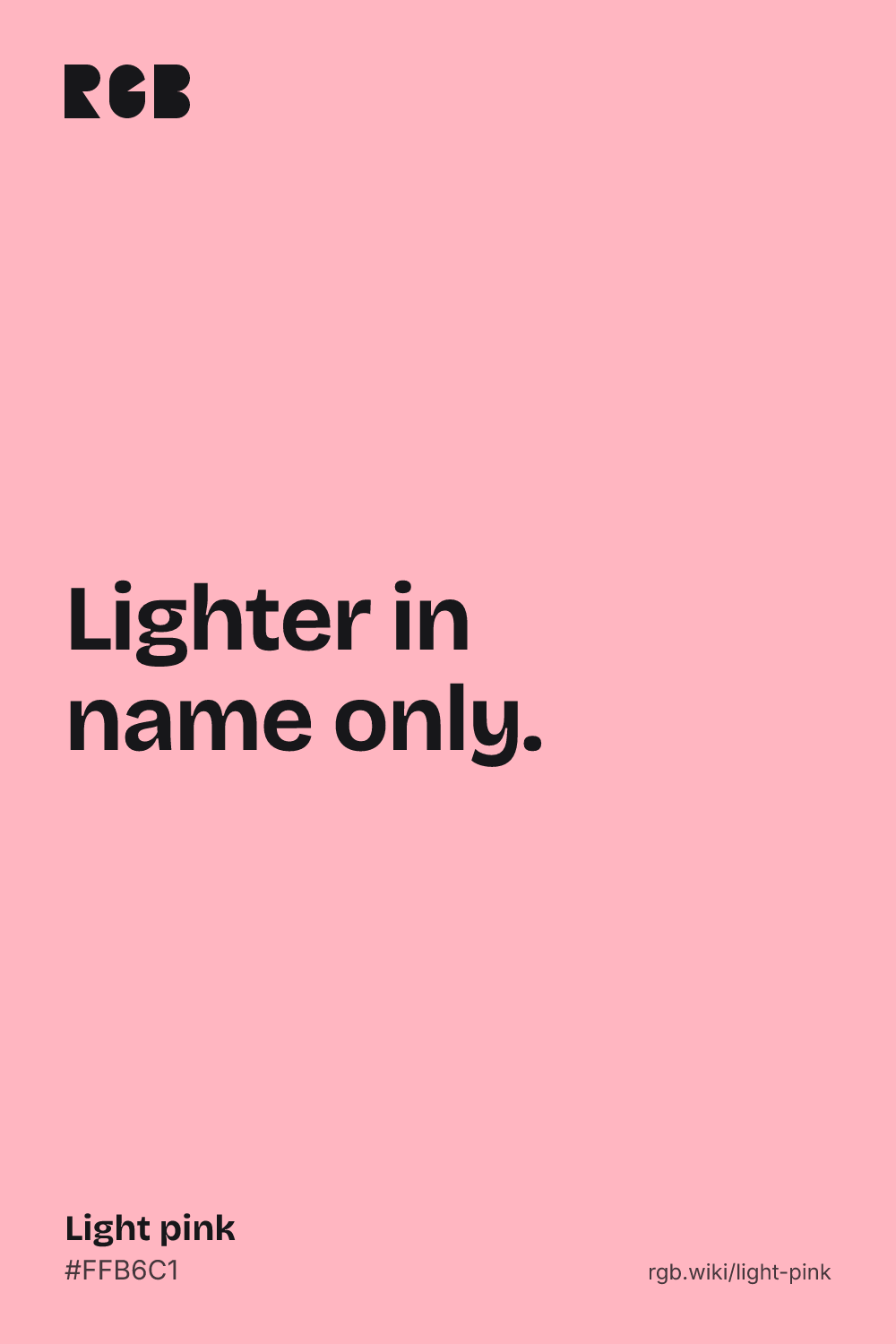
Light pink color card, hex #FFB6C1: “Lighter in name only”

Light pink on the color map

CSS pink sits just above the code: the same hue, a touch lighter. People’s average light pink in the xkcd survey is clearly paler, near the top of the outline, and the 1955 dictionary’s light pink is paler and warmer. The outline is an approximate range, not a measured one.

Shades and tints

Tints with white

Shades with black

Tones with gray

Light pink sits in the middle. Tints add white, shades add black and tones add gray, in 10% steps out from it. Tap any swatch to copy its code.

Light and dark light pink

#FFE2E6
Pale light pinkMixed 60% with white. A blush of color for backgrounds.
#FFD1DF
Survey light pinkWhat people called light pink, on average, in the xkcd color survey. Paler than the CSS code and close to pastel pink. See pastel pink
#FFC0CB
CSS pinkThe CSS keyword pink. A touch lighter than light pink, despite the names.
#FFB6C1
Light pinkThe reference color, the CSS keyword lightpink.
#FFAEB9
LightPink1The first of four numbered light pinks in the X11 list, and Paul Raveling’s original light pink of 1989.
#8B5F65
LightPink4The darkest numbered step: a muted rose brown.

Colors that go with light pink

Pairings that work in rooms, outfits and interfaces.

Light pink and navy

Crisp and grown-up. Navy carries the text and buttons; light pink is the accent.

Light pink and sage

Garden colors. A muted green calms the pink, with a deep green for text.

Light pink and gray

Cool grays keep light pink from turning sugary. Good for fashion and beauty pages.

Light pink and burgundy

Tonal and rich: a pale and a deep version of the same family.

Light pink and mint

Two pastels on warm cream, for sweets, baby goods and spring cards.

Light pink on charcoal

A dark theme where light pink glows. Use it for headings, links and buttons.

Color-wheel palettes

Pick a palette to see where its colors sit on the color wheel. The caret marks light pink. Tap a band to copy its code.

Similar colors

Thistle68%Carnation pink78%Pastel pink67%Light pinkMelon86%Apricot65%Nude62%

Lined up by hue around light pink. Hover a color to see how similar it is.The bar under each name shows how similar it is. Similarity comes from the distance between the two colors in OKLab, a model of how we see color.

Light pink vs pink

Light pink#FFB6C1 · hue 351°
  • Slightly darker and stronger
  • Green 182, blue 193
  • Added to the X11 list in 1989
Pink#FFC0CB · hue 350°
  • A touch lighter, despite the name
  • Green 192, blue 203
  • In the X11 list since 1986, then a dusty rose

Meaning

  • CSS keyword
  • Darker than pink
  • Baby girls
  • Read as positive

Light pink reads as soft, sweet and gentle, and in much of the world it is the color for baby girls. Those meanings belong to pink in general: research tests pink as a word or a broad category, never this code. The code has a quirk of its own, though. On the web, light pink is darker than pink.

Darker than pink, by ten steps

Specification

In CSS, pink is #FFC0CB and lightpink is #FFB6C1: the same full red, with green and blue each ten steps lower, 182 and 193 instead of 192 and 203. That makes light pink slightly darker and stronger than pink. The CSS Color Module Level 4 uses the pair as an example when it warns that the color names “are not even internally consistent (darkgray is lighter than gray, while lightpink is darker than pink)”.1

Set that way in 1989

Historical record

The X Window System’s first color list, of 1986, had one pink, a dusty 188 143 143 that is now called rosy brown, and no light pink. In 1989 Paul Raveling’s revised list set pink at 255 181 197 and added a light pink at 255 174 185, already the deeper of the two. The merged list in X11 Release 4, dated 7 December 1989, lightened both to today’s values and kept the order. No surviving note says why light pink sits below pink.2

People picture something paler

Online survey

In Randall Munroe’s 2010 color survey, where people named colors shown on their own screens, the average light pink was #FFD1DF, much paler than the CSS code and nearly the same as the usual code for pastel pink. The survey name that lands almost on the CSS code is baby pink, #FFB7CE.3

A vivid pink by the dictionary

Calculated

The ISCC-NBS system of 1955 sorts all colors into 267 named groups. Its light pink is centered around #F9CCCA, paler and warmer than the CSS code. The group nearest to #FFB6C1 is the one called vivid pink, centered around #FFB5BA, which is practically the same color.4

Pink for baby girls since the 1860s

Historical record

Pink for girls and blue for boys was already a known custom in the late 1860s. In Louisa May Alcott’s Little Women (1869), new parents mark their twins with ribbons, blue for the boy and pink for the girl, “French fashion”. A count of English-language books from 1881 to 2000 finds that pairing far more often than the reverse in every period. The popular story that the two colors once swapped is mostly a myth: see baby blue.5, 6

Read as positive, not proven calming

Review of studies

A 2025 review of 132 studies, covering more than 42,000 people in 64 countries, found that light colors and pink are both linked with positive emotions. Most of those studies asked people to match colors with feelings, so whether a pink room changes how anyone feels is still open. The studies tested pink in general, not this code.7

Sources (7)
  1. W3C, CSS Color Module Level 4, named colors: pink #ffc0cb, lightpink #ffb6c1, and the note that the names “are not even internally consistent”.
  2. The X Window System’s color lists: the first list (1986–88), old-rgb.txt (pink 188 143 143); Paul Raveling’s revision, raveling.txt (pink 255 181 197, light pink 255 174 185); and John Thomas’s thomas.txt, hosted by Aubrey Jaffer, MIT CSAIL. The merged list that shipped with X11 Release 4, mit/rgb/rgb.txt dated 7 December 1989 (pink 255 192 203, light pink 255 182 193, rosy brown 188 143 143), is in the X11 Release 4 archive.
  3. Randall Munroe (2010), “Color Survey Results”, and “The 954 most common RGB monitor colors” (light pink #ffd1df, baby pink #ffb7ce), xkcd color survey, CC0.
  4. Kelly, K. L. & Judd, D. B. (1955). The ISCC-NBS Method of Designating Colors and a Dictionary of Color Names, NBS Circular 553. Group centers as sRGB, converted by John Foster, in Aubrey Jaffer’s “Color-Name Dictionaries”, MIT CSAIL (light pink, vivid pink).
  5. Alcott, L. M. (1869). Little Women, part II, chapter 28, “Domestic Experiences”. Project Gutenberg.
  6. Del Giudice, M. (2017). Pink, blue, and gender: An update. Archives of Sexual Behavior, 46, 1555–1563. doi:10.1007/s10508-017-1024-3
  7. Jonauskaite, D. & Mohr, C. (2025). Do we feel colours? A systematic review of 128 years of psychological research linking colours and emotions. Psychonomic Bulletin & Review, 32(4), 1457–1486. doi:10.3758/s13423-024-02615-z

History

Pink has been a color word since the 17th century. Light pink, as a fixed code, dates from 1989, when two pinks went into a computer’s color list in an order the web has kept ever since.

  1. About 1669

    First known use of pink as the name of a color in English. The garden flowers called pinks are recorded a century earlier, in 1566.1

  2. 1986

    The X Window System’s first color list has a single pink, 188 143 143, a dusty brownish rose. There is no light pink.2

  3. 1989

    Paul Raveling at USC’s Information Sciences Institute rebuilds the list. He moves pink to 255 181 197, keeps the old value under the name rosy brown, and adds a light pink at 255 174 185, slightly deeper than his pink.2, 3

  4. Dec 1989

    X11 Release 4 ships a merged list, dated 7 December, with pink at 255 192 203 and light pink at 255 182 193. Raveling’s two values stay in the file as pink1 and LightPink1.2

  5. 2001

    SVG 1.0 lists “lightpink”, rgb(255, 182, 193), among the web’s color keywords, next to pink at rgb(255, 192, 203).4

  6. 2010

    In the xkcd color survey, people’s average light pink is #FFD1DF, much paler than the keyword.5

  7. 2011

    CSS Color Module Level 3 becomes a W3C Recommendation on June 7 and makes lightpink, #ffb6c1, an official CSS keyword. Level 4 keeps it and remarks that it is darker than pink.6, 7

Sources (7)
  1. Merriam-Webster, “pink”, first known use of the flower name (1566) and of the color name (circa 1669).
  2. The X Window System’s color lists, hosted by Aubrey Jaffer, MIT CSAIL: old-rgb.txt (pink 188 143 143), raveling.txt (pink 255 181 197, light pink 255 174 185, rosy brown 188 143 143) and thomas.txt; and the merged mit/rgb/rgb.txt (7 December 1989) in the X11 Release 4 archive.
  3. Aubrey Jaffer, “Color-Name Dictionaries”, MIT CSAIL, quoting the X11 README and the notes of Paul Raveling (ISI) and John Thomas (Tektronix).
  4. W3C (2001). Scalable Vector Graphics (SVG) 1.0, recognized color keyword names.
  5. Randall Munroe (2010), “Color Survey Results”, and “The 954 most common RGB monitor colors” (light pink #ffd1df), xkcd color survey, CC0.
  6. W3C (2011). CSS Color Module Level 3, extended color keywords, W3C Recommendation, June 7, 2011.
  7. W3C, CSS Color Module Level 4, named colors: lightpink, #ffb6c1, 255 182 193, and the note “lightpink is darker than pink”.

Questions

What color is light pink?

A soft, clear pink. Its code is #FFB6C1 (RGB 255, 182, 193), the CSS keyword lightpink: red at full strength with a lot of white mixed in and a faint rosy lean.

What is the hex code for light pink?

#FFB6C1, the CSS keyword lightpink. For a paler light pink, closer to what most people picture, try #FFD1DF, the average from the xkcd color survey.

Is light pink lighter than pink?

Not in CSS. The keyword pink is #FFC0CB and lightpink is #FFB6C1, which is slightly darker and stronger. Both values come from the X11 color list of 1989, and the CSS specification itself notes that “lightpink is darker than pink”.

What is the difference between light pink and pastel pink?

Pastel pink (#FFD1DC) is paler, with more white in it. Light pink (#FFB6C1) is a little stronger and slightly warmer.

Is light pink the same as baby pink?

Nearly. In the xkcd color survey, people’s average baby pink was #FFB7CE, almost the same as the CSS light pink. Another common code for baby pink, #F4C2C2, is a little grayer and warmer.

How do you make light pink?

With paint, start with white and stir in red a little at a time. A cool red gives a cleaner pink than an orange-red. On a screen, light pink is red at full strength with green at 71% and blue at 76%.

What colors go with light pink?

Navy, charcoal and gray for contrast, sage green or mint for a fresh look, cream for softness, and burgundy for a rich tonal pairing.

What text color works on light pink?

Dark text. Black on light pink has a contrast of about 12.7:1. White reaches only about 1.7:1, far too low for reading.

Color guides