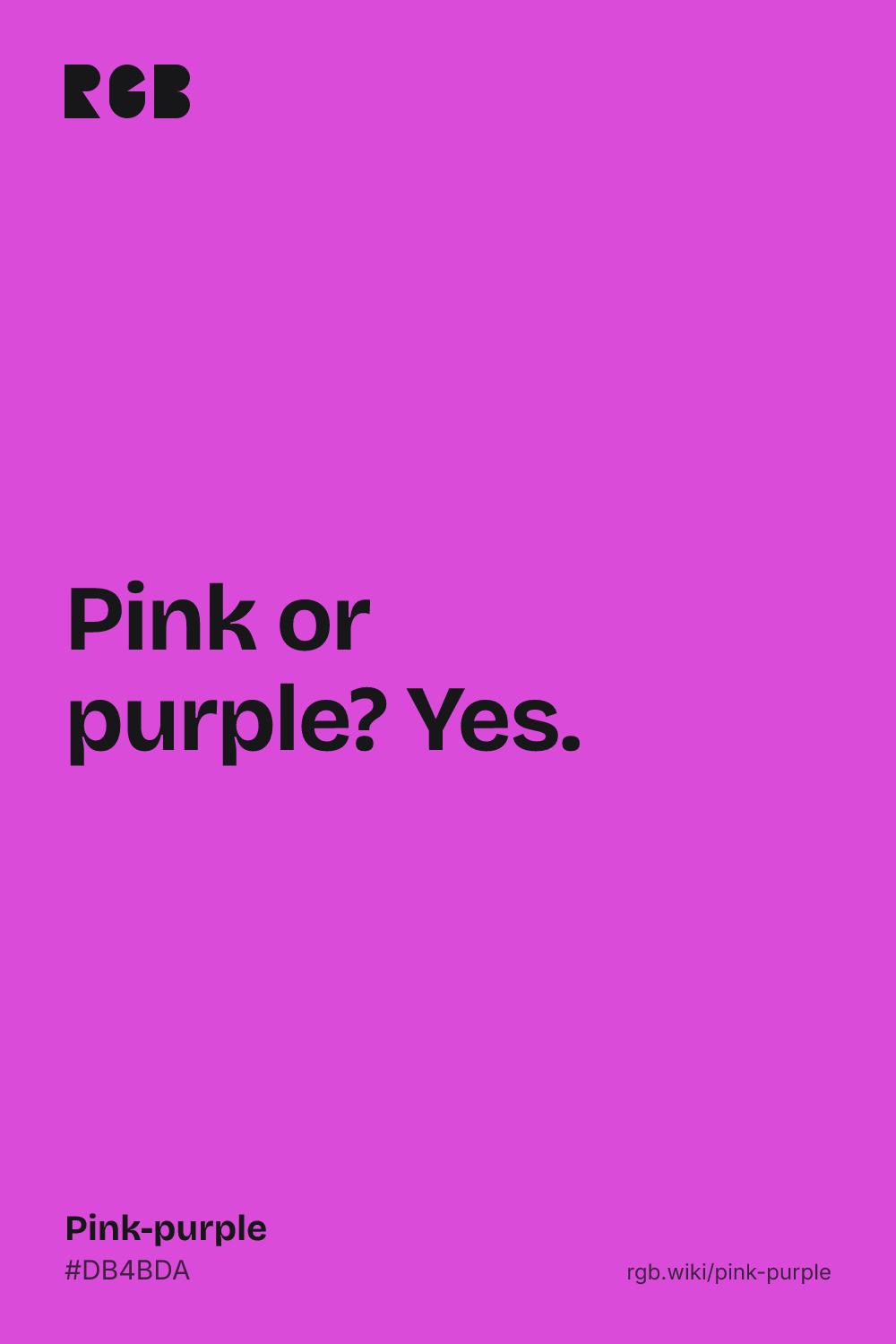
A bright blend of pink and purple, where two basic color words meet.
Overview
Pink-purple is a bright color halfway between pink and purple. The code used here, #DB4BDA, has red and blue almost equal at about 86%, with green at 29%. Equal red and blue give the hue of fuchsia; the green softens it into something less electric.
It is a mix, not a named color with a history of its own. Pink and purple are both basic color words in English, and pink-purple, purple pink and purplish pink are what people say for the colors where the two meet.
No color standard defines pink-purple. This code is the average of what people called “pink purple” in the xkcd color survey, and their “purple pink” came out almost the same. In nature it is a flower color: many pink-purple petals get their color from anthocyanins, plant pigments that can look red, pink, purple or blue.
To mix it on screen, take fuchsia and blend in about 40% light gray. In paint, mix a magenta or bright pink with a little violet and lighten it with white. Pink-purple works best as an accent, with charcoal, navy, lime or soft gray.
HEX
#DB4BDA
RGB
rgb(219, 75, 218)
HSL
hsl(300, 67%, 58%)
HSV
300°, 66%, 86%
CMYK
0, 66, 0, 14
OKLCH
oklch(66.2% 0.238 328.1)
Every code converts from the HEX value #DB4BDA. There is no standard code for pink-purple. #DB4BDA is the average color people called “pink purple” in the xkcd color survey (CC0 data). The ISCC-NBS system of color names has no pink-purple: it uses purplish pink for lighter, pinker colors and reddish purple for deeper ones. CMYK is a screen-based estimate; print results vary.
Pink-purple on the color map
LighterDarker
Purple pink and pinkish purple sit right on the code. Purplish pink sits to the right, toward red, and is softer. The ISCC-NBS deep purplish pink sits just outside the outline on the right: pinker still. In these names the last word wins, so “purplish pink” is pinker than “pinkish purple”. The outline is an approximate range, not a measured one.
Shades and tints
Tintswith white
Shadeswith black
Toneswith gray
Pink-purple sits in the middle. Tints add white, shades add black and tones add gray, in 10% steps out from it. Tap any swatch to copy its code.
Light and dark pink-purple
#E993E9
Light pink-purpleMixed 40% with white. A soft candy lilac.
#DA70D6
OrchidThe CSS keyword orchid: the same hue, lighter and softer. See orchid
#DB4BDA
Pink-purpleThe reference color.
#FF00FF
FuchsiaThe same hue at full strength, with no green. See fuchsia
#832D83
Dark pink-purpleMixed 40% with black. A deep plum that holds white text.
Colors that go with pink-purple
Pairings that work in rooms, outfits and interfaces.
Pink-purple and charcoal
Bright on dark. Bold and modern.
Pink-purple and lime
Electric opposites. Fun for parties and playful brands.
Pink-purple and navy
Deep and vivid. Good for night themes.
Pink-purple and gray
Gray tames it. Clean and balanced.
Pink-purple and teal
Cool against warm. Tropical and retro.
Pink-purple and lilac
Tonal and dreamy: purples from bright to pale.
Color-wheel palettes
Pick a palette to see where its colors sit on the color wheel. The caret marks pink-purple. Tap a band to copy its code.
Lined up by hue around pink-purple. Hover a color to see how similar it is.The bar under each name shows how similar it is. Similarity comes from the distance between the two colors in OKLab, a model of how we see color.
Pink-purple vs fuchsia
Pink-purple#DB4BDA · hue 300°
Softened by a little green
Less electric, easier on the eyes
A name built from two basic colors
Fuchsia#FF00FF · hue 300°
Full red and full blue, no green
The most intense purple-pink a screen shows
Named after a flower
Meaning
Flowers
Plant pigments
Between two names
A mix
Playful
Pink-purple sits where two basic colors meet, so it borrows from both: the sweetness of pink and the richness of purple. In nature it is a flower color. People use many names for it, which is typical of colors on a boundary. Research on color and emotion tests broad hues such as purple, not pink-purple itself.
Two basic colors meet here
Two studies
Berlin and Kay’s 1969 study of color words counted pink and purple among the basic colors that languages add once they have eight or more color terms. A 2014 study of American English found that most names beyond the basic ones label colors on the boundaries between them, where people agree least. Pink-purple is one of those colors.1, 2
The last word wins
Online survey
In the xkcd color survey, “purplish pink” averaged a pinker color than “pinkish purple”: the final word sets the family, and the word ending in -ish only tints it. “Pink purple” and “purple pink” came out almost the same.3
Petals colored by anthocyanins
Plant chemistry
Anthocyanins are water-soluble pigments found in the flowers and fruits of many plants. Depending on acidity, they look red, pink, purple, blue or black, and their colors help draw pollinators to flowers.4
Pink-purple is a mix, so its story is the story of its two halves, and of how people name the colors in between.
1400s
“Purple” is in use as an English color word for a color between red and blue.1
1607
“Pink” first appears as a color word, named after the garden flowers called pinks.2
1955
The ISCC-NBS system of color names makes purplish pink one of its hue names, in shades from brilliant to grayish.3
1969
Brent Berlin and Paul Kay publish Basic Color Terms, which counts pink and purple among the basic colors that languages add once they have eight or more color words.4
2010
In the xkcd color survey, people’s average “pink purple” is #DB4BDA, the code on this page.5
2014
A study of American English finds that names beyond the basic colors mostly label colors on the boundaries between them.6
Sources (6)
Merriam-Webster, “purple”, adjective, first known use.
Merriam-Webster, “pink”, adjective, first known use.
Jaffer, A. “NBS-ISCC Centroids”, the hue names and center colors of the ISCC-NBS system of color names.
Munroe, R. (2010). “Color survey results”. xkcd blog. The survey’s color averages are released as CC0 data.
Lindsey, D. T. & Brown, A. M. (2014). The color lexicon of American English. Journal of Vision, 14(2), 17. doi:10.1167/14.2.17
Questions
What color is pink-purple?
A bright color between pink and purple. The code used here is #DB4BDA (RGB 219, 75, 218): red and blue almost equal, with a little green to soften it.
Is there an official pink-purple color code?
No. This code is the average color people called “pink purple” in the xkcd color survey. Color dictionaries use names such as purplish pink and reddish purple instead.
Are purple pink and purplish pink the same as pink-purple?
They name the same area between pink and purple, and this page covers them all. On average, people pick a slightly pinker, softer color for purplish pink (#CE5DAE) than for pink purple.
How do you make pink-purple?
On screen, take fuchsia (#FF00FF) and blend in about 40% light gray. In paint, mix a magenta or bright pink with a little violet and lighten it with white.
What is the difference between pink-purple and fuchsia?
They share the same hue, with red and blue equal. Fuchsia (#FF00FF) is the full-strength version; pink-purple has some green mixed in, so it is softer and less electric.
What colors go with pink-purple?
Charcoal, navy and soft gray let it stand out. Lime and teal make bold, playful pairs, and pale lilac a gentle tonal one.