Amaranth

A vivid pinkish red named after the flower that never fades.

Overview

Amaranth is a vivid pinkish red. Its usual code is #E52B50: red near full strength, with a little blue and less green, so it sits between crimson and rose, a red with a cool pink edge. No color standard defines it. Wikipedia takes the code from a color website.

The name means “unfading”. Greek amarantos, from a- “not” and marainein “to waste away”, named a flower that poets said never died, and English still calls undying things amaranthine. The real plants, Amaranthus, carry dense clusters of small red, dark pink, purple or green flowers. One cultivated kind, with long, dense flower tassels, is called love-lies-bleeding.

The color word has wandered. Merriam-Webster defines amaranth as a pinkish or rosy red, close to the web code. Maerz and Paul’s 1930 color dictionary showed a much deeper color, which a later dictionary files as deep reddish purple, #702963. And a red food dye called amaranth colored American foods until 1976, when the FDA stopped allowing it.

On screens, #E52B50 is bright and warm. Black text reads well on it, at 4.8 to 1. White text reaches only 4.4 to 1, so keep white for large type, or put it on a deeper shade such as #B72240. It pairs well with navy, charcoal, cream and soft green.
HEX#E52B50
RGBrgb(229, 43, 80)
HSLhsl(348, 78%, 53%)
HSV348°, 81%, 90%
CMYK0, 81, 65, 10
OKLCHoklch(60.2% 0.217 16.8)
Every code converts from the HEX value #E52B50. No color standard defines amaranth. #E52B50 is the code most color lists use, and Wikipedia takes it from a color website. It fits Merriam-Webster’s definition, a pinkish or rosy red, but not Maerz and Paul’s A Dictionary of Color (1930), whose amaranth the ISCC-NBS dictionary (1955) files as deep reddish purple, centered on #702963. CMYK is a screen-based estimate; print results vary.
Amaranth color card, hex #E52B50: “It’s amaranth-on, not a sprint”

Amaranth on the color map

The dictionary’s amaranths all sit to the left, toward purple. Amaranth pink lies just outside the outline, lighter and pinker; amaranth purple and the dictionary’s amaranth fall far below it, dark and purplish. The painted amaranths sit straight below the reference: the same hue, but much darker and duller. No survey average exists for amaranth. The outline is an approximate range, not a measured one.

Shades and tints

Tints with white

Shades with black

Tones with gray

Amaranth sits in the middle. Tints add white, shades add black and tones add gray, in 10% steps out from it. Tap any swatch to copy its code.

Light and dark amaranth

#F7BFCA
Pale amaranthMixed 70% with white. A soft pink for backgrounds.
#EF8096
Light amaranthMixed 40% with white. A warm, rosy pink.
#E52B50
AmaranthThe reference color.
#B72240
Deep amaranthMixed 20% with black. Carries white text at 6.3 to 1.
#891A30
Dark amaranthMixed 40% with black. A deep wine red.
#702963
Dictionary amaranthThe ISCC-NBS deep reddish purple, where the 1930 dictionary’s amaranth sits. The same code byzantium uses. See byzantium

Colors that go with amaranth

Pairings that work in rooms, outfits and interfaces.

Amaranth and cream

Bright red-pink on a warm ground. Cheerful and inviting.

Amaranth and navy

Bold and confident. Good for sport and campaign graphics.

Love-lies-bleeding

After the plant’s red flower tassels: deep red, amaranth and leaf green.

Amaranth and mint

Fresh and lively. The cool green balances the warm red.

Amaranth and charcoal

Modern and graphic. Red as the only accent on gray.

Amaranth night

A dark theme with a lighter amaranth as the accent.

Color-wheel palettes

Pick a palette to see where its colors sit on the color wheel. The caret marks amaranth. Tap a band to copy its code.

Similar colors

Ruby81%Cerise86%Raspberry83%Pink-red92%AmaranthCrimson83%Alizarin crimson86%

Lined up by hue around amaranth. Hover a color to see how similar it is.The bar under each name shows how similar it is. Similarity comes from the distance between the two colors in OKLab, a model of how we see color.

Amaranth vs crimson

Amaranth#E52B50 · hue 348°
  • Lighter and a little softer
  • Named after an “unfading” flower
  • No standard code
Crimson#DC143C · hue 348°
  • Deeper and more intense
  • Named after the kermes insect
  • The CSS keyword crimson

Meaning

  • Unfading
  • Poetry
  • Love-lies-bleeding
  • Food dye

Amaranth’s meanings come from its name. For poets the amaranth was the flower that never fades, a sign of immortality. For food chemists it is a red dye the United States stopped allowing in 1976. Studies of color and emotion test basic words like red and pink, not amaranth.

The flower that never fades

Dictionary record

Greek amarantos meant “unfading” or “immortal”. Long ago, poets imagined a flower that did not fade and called it amaranth, and the adjective amaranthine came to mean undying. The Latin amarantus probably named the cockscomb, Celosia cristata.1, 2

Milton’s “immortal amarant”

Literary record

In Paradise Lost (1667), angels cast down crowns “inwove with Amarant and Gold”. Milton writes that the amarant first bloomed in Paradise by the Tree of Life and was taken back to Heaven after the Fall, where it flowers among flowers “that never fade”.3

A dye the US no longer allows

Regulatory record, disputed evidence

The synthetic dye amaranth, FD&C Red No. 2 or E123, was named after the red of the plant. The FDA ended its provisional listing in February 1976, after FDA tests found more malignant tumors in female rats fed high doses. Officials had earlier said they saw no evidence of a public health hazard, and the evidence was disputed.4, 5

Sources (5)
  1. Merriam-Webster, “amaranth”, definitions, etymology and first known use.
  2. Merriam-Webster, “amaranthine”, definition and “Did you know?” note.
  3. Milton, J. (1667). Paradise Lost, Book 3, lines 352–361. The John Milton Reading Room, Dartmouth College.
  4. U.S. Food and Drug Administration, “CPG Sec 587.200 Uncertified or Delisted Colors in Foods for Export (e.g., FD&C Red #2)” (1995).
  5. Wikipedia, “Amaranth (dye)”, history and health effects, citing Omaye, S. T. (2004), Food and Nutritional Toxicology, p. 257, and Time (1976).

History

The amaranth was a symbol long before it was a color. English took the plant’s name in the 1600s, the poets took its meaning, and the color name followed.

  1. 1616

    First known use of “amaranth” in English, for the plant.1

  2. 1664

    First known use of “love-lies-bleeding”, the name of a cultivated amaranth.2

  3. 1667

    John Milton’s Paradise Lost crowns the angels with “Immortal Amarant”, a flower removed from Paradise to Heaven.3

  4. 1690

    First recorded use of “amaranth” as a color name in English.4

  5. 1930

    Maerz and Paul’s A Dictionary of Color prints samples for amaranth, amaranth pink and amaranth purple. The 1955 ISCC-NBS dictionary files the amaranth as deep reddish purple.4, 5

  6. 1976

    In February, the FDA ends the provisional listing of FD&C Red No. 2, the food dye amaranth, and it can no longer be used in American foods.6

Sources (6)
  1. Merriam-Webster, “amaranth”, first known use.
  2. Merriam-Webster, “love-lies-bleeding”, first known use.
  3. Milton, J. (1667). Paradise Lost, Book 3, lines 352–361. The John Milton Reading Room, Dartmouth College.
  4. Wikipedia, “Amaranth (color)”, citing Maerz, A. & Paul, M. R. (1930), A Dictionary of Color, p. 189.
  5. Jaffer, A. “(M) Dictionary of Color”, the ISCC-NBS placements of Maerz and Paul’s color names (1955 dictionary).
  6. U.S. Food and Drug Administration, “CPG Sec 587.200 Uncertified or Delisted Colors in Foods for Export (e.g., FD&C Red #2)” (1995).

Amaranth in use

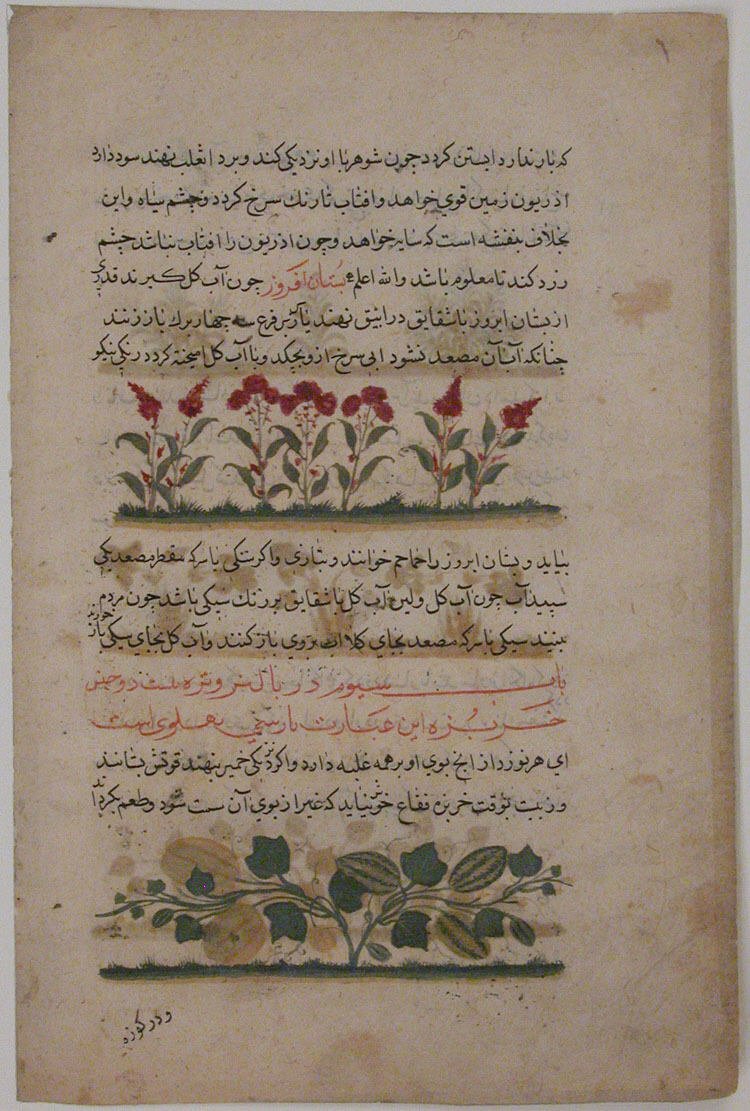
A manuscript page with Persian script in black and red ink, a painted row of red-flowered plants with green leaves in the middle and a watermelon vine at the bottom
#6D2B2D#7C393E#645F45#A49584
Manuscript“Purple Amaranth and Watermelon”, from the Nuzhatnama-i ‘Ala’i (Iran)

A page from a copy of an encyclopedia of nature written in Iran between 1095 and 1119. The museum calls the row of flowers purple amaranths in full bloom, but in the photo they read as a deep brownish red, about #6D2B2D, with olive leaves above the watermelon vine. Nothing on the page comes close to the bright web code.

#6D2B2D#7C393E#645F45#A49584
Source: The Met

Palettes are sampled in-house.

Questions

What color is amaranth?

A vivid pinkish red. The code most color lists use is #E52B50 (RGB 229, 43, 80). Merriam-Webster calls amaranth a pinkish or rosy red.

Is amaranth red or pink?

In between. #E52B50 is a red with a cool pink edge, which is why amaranth is often filed with pinks. Older color dictionaries put amaranth deeper and more purple.

What does amaranth mean?

It comes from the Greek amarantos, “unfading”. Poets used the amaranth as a flower that never dies, and amaranthine still means undying.

Is amaranth the same as crimson?

No, though they share a hue. Crimson (#DC143C) is deeper and more intense. Amaranth (#E52B50) is a little lighter and softer.

Is the amaranth food dye banned?

In the United States, yes. The FDA ended the provisional listing of FD&C Red No. 2, the dye amaranth, in 1976, so it cannot be used in American foods.

What colors go with amaranth?

Navy and charcoal for contrast, cream for a warm look, mint or leaf green for a fresh pairing, and a deeper red such as #B72240 for text and buttons.