A deep, brownish red named after a gem, and the gem after a pomegranate.
Overview
Garnet is a deep red with a brownish cast, the color of the most common garnet gems. The code most references use is #733635: medium red with a little green and blue, which mutes it. No standard defines this code, but it sits squarely in the dark red that color dictionaries give garnet.
The name comes from the pomegranate. Early French gernet meant “red like a pomegranate”, and English took the word in the 1300s. The gem is not one mineral but a group of more than twenty. Red garnets are the most common, but garnets also come in green, orange, purplish red and even blue.
Real garnets vary more than one code can show. Old inlaid garnets glow a clear wine red where light passes through them and look nearly black where it doesn’t, and the universities that use garnet as a school color each set their own: South Carolina’s is a pure, dark red, while Florida State’s leans purple.
On screens, #733635 is dark enough for white text and reads as warm, serious and a little old-fashioned. Pair it with gold or cream for a collegiate look, or with black and white for drama.
HEX
#733635
RGB
rgb(115, 54, 53)
HSL
hsl(1, 37%, 33%)
HSV
1°, 54%, 45%
CMYK
0, 53, 54, 55
OKLCH
oklch(41.3% 0.086 22.5)
Every code converts from the HEX value #733635. #733635 is the garnet most color lists use, but no color standard defines it. It agrees with the dictionaries: the ISCC-NBS system files Maerz and Paul’s garnet under dark red, whose center, #722F37, is almost the same color, and Merriam-Webster defines garnet as a deep red. Schools with garnet colors publish their own codes; see the range below. CMYK is a screen-based estimate; print results vary.
Garnet on the color map
LighterDarker
Garnets cluster tightly, all inside the outline. The dictionary’s dark red and the buckle’s garnets sit almost on the reference. Florida State’s garnet lies to the left at the same lightness, leaning purple. South Carolina’s sits a little lower and is far more intense, which this map of hue and lightness doesn’t show. The outline is an approximate range, not a measured one.
Shades and tints
Tintswith white
Shadeswith black
Toneswith gray
Garnet sits in the middle. Tints add white, shades add black and tones add gray, in 10% steps out from it. Tap any swatch to copy its code.
Light and dark garnet
#D5C3C2
Pale garnetMixed 70% with white. A dusty pink for backgrounds.
#AB8686
Light garnetMixed 40% with white. A muted, antique rose.
#733635
GarnetThe reference color.
#562828
Deep garnetMixed 25% with black. A dark brownish red for text and borders.
#3A1B1A
Dark garnetMixed 50% with black. Nearly black, with a red glow.
Colors that go with garnet
Pairings that work in rooms, outfits and interfaces.
Garnet and gold
The classic school pairing. Warm and traditional.
Garnet and black
Bold and formal, with white for air.
Cloisonné
From the Visigothic buckle: garnet red set in green bronze.
Garnet and blush
Soft pink lifts the deep red. Romantic and warm.
Garnet and navy
Deep red and deep blue. Collegiate and steady.
Garnet night
A dark theme with a lighter garnet as the accent.
Color-wheel palettes
Pick a palette to see where its colors sit on the color wheel. The caret marks garnet. Tap a band to copy its code.
Lined up by hue around garnet. Hover a color to see how similar it is.The bar under each name shows how similar it is. Similarity comes from the distance between the two colors in OKLab, a model of how we see color.
Garnet vs burgundy
Garnet#733635 · hue 1°
Browner and softer
Named after a red gem
The January birthstone
Burgundy#800020 · hue 345°
More intense, leaning purple
Named after a French wine
Reads cooler, like red wine
Meaning
Gemstone
January birthstone
School color
Fiery red
Abrasive
Garnet’s meanings come from its color and its long history in jewelry. GIA notes that pyrope, the classic red garnet, takes its name from the Greek for “fiery-eyed”. Garnet is New York’s state gemstone, star garnet is Idaho’s, and several universities wear garnet as a school color. As with most named colors, research on color and emotion tests broad hues, not garnet itself.
A family of minerals
Well established
Garnet is a group of more than twenty closely related minerals, five of them important as gems. Pyrope and almandine run from purple to red; spessartine is orange; tsavorite and demantoid are green. Harder garnets are crushed for abrasive blasting and for water jets that cut steel.1, 2, 3
The January birthstone
Historical record
Garnet was January’s stone in seven of the eight older birthstone lists that the gem scholar George F. Kunz compared, and American jewelers kept it there in their 1912 list. It is also the gem for a 2nd wedding anniversary.4, 2
Health and calm, in lore
Folklore
GIA records that in ancient and medieval times, gems like garnet were thought to treat inflammatory diseases and soothe the angry heart, and that Indian astrology credits garnet with lifting guilt and depression. These are beliefs, not tested effects.2
Wikipedia, “Garnet”, uses, state symbols and garnet cloisonné.
Kunz, G. F. (1913). The Curious Lore of Precious Stones, chapter on birthstones, including the tables of older lists and “The list suggested and adopted in Kansas City”. Project Gutenberg.
History
Red garnets were the favorite gem of the late Roman world and the peoples who followed. The color name followed the stone, and universities adopted it in the modern era.
Bronze Age
People begin using garnets as gems and abrasives. Necklaces studded with red garnets adorn the pharaohs of Egypt.1
Ancient Rome
Signet rings carry garnet intaglios, used to stamp the wax that seals important documents.1
1–200
A Parthian goldsmith sets a polished red garnet in a beaded gold mount.2
525–560
Visigothic craftsmen in Spain inlay a woman’s belt buckle with cut garnets, a “carpet” of red, in the cloisonné technique.3
650–675
Someone buries the Staffordshire Hoard in England: almost 4,600 pieces of gold and silver, with some 3,500 cloisonné garnets. It is found in 2009.4
1300s
First known use of “garnet” in English. Middle English gernet meant dark red, from early French for “red like a pomegranate”.5, 8
1837–1901
Red pyrope garnets from Bohemia, in today’s Czech Republic, are extremely popular in Victorian jewelry.1
1912
American jewelers make garnet the birthstone for January, as most older lists had.6
1955
The ISCC-NBS dictionary of color names places Maerz and Paul’s garnet in its dark red group.7
Merriam-Webster, “garnet”, definition, etymology and first known use.
Kunz, G. F. (1913). The Curious Lore of Precious Stones, chapter on birthstones, including the tables of older lists and “The list suggested and adopted in Kansas City”. Project Gutenberg.
Jaffer, A. “(M) Dictionary of Color”, the ISCC-NBS placements of Maerz and Paul’s color names (1955 dictionary).
South Carolina’s garnet is a pure, dark red, #73000A, with almost no green or blue. Its brand toolbox names garnet, black and white as the official colors and says accent colors should never replace garnet or black.
#73000A#000000#FFFFFF
Source: USC brand toolbox
Source
Official codes from the university’s brand toolbox. The logo is the university’s own horizontal garnet lockup from its logo package, converted to SVG from the print file, with the garnet fill of its RGB screen version.
#782F40#CEB888
BrandingFlorida State University
Florida State’s garnet, #782F40, leans toward purple and pairs with a pale gold, #CEB888. The brand guide says garnet should never be lightened and gold never darkened.
#782F40#CEB888
Source: FSU brand guide
Source
Official codes from the university’s brand guide. The logo is the university’s own lockup from its logo page.
#881124#981328#000000
BrandingBates College
Bates Garnet is the college’s one official color: #881124 for large and medium areas, and a slightly brighter #981328 for small and thin elements.
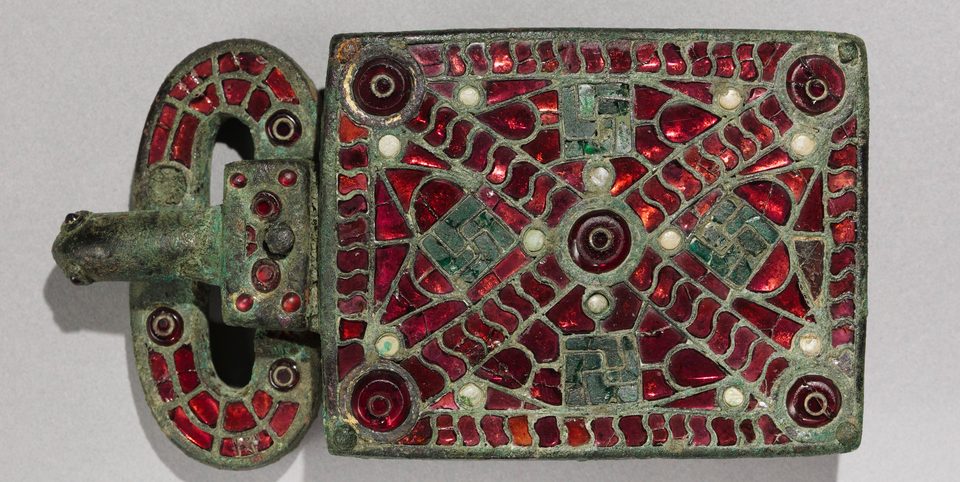
JewelryBelt buckle with garnet inlay, Visigothic Spain (about 525–560)
Cut garnets fill the cells of this bronze buckle, made for a woman. Lit from the front, the stones read as a deep wine red, about #7B282F, darkening to #441B1D in the shadows.
#7B282F#441B1D#646152
Source: Cleveland Museum of Art
Source
Sampled from the Cleveland Museum of Art’s photograph (2001.119), released as CC0 (public domain). The picture shown is a detail. Colors in a photo shift with the lighting, so read the codes as close, not exact.
#713129#280E0C#B97F41
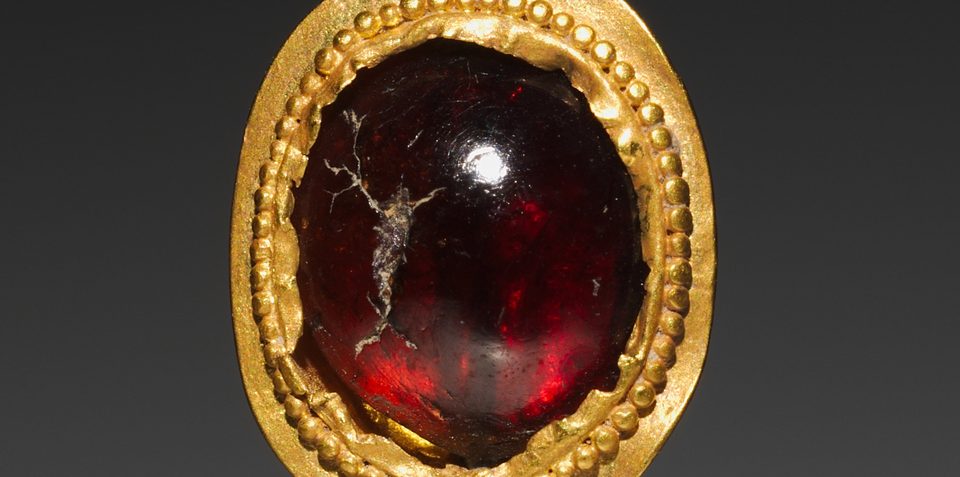
JewelryGarnet in a gold mount, Parthian Empire (1–200 CE)
A single polished garnet in a beaded gold setting. Where light shines through, the stone flares to a clear red, about #713129; elsewhere it is almost black, #280E0C, darker than the screen code.
#713129#280E0C#B97F41
Source: Cleveland Museum of Art
Source
Sampled from the Cleveland Museum of Art’s photograph (1933.192), released as CC0 (public domain). The picture shown is a detail. Colors in a photo shift with the lighting, so read the codes as close, not exact.
Logos belong to their owners and are shown unaltered, only to show where each palette comes from. Palettes are sampled in-house.
Questions
What color is garnet?
A deep red with a brownish cast. The code most references use is #733635 (RGB 115, 54, 53). Real garnets also come in green, orange and purple, but red is by far the most common.
Is garnet the same as burgundy?
No. Burgundy (#800020) is brighter and leans purple. Garnet (#733635) is softer and a little brown.
Is garnet the same as wine?
Almost. Wine’s code, #722F37, is the center of the dark red group where the ISCC-NBS dictionary files garnet. Side by side, the two are very hard to tell apart.
What is the hex code for school garnet?
It depends on the school. South Carolina uses #73000A, Florida State #782F40 and Bates #881124, each from its own brand guide.
What is the January birthstone?
Garnet. It was January’s stone in most older lists, and American jewelers kept it there in 1912.
What colors go with garnet?
Gold and cream for a classic look, black and white for contrast, navy for a collegiate feel, and soft pink or sage to lighten it.