Blue-green

The color between blue and green, and one that many languages never split.

Overview

Blue-green is the color between blue and green. The code most references use, #0D98BA, is a bright, clear blue-green with more blue than green. No standard defines it, and the name covers a wide range.

On the traditional painter’s color wheel of red, yellow and blue, blue-green is a tertiary color: the primary blue mixed with its neighbor, the secondary green. Albert Munsell made it one of the ten hues of his color system, opposite red, and wrote that it was “popularly called peacock blue”. On a screen’s RGB wheel, green and blue are both primaries, and the color halfway between them is cyan.

Many languages never split the two. In a survey of 120 languages, 68 had a single word for green and blue, which linguists call “grue”. English is going the other way: some American speakers now treat teal as a separate color between green and blue.

The usual code sits on the blue side. When people name colors themselves, their average blue green is darker and much greener, #137E6D. In design, #0D98BA makes a fresh accent. It is too light for white body text, but it carries dark text well.

HEX#0D98BA
RGBrgb(13, 152, 186)
HSLhsl(192, 87%, 39%)
HSV192°, 93%, 73%
CMYK93, 18, 0, 27
OKLCHoklch(63.0% 0.114 221.6)
Every code converts from the HEX value #0D98BA. #0D98BA is the blue-green most color references use, but no standard defines it: Wikipedia credits it only to a color website. Blue-green has no CSS keyword, and the ISCC-NBS system of color names dropped the term in favor of bluish green and greenish blue. Treat this code as typical, not official. CMYK is a screen-based estimate; print results vary.
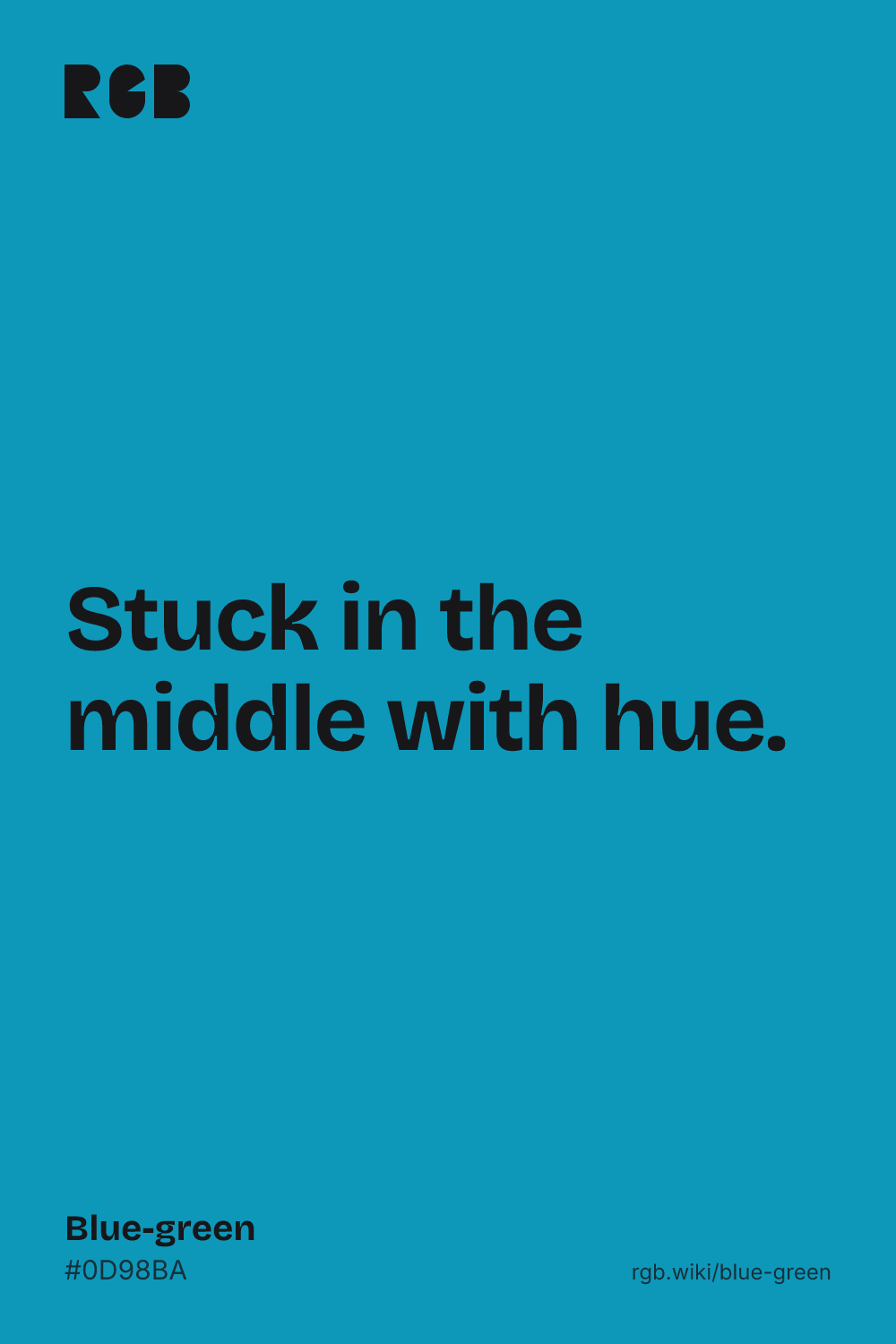
Blue-green color card, hex #0D98BA: “Stuck in the middle with hue”

Blue-green on the color map

People’s average blue green sits beyond the left edge of this view: darker and much greener. Their greenish blue is closer, but still outside the outline to the left. Teal, with equal green and blue, sits down and to the left, also outside. The ISCC-NBS brilliant greenish blue sits almost on top of the reference. The outline is an approximate range, not a measured one.

Shades and tints

Tints with white

Shades with black

Tones with gray

Blue-green sits in the middle. Tints add white, shades add black and tones add gray, in 10% steps out from it. Tap any swatch to copy its code.

Light and dark blue-green

#B6E0EA
Pale blue-greenMixed 70% with white. A soft, watery tint for backgrounds.
#76C1DA
Light blue greenThe same hue, lighter and softer.
#0D98BA
Blue-greenThe reference color.
#035C72
Dark blue greenThe same hue, much darker. Deep and inky, close to petrol blue.
#008080
TealAn even mix of screen green and blue at half strength: darker, and exactly between the two. See teal

Colors that go with blue-green

Pairings that work in rooms, outfits and interfaces.

Blue-green and coral

Near-opposites: cool water, warm reef. Bright and summery.

Blue-green and navy

Deep and nautical. Navy carries the text.

Blue-green and sand

Beach colors. Relaxed and easy.

Blue-green and red

Opposites on Munsell’s color wheel. Bold, so use red sparingly.

Blue-green and lime

Neighbors on the wheel. Fresh and outdoorsy.

Blue-green and white

Clean and airy, like surf. Good for health and travel.

Color-wheel palettes

Pick a palette to see where its colors sit on the color wheel. The caret marks blue-green. Tap a band to copy its code.

Similar colors

Cadet blue67%Bondi blue95%Blue-greenCarolina blue74%Steel blue68%Blue-gray67%Glaucous63%

Lined up by hue around blue-green. Hover a color to see how similar it is.The bar under each name shows how similar it is. Similarity comes from the distance between the two colors in OKLab, a model of how we see color.

Blue-green vs cyan

Blue-green#0D98BA · hue 192°
  • Darker, with more blue than green
  • A tertiary on the painter’s wheel
  • No standard code
Cyan#00FFFF · hue 180°
  • Green and blue both at full strength
  • A secondary on the screen’s RGB wheel
  • A CSS keyword, also called aqua

Meaning

  • One word for both
  • Tertiary color
  • Sunlight
  • Peacock blue
  • Water

Blue-green sits where two of the most basic color words meet, so its meaning starts with language. Most languages in one large survey use a single word for green and blue, and English is still drawing new lines here, with teal. As a hue, blue-green has been tested in the lab: it came out pleasant, but far from calming.

One word for green and blue

Survey of 120 languages

In the World Color Survey and related studies, 68 of 120 languages had one basic word covering both green and blue, the most common pattern. Only 30 had separate words, as English does. Linguists call the shared word “grue”.1
Sunlight may shape the words

Two studies

Languages without a word for blue are more common where sunlight carries more ultraviolet. One theory is that years of strong UV brown the eye’s lens and dull blues. A 2021 analysis of 142 populations found UV mattered, along with cultural factors.2, 3

Pleasant, but not calming

One lab study

In a 1994 study with Munsell color chips, blue-green was among the most pleasant hues, and also among the most arousing. That cuts against the idea that blue-greens soothe. The study tested the hue, not this exact code.4

Sources (4)
  1. Kay, P. & Maffi, L. (2013). “Green and Blue”. In Dryer, M. S. & Haspelmath, M. (eds.), The World Atlas of Language Structures Online, chapter 134.
  2. Lindsey, D. T. & Brown, A. M. (2002). Color naming and the phototoxic effects of sunlight on the eye. Psychological Science, 13(6), 506–512. doi:10.1111/1467-9280.00489
  3. Josserand, M., Meeussen, E., Majid, A. & Dediu, D. (2021). Environment and culture shape both the colour lexicon and the genetics of colour perception. Scientific Reports, 11, 19095. doi:10.1038/s41598-021-98550-3
  4. Valdez, P. & Mehrabian, A. (1994). Effects of color on emotions. Journal of Experimental Psychology: General, 123(4), 394–409. doi:10.1037/0096-3445.123.4.394

History

Blue-green has been a mixing color for painters, a formal hue for color scientists and, in many languages, simply part of one word.

  1. 1905

    Albert Munsell’s A Color Notation sets out five principal hues with five more in between. Blue-green is one of them, between green and blue and opposite red.1, 2

  2. 1907

    In the book’s second edition, Munsell writes that blue-green is “popularly called peacock blue”.2

  3. 1930

    Maerz and Paul’s A Dictionary of Color complains that paints sold as “blue-greens” range “from plain Green to plain Blue”.3

  4. 1955

    The ISCC-NBS method of naming colors drops the double term blue-green and uses bluish green and greenish blue instead.4

  5. 1969

    Brent Berlin and Paul Kay’s Basic Color Terms argues that languages gain color words in a broadly fixed order. In their account, words for brown, purple, pink, orange and gray come only after green and blue are told apart.5

  6. Late 1970s

    The World Color Survey records color names in 110 languages. Over half turn out to have a single “grue” word.6

  7. 2002

    Delwin Lindsey and Angela Brown link languages without “blue” to strong ultraviolet light, which ages the eye’s lens.7

  8. 2014

    A study of American English finds a “green-teal-blue” pattern, with teal emerging as a category between green and blue.8

  9. 2021

    A study of 142 populations finds that ultraviolet light and cultural factors both help predict whether a language has its own word for blue.9

Sources (9)
  1. Wikipedia, “Munsell color system”, citing Munsell’s A Color Notation (1905), chapter 2.
  2. Munsell, A. H. (1907). A Color Notation, 2nd ed., paragraphs 57–61. Project Gutenberg.
  3. Maerz, A. & Paul, M. R. (1930). A Dictionary of Color. New York: McGraw-Hill. Introduction, on the names of colors. Internet Archive.
  4. Kelly, K. L. & Judd, D. B. (1955). The ISCC-NBS Method of Designating Colors and a Dictionary of Color Names. NBS Circular 553, section 4.3. NIST PDF.
  5. Wikipedia, “Blue–green distinction in language”, citing David Crystal’s Cambridge Encyclopedia of Language (1997).
  6. Kay, P. & Maffi, L. (2013). “Green and Blue”. The World Atlas of Language Structures Online, chapter 134.
  7. Lindsey, D. T. & Brown, A. M. (2002). Color naming and the phototoxic effects of sunlight on the eye. Psychological Science, 13(6), 506–512. doi:10.1111/1467-9280.00489
  8. Lindsey, D. T. & Brown, A. M. (2014). The color lexicon of American English. Journal of Vision, 14(2), 17. doi:10.1167/14.2.17
  9. Josserand, M., Meeussen, E., Majid, A. & Dediu, D. (2021). Environment and culture shape both the colour lexicon and the genetics of colour perception. Scientific Reports, 11, 19095. doi:10.1038/s41598-021-98550-3

Blue-green in use

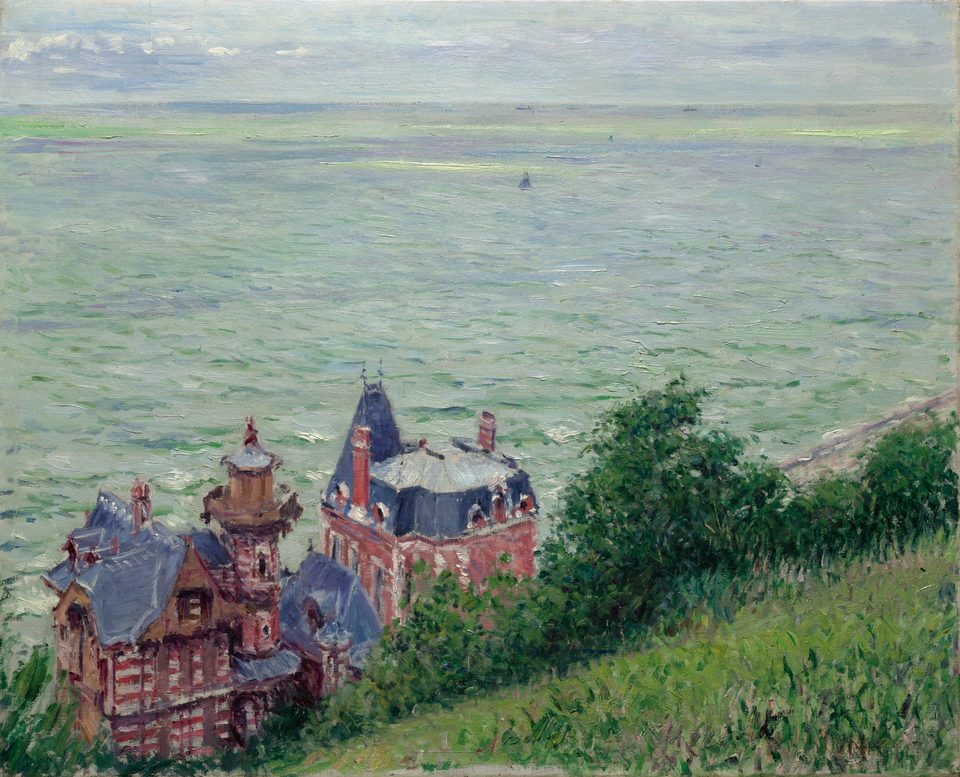
Caillebotte’s view from a grassy cliff over red-brick villas with slate roofs to a wide, pale blue-green sea under a cloudy sky
#A0B0AA#96A89C#AFBCB3#839988
PaintingVillas at Trouville (1884)

Gustave Caillebotte painted this view of the sea from a cliff at Trouville, on the Normandy coast. The Cleveland Museum of Art describes the water as blue-green. In the photo it samples as soft, grayish sea greens, much paler and greener than the web code.

#A0B0AA#96A89C#AFBCB3#839988
Source: Cleveland Museum

Palettes are sampled in-house.

Questions

What color is blue-green?

The color between blue and green. The code most references use is #0D98BA (RGB 13, 152, 186), a bright blue-green with more blue than green. No standard defines it.

Is blue-green a tertiary color?

Yes, on the traditional red-yellow-blue color wheel: it mixes the primary blue with the secondary green. On a screen’s RGB wheel, green and blue are both primaries, and the color halfway between them is cyan.

Is blue-green the same as green-blue?

Loosely, yes: both name colors between blue and green. Formal systems split them. The ISCC-NBS system uses bluish green for colors closer to green and greenish blue for colors closer to blue.

Why do some languages have one word for blue and green?

It is the most common pattern: in a survey of 120 languages, 68 had a single “grue” word. Languages tend to gain color words over time, and green and blue are often split late. Strong sunlight may also play a part.

What is the difference between blue-green and teal?

Teal (#008080) is darker, with green and blue exactly equal. The usual blue-green code (#0D98BA) is lighter and leans blue.

What colors go with blue-green?

Coral and red for contrast, navy and white for something crisp, sand for a beachy feel, and lime green as a fresh neighbor.