Bubblegum pink

A light, sweet candy pink, named after a gum that was pink by chance.

Overview

Bubblegum pink is a light, sugary pink with a slight purple lean, the color of a fresh piece of bubble gum. Its code, #FE83CC, has red almost at full strength, green at 51% and blue at 80%. That makes it cooler and a little purpler than hot pink, and brighter than flamingo pink.

The color comes from the candy, and the candy’s color, by the inventor’s own account, came from what was on the shelf. In 1928 Walter Diemer, an accountant at the Fleer gum company in Philadelphia, cooked up a gum base that stretched into bubbles without sticking to the face. He later said he made it pink because pink was the only food coloring he had on hand. The story was told decades later and no record from 1928 confirms it, but pink became the classic color of bubble gum.

No color standard defines bubblegum pink. The code is the average color that people named “bubblegum pink” in the 2010 xkcd color survey. Spelling changed the answer: people who typed just “bubblegum”, or “bubble gum pink” with a space, picked a deeper pink almost identical to the web’s hotpink. Wikipedia’s list of pinks uses a warmer, coral-leaning colored pencil color, #F58092.

By the late 1960s “bubblegum” had also become a word for things made for kids and young teens, from bubblegum pop to bubblegum fashions. On screen, #FE83CC is light enough for black text (contrast 9.3:1); white text does not work on it. It looks playful with mint and lemon, retro with sky blue and grown-up with charcoal or denim.
HEX#FE83CC
RGBrgb(254, 131, 204)
HSLhsl(324, 98%, 75%)
HSV324°, 48%, 100%
CMYK0, 48, 20, 0
OKLCHoklch(76.9% 0.170 345.3)
Every code converts from the HEX value #FE83CC. #FE83CC is the average color that people named “bubblegum pink” in the xkcd color survey (2010), published in its CC0 list of color names. No color dictionary or standard defines bubblegum pink, and it is not a CSS keyword. Wikipedia shows a colored pencil color, #F58092, instead. CMYK is a screen-based estimate; print results vary.
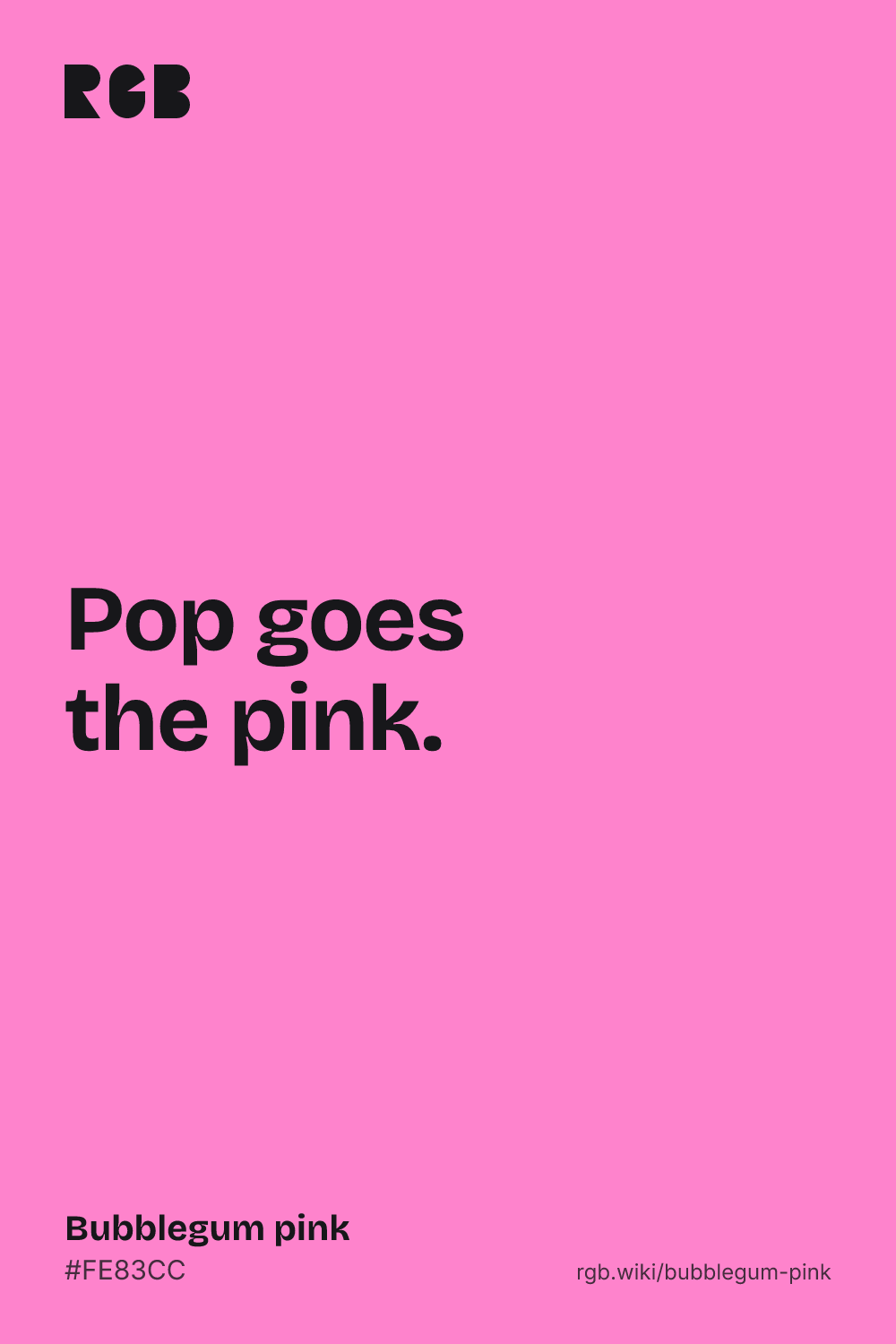
Bubblegum pink color card, hex #FE83CC: “Pop goes the pink”

Bubblegum pink on the color map

The two other survey answers, bubblegum and bubble gum pink, sit just below the base and a little to the right, inside the outline: deeper and slightly warmer, on top of each other. The colored pencil value falls far to the right, past the edge of the outline, warmer and closer to coral. The outline is an approximate range, not a measured one.

Shades and tints

Tints with white

Shades with black

Tones with gray

Bubblegum pink sits in the middle. Tints add white, shades add black and tones add gray, in 10% steps out from it. Tap any swatch to copy its code.

Light and dark bubblegum pink

#FFCDEB
Pale bubblegumMixed 60% with white. A soft candy pink for backgrounds.
#FEB5E0
Light bubblegumMixed 40% with white.
#FE83CC
Bubblegum pinkThe reference color.
#FF69AF
Bubble gum pink (survey)People’s average for the name written with a space, in the xkcd survey. It is practically hot pink. See hot pink
#984F7A
Deep bubblegumMixed 40% with black. Dark enough for white text, for buttons and headings.
#663452
Dark bubblegumMixed 60% with black. A plum-colored shade for text on pale pink.

Colors that go with bubblegum pink

Pairings that work in rooms, outfits and interfaces.

Candy shop

Bubblegum with mint and lemon, like a jar of mixed sweets. Bright and cheerful.

Bubblegum and gray

A cool gray keeps the pink calm and modern. Good for a product page or an app.

Bubblegum pop

Late-1960s pop colors: candy pink with sky blue and sunshine yellow.

Bubblegum and denim

Faded blue denim takes the sugar out of the pink. Casual and easy to wear.

Bubblegum and charcoal

A dark theme where the pink glows. Bold, a little punk.

Tonal bubblegum

Tints and shades of one pink, with dark bubblegum for text. Soft and consistent.

Color-wheel palettes

Pick a palette to see where its colors sit on the color wheel. The caret marks bubblegum pink. Tap a band to copy its code.

Similar colors

Orchid58%Bubblegum pinkHot pink73%Carnation pink59%Baker-Miller pink70%Flamingo pink71%Watermelon51%

Lined up by hue around bubblegum pink. Hover a color to see how similar it is.The bar under each name shows how similar it is. Similarity comes from the distance between the two colors in OKLab, a model of how we see color.

Bubblegum pink vs hot pink

Bubblegum pink#FE83CC · hue 324°
  • Lighter and a little purpler
  • The xkcd survey’s bubblegum pink
  • Named after a 1920s candy
Hot pink#FF69B4 · hue 330°
  • Deeper and warmer
  • The CSS keyword hotpink
  • The 1950s name for shocking pink

Meaning

  • Candy
  • Made for kids
  • Bubblegum pop
  • Sweet taste

Bubblegum pink means candy: a gum that, by its inventor’s account, turned pink because that was the coloring at hand. The word bubblegum came to mean anything made for kids and young teens, and in experiments people match pink with sweet tastes. Those studies test plain pink color patches, not this named shade.

Pink by chance, by his account

Inventor’s account

Walter Diemer said he made his 1928 bubble gum pink because it was the one food coloring he happened to have on hand. Reporters and historians have repeated the story ever since, but it comes from Diemer himself, told decades later, and no record from 1928 confirms it.1, 2, 3

Bubblegum came to mean made for kids

Word history

Merriam-Webster dates the adjective bubblegum, “appealing to or characteristic of preteens or adolescents”, to 1969. The record producers Jerry Kasenetz and Jeffry Katz said they coined “bubblegum music” for pop aimed at young teens, and The Archies’ “Sugar, Sugar” was the best-selling hit of 1969.4, 5

People match pink with sweet

Experiment

In taste-matching experiments, adults link pink or red with sweet tastes far more than with sour, bitter or salty ones, a pattern a 2016 Oxford study replicated. Japanese preschoolers aged 3 to 6 showed the same pink–sweet link. The studies used plain pink swatches, not bubblegum pink, and they do not show that pink makes gum taste sweeter.6, 7

Two spellings, two pinks

Survey

In the 2010 xkcd survey, people who wrote “bubblegum pink” as one word chose a light, slightly purple pink, the code on this page. People who wrote “bubblegum” alone, or “bubble gum pink” with a space, chose a deeper pink that is almost the same as hot pink.8

Sources (8)
  1. CBS News (2017). “Almanac: The inventor of bubble gum”. CBS Sunday Morning, January 8, 2017.
  2. Anthony, T. (2026). “A sweet (and chewy) path: One man’s life in gum, and the ripples his innovation caused”. The Associated Press, “American Objects” series, November 12, 2026.
  3. Byrne, K. J. (2024). “Meet the American who created bubble gum, Walter Diemer”. Fox News, May 10, 2024, quoting Lee Wardlaw’s Bubblemania (1997).
  4. Merriam-Webster, “bubblegum” and “bubble gum”, definitions and first known use.
  5. Wikipedia, “Bubblegum music”, citing Cafarelli, C. (1997), “An Informal History of Bubblegum Music”, Goldmine 437.
  6. Woods, A. T., Marmolejo-Ramos, F., Velasco, C. & Spence, C. (2016). Using single colors and color pairs to communicate basic tastes II: Foreground-background color combinations. i-Perception, 7(5). doi:10.1177/2041669516663750
  7. Meng, X., Chen, N., Ishida, J., Watanabe, K. & Murakami, T. (2023). Crossmodal correspondences between visual features and tastes in preschoolers: an exploratory study. Frontiers in Psychology, 14, 1226661. doi:10.3389/fpsyg.2023.1226661
  8. Munroe, R. (2010). “Color survey results”. xkcd blog. The survey’s color averages are released as CC0 data in rgb.txt.

History

Bubblegum pink is younger than the candy it is named after. The word bubble gum came first, then a gum that really bubbled, and the pink came with it, by its inventor’s account more or less by accident.

  1. 1906

    The confectioner Frank H. Fleer makes an early bubble gum, Blibber-Blubber. It is too brittle and sticky to sell.1

  2. 1910

    First known use of “bubble gum” in English, for a chewing gum that can be blown into bubbles.2

  3. 1928

    Walter Diemer, an accountant at the Fleer company in Philadelphia, works out a gum base that stretches into bubbles. In August he brings a five-pound batch into the office.3 He later says he made it pink because that was the one food coloring he had on hand.4, 5

  4. December 26, 1928

    The first 100 pieces, wrapped in taffy paper, go to a local candy shop.3

  5. 1968–69

    The producers Jerry Kasenetz and Jeffry Katz say they coined “bubblegum music” for pop aimed at young teens. The Archies’ “Sugar, Sugar” is the best-selling hit of 1969, and Merriam-Webster dates the adjective bubblegum, “appealing to or characteristic of preteens or adolescents”, to the same year.6, 2

  6. 1998

    Diemer dies on January 8, at 93.4 By his own telling, he never made much money from his invention.5

  7. 2010

    In the xkcd color survey, the average color people call bubblegum pink is #FE83CC, the source of today’s code. The same name with a space, and plain bubblegum, come out deeper, close to hot pink.7

Sources (7)
  1. Wikipedia, “Blibber-Blubber”, citing Nix, E., “Chew on This: The History of Gum”, History (A&E Television Networks).
  2. Merriam-Webster, “bubblegum” and “bubble gum”, definitions and first known use.
  3. Byrne, K. J. (2024). “Meet the American who created bubble gum, Walter Diemer”. Fox News, May 10, 2024, quoting Lee Wardlaw’s Bubblemania (1997).
  4. CBS News (2017). “Almanac: The inventor of bubble gum”. CBS Sunday Morning, January 8, 2017.
  5. Anthony, T. (2026). “A sweet (and chewy) path: One man’s life in gum, and the ripples his innovation caused”. The Associated Press, November 12, 2026.
  6. Wikipedia, “Bubblegum music”, citing Cafarelli, C. (1997), “An Informal History of Bubblegum Music”, Goldmine 437.
  7. Munroe, R. (2010). “Color survey results”. xkcd blog. The survey’s color averages are released as CC0 data in rgb.txt.

Questions

What color is bubblegum pink?

A light, sweet candy pink with a slight purple lean, the color of fresh bubble gum. Its usual code is #FE83CC (RGB 254, 131, 204).

Where does the hex code #FE83CC come from?

It is the average color people named bubblegum pink in the 2010 xkcd color survey. No color standard defines bubblegum pink, and it is not a CSS keyword.

Why is bubble gum pink?

Walter Diemer, who made the first successful bubble gum at a Philadelphia gum company in 1928, said he colored it pink because pink was the only food coloring he had on hand. The story comes from Diemer himself, years later, and no record from 1928 confirms it.

Is bubblegum pink the same as hot pink?

Close, but not quite. Bubblegum pink, #FE83CC, is lighter and a little purpler than hot pink, #FF69B4. In the xkcd survey, though, people who wrote just bubblegum, or bubble gum pink with a space, picked a pink almost identical to hot pink.

Is it bubblegum pink or bubble gum pink?

Both spellings name the same color. Merriam-Webster spells the gum as two words and the adjective as one, and both forms are common for the color.

Can I use white text on bubblegum pink?

Not for body text. White on #FE83CC has a contrast of only about 2.3:1. Black or a dark plum reads well, at about 9.3:1 for black. For a button with white text, use a deep shade such as #984F7A.

What colors go with bubblegum pink?

Mint green and lemon yellow for a candy look, sky blue for a retro pop feel, and charcoal, gray or faded denim to calm it down.

What does bubblegum mean when it describes music or fashion?

Made for or typical of preteens and young teens. Merriam-Webster dates this sense of bubblegum to 1969, the peak of bubblegum pop.