Denim blue

A strong mid blue named after the indigo-dyed cotton of blue jeans.

Overview

Denim blue is a strong, medium blue named after the cloth of blue jeans. Its usual code is #1560BD: blue at 74%, green at 38% and almost no red. That makes it clean and bright, close to sapphire, and a good deal livelier than most real jeans.

Denim is a sturdy cotton twill. Only the lengthwise warp threads are dyed with indigo; the crosswise weft threads stay white. The weave brings the blue warp to the front and the white weft to the back, which is why jeans are blue outside and pale inside. The name is French: serge de Nîmes, a serge cloth from the city of Nîmes, shortened in English to denim.

Denim also fades in a way few dyed fabrics do. Indigo does not soak into cotton the way most dyes do. Yarn is dipped in the dye bath and aired again and again, and each dip adds a layer of blue to the outside, while the core of the yarn stays white. As the surface wears away at the knees, seams and pockets, the white shows through. Stonewashing copies the effect with pumice stones, so “denim blue” covers everything from near-navy raw cloth to a pale, bleached sky blue.

The code #1560BD comes from a crayon color called denim, not from any standard. When people in the xkcd color survey named colors themselves, their average denim blue was a grayer, darker #3B5B92, much nearer to a pair of worn jeans. On screen, the code carries white text well (6.1:1) and pairs naturally with white, copper, tan and a red accent.

HEX#1560BD
RGBrgb(21, 96, 189)
HSLhsl(213, 80%, 41%)
HSV213°, 89%, 74%
CMYK89, 49, 0, 26
OKLCHoklch(50.0% 0.162 256.9)
Every code converts from the HEX value #1560BD. #1560BD is the value color lists give for denim, a crayon color introduced in 1993 (see Wikipedia’s list of colors). No color standard defines denim blue: the ISCC-NBS dictionaries and the CSS color names have no entry, and the xkcd color survey average is a grayer #3B5B92. CMYK is a screen-based estimate; print results vary.
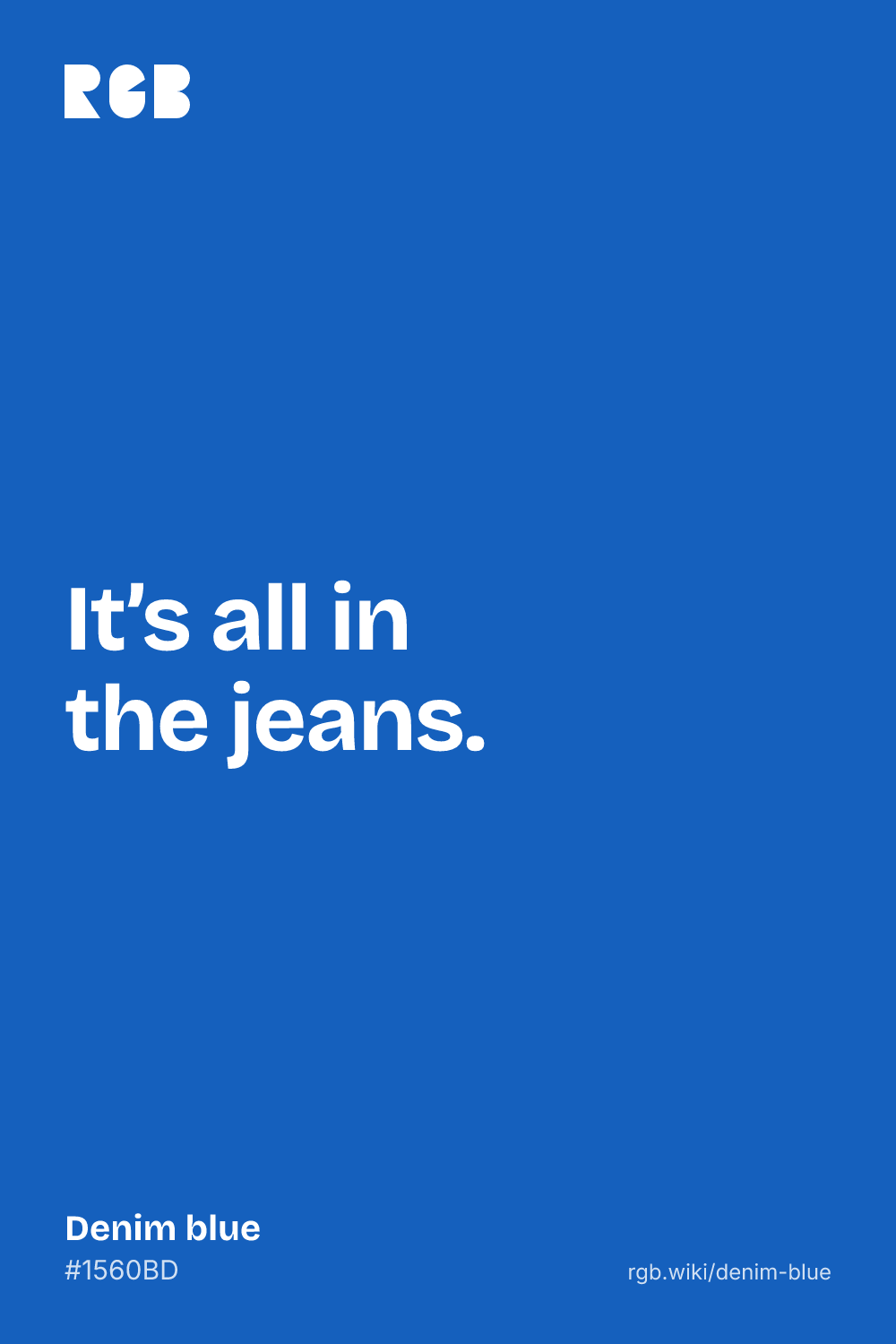
Denim blue color card, hex #1560BD: “It’s all in the jeans”

Denim blue on the color map

Both xkcd survey averages sit just below the code, inside the outline: a little darker, and much grayer than the dot alone shows. The survey’s denim blue leans a touch toward violet and its plain denim a touch toward green. The second crayon value sits lower and further toward violet, still inside the outline. The outline is an approximate range, not a measured one.

Shades and tints

Tints with white

Shades with black

Tones with gray

Denim blue sits in the middle. Tints add white, shades add black and tones add gray, in 10% steps out from it. Tap any swatch to copy its code.

Light and dark denim blue

#A1BFE5
Light denim blueMixed 60% with white. A soft, faded blue for backgrounds.
#73A0D7
Washed denim blueMixed 40% with white. Light enough for dark text.
#1560BD
Denim blueThe reference color.
#3B5B92
Survey denim blueThe xkcd survey’s average denim blue: grayer and a little darker.
#0D3A71
Dark denim blueMixed 40% with black. For headings, footers and dark buttons.
#08264C
Deep denim blueMixed 60% with black. Close to navy, for dark themes.

Colors that go with denim blue

Pairings that work in rooms, outfits and interfaces.

Denim and white

Blue and white, like jeans and a white shirt. Crisp and easy for everyday interfaces.

Copper rivets

Copper and tan leather, the hardware of work jeans, on a warm off-white.

Contrast stitching

Golden thread on dark denim. A workwear classic that also suits a dark theme.

Raw to faded

One blue from dark to pale, the way a pair of jeans changes with wear. Calm and tonal.

Denim and red

A red work bandana against blue. Loud, friendly and a little Americana.

Denim on charcoal

A dark theme. Denim blue is too dark to read on charcoal, so the lighter washed tint carries the links and buttons.

Color-wheel palettes

Pick a palette to see where its colors sit on the color wheel. The caret marks denim blue. Tap a band to copy its code.

Similar colors

Peacock blue64%Ocean blue69%French blue75%True blue73%Denim blueAzurite73%Sapphire81%

Lined up by hue around denim blue. Hover a color to see how similar it is.The bar under each name shows how similar it is. Similarity comes from the distance between the two colors in OKLab, a model of how we see color.

Denim blue vs sapphire

Denim blue#1560BD · hue 213°
  • A touch lighter and greener
  • Named after indigo-dyed cotton
  • A crayon color, with no standard behind it
Sapphire#0F52BA · hue 216°
  • Deeper and a little more intense
  • Named after the blue gemstone
  • Carries white text even better (7.2:1)

Meaning

  • Workwear
  • Everyday
  • Fading
  • Footprint

Denim blue means jeans, and jeans carry a story: work clothes that became youth fashion and then the world’s most ordinary garment. The color also means fading, because indigo denim is made to wear in, and it now carries questions about the water and chemicals the dye needs. Studies of color and emotion test broad words like “blue”, not denim blue, so its mood is a matter of association, not measurement.

From work clothes to everyday wear

Historical record

Denim has been used in the United States since the mid-19th century, first for hard-wearing work clothes. In the 1950s and 1960s young people took it up as a sign of rebellion, and by the end of the 1960s it was everyday fashion in Europe and far beyond.1

Half the world in jeans, by one estimate

Anthropologists’ estimate

The anthropologists Daniel Miller and Sophie Woodward open their book Global Denim (2011) with the estimate that on any given day nearly half the world’s population is wearing blue jeans. It is a striking estimate, not a measured count, but it shows how ordinary denim blue has become.2

Fading is built into the dye

Textile chemistry

Indigo dyes only the outside of a cotton yarn and leaves its core undyed, a pattern called ring dyeing. When the surface wears or is abraded away, the white core shows through. That is why jeans fade most at the knees, seams and pockets, and why stonewashing works.3, 4

The blue has an environmental cost

Scientific studies

Indigo is the only known molecule that gives blue denim its hue, and it is a vat dye that needs harsh reducing agents such as sodium dithionite. Dyeing has polluted waterways and soil. A 2026 study of a large rope-dyeing plant found emissions of about 2.3 kg of CO₂-equivalent for every kilogram of dyed yarn.5, 6

Sources (6)
  1. Wikipedia, “Denim”, History.
  2. Miller, D. & Woodward, S. (Eds.) (2011). Global Denim. Oxford: Berg (Bloomsbury). doi:10.2752/9781472504401
  3. McFarland, J. E., Davis, E., Jr. & Teague, E. W. (1996). Reduced indigo dye penetration. US Patent 5,514,187. Google Patents.
  4. Wikipedia, “Denim”, Dyeing.
  5. Bidart, G. N., Teze, D., Jansen, C. U. et al. (2024). Chemoenzymatic indican for light-driven denim dyeing. Nature Communications, 15, 1489. doi:10.1038/s41467-024-45749-3
  6. Abdelileh, M., Haddad, H. & Dhaouadi, H. (2026). Environmental life cycle assessment of indigo rope dyeing for denim production: a case study from the Tunisian textile industry. Environmental Science and Pollution Research, 33(20), 10218–10230. doi:10.1007/s11356-026-37961-z

History

Denim blue is the story of a cloth, not a pigment. Its names come from two textile cities, and its look comes from how indigo is dyed and how it wears off.

  1. 1567

    First known use of “jean” in English, short for jean fustian, a cotton cloth named after Genoa, Italy (Gênes in French).1

  2. 1695

    First known use of “denim”. The cloth was a heavy serge called serge de Nîmes. Because the “s” of Nîmes is silent in French, English wrote it serge de Nim, then serge denim, and finally just denim.2

  3. Late 1600s

    A painter in northern Italy, now called the Master of the Blue Jeans, shows poor working people dressed in a blue cloth that looks like denim, probably the cheaper Genoese jean. A 2010 exhibition in Paris brought ten of these paintings together.3, 4

  4. 1915

    Rope-dyeing machines arrive. Before this, cotton yarn was dyed in skeins dipped by hand; now long ropes of yarn run in and out of the indigo vats on rollers, picking up color with each dip.5

  5. 1965

    A boutique in New York’s East Village is said to be the first shop to wash new jeans to make them look worn, and the idea catches on.3

  6. 1970s

    Slasher, or sheet, dyeing machines are developed, dyeing the yarn laid out flat in the order it will be woven.5

  7. Early 1980s

    The denim industry takes up stonewashing, tumbling jeans with pumice stones, and the faded look becomes a mass-market product.3

  8. 1993

    A crayon color called denim, #1560BD, is introduced. It becomes the code most color lists give for denim blue.6, 7

  9. 1996

    A US patent spells out why denim fades: the cotton is “ring dyed”, colored only around the outside of the yarn, so wearing or abrading the surface leaves the undyed core exposed.8

  10. 2010

    In the xkcd color survey, the average color people call denim blue is #3B5B92, grayer and darker than the crayon code.9

Sources (9)
  1. Merriam-Webster, “jean”, etymology and first known use.
  2. Merriam-Webster, “denim”, etymology, first known use and “Did you know?” note.
  3. Wikipedia, “Jeans”, History.
  4. Gruber, G. (2010). The Master of the Blue Jeans: A New Painter of Reality in Late 17th Century Europe. Paris: Galerie Canesso.
  5. Wikipedia, “Denim”, Dyeing.
  6. Wikipedia, “List of colors: A–F”, denim.
  7. Wikipedia, list of crayon colors, standard colors table: denim, #1560BD, 1993 to the present.
  8. McFarland, J. E., Davis, E., Jr. & Teague, E. W. (1996). Reduced indigo dye penetration. US Patent 5,514,187. Google Patents.
  9. Munroe, R. (2010). xkcd color survey results (CC0).

Denim blue in use

All brand colors

Logos belong to their owners and are shown unaltered, only to show where each palette comes from. Palettes are sampled in-house.

Questions

What color is denim blue?

A strong, medium blue named after the cloth of blue jeans. The usual code is #1560BD (RGB 21, 96, 189). Real indigo denim is usually darker and grayer, from near-navy when new to pale blue when faded.

Where does the code #1560BD come from?

It is the value of a crayon color called denim, introduced in 1993. No color standard or dictionary defines denim blue. People in the xkcd color survey picked a grayer, darker average, #3B5B92.

Why is denim blue?

Classic denim is a cotton twill whose warp threads are dyed with indigo while the weft threads stay white. The weave puts the blue threads on the front and the white ones on the back, which is why jeans are paler inside.

Why do jeans fade?

Indigo colors only the outside of each cotton yarn and leaves the core white, which is called ring dyeing. As the surface wears away, the white core shows through, most of all at the knees, seams and pockets. Stonewashing speeds this up with pumice stones.

Where does the word denim come from?

From the French serge de Nîmes, a serge cloth from the city of Nîmes. English shortened it to serge denim and then denim. Merriam-Webster dates the word to 1695. Jean, the related cloth, is named after Genoa.

What colors go with denim blue?

White for a crisp everyday look, copper and tan like the rivets and leather patches of work jeans, mustard gold like contrast stitching, and a bright red for a bold accent.

What is the difference between denim blue and navy blue?

Navy blue (#000080) is a much darker, pure blue. Denim blue (#1560BD) is a lighter, brighter medium blue. New, unwashed indigo denim is often closer to navy than to the denim blue code.

Can I use white text on denim blue?

Yes. White text on #1560BD has a contrast ratio of about 6.1:1, enough for body text. Black text reaches only 3.4:1, so keep it for large headings.