Woad

A soft, grayish blue named after Europe’s old plant dye.

Overview

Woad is a plant, Isatis tinctoria, a yellow-flowered member of the mustard family whose leaves give a blue dye. As a color name it means the soft, grayish mid blue of woad-dyed cloth, usually shown on screen as #5A7BA6.

The dye in woad is the same molecule as in indigo, only at a much lower concentration. For centuries woad was Europe’s main blue dye. It was grown and processed on a huge scale around Toulouse in southern France, where it was called pastel, around Erfurt in Thuringia, and in England, until cheaper indigo from Asia began to replace it in the 1500s.

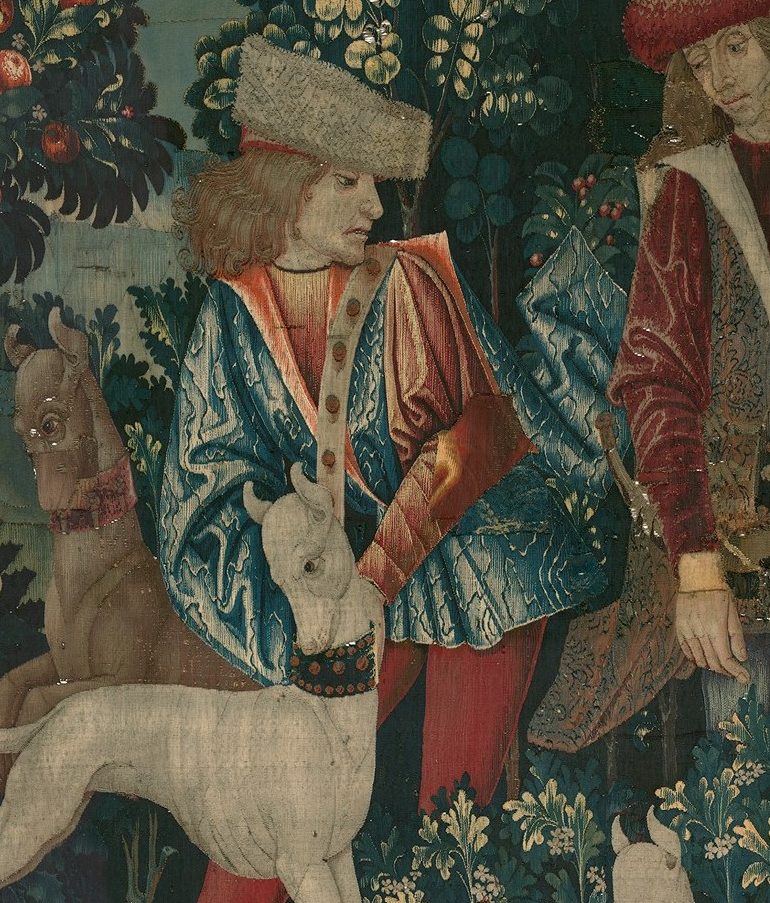
Woad-dyed cloth ranges from pale sky blue to near navy, depending on the strength of the vat and the number of dips, and old woad blues have often faded or shifted. The blue wool of a hunter’s doublet in the Unicorn Tapestries now photographs as a deep teal, about #264545.

As a design color, #5A7BA6 is calm and slightly muted. It works with cream and undyed wool, with the yellow of weld and the red of madder, the other two great European dye plants, and with rust and sage.

HEX#5A7BA6
RGBrgb(90, 123, 166)
HSLhsl(214, 30%, 50%)
HSV214°, 46%, 65%
CMYK46, 26, 0, 35
OKLCHoklch(57.6% 0.077 255.3)
Every code converts from the HEX value #5A7BA6. #5A7BA6 is the code most color references use for woad blue, but no standard defines it. Maerz and Paul’s A Dictionary of Color (1930) has a color called woad, and the 1955 ISCC-NBS dictionary files it as a grayish blue, darker and grayer than this code. Treat this code as typical, not official. CMYK is a screen-based estimate; print results vary.
Woad color card, hex #5A7BA6: “On the woad again”

Woad on the color map

The dictionary’s woad sits inside the outline, darker and much grayer than the code. The tapestry wool, dyed more than 500 years ago, now photographs far darker and greener and falls off the close view, toward the bottom left. The xkcd survey has no average for woad. The outline is an approximate range, not a measured one.

Shades and tints

Tints with white

Shades with black

Tones with gray

Woad sits in the middle. Tints add white, shades add black and tones add gray, in 10% steps out from it. Tap any swatch to copy its code.

Light and dark woad

#CED7E4
Pale woadMixed 70% with white. Like cloth given one quick dip in the vat.
#9CB0CA
Light woadMixed 40% with white. A soft, washed blue.
#5A7BA6
WoadThe reference color.
#364A64
Dark woadMixed 40% with black. Like cloth dipped again and again.

Colors that go with woad

Pairings that work in rooms, outfits and interfaces.

Woad and weld

Blue with the yellow of the old dyer’s plant. Bright but earthy.

Woad and madder

The blue and red of medieval cloth. Warm and classic.

Woad and undyed wool

Blue with oatmeal and brown. Quiet and handmade.

Deep vat

A dark theme in the deepest woad blues. Calm at night.

Woad and sage

Two muted garden colors. Soft and natural.

Woad and rust

A warm accent against cool blue. Good for workwear and craft brands.

Color-wheel palettes

Pick a palette to see where its colors sit on the color wheel. The caret marks woad. Tap a band to copy its code.

Similar colors

Cerulean71%Steel blue85%Slate gray75%Light slate gray69%WoadGlaucous85%Dark periwinkle69%

Lined up by hue around woad. Hover a color to see how similar it is.The bar under each name shows how similar it is. Similarity comes from the distance between the two colors in OKLab, a model of how we see color.

Woad vs indigo

Woad#5A7BA6 · hue 214°
  • From a European plant, Isatis tinctoria
  • A soft, grayish mid blue
  • Little dye per leaf, so weaker vats
Indigo#4B0082 · hue 275°
  • From tropical plants, mainly Indigofera tinctoria
  • On screen, a deep blue-violet
  • The same blue molecule, far more concentrated

Meaning

  • Plant dye
  • Tapestry
  • Trade
  • Dye vat
  • Toulouse and Erfurt

Woad stands for old Europe’s blue: working cloth, tapestries, and the fortunes of the towns that grew and sold it. It also carries a famous myth, ancient Britons painted blue for battle, that rests on much weaker evidence than its fame suggests. Color research tests basic hues such as blue, not woad, so there is no evidence about its mood.

The same dye as indigo

Plant chemistry

Woad leaves hold colorless compounds that, after fermenting and meeting air, turn into indigotin, the blue molecule of indigo. Woad simply holds much less of it than tropical indigo plants, which is why imported indigo won once sea trade made it cheap.1, 2
Blue-painted Britons: weak evidence

Disputed

Julius Caesar wrote that the Britons colored themselves with “vitrum” to look more frightening in battle. The word usually means glass, and reading it as woad is a guess. Woad is too caustic to work as a tattoo pigment in experiments, and a study of the Lindow Man bog body pointed to a copper- or iron-based body paint instead. The name Picts, “painted ones”, first appears in 297, about 350 years after Caesar.3, 2, 4

Protected by law

Historical record

As Indian indigo arrived, woad growers fought back. Indigo was said to rot yarn, and a French edict of 1609 under Henry IV banned, under penalty of death, “the false and pernicious Indian drug”. German, English and Dutch rulers passed similar laws.5, 2

Sources (5)
  1. Speranza, J., Miceli, N., Taviano, M. F., et al. (2020). “Isatis tinctoria L. (Woad): A Review of Its Botany, Ethnobotanical Uses, Phytochemistry, Biological Activities, and Biotechnological Studies.” Plants 9(3): 298. doi:10.3390/plants9030298.
  2. Wikipedia, “Isatis tinctoria”, citing Gillian Carr, “Woad, Tattooing and Identity in Later Iron Age and Early Roman Britain”, Oxford Journal of Archaeology (2005), and Pyatt et al., “Non Isatis Sed Vitrum or, the Colour of Lindow Man”, Oxford Journal of Archaeology (1991).
  3. Caesar, J. Commentaries on the Gallic War, book 5, chapter 14, translated by W. A. McDevitte and W. S. Bohn (1869). Project Gutenberg.
  4. Wikipedia, “Picts”, citing Nixon and Rodgers, In Praise of Later Roman Emperors (1994), and James E. Fraser, From Caledonia to Pictland (2009).
  5. Foucaud, E. (1846). The Book of Illustrious Mechanics of Europe and America, translated by John Frost, p. 236. Internet Archive.

History

Woad’s story runs from Iron Age pits to medieval boom towns, a royal ransom and a death penalty, and ends when cheaper indigo, then synthetic dye, took its place.

  1. Iron Age

    Woad seeds and pod fragments are left in a pit at Dragonby, in Lincolnshire, England, early evidence of the plant in Britain.1

  2. 54 BCE

    After his second landing in Britain, Julius Caesar writes that all the Britons color themselves with “vitrum”, which gives a blue color and a more frightening look in battle. The word has often been translated as woad, but it usually means glass.2, 1

  3. 297

    A Roman speech in praise of the emperor first names the Picti, “painted ones”, of northern Britain. The name is usually taken to mean tattoos, but nothing in it names woad, and evidence for Pictish tattooing is limited.3

  4. Before 1100

    The word “woad” is in use in Old English, as “wād”.4

  5. Middle Ages

    Erfurt and the Thuringian towns of Gotha, Tennstedt, Arnstadt and Langensalza grow rich as the center of the German woad trade. Erfurt’s natural history museum stands today in a medieval woad warehouse.5

  6. 1495–1505

    The Unicorn Tapestries are woven with wool dyed from weld for yellow, madder for red and woad for blue, blended to make many more shades.6

  7. 1525

    After King Francis I of France is captured at the Battle of Pavia, the Toulouse woad merchant Jean de Bernuy is rich enough to act as the main guarantor of his ransom.1

  8. 1609

    A French edict under Henry IV forbids, under penalty of death, the use of indigo, “the false and pernicious Indian drug”, to protect woad.7

  9. 1932

    The last commercial woad harvest in Britain, until recent revivals, takes place in Lincolnshire. Synthetic indigo had already ruined both the woad and natural indigo trades.1

Sources (7)
  1. Wikipedia, “Isatis tinctoria”, citing Marijke van der Veen et al. on Dragonby (1993), Jenny Balfour-Paul, Indigo (2006), and Chris Cooksey on the last harvest.
  2. Caesar, J. Commentaries on the Gallic War, book 5, chapter 14, translated by W. A. McDevitte and W. S. Bohn (1869). Project Gutenberg.
  3. Wikipedia, “Picts”, citing Nixon and Rodgers (1994) and James E. Fraser (2009).
  4. Merriam-Webster, “woad”, etymology and first known use.
  5. Wikipedia, “Erfurt”.
  6. Metropolitan Museum of Art, “The Unicorn Defends Himself (from the Unicorn Tapestries)”, 1495–1505 (37.80.4).
  7. Foucaud, E. (1846). The Book of Illustrious Mechanics of Europe and America, translated by John Frost, p. 236. Internet Archive.

Woad in use

Detail of a medieval tapestry: a long-haired hunter in a fur hat and a blue-green doublet over red, with a white hound at his side and a man in red beside him, among dense leaves
#264545#466A69#5E3E2E#9A8B6E
TextileThe Unicorn Defends Himself, from the Unicorn Tapestries (1495–1505)

One of the Unicorn Tapestries at the Metropolitan Museum of Art. The museum reports that their blues came from woad, their yellows from weld and their reds from madder, often blended. The hunter’s doublet now photographs as a deep teal, about #264545, far darker and greener than the web code. Fading, blending with weld and the photograph itself may all play a part.

#264545#466A69#5E3E2E#9A8B6E
Source: Metropolitan Museum of Art

Palettes are sampled in-house.

Questions

What color is woad?

A soft, grayish mid blue. The usual code is #5A7BA6 (RGB 90, 123, 166). Real woad-dyed cloth ranges from pale sky blue to near navy, depending on how often it was dipped.

Is woad the same as indigo?

Chemically, yes: woad and the indigo plant give the same blue molecule, indigotin. Woad holds much less of it, so its vats were weaker and its blues often paler. On screen, the named color indigo is a deep blue-violet, quite unlike woad blue.

Did the Picts really paint themselves with woad?

There is no good evidence that they did. Caesar described Britons coloring themselves with “vitrum”, a word that usually means glass. The name Picts appears more than three centuries later, woad makes a poor tattoo, and a study of the Lindow Man bog body pointed to a copper- or iron-based paint.

Where was woad grown?

Across Europe, but the great centers were the Lauragais around Toulouse in France, Thuringia around Erfurt in Germany, and parts of England such as Lincolnshire and Somerset.

Is woad still grown?

Yes, on a small scale for craft dyers in Britain and France. In several western US states it has escaped cultivation and is listed as a noxious weed.

What colors go with woad blue?

Weld yellow and madder red for a medieval look, cream or undyed wool for something quiet, and rust or sage for a modern, earthy palette.