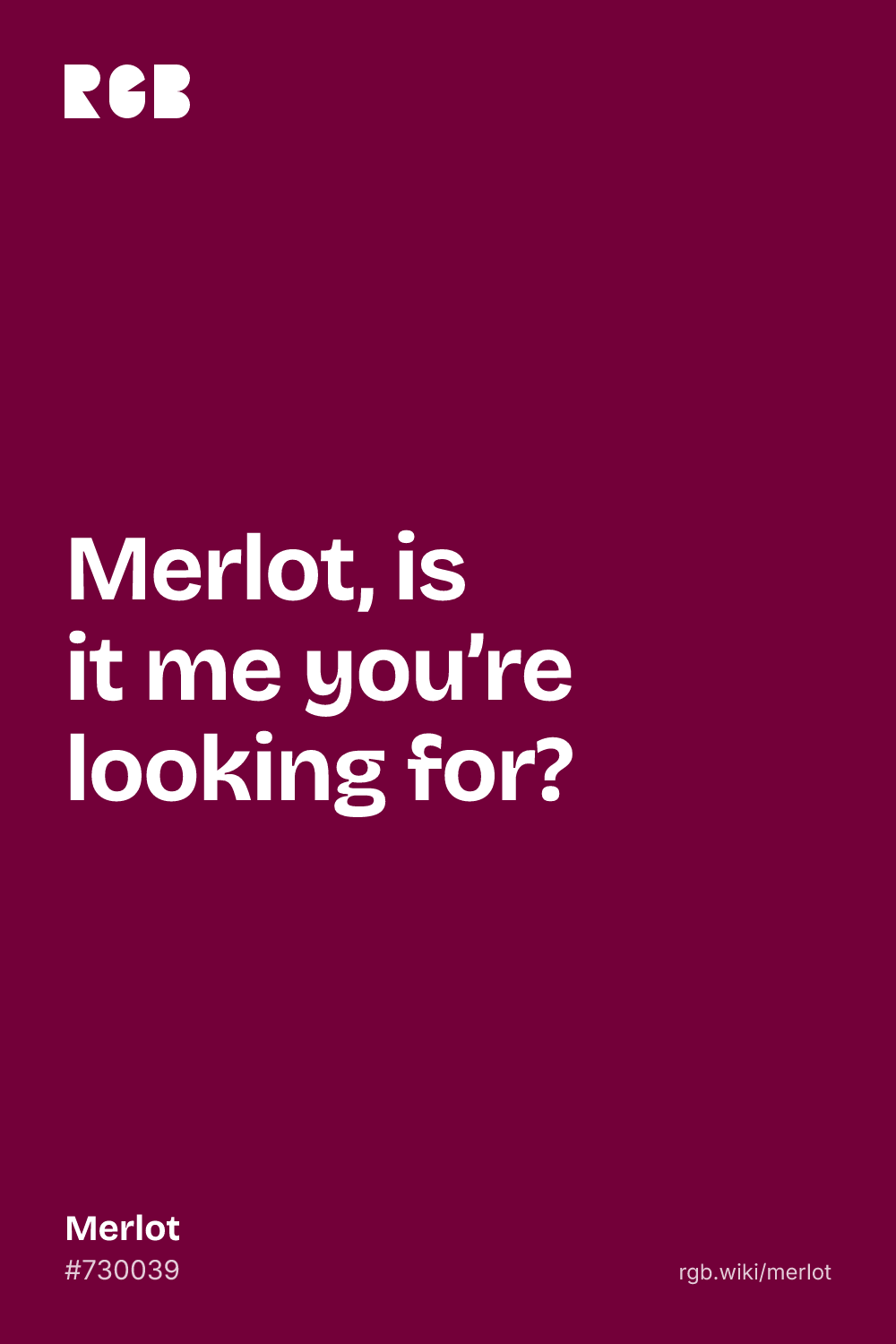
A deep purplish red named after a wine grape, and the grape after a blackbird.
Overview
Merlot is a deep purplish red, the color of a young red wine in the glass. Its code, #730039, is red at under half strength, no green and some blue. The blue gives it a clear purple lean next to burgundy or wine.
The name comes from the grape, which is probably named after the blackbird, merle in French. Merlot is the most planted grape in the vineyards of Bordeaux and one of the most planted wine grapes in the world. Its berries are dark blue.
No color dictionary defines merlot. The code comes from a crowd: it is the average of the colors people called merlot in the xkcd online color survey. Another online survey found a lighter, more purple merlot. Both are purple-reds, like a young wine, and far from the blue-black of the grape’s skin.
Merlot is dark enough for white or cream text. It pairs well with champagne, blush, sage and cool grays, and because it sits between burgundy and Tyrian purple, it can bridge reds and purples in one palette.
HEX
#730039
RGB
rgb(115, 0, 57)
HSL
hsl(330, 100%, 23%)
HSV
330°, 100%, 45%
CMYK
0, 100, 50, 55
OKLCH
oklch(36.0% 0.146 0.6)
Every code converts from the HEX value #730039. No color standard defines merlot. #730039 is the average of the colors people named merlot in the xkcd color survey (2010), and the code most color lists use. HP Labs’ online color naming experiment found a lighter, more purple merlot, #8E1F66; see the range below. CMYK is a screen-based estimate; print results vary.
Merlot on the color map
LighterDarker
People’s average wine sits just above merlot at almost the same hue: in everyday naming, the two are nearly the same color. HP Labs’ merlot lies to the left, toward purple, and higher. The dictionary wine sits to the right and a little higher, redder and much grayer, which this map of hue and lightness doesn’t show. The outline is an approximate range, not a measured one.
Shades and tints
Tintswith white
Shadeswith black
Toneswith gray
Merlot sits in the middle. Tints add white, shades add black and tones add gray, in 10% steps out from it. Tap any swatch to copy its code.
Light and dark merlot
#D5B2C4
Pale merlotMixed 70% with white. A soft mauve pink.
#9D4C74
Light merlotMixed 30% with white. A dusty berry rose.
#730039
MerlotThe reference color.
#66023C
Tyrian purpleDarker and more purple, with a page of its own. See tyrian purple
#450022
Dark merlotMixed 40% with black. Nearly black, with a purple-red glow.
Colors that go with merlot
Pairings that work in rooms, outfits and interfaces.
Merlot and champagne
Warm and celebratory. Good for menus and invitations.
Merlot and sage
Grape and vine leaf. Natural and calm.
Merlot and blush
Soft and romantic, with merlot for headings.
Merlot and gray
Modern and cool. Let merlot be the only color.
Merlot and plum
A tonal mix of red-purples. Rich and moody.
Merlot night
A dark theme with a lighter berry pink as the accent.
Color-wheel palettes
Pick a palette to see where its colors sit on the color wheel. The caret marks merlot. Tap a band to copy its code.
Lined up by hue around merlot. Hover a color to see how similar it is.The bar under each name shows how similar it is. Similarity comes from the distance between the two colors in OKLab, a model of how we see color.
Merlot vs wine
Merlot#730039 · hue 330°
Vivid, with a clear purple lean
Named after a grape and a blackbird
A crowd-sourced code from a survey
Wine#722F37 · hue 353°
Muted, with gray and brown in it
Looks like an aged red wine
A dictionary color: ISCC-NBS dark red
Meaning
Wine grape
Blackbird
Bordeaux blends
Sideways
Merlot reads as plush, velvety and a little purple. Its associations come from the grape: a soft, early-ripening variety that winemakers in Bordeaux blend with the sterner Cabernet Sauvignon, and that became a favorite of American wine drinkers in the 1990s, until a film made fun of it. Research on color and emotion tests broad words such as red or purple, not merlot.
Named after a blackbird
Likely origin
Merlot is thought to be a diminutive of merle, French for blackbird. An 1824 article on Médoc wine said the grape was named after the local blackbird, merlau in Occitan, which liked to eat the ripe grapes. Others connect the name to the dark color of the berries.1
A dark-blue grape with a lost parent
Well established
Merlot grapes are dark blue, a little less blue-black than Cabernet Sauvignon, with thinner skins and fewer tannins. DNA tests published in 2009 showed that its father is Cabernet Franc and its mother a forgotten variety found in Brittany and Charentes, now named Magdeleine Noire des Charentes.1, 2
A film dented its sales, a little
One study
In the 2004 film Sideways, the hero refuses to drink merlot. A study of US sales found a small drop in merlot consumption afterward, mostly in bottles under $10, and a much larger rise for Pinot Noir, the wine he praises. The authors call the effect on merlot small, far from devastating.3
Sources (3)
Wikipedia, “Merlot”, history and name, and viticulture, citing Robinson (1986), Vines, Grapes & Wines, and Robinson, Harding & Vouillamoz (2012), Wine Grapes.
Boursiquot, J.-M. et al. (2009). Parentage of Merlot and related winegrape cultivars of southwestern France: discovery of the missing link. Australian Journal of Grape and Wine Research, 15(2), 144–155. doi:10.1111/j.1755-0238.2008.00041.x
Cuellar, S. S., Karnowsky, D. & Acosta, F. (2009). The Sideways effect: a test for changes in the demand for Merlot and Pinot Noir wines. Journal of Wine Economics, 4(2), 219–232. Working paper version.
History
The grape got its name in the vineyards around Bordeaux. The color got its code more than two centuries later, from thousands of people naming colors online.
1784
A local official in Bordeaux notes that wine from a grape called merlau, in the Libournais, is one of the area’s best: the first known mention of Merlot.1
1824
The name Merlot appears in an article on Médoc wine, which says the grape is named after the local blackbird.1
1855
Merlot is recorded around Venice under the name Bordò, the Italian word for Bordeaux.1
1926
First known use of “merlot” in English, for the wine and the grape.2
1970–75
After a severe frost in 1956 and several vintages lost to rot, French authorities ban new Merlot plantings in Bordeaux.1
2004
In the film Sideways, the lead character refuses to drink merlot. Sales of cheap merlot slow afterward.3
2009
A DNA study names Merlot’s parents: Cabernet Franc and Magdeleine Noire des Charentes.4
2010
The xkcd color survey publishes its average merlot, #730039, the code used here.5
Sources (5)
Wikipedia, “Merlot”, history and name, citing Clarke (2001), Encyclopedia of Grapes, Robinson (1986), Vines, Grapes & Wines, and Robinson, Harding & Vouillamoz (2012), Wine Grapes.
Merriam-Webster, “merlot”, definition and first known use.
Cuellar, S. S., Karnowsky, D. & Acosta, F. (2009). The Sideways effect: a test for changes in the demand for Merlot and Pinot Noir wines. Journal of Wine Economics, 4(2), 219–232. Working paper version.
Boursiquot, J.-M. et al. (2009). Parentage of Merlot and related winegrape cultivars of southwestern France: discovery of the missing link. Australian Journal of Grape and Wine Research, 15(2), 144–155. doi:10.1111/j.1755-0238.2008.00041.x
Munroe, R. (2010). “Color Survey Results”, xkcd blog, with the survey’s color list (CC0).
Questions
What color is merlot?
A deep purplish red, like a young red wine. Its usual code is #730039 (RGB 115, 0, 57).
Where does the merlot hex code come from?
From the xkcd color survey of 2010, in which visitors named colors online. #730039 is the average of the colors they called merlot. No color standard defines merlot.
What is the difference between merlot and burgundy?
Burgundy (#800020) is redder. Merlot (#730039) has more blue, so it leans purple. Both are named after French wine: burgundy after a region, merlot after a grape.
Is merlot the same as wine or maroon?
No. Wine (#722F37) is muted and brownish, and maroon (#800000) is a pure dark red. Merlot is more vivid and more purple than either, although people’s everyday “wine” comes out very close to it.
Why is merlot called merlot?
The grape’s name is thought to come from merle, French for blackbird. An 1824 article said the grape was named after the local blackbird, which liked to eat the ripe grapes.
What colors go with merlot?
Champagne and cream, blush pink, sage green, cool grays and deep plum. Use white or cream text on it.