Eggshell

A warm yellowish white, and a paint finish of the same name.

Overview

Eggshell is a soft white with a warm, slightly yellow cast, like the shell of a white hen’s egg. Its code is #F0EAD6: red 240, green 234 and blue 214. The blue is clearly lower than the red and green, so it reads as warmer and a little deeper than off-white or alabaster.

The code has a precise origin. It is the center point of the “yellowish white” group in the ISCC-NBS color system, a United States standard for naming colors. When that system’s 1955 dictionary sorted real color names into groups, it put most eggshells, from textile cards, color atlases and paint lists, one step yellower, in pale yellow. Only an eggshell paint used by the U.S. Army Engineers landed in yellowish white.

In paint, “eggshell” usually means something else: a sheen, not a color. An eggshell finish has a low, soft shine, like the surface of an egg, between flat and satin. It comes in any color. So a can marked “eggshell” may hold navy blue, and a wall in the color eggshell may be flat or glossy.

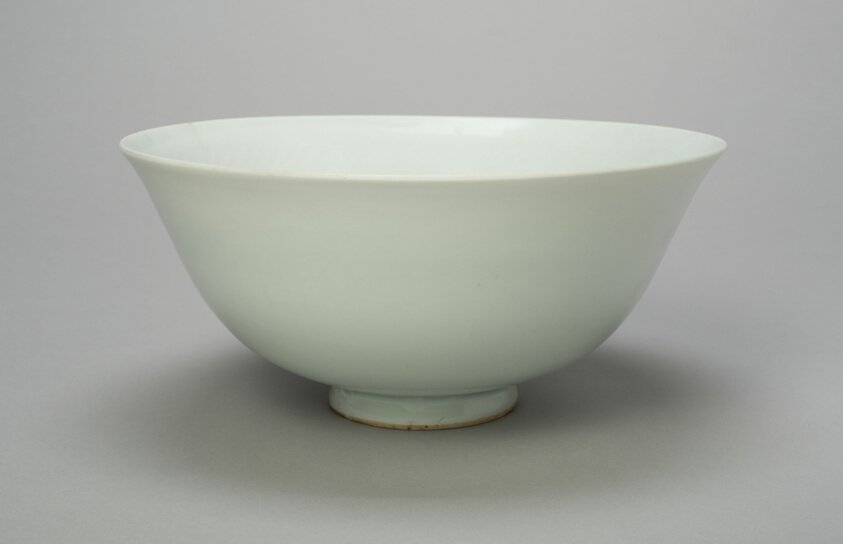
Real eggshells vary. A hen’s breed decides whether she lays white, brown or blue eggs. Thin porcelain is called eggshell too, and a Chinese white ware known as “eggshell white” has a cool, blue-green glaze, as the bowl below shows.
HEX#F0EAD6
RGBrgb(240, 234, 214)
HSLhsl(46, 46%, 89%)
HSV46°, 11%, 94%
CMYK0, 3, 11, 6
OKLCHoklch(93.6% 0.027 93.1)
Every code converts from the HEX value #F0EAD6. #F0EAD6 is the center point (centroid) of group 92, yellowish white, in the ISCC-NBS color system. The system’s 1955 dictionary places one eggshell there, a U.S. Army Engineers paint, and most other eggshells in pale yellow. CMYK is a screen-based estimate; print results vary.
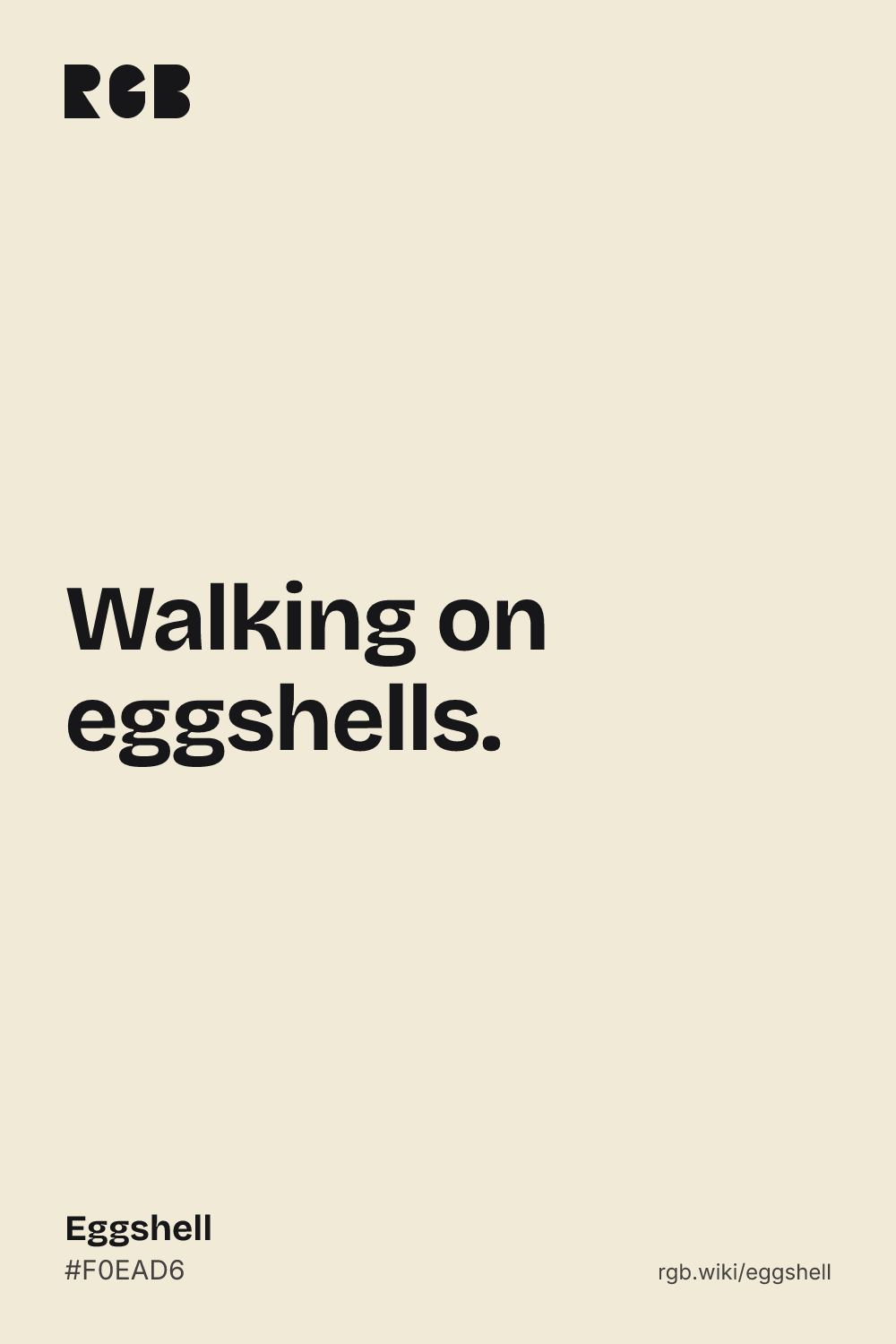
Eggshell color card, hex #F0EAD6: “Walking on eggshells”

Eggshell on the color map

The xkcd survey’s eggshell is lighter and yellower than the code, near the top of the view. The dictionary’s pale yellow sits lower and clearly more yellow; pale orange yellow sits off the left edge, more peach. The luanbai glaze sits off the right edge: a cool, green-gray white, nothing like the warm web code. The outline is an approximate range, not a measured one.

Shades and tints

Tints with white

Shades with black

Tones with gray

Eggshell sits in the middle. Tints add white, shades add black and tones add gray, in 10% steps out from it. Tap any swatch to copy its code.

Light and dark eggshell

#F8F4EA
Light eggshellMixed 50% with white. A barely warm white.
#F0EAD6
EggshellThe reference color, ISCC-NBS yellowish white.
#F3E5AB
Dictionary eggshellISCC-NBS pale yellow, where the 1955 dictionary files most eggshell samples. Clearly yellow.
#E3DAC9
BoneA grayer, deeper warm white. See bone
#D8D3C1
Shaded eggshellMixed 10% with black. A pale warm gray, like the color on a wall in shadow.
#D9DED6
Eggshell white glazeSampled from a 14th-century Chinese luanbai bowl, the ware called “eggshell white”. A cool green-gray white.

Colors that go with eggshell

Pairings that work in rooms, outfits and interfaces.

Eggshell and walnut

Warm and settled. A classic for living rooms and furniture.

Eggshell and brown egg

Farmhouse colors, from white and brown shells.

Eggshell and celadon

Quiet and cool, like old porcelain glazes.

Eggshell and slate blue

Calm and clean. Suits bedrooms and stationery.

Eggshell and burgundy

Rich and traditional. Good for menus and invitations.

Eggshell and forest

Deep green against a warm white. Natural and calm.

Color-wheel palettes

Pick a palette to see where its colors sit on the color wheel. The caret marks eggshell. Tap a band to copy its code.

Similar colors

Antique white93%Blanched almond88%Champagne94%Lead white91%Parchment98%EggshellAlabaster89%

Lined up by hue around eggshell. Hover a color to see how similar it is.The bar under each name shows how similar it is. Similarity comes from the distance between the two colors in OKLab, a model of how we see color.

Eggshell vs ivory

Eggshell#F0EAD6 · hue 46°
  • Deeper and a little grayer
  • Warm, slightly yellow
  • ISCC-NBS yellowish white
Ivory#FFFFF0 · hue 60°
  • Almost white
  • A faint clear yellow tint
  • A CSS keyword

Meaning

  • Hen’s eggs
  • Paint sheen
  • Porcelain
  • Interiors

Eggshell is a word that does three jobs. It names a warm white, a low paint sheen and a very thin porcelain. Most of what people mean by it comes from the egg itself: its color, its soft surface and its thinness. Color studies test the word white, not eggshell, so the claims here are about eggs, paint and porcelain.

Eggshell is a defined paint sheen

Industry standard

The Master Painters Institute defines seven gloss levels. Eggshell is level 3: 10 to 25 gloss units measured at 60 degrees, more shine than flat or velvet and less than satin. U.S. military building specifications use the same scale and note that the government has historically used flat, eggshell, semi-gloss and gloss.1

The hen’s breed sets the shell color

Extension science

Egg color is mainly genetic: Leghorns lay white eggs, Orpingtons brown and Ameraucanas blue. Brown comes from a pigment, protoporphyrin, laid onto the shell as it forms, so most brown eggs are still white inside. White and brown eggs have no major difference in taste or nutrition.2

“Eggshell white” porcelain is cool, not warm

Museum record

In the early 1300s, potters at Jingdezhen in China added more kaolin to their clay and made a sturdier white ware called luanbai, translated as “eggshell white”, for its opaque glaze. Its glaze has a faint blue-green tint, very different from the warm web eggshell.3, 4

Sources (4)
  1. USACE, NAVFAC and AFCEC, UFGS 09 90 00, “Architectural Paints and Coatings” (August 2026), definitions: MPI gloss levels, tested to ASTM D523.
  2. Schattenberg, P. (3 June 2024). “Cracking the mystery on chicken eggs”. AgriLife Today, Texas A&M AgriLife, quoting poultry specialist Gregory Archer.
  3. Wikipedia, “Qingbai ware”, citing Osborne, The Oxford Companion to the Decorative Arts, pp. 192–193, and “Jingdezhen porcelain”, citing Vainker, Chinese Pottery and Porcelain, pp. 179–180.
  4. Art Institute of Chicago, “Bowl with Peony Scrolls, Thunderbolt (Vajra) Symbol, and Characters Shufu (Privy Council)”, 1925.39, medium: “Luanbai (eggshell white) ware”.

History

The eggshell is an old word, but as a color it was pinned down late. The adjective first meant thin and fragile, paint makers borrowed it for a soft sheen, and a 1955 government dictionary finally gave the color a measured place.

  1. 1300s

    First known use of the noun “eggshell” in English, for the hard covering of an egg.1

  2. 1300–50

    Jingdezhen potters make luanbai, “eggshell white” ware, including pieces marked Shufu, which may mean they were ordered for the Privy Council.2

  3. 1835

    First known use of “eggshell” as an adjective meaning thin and fragile, as in eggshell china.1

  4. 1950

    Federal Specification TT-C-595 sets the colors of ready-mixed paints for U.S. government agencies. Its list includes eggshell paints used by the U.S. Army Engineers.3

  5. 1955

    The ISCC-NBS Dictionary of Color Names sorts eggshells from textile cards, color atlases and paint lists. Most land in pale yellow; one Army Engineers eggshell lands in yellowish white, whose center point is #F0EAD6.34

  6. 2026

    The current U.S. military building specification for paints names eggshell as gloss level 3 on the Master Painters Institute scale.5

Sources (5)
  1. Merriam-Webster, “eggshell”, definitions and first known use.
  2. Wikipedia, “Jingdezhen porcelain”, citing Vainker, Chinese Pottery and Porcelain, pp. 179–180; Art Institute of Chicago, bowl 1925.39, dated 1300/50.
  3. Kelly, K. L. & Judd, D. B. (1955). The ISCC-NBS Method of Designating Colors and a Dictionary of Color Names. NBS Circular 553, section 9.3 and pp. 50, 54–55 (groups 73, 89 and 92). PDF at NIST.
  4. Aubrey Jaffer, NBS/ISCC color system centroids in sRGB, yellowish white: 240, 234, 214.
  5. USACE, NAVFAC and AFCEC, UFGS 09 90 00, “Architectural Paints and Coatings” (August 2026).

Eggshell in use

A plain white porcelain bowl with a flaring rim and a small foot, its glaze tinted faintly blue-green, on a gray background
#D9DED6#B1B6A8#9A9F93#74796F
PorcelainShufu bowl, “eggshell white” ware, China (1300–50)

A luanbai bowl from the Jingdezhen kilns, with molded peony scrolls and the characters Shufu (Privy Council) inside. The ware is called “eggshell white”, yet its glaze is a cool, faintly blue-green white. Lit inside it reads about #D9DED6, and in shade it falls to a gray-green near #B1B6A8.

#D9DED6#B1B6A8#9A9F93#74796F
Source: Art Institute of Chicago

Palettes are sampled in-house.

Questions

What color is eggshell?

A warm, slightly yellow white, like a white hen’s egg. The code is #F0EAD6 (RGB 240, 234, 214).

Where does the eggshell hex code come from?

#F0EAD6 is the center point of the yellowish white group in the ISCC-NBS color system. The system’s 1955 dictionary put an eggshell paint used by the U.S. Army Engineers in that group.

Is eggshell a color or a paint finish?

Both. As a color it is a warm off-white. As a paint finish it is a low sheen, between flat and satin, and it comes in any color.

What is the difference between eggshell and ivory?

Ivory (#FFFFF0) is lighter, almost white with a faint clear yellow tint. Eggshell (#F0EAD6) is deeper and a little grayer.

What is the difference between eggshell and cream?

Cream (#FFFDD0) is lighter and more clearly yellow. Eggshell is a duller, more neutral warm white.

What colors go with eggshell?

Walnut and warm browns for a cozy room, slate blue or forest green for calm contrast, and burgundy for a rich, traditional look.