Old lace

A creamy near-white named after aged lace, which real centuries-old lace is several shades darker than.

Overview

Old lace is a near-white with a warm, creamy tint. Its code is #FDF5E6: red almost at full strength at 253, green at 245 and blue lower, at 230. The lower blue gives the cream, and the hue lands at 39°, a yellowish orange, so pale that most people read it as an off-white. Beside pure white it barely shows (1.08:1), and beside its neighbors it is a matter of degree: a touch darker than floral white, lighter and less peach than linen, and paler than antique white.

The name is the CSS keyword oldlace. It is not one of the X Window System’s first colors, whatever some references say: the lists of 1986, 1987 and 1988 don’t have it. Paul Raveling added it in 1989, among light and off-white colors “copied from several Sinclair Paints color samples” to give windows better light backgrounds. In his list it sits between floral white and linen, and unlike many X11 colors it never got numbered darker steps. X11 Release 4 shipped it that December, and the web adopted the list in 2001.

Lace itself is an openwork fabric, a pattern of holes held together by thread; the word goes back to the Latin laqueus, a noose or snare. Early lace was made of linen, silk, gold or silver thread, and white lace does yellow as it ages. Household columns from the 1890s to the 1910s explain both how to whiten old lace in the sun and how to tint new lace with tea, coffee or saffron for a creamier, older look. Real old lace is much darker than the code: a Genoese edging from the late 1500s reads about #DAD3C2 in its museum photo, at nearly the same hue.

On screens, old lace makes a soft, warm page or card background. Black text on it has a contrast of 19.4:1, while white text practically disappears, at 1.08:1. It pairs well with ink brown, navy, dusty rose and tea tones, and with charcoal for a dark theme where old lace is the text color.
HEX#FDF5E6
RGBrgb(253, 245, 230)
HSLhsl(39, 85%, 95%)
HSV39°, 9%, 99%
CMYK0, 3, 9, 1
OKLCHoklch(97.2% 0.022 83.3)
Every code converts from the HEX value #FDF5E6. #FDF5E6 is the CSS keyword oldlace, rgb(253, 245, 230), defined in the CSS Color Module Level 4 and first listed among the web’s color names in SVG 1.0 (2001). It comes from Paul Raveling’s 1989 list for the X Window System (raveling.txt, 253 245 230), one of the light colors he copied from Sinclair Paints samples. X11 Release 4 first shipped it in December 1989, and the value is unchanged in the X Consortium’s rgb.txt of 1994. Neither Maerz and Paul’s 1930 dictionary nor the xkcd color survey has an old lace to compare it with. CMYK is a screen-based estimate; print results vary.
Old lace color card, hex #FDF5E6: “Aged gracefully, no tea required”

Old lace on the color map

No color dictionary or survey defines an old lace of its own, so the dots are real old lace. The Genoese edging from the 1500s sits far below the outline at almost the same hue, 42° against 39°: the same creamy direction, much darker and grayer. The Brussels lappets are darker still and lean toward yellow. Colors in photos shift with the lighting, so read both as close, not exact. The outline is an approximate range, not a measured one.

Shades and tints

Tints with white

Shades with black

Tones with gray

Old lace sits in the middle. Tints add white, shades add black and tones add gray, in 10% steps out from it. Tap any swatch to copy its code.

Light and dark old lace

#FEF9F0
Pale old laceMixed 40% with white: nearly white, with a breath of cream.
#FFFAF0
Floral whiteOld lace’s neighbor in Raveling’s 1989 list: almost the same hue, one step lighter. See floral white
#FDF5E6
Old laceThe reference color. The X11 list gives it no numbered darker steps.
#DAD3C2
Genoese laceSampled from the brightest threads of a bobbin lace edging made in Genoa in 1550–99, in a museum photo.
#CAC4B8
Old lace grayMixed 20% with black: a soft warm gray for borders and dividers.
#65625C
Dark old laceMixed 60% with black: a warm dark gray that passes for body text on old lace, at 5.6:1.

Colors that go with old lace

Pairings that work in rooms, outfits and interfaces.

Old lace and ink

Like a letter on good paper: a warm page, dark brown-black text and a leather-brown button.

Tea-dyed

After the old trick of tinting lace in tea or coffee: cream, a tea tan, coffee brown and a dark roast.

Lace on black

Museums photograph lace on black to show the pattern. A dark theme with old lace text and an aged-thread accent.

Raveling’s whites

Old lace with its 1989 neighbors floral white, linen and antique white, grounded by the darkest antique white step.

Old lace and dusty rose

Soft and romantic, for invitations and stationery. Use the deep plum-brown for text.

Old lace and navy

Crisp and calm. Navy reads as clearly on old lace as on white, with less glare, and brass adds warmth.

Color-wheel palettes

Pick a palette to see where its colors sit on the color wheel. The caret marks old lace. Tap a band to copy its code.

Similar colors

Seashell94%Linen93%Old laceFloral white92%Cosmic latte96%Cornsilk91%Beige91%

Lined up by hue around old lace. Hover a color to see how similar it is.The bar under each name shows how similar it is. Similarity comes from the distance between the two colors in OKLab, a model of how we see color.

Old lace vs linen

Old lace#FDF5E6 · hue 39°
  • A touch lighter, with a creamy yellow lean
  • Next to floral white in Raveling’s 1989 list
  • Named after aged lace
Linen#FAF0E6 · hue 30°
  • A touch darker, leaning toward peach
  • The next color after old lace in the same list
  • Named after cloth woven from flax

Meaning

  • Named for lace
  • Yellows with age
  • Tinted with tea
  • Copied from paint samples

No study has looked at what old lace means to people. Color research tests broad words such as white or cream, never old lace, so the claims below are about the fabric behind the name, how real lace changes color and the written record of the code.

Added in 1989

Software record

Old lace isn’t in the X Window System’s lists of 1986, 1987 and 1988, or in John Thomas’s 1989 list matched to crayons. Paul Raveling put it in his 1989 revision among light colors “copied from several Sinclair Paints color samples”, meant “to provide a better choice for light-colored window backgrounds”, between floral white and linen. X11 Release 4, in December 1989, was the first release to ship it, at his 253 245 230. No record says which paint sample it came from.1, 2

A fabric named for a snare

Dictionary

Merriam-Webster traces lace to the Latin laqueus, a snare; in English it is first recorded in the 14th century, for a cord or string, and it also names an openwork fabric of thread. The earliest surviving examples of that fabric are from 16th-century Italy, and early lace was made of linen, silk, gold or silver thread.3, 4

Real lace yellows

Care advice and conservation

A 1910 newspaper column on the care of lace explains how to whiten lace “discolored by age” by drying it wet in the sun for two or three days. A textile conservator describes a cream-colored lace shawl dated 1830–1920 as “generally yellowed and soiled” before treatment. The code keeps only a hint of that cream.5, 6

Yellowed on purpose, too

Period advice

Old-looking lace was also made deliberately. A New Zealand paper noted in 1893 that “washed lace is improved by being dyed in cold coffee”, and suggested tea as an alternative. The Ladies’ Home Journal advised in 1901 that for an ecru tint you could use tea, coffee or saffron, and gave a recipe for a “soft, old look”.7, 8

No dictionary or survey entry

Dictionary, survey and museum photos

Maerz and Paul’s 1930 A Dictionary of Color has no old lace, and in Randall Munroe’s 2010 color survey neither old lace nor lace is among the 954 most common names. Museum photos give a real comparison: the brightest threads of a Genoese edging from 1550–99 read about #DAD3C2, almost the code’s hue but far darker.9, 10, 11

Sources (11)
  1. The X Window System’s color lists at X.Org: the first list in the X10R3 archive (1986), util/rgb/rgb.txt in X11R1 (1987) and the Release 3 list in X11R3 (1988), none with old lace; and, in the X11R4 archive, mit/rgb/others/raveling.txt (dated 3 December 1989; old lace 253 245 230, between floral white and linen), thomas.txt (no old lace), the README with Raveling’s notes, and the merged mit/rgb/rgb.txt (dated 7 December 1989) with mit/rgb/CHANGES. The lists are also hosted by Aubrey Jaffer, MIT CSAIL: old-rgb.txt, thomas.txt, raveling.txt and the X Consortium’s 1994 rgb.txt (old lace unchanged, with no numbered steps).
  2. Aubrey Jaffer, “Color-Name Dictionaries”, MIT CSAIL, quoting the X11 README and the notes of Paul Raveling (ISI) and John Thomas (Tektronix).
  3. Merriam-Webster, “lace”, definitions, etymology (from Latin laqueus, “snare”) and first known use of the noun (14th century, in the sense of a cord or string). The dictionary has no entry for “old lace”.
  4. Wikipedia, “Lace”, introduction (earliest examples from 16th-century Italy; early lace of linen, silk, gold or silver thread) and section “Etymology”.
  5. “The care of lace”, Los Angeles Herald, 18 December 1910, republished by Click Americana (2021).
  6. Weber-Fuhr, S. “Dual bleaching of a lace shawl”. Textile Conservation Newsletter, issue 18; abstract at the Smithsonian Museum Conservation Institute.
  7. “Treating washed lace”, Wairoa Bell, 3 March 1893, p. 6, Papers Past, National Library of New Zealand.
  8. “My Methods of Cleaning Lace”, The Ladies’ Home Journal, vol. 18, no. 11, October 1901, p. 40, transcription at GG Archives (lightly edited by the archive).
  9. Maerz, A. & Paul, M. R. (1930). A Dictionary of Color, as tabulated with ISCC-NBS centroids by Aubrey Jaffer, MIT CSAIL, Maerz and Paul: no entry for old lace.
  10. Randall Munroe (2010), “Color Survey Results”, and the survey’s 954 most common color names (no old lace and no lace; off white #ffffe4), CC0.
  11. Cleveland Museum of Art, Lace Edging of Points (Italy, Genoa, 1550–99, 1920.957) and Pair of Lace Lappets (Belgium, Brussels, early 1700s, 1923.1002), photographs released as CC0; colors sampled from the brightest threads.

History

Lace is centuries old, and so is the habit of fussing over its color. The screen color is young: a 1989 addition to a computer list, adopted by the web in 2001.

  1. 14th century

    First known use of “lace” in English as a noun, for a cord or string; the word comes from the Latin laqueus, a snare.1

  2. 1500s

    The earliest surviving examples of lace, the openwork fabric, come from 16th-century Italy. They are made of linen, silk, gold or silver thread.2

  3. 1893

    A New Zealand newspaper notes that washed lace “is improved by being dyed in cold coffee”, and that tea gives a color that suits some people better.3

  4. 1901

    The Ladies’ Home Journal recommends tea, coffee or saffron for an ecru tint, and blued water with a little ink for a “soft, old look”.4

  5. 1910

    The Los Angeles Herald explains how to whiten lace “discolored by age” in the sun, and says skimmed milk gives real lace a soft creamy tint.5

  6. 1986–1988

    The X Window System’s color lists, from X10 Release 3 in 1986 through X11 Release 3 in 1988, have no old lace, although some references call it one of the original X11 colors.6, 7

  7. 1989

    Paul Raveling at USC’s Information Sciences Institute revises the list on his HP monitor. Its first section, light and off-white colors “copied from several Sinclair Paints color samples”, includes old lace, 253 245 230, between floral white and linen, with no numbered steps. John Thomas’s crayon-matched list of the same year has no old lace.6, 8

  8. December 1989

    The merged list for X11 Release 4, dated 7 December, keeps Raveling’s old lace, the first release to include it. The release comes out on 22 December.6, 9

  9. 2001

    SVG 1.0 lists “oldlace”, rgb(253, 245, 230), among the web’s color keywords.10

  10. 2011

    CSS Color Module Level 3 becomes a W3C Recommendation on June 7 and makes oldlace, #fdf5e6, an official CSS keyword. Level 4 keeps it.11, 12

Sources (12)
  1. Merriam-Webster, “lace”, definitions, etymology (from Latin laqueus, “snare”) and first known use of the noun (14th century, in the sense of a cord or string). The dictionary has no entry for “old lace”.
  2. Wikipedia, “Lace”, introduction (earliest examples from 16th-century Italy; early lace of linen, silk, gold or silver thread) and section “Etymology”.
  3. “Treating washed lace”, Wairoa Bell, 3 March 1893, p. 6, Papers Past, National Library of New Zealand.
  4. “My Methods of Cleaning Lace”, The Ladies’ Home Journal, vol. 18, no. 11, October 1901, p. 40, transcription at GG Archives (lightly edited by the archive).
  5. “The care of lace”, Los Angeles Herald, 18 December 1910, republished by Click Americana (2021).
  6. The X Window System’s color lists at X.Org: the first list in the X10R3 archive (1986), util/rgb/rgb.txt in X11R1 (1987) and the Release 3 list in X11R3 (1988), none with old lace; and, in the X11R4 archive, mit/rgb/others/raveling.txt (dated 3 December 1989; old lace 253 245 230, between floral white and linen), thomas.txt (no old lace), the README with Raveling’s notes, and the merged mit/rgb/rgb.txt (dated 7 December 1989) with mit/rgb/CHANGES. The lists are also hosted by Aubrey Jaffer, MIT CSAIL: old-rgb.txt, thomas.txt, raveling.txt and the X Consortium’s 1994 rgb.txt (old lace unchanged, with no numbered steps).
  7. Wikipedia, “Shades of white”, section “Old lace”, which calls old lace “one of the original X11 colors”.
  8. Aubrey Jaffer, “Color-Name Dictionaries”, MIT CSAIL, quoting the X11 README and the notes of Paul Raveling (ISI) and John Thomas (Tektronix).
  9. Fulton, J. (December 1989). X Window System, Version 11, Release 4: Release Notes, X Consortium, MIT, announcing a “new rgb color database”; release date (22 December 1989) from Wikipedia, “X Window System”.
  10. W3C (2001). Scalable Vector Graphics (SVG) 1.0, recognized color keyword names: oldlace, rgb(253, 245, 230).
  11. W3C (2011). CSS Color Module Level 3, extended color keywords, W3C Recommendation, June 7, 2011.
  12. W3C, CSS Color Module Level 4, named colors: oldlace, #fdf5e6, 253 245 230.

Old lace in use

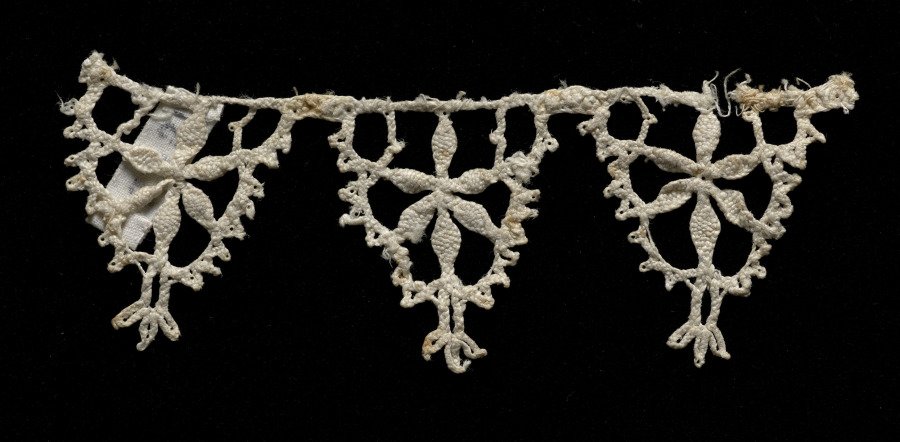
A short strip of cream bobbin lace on a black background, with three hanging triangular points, each holding a five-petaled flower, and small brownish stains along the top edge
#DAD3C2#D0C9B7#C5BEAB#AF9F82
TextileLace edging of points, Genoa (1550–99)

A strip of bobbin lace less than 10 centimeters long, three triangular points with star-like flowers, worked after a needle lace (reticella) design. More than 420 years on, its brightest threads read about #DAD3C2 in the photo: almost the hue of old lace, far darker and grayer. Brownish patches near #AF9F82 show where it has stained.

#DAD3C2#D0C9B7#C5BEAB#AF9F82
Source: Cleveland Museum of Art
A long, narrow band of pale gray-cream lace on black, patterned with flower sprays and curving scrolls on a fine net ground, with scalloped edges
#CDCBBC#C1BFB1#B9B8AA#1C1C1E
TextilePair of lace lappets, Brussels (early 1700s)

A long, narrow band of bobbin lace, 1.2 meters long, that formed the lappets of a lace headdress: the streamers that framed the face. Its flowers and scrolls float on a fine net. In the photo the brightest threads read about #CDCBBC, a soft gray-cream well below the code.

#CDCBBC#C1BFB1#B9B8AA#1C1C1E
Source: Cleveland Museum of Art

Palettes are sampled in-house.

Questions

What color is old lace?

A near-white with a warm, creamy tint. Its code is #FDF5E6 (RGB 253, 245, 230), the CSS keyword oldlace. In HSL it is 39°, 85%, 95%.

Is old lace white or cream?

Somewhere in between. Its hue is a yellowish orange, but it is so light that most people read it as a warm off-white. On this site it belongs to the whites.

Is real old lace this color?

Usually not. White lace yellows and grays with age, and centuries-old lace in museum photos reads around #DAD3C2 or darker. People also tinted new lace with tea, coffee or saffron to give it a creamier, older look.

What is the difference between old lace and linen?

Both are CSS keywords from the same 1989 list. Old lace (#FDF5E6) is a touch lighter and leans toward creamy yellow; linen (#FAF0E6) is a touch darker and leans toward peach.

What is the difference between old lace and floral white?

Floral white (#FFFAF0) is one step lighter at almost the same hue and passes for white. Old lace (#FDF5E6) reads as a pale cream. They sit next to each other in the X11 list.

Was old lace one of the original X11 colors?

No. The X color lists of 1986 to 1988 don’t include it. Paul Raveling added it in 1989, and it first shipped in X11 Release 4 that December.

What text color works on old lace?

Dark text. Black on old lace has a contrast of about 19.4:1. White on it is about 1.08:1, which is unreadable.

What colors go with old lace?

Ink brown and navy for crisp text, tea and coffee browns for a vintage look, dusty rose for stationery, and charcoal for a dark theme where old lace is the text color.
