Cornsilk

A warm near-white named after corn silk, which in the field is yellow-green, then brown.

Overview

Cornsilk is a near-white with a warm, pale yellow tint. Its code is #FFF8DC: red at full strength, green just below it at 248 and blue lower, at 220. The lower blue gives the yellow cast, and because green sits a little under red, the hue is 48°, a step from plain yellow toward gold. Beside ivory or cream it looks warmer and a shade more golden; beside beige it looks lighter and less gray.

The name is the CSS keyword cornsilk, after corn silk: the long, shiny threads that hang from the tip of an ear of corn, a term English has used since 1846. Each thread belongs to one female flower and must catch pollen for its kernel to form. In the field the threads are more colorful than the code. Growing silks are yellow-green, some hybrids have pink or red silks, and once their kernels are fertilized the silks turn brown.

As a color name, cornsilk started in the textile trade. Maerz and Paul’s 1930 A Dictionary of Color dates it to 1927, and its sample is a full light yellow, which the 1955 ISCC-NBS dictionary centers around #F8DE7E. The pale screen version came later. It isn’t in the X Window System’s color lists of 1987 and 1988: Paul Raveling put it in his 1989 revision, among light colors he copied from Sinclair Paints samples to give windows better light backgrounds, with four darker steps, cornsilk1 to cornsilk4. X11 Release 4 shipped it that December, and the web adopted the list in 2001.

On screens, cornsilk makes a soft page or card background. Black text on it has a contrast of 19.7:1, while white text practically disappears, at 1.07:1. It pairs well with navy, husk green, warm browns and charcoal, with a golden yellow as an accent.
HEX#FFF8DC
RGBrgb(255, 248, 220)
HSLhsl(48, 100%, 93%)
HSV48°, 14%, 100%
CMYK0, 3, 14, 0
OKLCHoklch(97.7% 0.037 95.4)
Every code converts from the HEX value #FFF8DC. #FFF8DC is the CSS keyword cornsilk, rgb(255, 248, 220), defined in the CSS Color Module Level 4 and first listed among the web’s color names in SVG 1.0 (2001). It comes from Paul Raveling’s 1989 list for the X Window System (raveling.txt, 255 248 220), one of the light colors he copied from Sinclair Paints samples. X11 Release 4 first shipped it in December 1989, and the value is unchanged in the X Consortium’s rgb.txt of 1994. The older cornsilk of Maerz and Paul’s 1930 dictionary is a different color: the 1955 ISCC-NBS dictionary files it as light yellow (#F8DE7E). The xkcd color survey has no entry for cornsilk. CMYK is a screen-based estimate; print results vary.
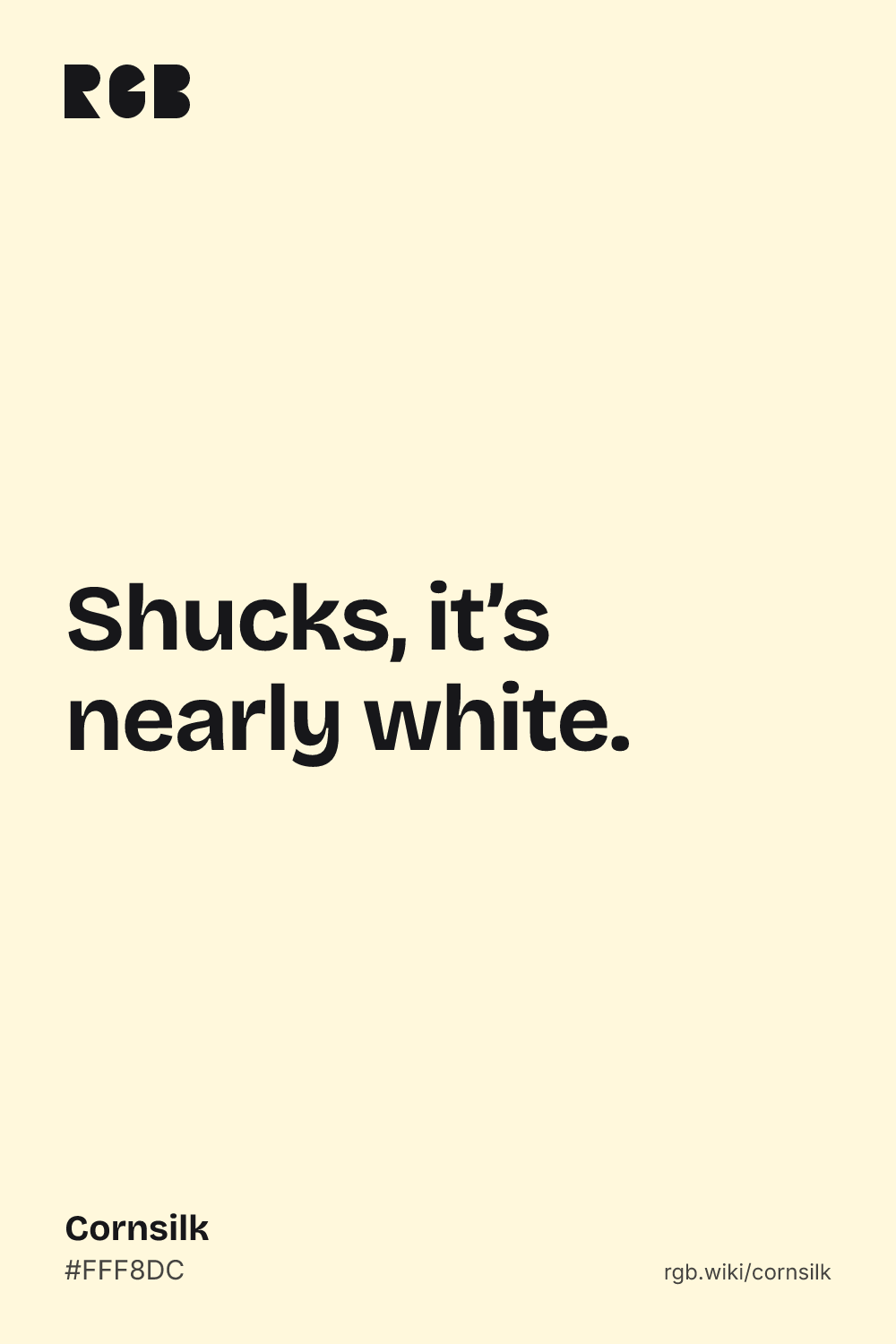
Cornsilk color card, hex #FFF8DC: “Shucks, it’s nearly white”

Cornsilk on the color map

No survey measures cornsilk itself, and the xkcd color survey has no entry for it. Its nearest name there, off white, sits just above the code and a little to the right, toward plain yellow. Maerz and Paul’s 1930 cornsilk sits far below at almost the same hue: a much deeper, stronger yellow. The outline is an approximate range, not a measured one.

Shades and tints

Tints with white

Shades with black

Tones with gray

Cornsilk sits in the middle. Tints add white, shades add black and tones add gray, in 10% steps out from it. Tap any swatch to copy its code.

Light and dark cornsilk

#FFFBEA
Pale cornsilkMixed 40% with white: almost white, with the faintest warmth.
#FFF8DC
CornsilkThe reference color. The X11 list also calls it cornsilk1.
#EEE8CD
Cornsilk 2The X11 list’s first darker step, the reference at about 93% strength. Not a CSS keyword.
#CDC8B1
Cornsilk 3X11’s step at about 80% strength: a pale warm gray. Not a CSS keyword.
#8B8878
Cornsilk 4X11’s darkest step, at about 55% strength: a mid gray with a faint khaki cast. Not a CSS keyword.
#F8DE7E
Dictionary cornsilkLight yellow, the ISCC-NBS center where the 1955 dictionary files Maerz and Paul’s 1930 cornsilk, a 1927 textile color. This site uses the same code for jasmine. See jasmine

Colors that go with cornsilk

Pairings that work in rooms, outfits and interfaces.

Cornfield

Cornsilk with husk green, kernel gold and dark soil brown. Warm and rural, for farm stands and harvest menus.

From fresh silk to dry

Inspired by the silks themselves: yellow-green when fresh, red on some hybrids, brown once the kernels are set.

The X11 steps

Cornsilk with the three darker versions the X11 list gave it. Quiet, warm and tonal.

Both cornsilks

Today’s near-white beside the light yellow where the dictionary files the cornsilk of 1927, grounded with deep golden browns.

Cornsilk and navy

Crisp and calm. Navy text on cornsilk reads as clearly as on white, but softer.

Cornsilk on charcoal

A dark theme. Cornsilk text glows warm on a brown-black, with a golden accent for buttons.

Color-wheel palettes

Pick a palette to see where its colors sit on the color wheel. The caret marks cornsilk. Tap a band to copy its code.

Similar colors

Old lace91%Cosmic latte93%CornsilkLemon chiffon89%Beige92%Light yellow92%Light goldenrod yellow91%

Lined up by hue around cornsilk. Hover a color to see how similar it is.The bar under each name shows how similar it is. Similarity comes from the distance between the two colors in OKLab, a model of how we see color.

Cornsilk vs beige

Cornsilk#FFF8DC · hue 48°
  • Lighter, with a faint gold lean
  • From Raveling’s 1989 paint-sample colors
  • Named after the threads on an ear of corn
Beige#F5F5DC · hue 60°
  • A touch grayer, with a plain yellow tint
  • Added to the X11 list in December 1989
  • Named after undyed wool

Meaning

  • Threads of a corn flower
  • 1927 textile color
  • Copied from paint samples
  • CSS keyword

No study has looked at what cornsilk means to people. Color research tests broad words such as white or yellow, never cornsilk, so the claims below are about the plant part behind the name and the written record of the color.

Each thread leads to a kernel

Botany

Merriam-Webster defines corn silk as “the silky styles on an ear of corn”. Bob Nielsen, an agronomist at Purdue University, explains that the silks are the working stigmas of the ear’s female flowers: each one connects to a single ovule, a potential kernel, which forms only if that silk catches pollen. Up to 1,000 ovules form on an ear.1, 2

Fresh silk is yellow-green

Agronomy

Iowa State agronomist Roger Elmore describes growing silks as yellow-green; they stop growing and turn brown once their ovules are fertilized, and reddish silks are likely a hybrid trait. Breeders’ variety descriptions use similar terms: a 2012 patent for an inbred corn line rates silk color as yellow, pink or red, and calls its own line’s silks light green that “often looks pale yellow”. None of these is as pale as the web’s cornsilk.3, 4

A yellower cornsilk in 1927

Color dictionary

Maerz and Paul’s 1930 A Dictionary of Color dates cornsilk to 1927, marks it as a name used only in the textile industry and prints its sample on plate 10. The 1955 ISCC-NBS dictionary files that sample as light yellow, centered around #F8DE7E, the same group as the dictionary’s popcorn. That is far deeper and more golden than the screen color.5, 6

Picked for window backgrounds

Software record

Cornsilk isn’t in the color lists shipped with X11 Release 1 in 1987 and Release 3 in 1988, or in John Thomas’s 1989 list matched to crayons. Paul Raveling put it in his 1989 revision among light colors “copied from several Sinclair Paints color samples”, meant “to provide a better choice for light-colored window backgrounds”. It sits between moccasin and ivory, and X11 Release 4, in December 1989, was the first release to ship it, with his value, 255 248 220.7, 8

Missing from the survey

Online survey

In Randall Munroe’s 2010 color survey, where people named colors shown on their own screens, cornsilk isn’t among the 954 most common names. The nearest average color with a name is off white, #FFFFE4, a little lighter and closer to plain yellow.9

Sources (9)
  1. Merriam-Webster, “corn silk”, definition (“the silky styles on an ear of corn”) and first known use (1846).
  2. Nielsen, R. L. (July 2016). “Silk Development and Emergence in Corn”. Corny News Network, Agronomy Department, Purdue University.
  3. Elmore, R. (29 July 2011). “Long Silks?” Integrated Crop Management News, Iowa State University Extension and Outreach.
  4. Hoegemeyer, T. C. (4 September 2012). Inbred corn line NPLC8632. US Patent 8,258,378 B1, columns 9–10 (silk color: yellow, pink, red) and Table 1 (silk color light green, “often looks pale yellow”). PDF at the USPTO.
  5. Maerz, A. & Paul, M. R. (1930). A Dictionary of Color. New York: McGraw-Hill. Index, p. 193, “1927 Cornsilk T … 10 G 3”, where T marks “a color name used only in the textile industry”; plate 10. Scan at the Internet Archive.
  6. Kelly, K. L. & Judd, D. B. (1955). The ISCC-NBS Method of Designating Colors and a Dictionary of Color Names. National Bureau of Standards Circular 553. PDF at NIST. Tabulated by Aubrey Jaffer for Maerz and Paul (cornsilk and popcorn: group 86, light yellow, #F8DE7E in John Foster’s sRGB version).
  7. The X Window System’s color lists at X.Org: util/rgb/rgb.txt in X11R1 (1987) and the Release 3 list in X11R3 (1988), neither with cornsilk; and, in the X11R4 archive, mit/rgb/others/raveling.txt (dated 3 December 1989; cornsilk 255 248 220, cornsilk1 to cornsilk4), thomas.txt, the README with Raveling’s notes, and the merged mit/rgb/rgb.txt (dated 7 December 1989) with mit/rgb/CHANGES. Raveling’s list is also hosted by Aubrey Jaffer, MIT CSAIL: raveling.txt.
  8. Aubrey Jaffer, “Color-Name Dictionaries”, MIT CSAIL, quoting the X11 README and the notes of Paul Raveling and John Thomas.
  9. Randall Munroe (2010), “Color Survey Results”, and the survey’s 954 most common color names (off white #ffffe4; no cornsilk), CC0.

History

Corn silk was a farm word long before it was a color. It became a textile color in the 1920s, a pale screen color in 1989 and a web keyword in 2001, getting lighter at almost every step.

  1. 1846

    First known use of “corn silk” in English, for the silky styles on an ear of corn.1

  2. 1927

    Cornsilk is in use as a textile color name, according to Maerz and Paul’s later dating.2

  3. 1930

    Maerz and Paul’s A Dictionary of Color prints a cornsilk sample on plate 10, a full light yellow.2

  4. 1955

    The ISCC-NBS dictionary files Maerz and Paul’s cornsilk as light yellow, centered around #F8DE7E.3

  5. 1987–1988

    The color lists shipped with X11 Release 1 in 1987 and Release 3 in 1988, the second tuned for DEC VT240 terminals, have no cornsilk, although some references say the 1987 list does.4, 5

  6. 1989

    Paul Raveling at USC’s Information Sciences Institute revises the list on his HP monitor. Its first section, light and off-white colors “copied from several Sinclair Paints color samples”, includes cornsilk, 255 248 220, with four darker steps, cornsilk1 to cornsilk4. John Thomas’s crayon-matched list of the same year has no cornsilk.6, 7

  7. December 1989

    The merged list for X11 Release 4, dated 7 December, keeps Raveling’s cornsilk and its four steps, the first release to include them. The release comes out on 22 December.6, 8

  8. 2001

    SVG 1.0 lists “cornsilk”, rgb(255, 248, 220), among the web’s color keywords.9

  9. 2011

    CSS Color Module Level 3 becomes a W3C Recommendation on June 7 and makes cornsilk, #fff8dc, an official CSS keyword. Level 4 keeps it.10, 11

Sources (11)
  1. Merriam-Webster, “corn silk”, definition and first known use.
  2. Maerz, A. & Paul, M. R. (1930). A Dictionary of Color. New York: McGraw-Hill. Index, p. 193, “1927 Cornsilk T … 10 G 3”; plate 10. Scan at the Internet Archive.
  3. Kelly, K. L. & Judd, D. B. (1955). The ISCC-NBS Method of Designating Colors and a Dictionary of Color Names. National Bureau of Standards Circular 553. PDF at NIST. Tabulated by Aubrey Jaffer for Maerz and Paul (cornsilk: group 86).
  4. The X Window System’s color lists of 1987 and 1988 at X.Org: util/rgb/rgb.txt in X11R1 (1987) and the Release 3 list in X11R3 (1988), also hosted by Aubrey Jaffer, MIT CSAIL, as old-rgb.txt, which the X11 README describes as “tuned” for Digital VT240 terminals.
  5. Wikipedia, “Shades of white”, section “Cornsilk”, which says cornsilk was one of the X11 colors in 1987.
  6. X Consortium (December 1989). X Window System, Version 11, Release 4: the merged color list mit/rgb/rgb.txt (dated 7 December 1989; cornsilk 255 248 220, cornsilk1 to cornsilk4), mit/rgb/CHANGES and the contributed lists in mit/rgb/others/ (raveling.txt, dated 3 December 1989, thomas.txt and the README with Raveling’s notes), in the release’s archive at X.Org. Raveling’s and Thomas’s lists are also hosted by Aubrey Jaffer, MIT CSAIL: raveling.txt, thomas.txt.
  7. Aubrey Jaffer, “Color-Name Dictionaries”, MIT CSAIL, quoting the X11 README and the notes of Paul Raveling (ISI) and John Thomas (Tektronix).
  8. Fulton, J. (December 1989). X Window System, Version 11, Release 4: Release Notes, X Consortium, MIT, announcing “a new color database”; release date (22 December 1989) from Wikipedia, “X Window System”.
  9. W3C (2001). Scalable Vector Graphics (SVG) 1.0, recognized color keyword names.
  10. W3C (2011). CSS Color Module Level 3, extended color keywords, W3C Recommendation, June 7, 2011.
  11. W3C, CSS Color Module Level 4, named colors: cornsilk, #fff8dc, 255 248 220.

Questions

What color is cornsilk?

A near-white with a warm, pale yellow tint. Its code is #FFF8DC (RGB 255, 248, 220), the CSS keyword cornsilk. In HSL it is 48°, 100%, 93%.

Is cornsilk white or yellow?

Both, in a way. Its hue is a golden yellow, but it is so light that most people read it as a warm off-white. On this site it belongs to the whites.

Is real corn silk this color?

Not really. Fresh corn silks are yellow-green, some hybrids have pink or red silks, and silks turn brown once their kernels are fertilized. The web color is paler than any of them.

What is the difference between cornsilk and beige?

Both are CSS keywords. Cornsilk (#FFF8DC) is lighter and warmer, with a faint lean toward gold. Beige (#F5F5DC) is a touch grayer and has a plain yellow tint.

What is the difference between cornsilk and cream?

Cream (#FFFDD0) is more clearly yellow, while cornsilk (#FFF8DC) is paler and a shade more golden. Cornsilk is a CSS keyword; cream is not.

Where does the name cornsilk come from?

From corn silk, the threads on an ear of corn, a term in English since 1846. It was a textile color name by 1927, and the pale screen version comes from Paul Raveling’s 1989 X11 color list, which the web adopted in 2001.

What text color works on cornsilk?

Dark text. Black on cornsilk has a contrast of about 19.7:1. White on it is about 1.07:1, which is unreadable.

What colors go with cornsilk?

Navy for crisp contrast, husk green and kernel gold for a cornfield look, warm browns, and charcoal for a dark theme where cornsilk is the text color.