Linen

The white of fully bleached flax cloth, a color that once took a whole summer to make.

Overview

Linen is a very pale, warm white with a faint beige tint, named after the cloth woven from flax. Its code, #FAF0E6, is the CSS keyword linen: red 250, green 240, blue 230, each a step of ten below the last, which tips white just slightly toward peach.

The name reached screens from a paint chart. In 1989 Paul Raveling added a set of light and off-white colors to the X Window System’s color list, copied from a paint maker’s samples, to give a better choice of light window backgrounds. Linen came in with antique white, old lace and seashell. Web browsers took over the list, and CSS still uses it.

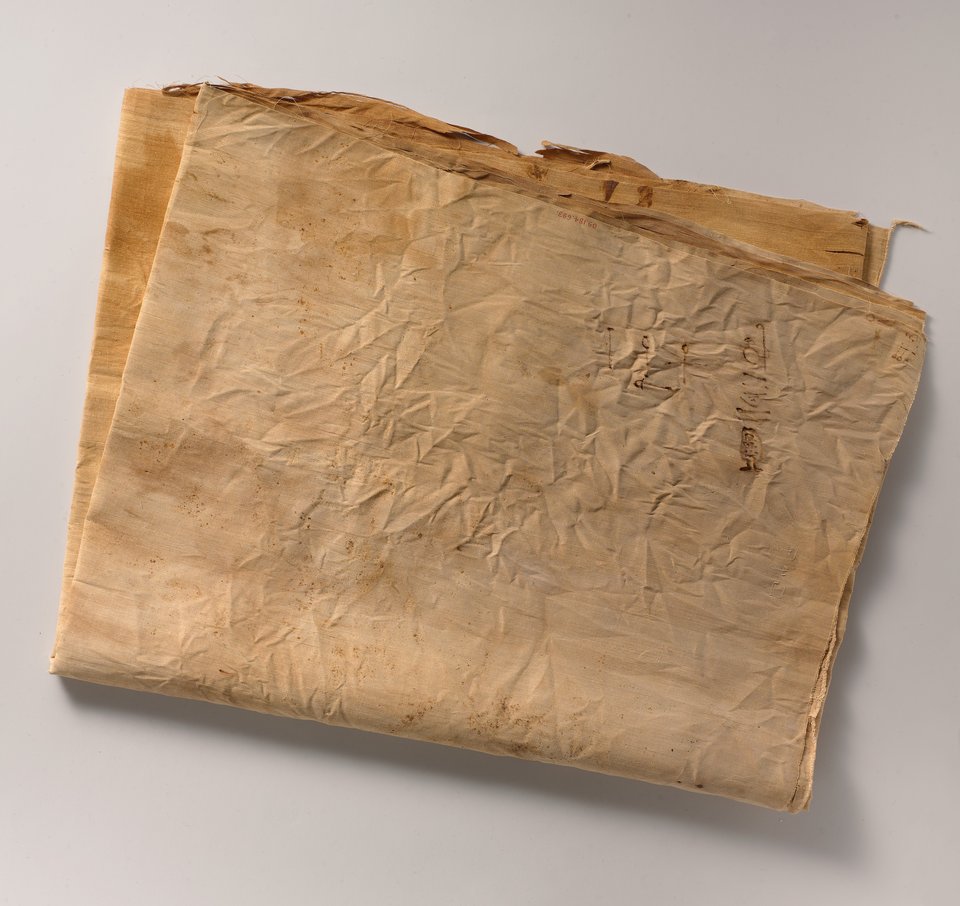
Real linen does not start out this color. Cloth woven from unbleached flax was called “brown linen”, and in 1911 the Encyclopædia Britannica reckoned that a fifth or more of the raw fiber’s weight was impurities, coloring matter and “flax wax” among them. Before chlorine bleach, whitening linen took a whole summer of lye, sour milk and sun on the grass. Unbleached linen is closer to ecru or oatmeal. The code is the end of that process, new and fully bleached, and old linen drifts back toward tan, like the sheet from Tutankhamun’s embalming cache below.

On screens, linen is about as light as an off-white gets. Black text on it has a contrast of 18.7:1, and against pure white it nearly disappears (1.12:1), so a linen panel on a white page needs a border or a shadow. Next to antique white it is paler and less peach, next to old lace a touch pinker, and isabelline, a name a popular legend ties to a shift left unwashed for three years, is grayer.
HEX#FAF0E6
RGBrgb(250, 240, 230)
HSLhsl(30, 67%, 94%)
HSV30°, 8%, 98%
CMYK0, 4, 8, 2
OKLCHoklch(96.0% 0.017 67.6)
Every code converts from the HEX value #FAF0E6. #FAF0E6 is the CSS keyword linen, defined in the CSS Color Module Level 4 and first listed among the web’s color names in SVG 1.0 (2001). It comes from the X Window System’s 1989 color list, whose light and off-white colors were copied from a paint maker’s samples. The ISCC-NBS color dictionaries and the xkcd survey have no linen to compare it with. CMYK is a screen-based estimate; print results vary.
Linen color card, hex #FAF0E6: “No dirty linen here”

Linen on the color map

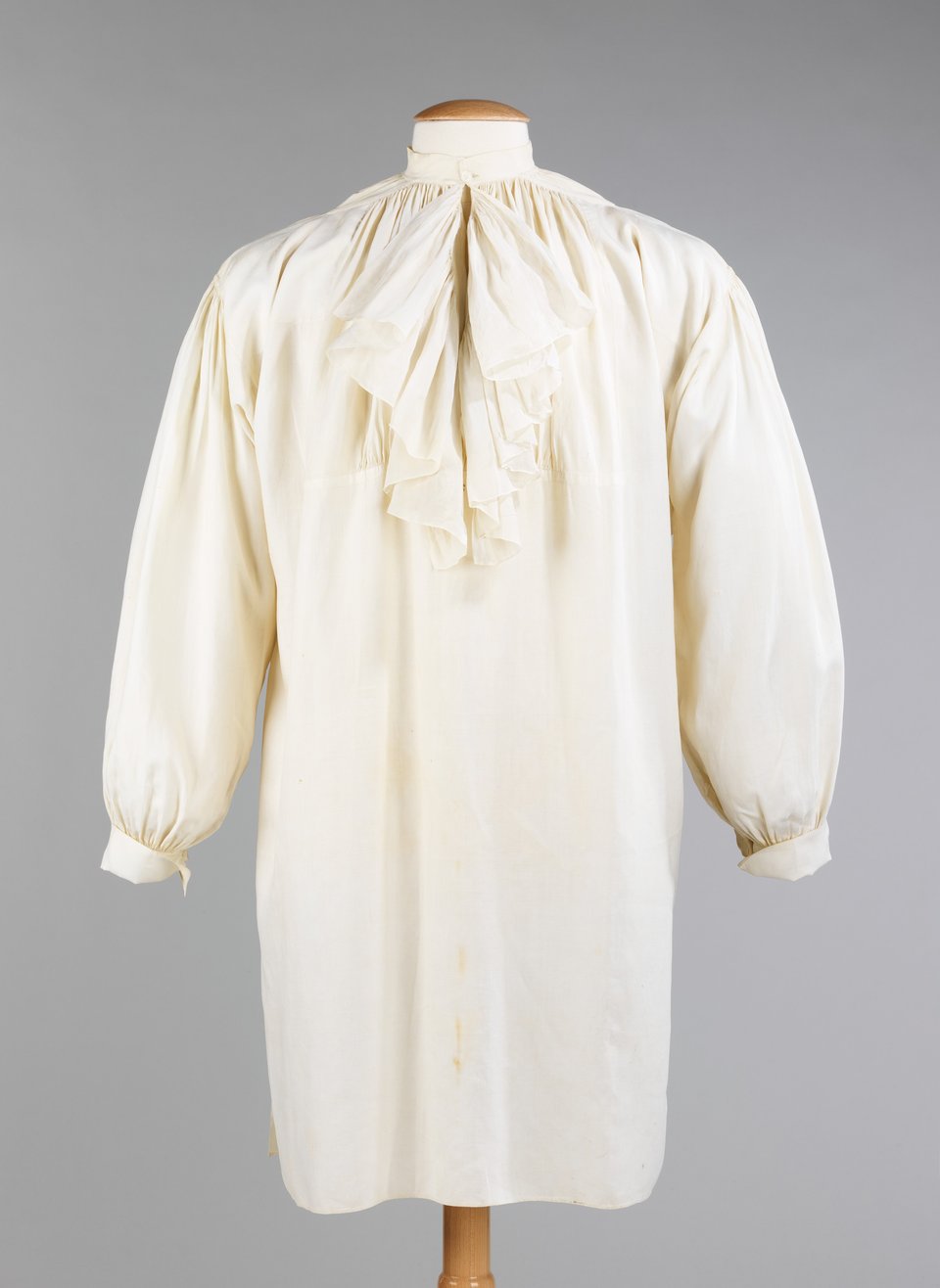
No color dictionary or survey defines a linen of its own, so the dots are real cloth. The 1780s shirt sits inside the outline toward its right edge: a little darker, grayer and yellower than the code. The linen from Tutankhamun’s embalming cache lies far below the outline, much darker, and is pinned to the bottom edge. Colors in photos shift with the lighting, so read both as close, not exact. The outline is an approximate range, not a measured one.

Shades and tints

Tints with white

Shades with black

Tones with gray

Linen sits in the middle. Tints add white, shades add black and tones add gray, in 10% steps out from it. Tap any swatch to copy its code.

Light and dark linen

#FCF6F0
Pale linenMixed 40% with white. Almost white, with a trace of warmth.
#FAF0E6
LinenThe reference color.
#F1EEE8
Old bleached linenSampled from the lightest folds of a French linen shirt from about 1780, in a museum photo. Close to the code, a little grayer.
#C8C0B8
Linen grayMixed 20% with black. A soft warm gray for borders and dividers.
#96908A
Deep linen grayMixed 40% with black. For icons and rules; too light for text on linen.
#64605C
Dark linenMixed 60% with black. A warm dark gray that passes for body text on linen, at 5.5:1.
#AD8862
Ancient linenSampled from a linen sheet from Tutankhamun’s embalming cache, about 3,300 years old, in a museum photo.

Colors that go with linen

Pairings that work in rooms, outfits and interfaces.

Linen and navy

The summer classic: a linen shirt under a navy jacket. Navy text reads well on the pale page.

Bleaching field

Linen spread on the grass under a summer sky, with a strip of brown linen still waiting its turn.

Tutankhamun’s linen

From the museum photo of the sheet from his embalming cache: aged tans on a linen page.

Moonlit linen

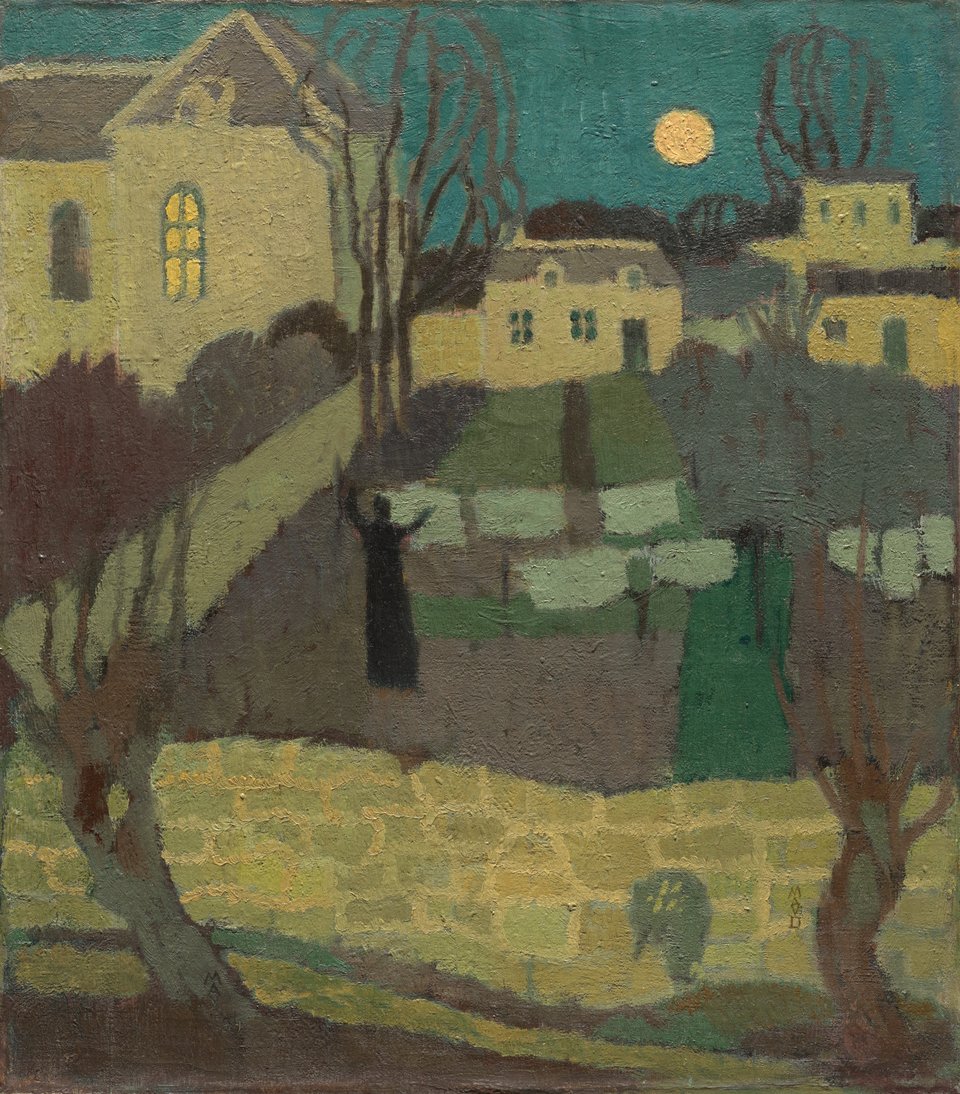
From Maurice Denis’s night garden: teal sky, golden moon and pale green-gray cloth. A dark theme with linen text.

Linen and terracotta

Warm and Mediterranean, like linen curtains against clay walls.

Linen and olive

Natural and quiet. Suits food, garden and home brands.

Color-wheel palettes

Pick a palette to see where its colors sit on the color wheel. The caret marks linen. Tap a band to copy its code.

Similar colors

Seashell92%LinenTitanium white92%Isabelline95%Old lace93%Lead white94%Alabaster95%

Lined up by hue around linen. Hover a color to see how similar it is.The bar under each name shows how similar it is. Similarity comes from the distance between the two colors in OKLab, a model of how we see color.

Linen vs antique white

Linen#FAF0E6 · hue 30°
  • Paler, with less tint
  • No numbered shades in the X11 list
  • The CSS keyword linen
Antique white#FAEBD7 · hue 34°
  • A little deeper and more peach
  • Four numbered shades in the X11 list
  • The CSS keyword antiquewhite

Meaning

  • Flax
  • Purity
  • Summer cloth
  • Bed and table linen

Linen’s meanings come from the cloth. Merriam-Webster defines linen as cloth made of flax, “noted for its strength, coolness, and luster”, which is why it says summer. White linen stood for cleanliness and purity in ancient Egypt and in the Bible, and the word now covers household cloth of any fiber. Studies of color and emotion test basic words such as white, not linen, so the claims here are about the cloth and the word.

Named for the flax plant

Word history

Linen comes from Old English līnen, “made of flax”, from līn, flax, akin to Latin linum. The same root gives linseed, flax seed, and partly line, through Latin linea, from a word meaning “made of flax”. Lingerie comes from French linge, linen, and once meant linen goods of any kind.1, 2

Worn by priests for purity

Historical record

Herodotus wrote in the 400s BCE that Egyptians were careful always to wear newly washed linen, and that priests wore a single linen garment and nothing else. Plutarch, about five centuries later, said the priests of Isis shunned wool, which they counted as an animal’s impure surplus like hair, and chose flax for “a plain and cleanly clothing”. The Book of Revelation calls “fine linen, clean and white” the righteousness of saints.3, 4, 5

Flax flowers are blue

Botany and dictionary record

Plutarch also reports that some thought the priests wore linen for the color of flax in bloom, “like to the heavenly azure”. Cultivated flax has blue flowers, and the old color dictionaries list a flaxflower blue, so the plant behind this near-white blooms nothing like it.4, 6, 7

Bed linen need not be linen

Dictionary record

Merriam-Webster’s second sense of linen is clothing or household articles made of linen “or similar fabric”. That is how cotton sheets and napkins became bed linen and table linen, kept in a linen closet.1

Dirty linen means private trouble

Idiom

Dirty linen, or dirty laundry, means private matters whose public exposure brings distress and embarrassment, which is why it should not be washed or aired in public.8

Sources (8)
  1. Merriam-Webster, “linen”, definitions and etymology.
  2. Merriam-Webster, “linseed”, “line” and “lingerie”, etymologies.
  3. Herodotus, The Histories 2.37, translated by A. D. Godley (1920). Perseus Digital Library.
  4. Plutarch, Isis and Osiris 3–4, Moralia vol. V, translated by F. C. Babbitt (Loeb Classical Library, 1936). LacusCurtius.
  5. Revelation 19:8, King James Version. Bible Gateway.
  6. Wikipedia, “Flax”, description of cultivated flax and related species with blue flowers.
  7. Jaffer, A. “Maerz and Paul color names” (flaxflower blue, 1930) and “Ridgway color names” (flax-flower blue, 1912), with their ISCC-NBS blue groups, MIT CSAIL.
  8. Merriam-Webster, “dirty laundry” (“called also dirty linen”).

History

Linen is one of the oldest cloths people make, and white linen was one of the hardest to get: for most of history it took a summer of lye, sour milk and sun. The color name reached screens in 1989 and has kept the same code since: 250, 240, 230.

  1. About 30,000 years ago

    People in Dzudzuana Cave, in the foothills of the Caucasus in Georgia, leave behind wild flax fibers in layers dated to 32,000–26,000 years ago. Many of the fibers are spun and knotted, perhaps for cords, baskets or sewing. Archaeologists reported the find in 2009.1

  2. 3482–3102 BCE

    The Tarkhan dress, a linen garment from a cemetery south of Cairo, is made some time in these years. Radiocarbon dating in 2015 made it the oldest surviving piece of woven clothing.2

  3. 1320s BCE

    Linen goes into the embalming cache of Tutankhamun in the Valley of the Kings. One piece found there in 1907 is marked with the king’s name and “Linen of year 6”, a clue that his tomb was still to be found, fifteen years before it was.3, 4

  4. 1600s–1700s

    The Dutch hold almost a monopoly on bleaching. Scotland sends its brown linen to Holland in March and gets it back at the end of October: near Haarlem it is steeped in lye, soaked in buttermilk, then kept wet on the grass for months of summer sun.5

  5. 1785

    In April, Claude Berthollet tells the Academy of Sciences in Paris that chlorine, discovered about a decade earlier, destroys plant colors, and could shorten bleaching.5

  6. 1799

    Charles Tennant of Glasgow introduces bleaching powder, chlorine in solid form. Bleaching can now run indoors all year, and the bleachfields fall out of use.5, 6

  7. 1911

    The Encyclopædia Britannica notes that linen still needs at least six weeks to bleach, against less than a week for cotton, and that grassing, laying the cloth out on the grass, is still essential for the finest whites.5

  8. 1989

    Release 4 of the X Window System adds linen, 250, 240, 230, in a new set of light and off-white colors copied from a paint maker’s samples. Unlike antique white or seashell, it gets no numbered shades.7, 8

  9. 2001

    SVG 1.0 lists “linen”, rgb(250, 240, 230), among the web’s color keywords.9

  10. 2011

    CSS Color Module Level 3 becomes a W3C Recommendation on June 7 and makes the same list official in CSS, linen #faf0e6 included.10

Sources (10)
  1. Kvavadze, E. et al. (2009). 30,000-year-old wild flax fibers. Science, 325(5946), 1359. doi:10.1126/science.1175404
  2. Wikipedia, “Tarkhan dress”, citing Lobell, J. A. (2016), “Dressing for the Ages”, Archaeology 69(3).
  3. Wikipedia, “KV54”, citing Bickerstaffe, D. (2007), “Embalming Caches in the Valley of the Kings”, KMT.
  4. The Metropolitan Museum of Art, “Inscribed Linen Sheet from Tutankhamun’s Embalming Cache”, ca. 1328–1318 BCE, Embalming Cache of Tutankhamun (KV 54), Davis/Ayrton excavations 1907–08 (09.184.693).
  5. Knecht, E. (1911). “Bleaching”. Encyclopædia Britannica, 11th edition, vol. 4, on Wikisource.
  6. Wikipedia, “Bleachfield”.
  7. Paul Raveling’s list, raveling.txt, and his notes from the X11 README, quoted in Jaffer, “Color-Name Dictionaries”, MIT CSAIL.
  8. Wikipedia, “X11 color names”, history of the list, and “X Window System”, release history (X11R4, 1989).
  9. W3C (2001). Scalable Vector Graphics (SVG) 1.0, recognized color keyword names.
  10. W3C (2011). CSS Color Module Level 3, extended color keywords, W3C Recommendation, June 7, 2011.

Linen in use

A folded, crinkled sheet of tan linen with frayed edges and a few faint dark hieroglyphs, on a pale gray background
#D0A77E#BF976E#AD8862#866443
TextileInscribed linen sheet from Tutankhamun’s embalming cache (1320s BCE)

A sheet 2.4 meters long from the pit where the leftovers of the young king’s embalming and funeral were buried, found in the Valley of the Kings in 1907. Linen from this cache, marked with his name, hinted at his tomb fifteen years before it was found. In the photo the cloth reads a mid tan, about #AD8862, far darker than the code.

#D0A77E#BF976E#AD8862#866443
Source: The Met
A long cream-white linen shirt on a dress form, with full sleeves gathered at the cuffs and a ruffled frill falling from the high collar
#F1EEE8#EBE7DE#E3DFD7#D2BD94
ClothingLinen shirt, France (about 1780)

A full-cut white linen shirt with a ruffled frill down the front and sleeves gathered at the cuffs. More than 240 years on, the body reads about #EBE7DE in the photo and the lightest folds about #F1EEE8: close to linen, a little grayer. Small spots near #D2BD94 show where age has started to yellow it.

#F1EEE8#EBE7DE#E3DFD7#D2BD94
Source: The Met
A night garden painted in muted greens and yellows: pale cloths hang on lines behind a dark figure with raised arms, under a teal sky with a round golden moon above yellow houses
#869572#48645A#D9B06A#A39457#262622
PaintingDrying the Linen, or Moonrise at the Priory, Maurice Denis (1894)

A woman in black hangs linens in a walled garden at night. The Cleveland Museum of Art explains that, by custom, the cloth was left out so the moonlight would bleach it. Under Denis’s full moon the white linen turns a soft gray-green, about #869572: a white cloth takes the color of its light.

#869572#48645A#D9B06A#A39457#262622
Source: Cleveland Museum of Art

Palettes are sampled in-house.

Questions

What color is linen?

A very pale, warm white with a faint beige tint, named after linen cloth. Its code is #FAF0E6 (RGB 250, 240, 230), the CSS keyword linen.

What is the hex code for linen?

#FAF0E6. In CSS you can also write the keyword linen, which every modern browser understands. In HSL it is about 30°, 67%, 94%.

Is linen white or beige?

On screens it is an off-white: light enough to read as white beside most colors, with a faint warm tint that shows next to pure white. The cloth itself runs from gray-beige when unbleached to white when fully bleached, and is often a soft cream in between.

Why doesn’t natural linen fabric look like the linen color?

Cloth woven from unbleached flax is a gray-beige, once sold as brown linen, and much of that color has to be washed and bleached out. Undyed natural linen is closer to ecru or oatmeal. The code matches new, fully bleached linen, and old linen yellows and browns again with age.

What is the difference between linen and antique white?

Both are CSS off-whites from the same 1989 color list. Linen (#FAF0E6) is paler, with less tint. Antique white (#FAEBD7) is a little deeper and more peach.

What is the difference between linen and flax?

Flax is the plant linen is woven from. As a color it is much yellower: the flax code, #EEDC82, is a pale straw yellow, the color of flaxen hair. Linen, #FAF0E6, is the near-white of bleached cloth.

What colors go with linen?

Navy and charcoal for readable text, olive and sage for a natural look, terracotta for warmth, and soft tans for a tone-on-tone feel.