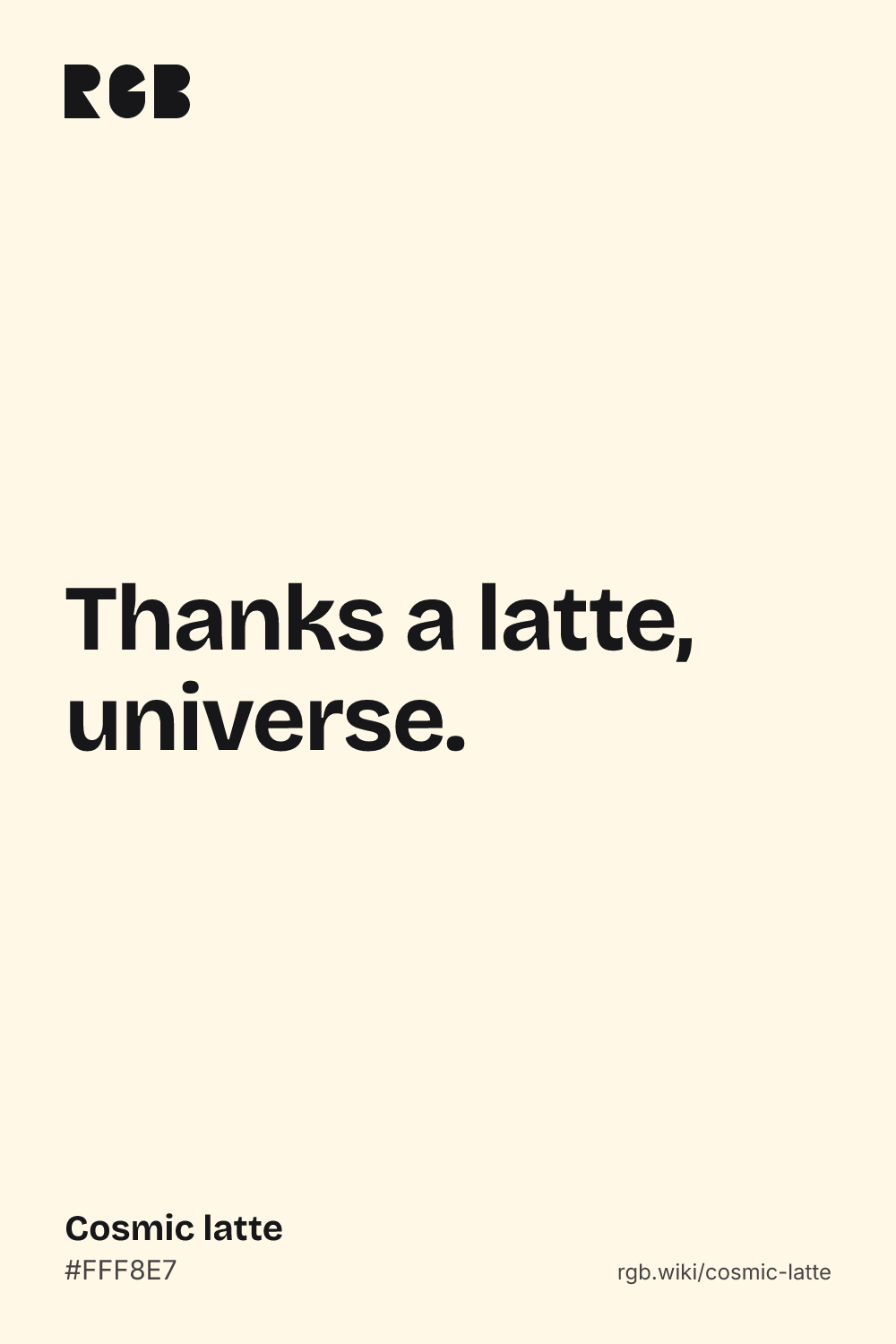
The average color of all the starlight in the universe: a warm, milky white.
Overview
Cosmic latte is a warm off-white with a faint peach tint. Its code is #FFF8E7: red at full strength, green almost full and blue a little lower, so it reads as white with a touch of cream.
It is the average color of the universe. In 2002 the astronomers Karl Glazebrook and Ivan Baldry, then at Johns Hopkins University, added up the light of more than 200,000 galaxies from the 2dF Galaxy Redshift Survey and worked out the color the eye would see if all that light were mixed together. The answer is very close to white. The code above is the authors’ own best-guess swatch.
Their first answer, announced in January 2002, was a pale turquoise. A program they used had the wrong white point, the reference for what counts as white, and two months later they corrected the color to beige. Emailed suggestions for a name followed, and they chose cosmic latte: Italian latteo means milky, and the Milky Way is the Via Lattea.
On screens, cosmic latte makes a soft background, a little warmer and peachier than ivory and far less yellow than cream. It needs dark text, and it looks its best against near-black, as the galaxies do.
HEX
#FFF8E7
RGB
rgb(255, 248, 231)
HSL
hsl(42, 100%, 95%)
HSV
42°, 9%, 100%
CMYK
0, 3, 9, 0
OKLCH
oklch(98.0% 0.024 88.2)
Every code converts from the HEX value #FFF8E7. #FFF8E7 is the color patch Karl Glazebrook and Ivan Baldry publish as their best guess for the color of the universe on their cosmic spectrum page: the chromaticity they measured (CIE x 0.345, y 0.345), shown for an equal-energy white point with a gamma of 2.2, at full brightness. We read the code from their image file. CMYK is a screen-based estimate; print results vary.
Cosmic latte on the color map
LighterDarker
Cosmic latte is so close to white that it sits at the top edge of this map, where small changes in tint swing its hue a long way. The authors’ linear version sits just below it, a deeper cream. Their daylight version lies lower and to the left: a faint pink. Their lamplight version, a clear blue, and the pale turquoise of the first announcement fall far outside the outline. The outline is an approximate range, not a measured one.
Shades and tints
Tintswith white
Shadeswith black
Toneswith gray
Cosmic latte sits in the middle. Tints add white, shades add black and tones add gray, in 10% steps out from it. Tap any swatch to copy its code.
Light and dark cosmic latte
#FFF8E7
Cosmic latteThe reference color: the authors’ best guess for an eye adapted to darkness.
#FFF2D1
Linear cosmic latteThe same color without gamma correction, which the authors also published. A deeper cream.
#FFFAF0
Floral whiteA CSS keyword almost the same color, slightly paler, with a page of its own. See floral white
#FFDAC9
Daylight viewThe universe seen against daylight white, in the authors’ D65 version. A faint pink.
#AFEEEE
Pale turquoiseThe CSS pale turquoise. The first, wrong answer for the color of the universe was a few percent greener.
#6D96FF
Lamplight viewThe universe seen from a room lit by light bulbs, in the authors’ Illuminant A version. Clearly blue.
Colors that go with cosmic latte
Pairings that work in rooms, outfits and interfaces.
Night sky
Milky starlight on deep space blue-black.
Latte
The name taken literally: milk, foam and coffee browns.
Cosmic latte and navy
A warm white with deep blue. Calm and classic.
Three white points
The universe’s color in the dark, against daylight and under lamplight.
Cosmic latte and sage
Soft and natural. Good for homes and quiet brands.
Paper and ink
A warm page for long reading, with a soft gray for details.
Color-wheel palettes
Pick a palette to see where its colors sit on the color wheel. The caret marks cosmic latte. Tap a band to copy its code.
Lined up by hue around cosmic latte. Hover a color to see how similar it is.The bar under each name shows how similar it is. Similarity comes from the distance between the two colors in OKLab, a model of how we see color.
Cosmic latte vs ivory
Cosmic latte#FFF8E7 · hue 42°
A peachy, milky white
The average color of the universe
Named by astronomers in 2002
Ivory#FFFFF0 · hue 60°
Paler, with a lemony tint
Named after elephant tusks
The CSS keyword ivory
Meaning
200,000 galaxies
Astronomy
Depends on the light
Named by vote
Cosmic latte is a scientist’s color with a joke for a name. It began as a footnote to a study of when the universe’s stars were born, and it shows how much the color we see depends on our eyes and our surroundings. Its meaning is in that story, not in any study of how the color makes people feel.
The sum of 200,000 galaxies
Measured
Glazebrook and Baldry added together the spectra of the galaxies in the 2dF Galaxy Redshift Survey, each weighted by how much light it gives out. Their “cosmic spectrum” has a chromaticity of x 0.345, y 0.345 on the CIE diagram, and the numbers barely changed across subsamples or with a second survey, the Sloan Digital Sky Survey.1
A turquoise mistake
Historical record
In January 2002 the team announced the universe was a color a few percent greener than pale turquoise. Color scientist Mark Fairchild and colleagues at the Munsell Color Science Laboratory, at the Rochester Institute of Technology, showed that the free software the astronomers used had set the white point wrongly. With that fixed, the color came out beige.2
It depends on the light around you
Stated method
Against daylight the cosmic spectrum looks faintly pink, and in a room lit by light bulbs it looks clearly blue. The authors chose an equal-energy white point, close to what the eye takes as white in the dark, then showed the brightest color with that hue. They say plainly that this is a choice.1, 3
Not the color of the night sky
Stated method
The sky between the stars looks black because most galaxies are too faint for our eyes, and black, as Baldry puts it, says only that. Cosmic latte is the hue of all that faint light, shown at full brightness.3
The universe is getting redder
Well established
The same spectrum shows that most of today’s stars formed more than 5 billion years ago. The universe began young and blue, and it grows redder as star formation slows and more stars become red giants.1, 4
Cosmic latte is one of the few colors with a known birthday. It came out of a study of starlight in 2002, after a very public correction.
October 2001
Ivan Baldry, Karl Glazebrook and the 2dF team post their study of the “cosmic spectrum”, the summed light of present-day galaxies, and what it says about the history of star formation.1
January 2002
Glazebrook and Baldry announce the average color of the universe as a pale turquoise, a playful extra to the study.2
7 March 2002
Johns Hopkins announces a correction: a wrongly set white point in a free color program had turned the result turquoise. The universe is beige.2
April 2002
The study appears in The Astrophysical Journal, with the color of the universe as a footnote.1, 2
2002
From emailed suggestions voted on by Johns Hopkins astronomers, the authors pick “Cosmic Latte”, from Peter Drum and Rees Bear, over the most popular entry, “Cappuccino Cosmico”.3
2004
Color scientist Mark Fairchild lights a room with light sources set to match the cosmic spectrum, so the team can see the color of the universe for themselves; the authors post a photo of him inside it.4
2009
NASA’s Astronomy Picture of the Day features the average color of the universe, a “conditionally perceived shade of beige”.5
Sources (5)
Baldry, I. K., Glazebrook, K., et al. (2002). The 2dF Galaxy Redshift Survey: constraints on cosmic star-formation history from the cosmic spectrum. The Astrophysical Journal, 569, 582–594. arXiv:astro-ph/0110676 (first posted 30 October 2001).
A warm off-white with a faint peach tint: #FFF8E7 (RGB 255, 248, 231). It is the average color of the light from galaxies, as worked out by the astronomers Karl Glazebrook and Ivan Baldry in 2002.
Is the universe really beige?
Its average starlight is very close to white, with a slight warm tint for an eye adjusted to darkness. Against daylight it would look faintly pink, and in a room lit by light bulbs it would look blue.
Why was the color of the universe first reported as turquoise?
A free computer program the astronomers used had the wrong white point, the reference for what counts as white. With the white point corrected, the color came out beige.
Who named cosmic latte?
The name came from suggestions emailed to the astronomers and voted on by Johns Hopkins colleagues. Cappuccino Cosmico won the most votes, but the authors chose Cosmic Latte, from Peter Drum and Rees Bear, because latteo means milky in Italian, as in Via Lattea, the Milky Way.
If the universe is cosmic latte, why is the night sky black?
Most galaxies are far too faint for our eyes, so the sky between the stars looks black. Cosmic latte is the hue of their combined light, shown at full brightness.
What is the difference between cosmic latte and ivory?
Both are warm off-whites. Cosmic latte (#FFF8E7) is a little deeper and peachier; ivory (#FFFFF0) is paler, with a lemony tint.
What colors go with cosmic latte?
Near-black or deep navy for a night-sky look, coffee browns for a cozy one, and sage or soft gray for a quiet, natural palette.