Made from insects
Reference worksCarmine is made from cochineal, a dye of the dried bodies of female cochineal insects. It takes about 70,000 insects to make a pound of dye.1, 2
A deep red named after a pigment made from crushed insects.
Carmine is a deep red with a faint purple lean. Its usual web code is #960018: red at a little over half strength, no green and a trace of blue. It is a dark color, so white text sits on it easily.
Carmine is the name of a pigment before it is a color. The word came into English from French carmin and Medieval Latin carminium, perhaps from Arabic qirmiz, the kermes insect, and Latin minium, cinnabar.
The pigment is made from cochineal, insects that live on cacti in the Americas. People there used them for red as early as 700 BCE, and from the 1500s cochineal was a major source of income for the Spanish Crown. It takes about 70,000 insects to make a pound of dye. Carmine is still used in food and cosmetics, and U.S. rules require it to be named on the label.
The web code shows carmine at its darkest: Wikipedia gives it as the color of the raw pigment, while dictionaries describe carmine as a vivid red. The deep version suits rich, formal designs. It carries white text well (contrast about 9:1) and pairs with cream, gold and charcoal.
| HEX | #960018 | |
|---|---|---|
| RGB | rgb(150, 0, 24) | |
| HSL | hsl(350, 100%, 29%) | |
| HSV | 350°, 100%, 59% | |
| CMYK | 0, 100, 84, 41 | |
| OKLCH | oklch(42.4% 0.172 24.1) |
People’s average carmine in the xkcd survey sits almost on top of the web code. The dictionary’s vivid red sits near the top edge of the outline, a little to the left: lighter and very slightly more purple. The outline is an approximate range, not a measured one.
Tints with white
Shades with black
Tones with gray
Pairings that work in rooms, outfits and interfaces.
Warm and classic. A safe choice for long text.
Rich and festive. Strong for menus and invitations.
Modern and serious. Good for interfaces and packaging.
Soft contrast. Suits weddings and beauty brands.
Deep and traditional. Think holly and tartan.
Serious and tailored. Suits law, finance and libraries.
Pick a palette to see where its colors sit on the color wheel. The caret marks carmine. Tap a band to copy its code.
Lined up by hue around carmine. Hover a color to see how similar it is.The bar under each name shows how similar it is. Similarity comes from the distance between the two colors in OKLab, a model of how we see color.
Carmine reads as deep, rich and old-fashioned. It is a material before it is a color: a red made from insects, used to dye cloth, to make paint and, today, to color food and cosmetics. Latvia’s flag rules call its red carmine. As with most named colors, mood research tests broad hues such as red, not carmine itself.
Carmine is made from cochineal, a dye of the dried bodies of female cochineal insects. It takes about 70,000 insects to make a pound of dye.1, 2
Since January 2011, U.S. rules require carmine and cochineal extract to be named on the label of every food and cosmetic that contains them. The FDA acted after reports of severe allergic reactions, including anaphylaxis.3
Latvia’s rules for making the national flag, first issued in 2010, describe its red as carmine red: in Latvian, “karmīnsarkanā auduma krāsa,” the color of the carmine red cloth.4
Carmine is a fugitive pigment. It is highly sensitive to light and tends to fade into brownish tones, especially in watercolor.2
Carmine’s story is the story of cochineal: an American insect red that crossed the Atlantic, made Spain rich and ended up on food labels.
People in the Americas are already using cochineal insects for their red.1
The first shipments of cochineal reach Seville from Mexico.2
Pietro Andrea Mattioli is the first to describe carmine.3
The word “cochineal” is first recorded in English, from Old Spanish cochinilla.4
First known use of “carmine” in English, as the name of the pigment.5
A U.S. rule takes effect requiring carmine and cochineal extract to be named on food and cosmetic labels.6
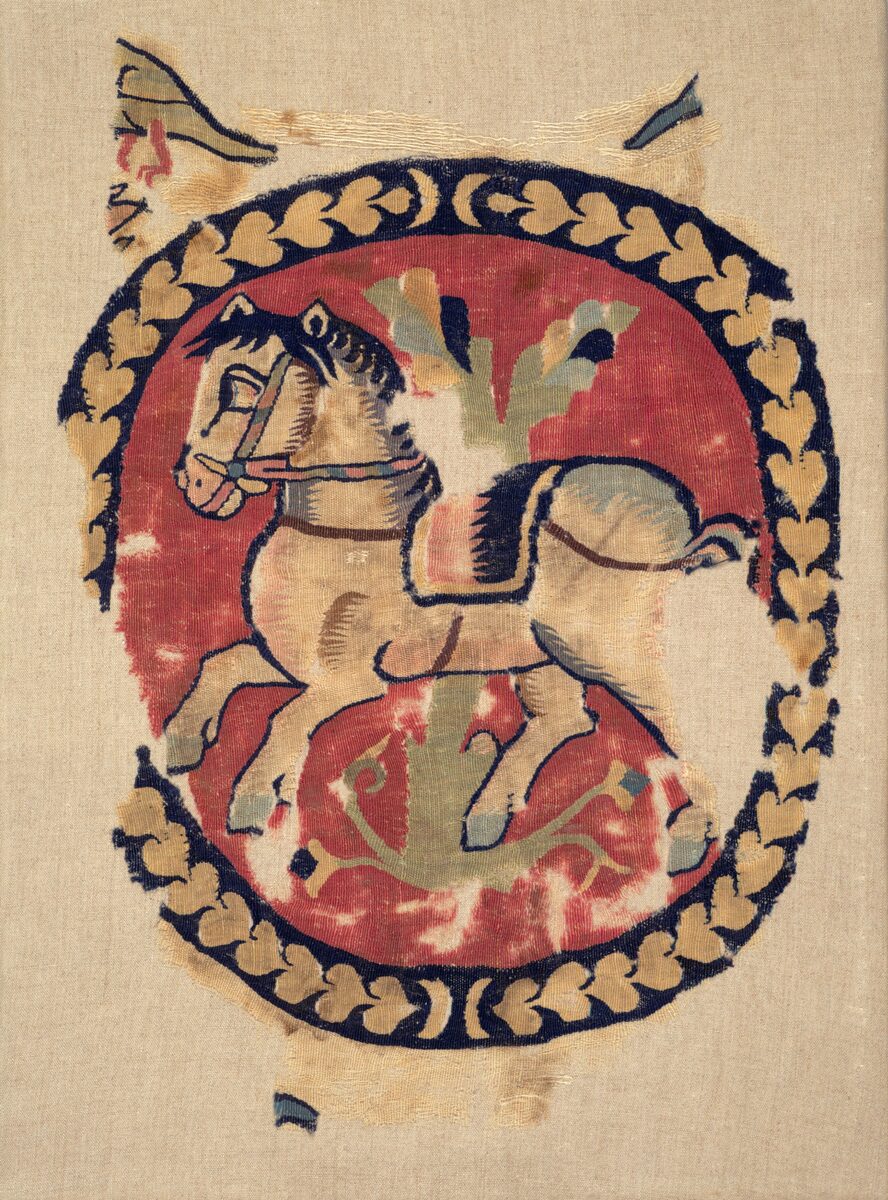
A wool curtain fragment woven in Egypt in the 500s, now at the Cleveland Museum of Art. The museum says its reds and pinks came from an insect dye, perhaps Armenian cochineal, an Old World relative of the insect behind carmine. Its red samples lighter and softer than the web code.
Sampled from the Cleveland Museum of Art’s photograph (1948.27), released as CC0 (public domain). The date, place and dyes come from the museum’s record. Colors in a photo shift with the lighting, so read the codes as close, not exact.
Palettes are sampled in-house.
A deep red with a faint purple lean. The usual web code is #960018 (RGB 150, 0, 24): red at a little over half strength, no green and a trace of blue.
Yes. Carmine pigment is made from cochineal, the dried bodies of female cochineal insects. It takes about 70,000 insects to make a pound of dye.
They have almost the same hue, but the web’s carmine (#960018) is much darker than crimson (#DC143C). Carmine is named after a pigment made from cochineal, crimson after the kermes insect.
Nearly. Cochineal is the insect and the dye made from it, and carmine is the pigment made from that dye. As web colors, cochineal (#9B1B30) is a touch softer than carmine.
Some people are allergic to it, with reactions as severe as anaphylaxis. Since 2011, U.S. rules require foods and cosmetics that contain carmine or cochineal extract to name it on the label.
Cream and gold for a warm, classic look, charcoal or navy for something serious, and blush pink for a softer pairing.