Egyptian blue

The first pigment people made, and one that glows in infrared.

Overview

Egyptian blue is the oldest known synthetic pigment, a copper calcium silicate that Egyptian craftsmen made by heating sand, lime, copper and an alkali. On screens it is given as #1034A6, a deep, strong blue that is almost the same as International Klein Blue.

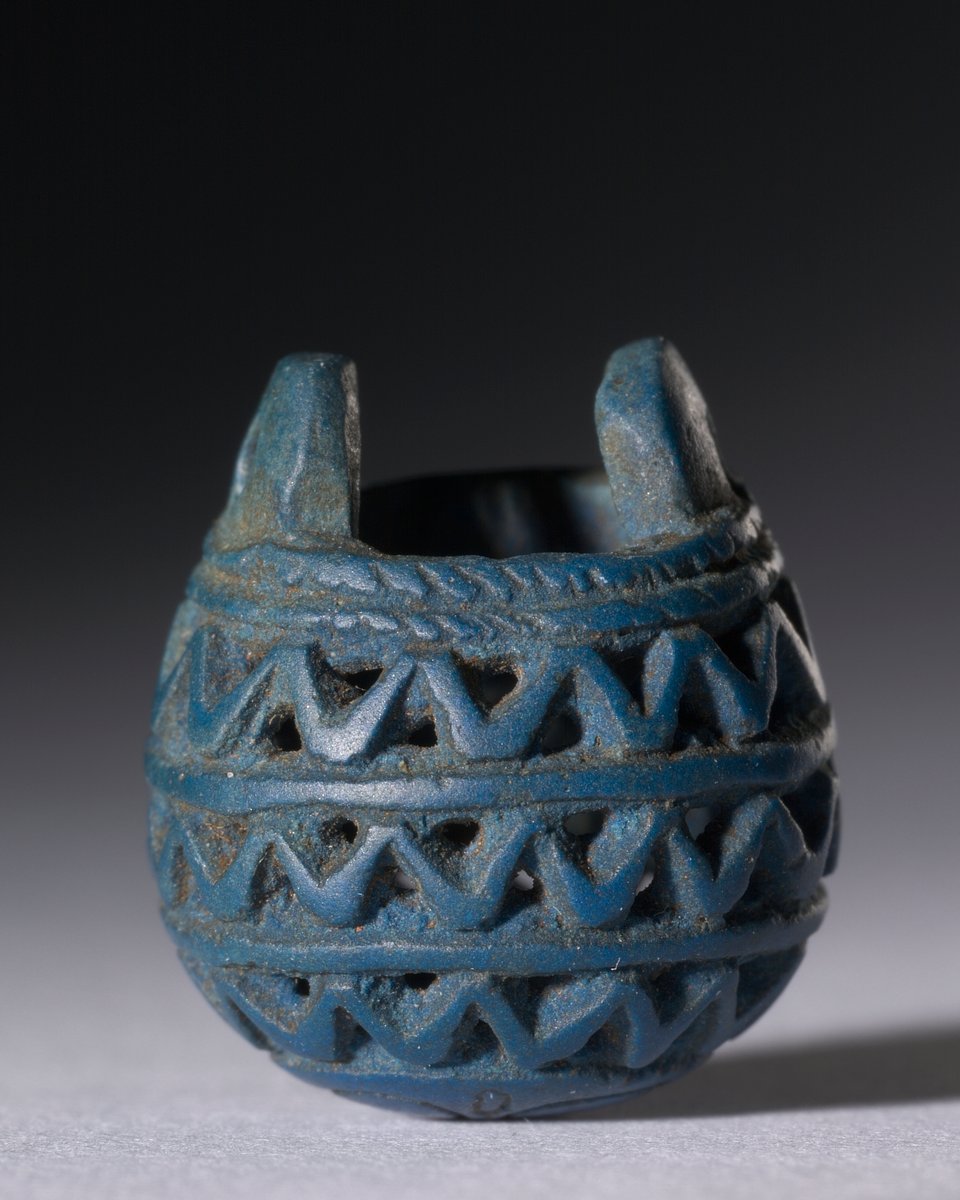
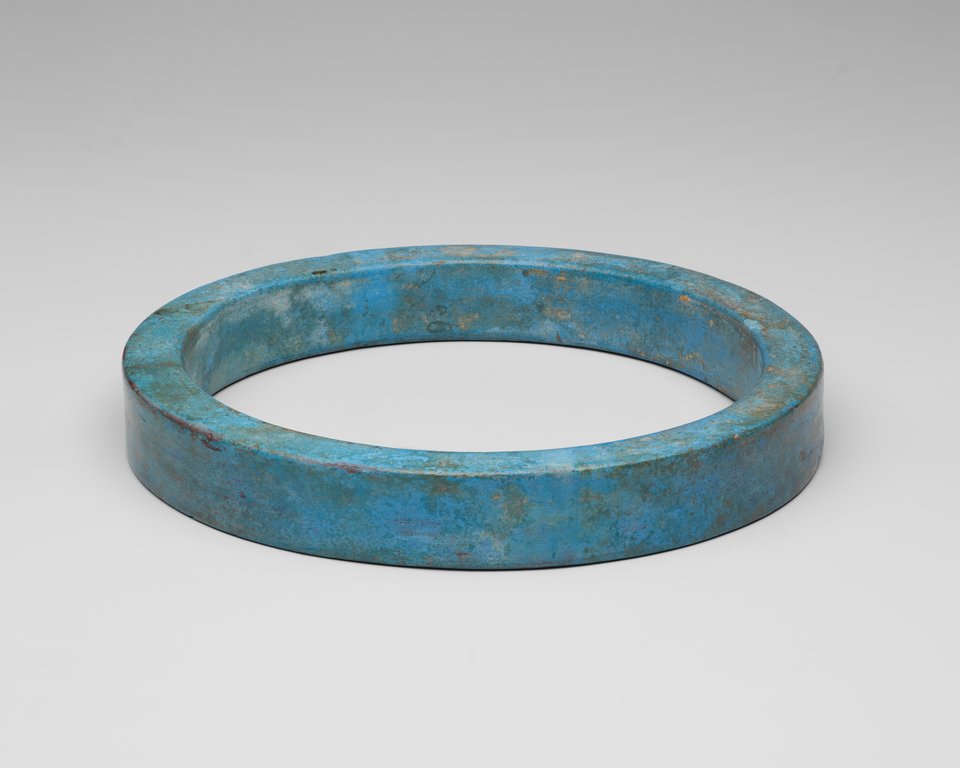
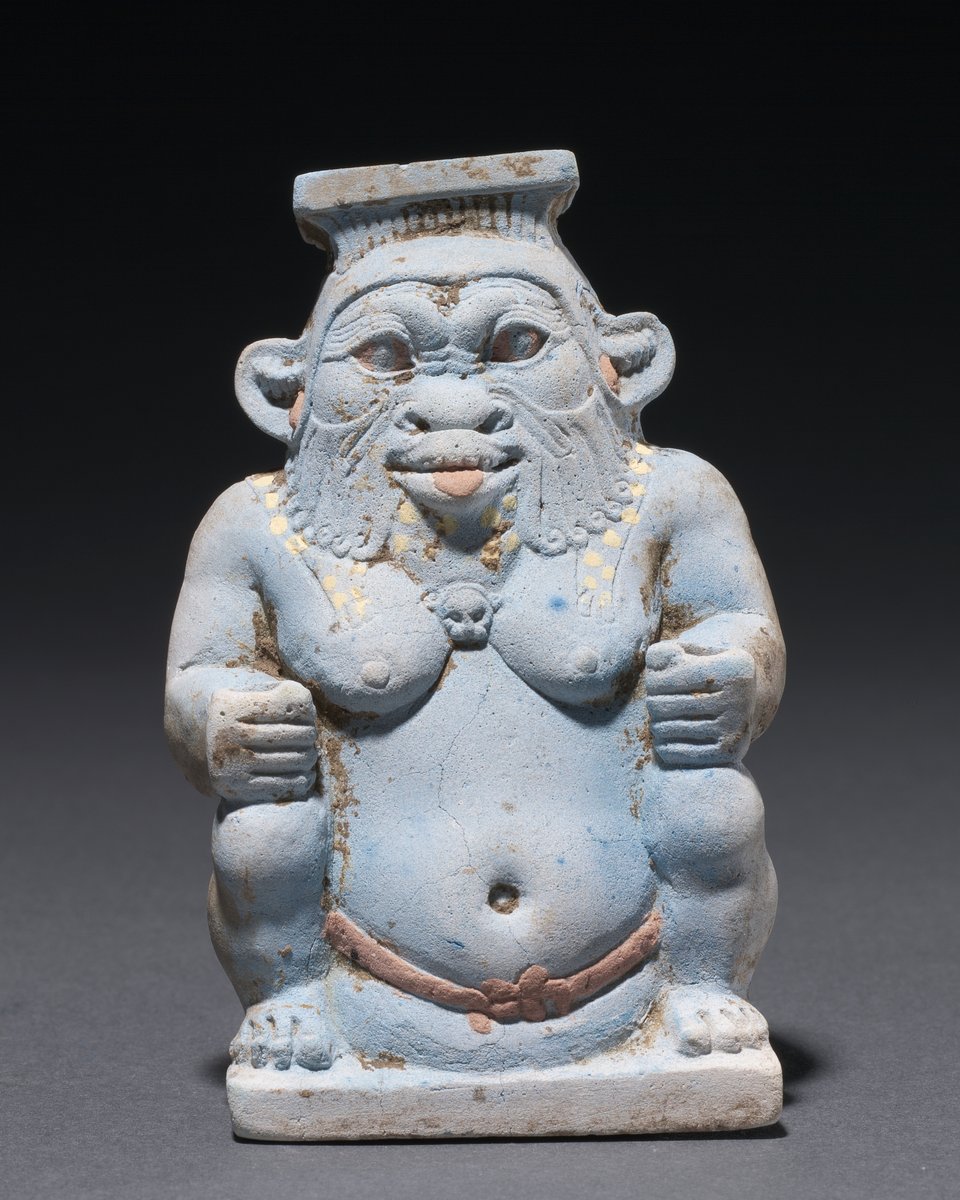
The real pigment is often lighter and greener. Depending on its ingredients and how long it was fired, it ranges from deep blue to dull gray or green. The ancient objects on this page, a chalky pale Bes jar, a dark basket amulet and a turquoise armlet, show the spread.

Egyptians used it for more than 3,000 years. The Romans, who called it caeruleum, made it at Pozzuoli near Naples. Then the recipe was lost, and chemists only began to study it again in the 1800s.

Today it has a second career. Under ordinary light, Egyptian blue gives off near-infrared light that people cannot see, so a modified camera can find traces of it too faint for the eye.

HEX#1034A6
RGBrgb(16, 52, 166)
HSLhsl(226, 82%, 36%)
HSV226°, 90%, 65%
CMYK90, 69, 0, 35
OKLCHoklch(38.9% 0.186 264.7)
Every code converts from the HEX value #1034A6. No color standard defines Egyptian blue. #1034A6 is the code most color lists use; it has no published source. The 1955 ISCC-NBS dictionary files the Egyptian blue of Maerz and Paul’s A Dictionary of Color (1930) as a strong blue to vivid greenish blue, much lighter and greener, around #0067A5. CMYK is a screen-based estimate; print results vary.
Egyptian blue color card, hex #1034A6: “Pharaoh-ly old, for a blue”

Egyptian blue on the color map

Every dictionary and real-object value sits above and to the left of the outline: lighter and greener than the code. ISCC-NBS strong blue sits just outside the top-left edge. The basket amulet sits beyond the left edge, a dark grayish blue, and the armlet near the left edge of the view, a turquoise blue. The vivid greenish blue lies off this view to the left, and the pale Bes jar would sit far above it. The outline is an approximate range, not a measured one.

Shades and tints

Tints with white

Shades with black

Tones with gray

Egyptian blue sits in the middle. Tints add white, shades add black and tones add gray, in 10% steps out from it. Tap any swatch to copy its code.

Light and dark egyptian blue

#A9B2BC
Bes jar blueSampled from the pale Bes jar of about 600 BCE: a chalky blue-gray.
#437C93
Armlet blueSampled from an Egyptian blue armlet of about 1450 BCE: a soft turquoise blue.
#0067A5
Dictionary Egyptian blueMaerz and Paul’s Egyptian blue as the ISCC-NBS dictionary places it: lighter and greener than the code.
#1034A6
Egyptian blueThe reference color.
#002FA7
International Klein BlueAlmost the same as the web code, a touch more intense. See international klein blue
#0A1F64
Deep Egyptian blueMixed 40% with black.

Colors that go with egyptian blue

Pairings that work in rooms, outfits and interfaces.

Egyptian blue and gold

Blue and gold, as on Egyptian jewelry and coffins. Rich and formal.

Tomb painting

Red and yellow ochre with Egyptian blue on a plaster ground. Warm and earthy.

Faience

The turquoise of the armlet beside the deep blue code. Cool and bright.

Egyptian blue and limestone

A pale stone ground with a warm gray. Calm, with the blue as the only strong color.

Infrared glow

A dark ground with a lighter blue as the accent, a nod to how the pigment shines in luminescence images.

Egyptian blue tones

One hue from pale to deep. Easy to use for charts and layered screens.

Color-wheel palettes

Pick a palette to see where its colors sit on the color wheel. The caret marks egyptian blue. Tap a band to copy its code.

Similar colors

Cobalt blue78%Sapphire60%Smalt88%International Klein Blue92%Zaffre72%Egyptian bluePersian blue81%

Lined up by hue around egyptian blue. Hover a color to see how similar it is.The bar under each name shows how similar it is. Similarity comes from the distance between the two colors in OKLab, a model of how we see color.

Egyptian blue vs International Klein Blue

Egyptian blue#1034A6 · hue 226°
  • A touch lighter and softer
  • An ancient copper pigment
  • Real samples are often lighter and greener
International Klein Blue#002FA7 · hue 223°
  • A touch more intense
  • A 1950s artist’s blue
  • Ultramarine pigment in a special binder

Meaning

  • First synthetic pigment
  • Ancient Egypt
  • Rome
  • Infrared imaging

Egyptian blue is less a color than a material, and its story is about making and losing it. Egyptians made it to stand in for lapis lazuli and turquoise, the Romans produced it in bulk, and scientists now track it by the invisible light it gives off.

The first pigment people made

Well established

Egyptian blue is considered the first synthetic pigment, thousands of years before Prussian blue, the first modern one. The earliest known use is on a stone bowl from Hierakonpolis of about 3250 BCE. Its Egyptian name meant artificial lapis lazuli, and it served as a cheaper stand-in for lapis and turquoise.1, 2, 3
A recipe Rome wrote down

Historical record

No Egyptian text describes how it was made. The Roman architect Vitruvius did, in the first century BCE: sand ground fine with natron, mixed with coarse filings of Cypriot copper, rolled into balls and fired in a furnace. He wrote that it was first made at Alexandria and then by Vestorius at Pozzuoli.4, 2

It glows in light we cannot see

Lab measurements

When Egyptian blue absorbs visible light, it gives off near-infrared light, peaking at 910 nanometers, with an unusually high efficiency and a long-lived emission. The British Museum showed in 2009 that a modified digital camera with filters can map it on objects. Berkeley Lab found the glow can be 10 times stronger than previously thought, enough to help cool sunlit roofs and walls.5, 6, 7

Not quite lost after Rome

Case studies

Its use died out by the fourth century CE, and the recipe was forgotten. Yet traces keep turning up in later paintings. A 2025 study confirmed Egyptian blue in the background of Raphael’s Christ Blessing (1505–06), used alongside azurite and ultramarine, the only documented case in a panel painting by Raphael.2, 8

Sources (8)
  1. WebExhibits. “Egyptian blue: History”. Pigments through the Ages.
  2. Wikipedia, “Egyptian blue”, citing Corcoran (2016), Chase (1971) and Pagès-Camagna (1998).
  3. Washington State University (2025, June 2). “Researchers recreate ancient Egyptian blues”.
  4. Vitruvius. On Architecture, Book 7, chapter 11, translated by Joseph Gwilt. LacusCurtius.
  5. Accorsi, G. et al. (2009). The exceptional near-infrared luminescence properties of cuprorivaite (Egyptian blue). Chemical Communications, 3392–3394.
  6. Verri, G. (2009). The spatially resolved characterisation of Egyptian blue, Han blue and Han purple by photo-induced luminescence digital imaging. Analytical and Bioanalytical Chemistry, 394, 1011–1021.
  7. Lawrence Berkeley National Laboratory, Heat Island Group (2018, October 9). “Egyptian Blue for Energy Efficiency”.
  8. Pozzi, F. et al. (2025). Unveiling Raphael’s Christ Blessing: chemical analysis reveals distinctive underdrawing techniques and a rare early use of Egyptian blue in Renaissance art. ACS Omega, 11(2), 3509–3517.

History

Egyptian blue was made for more than three thousand years, forgotten for more than a thousand, and is now being made again in laboratories.

  1. c. 3250 BCE

    A stone bowl from Hierakonpolis in Upper Egypt carries the earliest known Egyptian blue.1

  2. c. 3200–3000 BCE

    In Sumer, in present-day Iraq, a carver sets Egyptian blue into a tiny limestone goat, now in the Cleveland Museum of Art.2

  3. c. 1479–1425 BCE

    Under Thutmose III, makers switch from copper ore to bronze filings. An armlet made of Egyptian blue is buried in the tomb of three of his foreign wives.1, 3

  4. 1st century BCE

    Vitruvius records the recipe and says production moved from Alexandria to Pozzuoli under Vestorius.4

  5. 4th century CE

    Use of the pigment dies out, and the secret of making it is lost.1

  6. 1505–1506

    Raphael uses Egyptian blue in the background of Christ Blessing, long after it was thought to have vanished.5

  7. 1815

    The chemist Humphry Davy analyzes the colors of ancient painting, Egyptian blue among them, reviving interest in how it was made.1

  8. 2009

    Researchers measure its strong near-infrared glow, and the British Museum shows how a modified camera can map it on objects.6, 7

  9. 2025

    A Washington State University team recreates the pigment with 12 recipes, firing them at about 1,000 °C for one to 11 hours.8

Sources (8)
  1. Wikipedia, “Egyptian blue”, citing Corcoran (2016), Lee & Quirke (2000), Chase (1971) and Davy (1815).
  2. Cleveland Museum of Art. Striding Goat, Sumerian, c. 3200–3000 BCE, 1984.35, collection record.
  3. The Metropolitan Museum of Art. Armlet, New Kingdom, reign of Thutmose III, 26.8.140, collection record.
  4. Vitruvius. On Architecture, Book 7, chapter 11, translated by Joseph Gwilt. LacusCurtius.
  5. Pozzi, F. et al. (2025). Unveiling Raphael’s Christ Blessing. ACS Omega, 11(2), 3509–3517.
  6. Accorsi, G. et al. (2009). The exceptional near-infrared luminescence properties of cuprorivaite (Egyptian blue). Chemical Communications, 3392–3394.
  7. Verri, G. (2009). The spatially resolved characterisation of Egyptian blue, Han blue and Han purple by photo-induced luminescence digital imaging. Analytical and Bioanalytical Chemistry, 394, 1011–1021.
  8. Washington State University (2025, June 2). “Researchers recreate ancient Egyptian blues”.

Egyptian blue in use

A plain, flat ring of mottled turquoise-blue material lying on a gray surface
#437C93#386F83#496D76#425C62
JewelryArmlet from the tomb of Thutmose III’s foreign wives (about 1479–1425 BCE)

This solid ring is made entirely of Egyptian blue. Sampled, it is a soft turquoise blue, far lighter and greener than the web code.

#437C93#386F83#496D76#425C62
Source: The Met
A small pale blue jar shaped as the squatting god Bes, with a broad bearded face, protruding tongue and a reddish belt
#A9B2BC#C6CCD3#8A8F95#5F6368
Ritual objectCosmetic jar in the form of the god Bes (664–525 BCE)

Bes, a god of cosmetics, war and childbirth, squats on this small cosmetic jar. Its Egyptian blue has a chalky, pale blue-gray surface, with traces of red on the belt.

#A9B2BC#C6CCD3#8A8F95#5F6368
Source: Cleveland Museum of Art
A tiny dark blue openwork basket with two handles and rows of zigzag openings
#415867#5C7280#263C4A#8898A7
Ritual objectModel basket as amulet (about 1069–945 BCE)

This openwork basket, only 1.5 cm in size, was an amulet linked to the cat goddess Bastet, who is often shown carrying kittens in baskets. Here the pigment is a dark grayish blue.

#415867#5C7280#263C4A#8898A7
Source: Cleveland Museum of Art

Palettes are sampled in-house.

Questions

What is the hex code for Egyptian blue?

#1034A6 (RGB 16, 52, 166) is the code most color lists use, but no standard defines it. Real Egyptian blue objects are usually lighter and greener.

What is Egyptian blue made of?

Calcium copper silicate. Ancient makers heated sand, lime, a copper source such as ore or bronze filings, and an alkali such as natron in a furnace.

Why is Egyptian blue called the first synthetic pigment?

Because people made it by a chemical reaction rather than grinding a natural mineral, starting more than 5,000 years ago in Egypt.

Why does Egyptian blue glow?

It absorbs visible light and gives off near-infrared light. People cannot see the glow, but a camera with the right filters can, which lets museums find tiny traces of the pigment.

Is Egyptian blue the same as International Klein Blue?

No. They look almost identical as screen codes, but Egyptian blue is an ancient copper pigment, while International Klein Blue is a 1950s artist’s blue made with ultramarine.

What colors go with Egyptian blue?

Gold, red and yellow ochre, and warm stone colors, the palette of Egyptian painting. A pale turquoise makes a softer partner.