Zaffre

A deep, inky blue named after the roasted cobalt ore that potters and glassmakers bought to make their blues.

Overview

Zaffre is a deep, intense blue with a slight violet lean. Its web code, #0014A8, has no red, almost no green and blue at about two-thirds strength. It is darker and purer than cobalt blue and sits close to ultramarine and International Klein Blue.

The name comes from zaffre, also spelled zaffer: cobalt ore roasted until most of its arsenic burned off, leaving a dark, earthy powder of cobalt oxides. Glassmakers and potters from Persia to Venice and Saxony bought it by the hundredweight. Melted into glass or a glaze, a little of it gives a strong blue. Ground blue glass made from it is smalt.

The powder itself is not blue. Reference works describe it as dark and earthy, gray-brown to reddish, and the blue only appears in the fire. The color name is also looser than the web code suggests: the 1955 ISCC-NBS dictionary files Maerz and Paul’s zaffre blue as a deep blue, #00416A, much greener and duller than #0014A8.

Zaffre is a dark color. White text on it reaches about 12.6:1, while black fails at 1.7:1. It looks at home on warm white, the way it sat on tin-glazed pottery, and it gives strong contrast to saffron yellow and coral.

HEX#0014A8
RGBrgb(0, 20, 168)
HSLhsl(233, 100%, 33%)
HSV233°, 100%, 66%
CMYK100, 88, 0, 34
OKLCHoklch(34.4% 0.220 264.2)
Every code converts from the HEX value #0014A8. No color standard defines #0014A8, and we could not trace where it first came from. Wikipedia’s Zaffre article shows it and credits the X11 color list, but X11 has no zaffre. The 1955 ISCC-NBS dictionary files the zaffre blue of Maerz and Paul’s A Dictionary of Color (1930) as deep blue, #00416A, with a second placement in moderate blue, #436B95 (Jaffer’s table). CMYK is a screen-based estimate; print results vary.
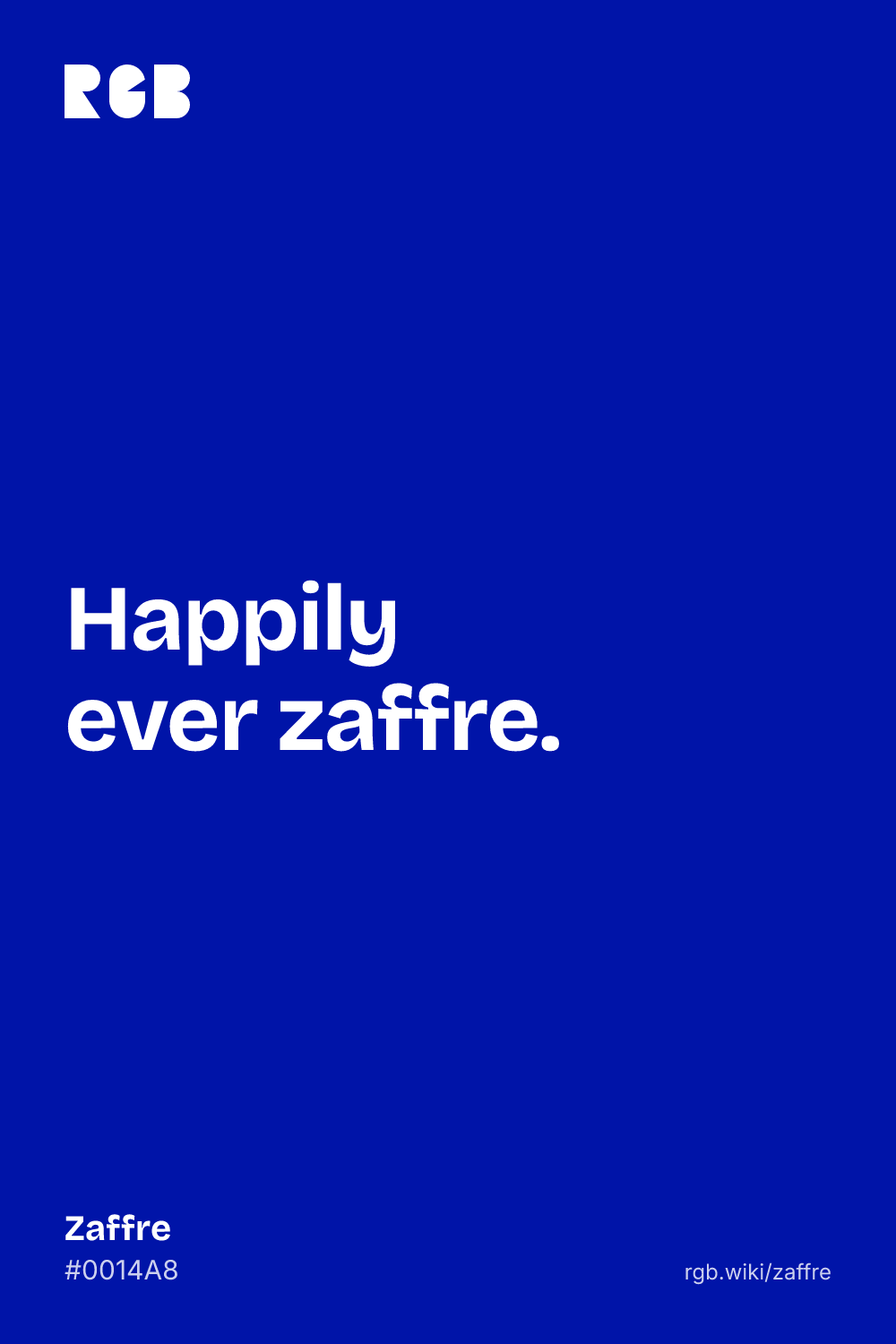
Zaffre color card, hex #0014A8: “Happily ever zaffre”

Zaffre on the color map

The dictionary’s deep blue sits to the left of the web code, toward the greenish blues, at about the same lightness and near the edge of the outline. Its moderate blue sits above and to the left, outside the outline: lighter, greener and much grayer. The outline is an approximate range, not a measured one.

Shades and tints

Tints with white

Shades with black

Tones with gray

Zaffre sits in the middle. Tints add white, shades add black and tones add gray, in 10% steps out from it. Tap any swatch to copy its code.

Light and dark zaffre

#99A1DC
Pale zaffreMixed 60% with white. A soft periwinkle blue.
#3343B9
Light zaffreMixed 20% with white. A clear, strong blue.
#0014A8
ZaffreThe reference color.
#003399
SmaltThe ground cobalt glass made from zaffre. See smalt
#00416A
Deep blueWhere the 1955 ISCC-NBS dictionary filed Maerz and Paul’s zaffre blue.
#000C65
Dark zaffreMixed 40% with black. Close to navy.

Colors that go with zaffre

Pairings that work in rooms, outfits and interfaces.

Zaffre and tin white

Blue on a warm white glaze with a touch of copper green, like early Italian maiolica.

Zaffre and saffron

Near-opposites. Bright, confident and easy to read.

Zaffre and coral

Deep blue warmed by coral. Lively for fashion and events.

Zaffre night

A dark theme built on zaffre’s shades, with a light blue accent.

Zaffre and turquoise

The two blues of Persian tiles. Cool and decorative.

Zaffre and stone gray

Quiet and businesslike. Good for reports and dashboards.

Color-wheel palettes

Pick a palette to see where its colors sit on the color wheel. The caret marks zaffre. Tap a band to copy its code.

Similar colors

Smalt73%International Klein Blue79%Dark blue70%Phthalo blue72%ZaffreEgyptian blue72%Ultramarine76%

Lined up by hue around zaffre. Hover a color to see how similar it is.The bar under each name shows how similar it is. Similarity comes from the distance between the two colors in OKLab, a model of how we see color.

Zaffre vs smalt

Zaffre#0014A8 · hue 233°
  • Deeper, with a violet lean
  • Named after the roasted cobalt ore
  • The raw material, not a paint
Smalt#003399 · hue 220°
  • A little lighter and greener
  • Named after ground cobalt glass
  • The pigment made from zaffre

Meaning

  • Sapphire name
  • Roasted ore
  • Guarded trade
  • Arsenic smoke

Zaffre’s meanings come from the material, not from studies of how the color feels. It was a trade good: an ugly-looking powder that turned into the finest blue in the kiln, worth enough that Saxony hanged people for stealing the ore. Making it was dirty, poisonous work. No study has tested how people respond to the color zaffre itself.

Probably named after sapphire

Word history

Merriam-Webster traces zaffer to Italian zaffera, probably from Latin sapphirus, sapphire. In 1744 the German chemist Johann Albrecht Gesner made the same case and explained the German name Saflor as a shortening of sapphiri color, “sapphire color.” Other writers suggest an Arabic origin, so the link is likely but not proven.1, 2

Not blue until fired

Reference works

Merriam-Webster defines zaffer as an impure cobalt oxide, “a dark earthy powder,” made by roasting cobalt ores and used for smalt and as a blue ceramic color. It does not melt on its own: only fired with quartz and potash, or in a glass or glaze, does it give its blue.1, 3

Guarded like a state secret

Historical record

In Saxony, Europe’s main source of cobalt, the trade became a privilege of the ruler. From 1656 cobalt inspectors were appointed, exports were banned and gallows were put up for cobalt thieves. From 1724 no stranger could enter the color mills.3

Made in poisonous smoke

Historical record

Roasting cobalt ore drives off its arsenic as a toxic smoke. A Saxon mining writer of 1699 recalled cobalt workers whose skin and lungs the poison had eaten away, and a poison works built in 1670 killed every fish in the stream below it. Later works caught the arsenic in smoke chambers, where workers with cloths over their mouths shoveled it out.3

Sources (3)
  1. Merriam-Webster, “zaffer”, definition, variants and etymology.
  2. Gesner, J. A. (1744). Historia cadmiae fossilis metallicae sive cobalti et ex illo praeparatorum Zaffariae et Smalti, part 1, chapter 3, § 2, “Zafferae etymologia”, p. 27. Berlin. Google Books.
  3. Hammer, P. (2004). Das Sächsische Blaufarbenwesen und der Handel mit Kobaltfarben. Scripta Geologica, Special Issue 4, 108–117. PDF, Naturalis. Quotes Lehmann (1699) and Gerber (1864).

History

Zaffre was the semi-finished blue of the old world: ore roasted near the mine, then sold on to glasshouses and potteries. It traveled from Persia to Venice, and later from Saxony to Holland.

  1. 1301

    Abu’l-Qasim, from a family of potters in Kashan, Persia, writes a treatise on ceramics that describes the cobalt ore mined near the city for blue glazes. Cobalt was still mined and processed there in the late 1800s.1, 2

  2. 1400s

    Italy starts using cobalt blue early in the century. The impure oxide arrives from Syria through Venice as colore damaschino, “Damascus color,” and is so heavily taxed that it is often smuggled.2

  3. About 1430–50

    Florentine potters paint maiolica in zaffera a rilievo, cobalt blue laid on so thickly that it stands up from the glaze.3

  4. 1520

    In Schneeberg, Saxony, Peter Weidenhammer makes a blue color from local ore and sells it by the hundredweight to Venice. A town chronicle of 1684 says he arrived poor and grew rich enough to build a fine house on the market square; his name stands in the church with the year 1520.4

  5. 1540

    Vannoccio Biringuccio’s Pirotechnia, printed in Venice, gives the earliest known written use of the name zaffera.5

  6. 1612

    Antonio Neri’s L’arte vetraria, a glassmaking manual, gives a recipe for preparing zaffera: lumps are set in earthen pans in the furnace chamber for half a day, then washed with vinegar and water.6

  7. 1656

    Saxony appoints cobalt inspectors and bans the export of ore, with gallows for cobalt thieves. Holland, which had no cobalt mines of its own, was the biggest buyer of Saxon blue.7

  8. 1930

    Maerz and Paul’s A Dictionary of Color includes zaffre blue among its color samples. In 1955 the ISCC-NBS dictionary files it as deep blue.8, 9

Sources (9)
  1. Allan, J. W. (1973). Abū’l-Qāsim’s treatise on ceramics. Iran, 11, 111–120.
  2. al-Hassan, A. Y. “Lazaward (lajvard) and zaffer cobalt oxide in Islamic and Western lustre glass and ceramics”, History of Science and Technology in Islam, citing Allan (1973) and Saliba in The Arts of Fire (Getty, 2004).
  3. Cleveland Museum of Art, “Dish with a Lion”, Italy, Florence, about 1430–50 (1966.19).
  4. Meltzer, C. (1684). Bergkläufftige Beschreibung der … Bergk-Stadt Schneebergk, p. 469. Schneeberg. Quoted in Wikipedia (German), “Zaffer”.
  5. Biringuccio, V. (1540). De la pirotechnia. Venice. As reported by Wikipedia (German), “Zaffer”, history section.
  6. Neri, A. (1612). L’arte vetraria distinta in libri sette, book 1, chapter 12, “A preparare la zaffera”, p. 15. Florence. Gallica.
  7. Hammer, P. (2004). Das Sächsische Blaufarbenwesen und der Handel mit Kobaltfarben. Scripta Geologica, Special Issue 4, 108–117. PDF, Naturalis.
  8. Wikipedia, “Zaffre”, citing Maerz and Paul, A Dictionary of Color (1930), p. 207 and plate 43.
  9. Jaffer, A. “Maerz and Paul color names”, from the ISCC-NBS Dictionary of Color Names (1955).

Zaffre in use

All brand colors
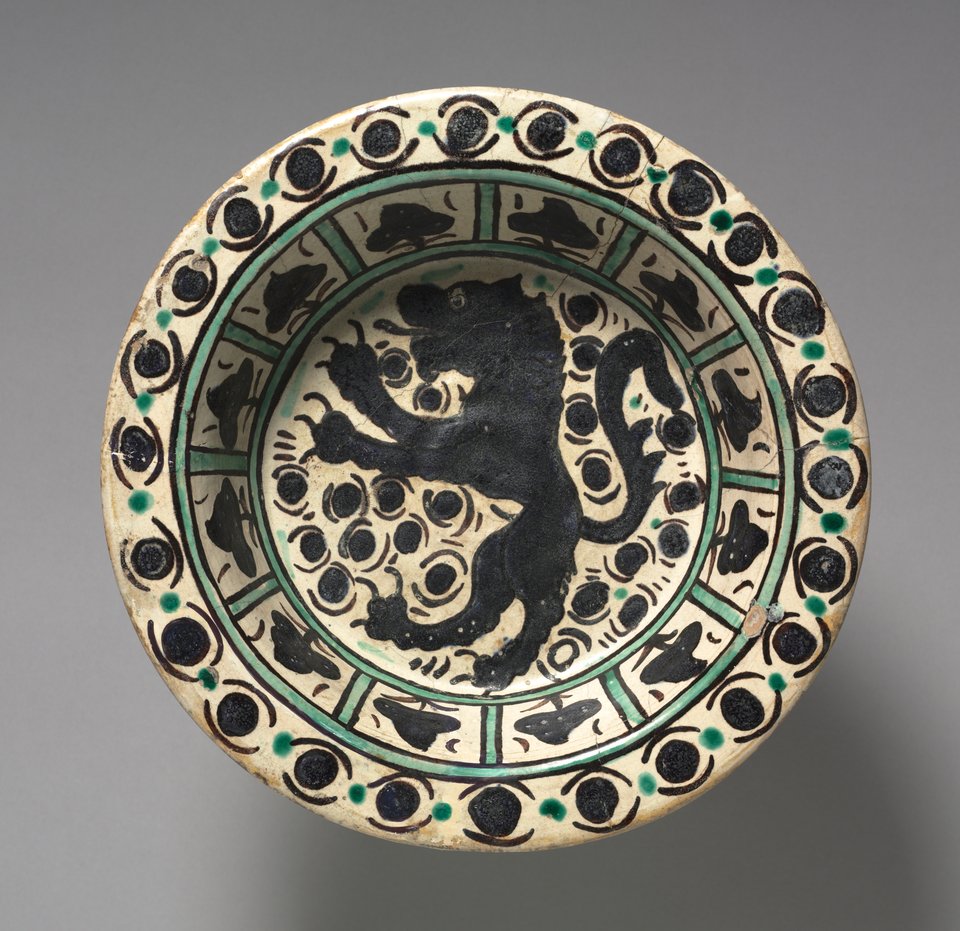
A round tin-glazed dish painted with a rampant lion in thick, nearly black blue, ringed by blue roundels, leaf shapes and green bands on a cream ground
#292A2B#464740#62826A#E5D7B7
CeramicDish with a lion (about 1430–50)

Florentine maiolica at the Cleveland Museum of Art, painted in what the museum calls a cobalt blue impasto technique, zaffera a rilevo. Laid on this thick, the blue fired so dark that it reads almost black, near #292A2B, beside copper green and the warm white glaze. It shows how far real zaffre can sit from the web’s bright #0014A8.

#292A2B#464740#62826A#E5D7B7
Source: Cleveland Museum of Art

Logos belong to their owners and are shown unaltered, only to show where each palette comes from. Palettes are sampled in-house.

Questions

What color is zaffre?

A deep, intense blue with a slight violet lean. The usual web code is #0014A8 (RGB 0, 20, 168).

What is zaffre made of?

Zaffre is cobalt ore roasted to burn off most of its arsenic. What is left is an impure cobalt oxide, a dark earthy powder that turns glass and glazes blue when fired.

Is zaffre the same as smalt?

No. Zaffre is the roasted ore. Smalt is a blue glass made by melting zaffre with quartz and potash, then grinding it to a powder. The web code for smalt, #003399, is a little lighter and greener.

Where does the code #0014A8 come from?

No standard defines it. Wikipedia credits the X11 color list, but that list has no zaffre. The 1955 ISCC-NBS dictionary files Maerz and Paul’s zaffre blue as deep blue, #00416A, which is greener and duller.

How do you spell it, zaffre or zaffer?

Both are correct. Merriam-Webster lists zaffer first, with zaffre as a variant; zaffre is the usual spelling for the color name.

Why is it called zaffre?

It comes from Italian zaffera, probably from Latin sapphirus, sapphire, after the blue it gave glass. Some writers suggest an Arabic origin instead.

What colors go with zaffre?

Warm white for the look of old blue-and-white pottery, saffron yellow or coral for strong contrast, turquoise for a Persian tile feel, and stone gray for something quiet.