A vivid blue with a name that is older, and darker, than its code.
Overview
Persian blue is a strong, vivid blue with a slight violet lean. Its usual web code is #1C39BB: a little red, some green and blue at about three-quarters strength.
The name is older than this color. In the 1600s “Persian blue” meant a dark blue cloth dyed with indigo. Maerz and Paul, authors of a 1930 color dictionary, argued that the “Persian” had nothing to do with Persia. They traced it to pers, an old French and English word for blue cloth. Many color lists now tie the name to the blue tiles and pottery of Iran instead. Neither story has firm proof.
The early color standards never agreed on a shade. Ridgway’s 1912 standard made Persian blue a pale blue, Maerz and Paul showed a dark grayish indigo and a pale blue, and a British horticultural chart of 1938–41 a strong mid blue, about #0067A5. None of them matches the vivid web code. On a Safavid tile from Iran, the deep blue ground photographs darker and more violet, about #393779.
On screens, Persian blue carries white text easily. It looks at home with the colors of Iranian tilework: turquoise, cream, gold and a warm brick red.
HEX
#1C39BB
RGB
rgb(28, 57, 187)
HSL
hsl(229, 74%, 42%)
HSV
229°, 85%, 73%
CMYK
85, 70, 0, 27
OKLCH
oklch(42.3% 0.205 266.5)
Every code converts from the HEX value #1C39BB. No color standard defines Persian blue as #1C39BB, though it is the code most color lists use. Wikipedia credits it to a color website and to a sample in Maerz and Paul’s A Dictionary of Color (1930), but the ISCC-NBS dictionary files Maerz and Paul’s two Persian blue samples as a pale blue and a grayish purplish blue, not a vivid one. CMYK is a screen-based estimate; print results vary.
Persian blue on the color map
LighterDarker
Persian blue has meant very different blues. The horticultural chart’s strong blue sits to the left of the outline, greener than the code. The pale blue of Ridgway and Maerz and Paul sits far above it. Maerz and Paul’s dark sample falls inside the outline, near its right edge, though it is much grayer than the code. The two Iranian glazes sit just past the right edge, a little darker and more violet. The outline is an approximate range, not a measured one.
Shades and tints
Tintswith white
Shadeswith black
Toneswith gray
Persian blue sits in the middle. Tints add white, shades add black and tones add gray, in 10% steps out from it. Tap any swatch to copy its code.
Light and dark persian blue
#BBC4EB
Pale Persian blueMixed 70% with white. A soft periwinkle for backgrounds.
#7788D6
Light Persian blueMixed 40% with white. A clear, gentle violet-blue.
#1C39BB
Persian blueThe reference color.
#0067A5
Medium Persian blueThe strong blue where the ISCC-NBS dictionary files the Persian blue of the 1938–41 Horticultural Colour Chart.
#112270
Dark Persian blueMixed 40% with black. A deep, inky blue, close to the old indigo cloth.
Colors that go with persian blue
Pairings that work in rooms, outfits and interfaces.
Persian blue and turquoise
The two blues of Iranian tilework, on a cream ground. Lively and bright.
Persian blue and gold
Deep blue with gold leaf, as on lajvardina pottery. Rich and formal.
Persian blue and white
Vivid blue with crisp white. Strong for headers, banners and dark themes.
Persian blue and saffron
Near-opposites with high contrast. Let the yellow be the accent.
Persian blue and terracotta
Blue glaze against warm brick and fired clay. Earthy and grounded.
Two Persian blues
The vivid web code with the pale Persian blue of the old color standards. Calm and cool.
Color-wheel palettes
Pick a palette to see where its colors sit on the color wheel. The caret marks persian blue. Tap a band to copy its code.
Cobalt blue80%Sapphire72%Smalt69%International Klein Blue77%Zaffre60%Egyptian blue81%Persian blue
Lined up by hue around persian blue. Hover a color to see how similar it is.The bar under each name shows how similar it is. Similarity comes from the distance between the two colors in OKLab, a model of how we see color.
Persian blue vs Prussian blue
Persian blue#1C39BB · hue 229°
Vivid blue with a violet lean
Named for a cloth color, or for Iran
No standard code
Prussian blue#003153 · hue 205°
Very dark blue with a green lean
Named for a pigment made in Berlin
An iron and cyanide compound
Meaning
Disputed name
Cloth
Pottery
Tilework
Persian blue carries two stories at once. One is a cloth color: an indigo-dyed blue sold in Europe under a name that may come from the French word pers, not from Persia. The other is the blue of Iranian pottery and tiles, the domes and walls of cities such as Isfahan, which most color lists now name as the source. The claims below say how sure each one is. As with most named colors, research on color and emotion tests broad words such as blue, not Persian blue itself.
Maybe not Persian at all
One source, disputed
Maerz and Paul argued that the 1600s “Persian blue”, a dark indigo-dyed cloth color, grew out of pers, the name for blue in the French cloth regulations, and had no link to Persia. They admitted it may have been, and gave no proof either way. Pers itself is an old word: Merriam-Webster traces English perse to Medieval Latin persus, with no link to Persia.1, 2
The blue of Iranian pottery came from cobalt
Museum records
Iranian potters of the 1200s and 1300s made a deep blue ware now called lajvardina, from lajvard, the Persian word for lapis lazuli. The Metropolitan Museum and the Louvre Abu Dhabi both explain the name. The Louvre Abu Dhabi adds that the color itself came from cobalt oxide, not from the stone.3, 4
Blue tiles cover Isfahan’s great mosque
Historical record
The Shah Mosque in Isfahan, built from 1611 to about 1630, is faced in a newer, quicker style of tilework in which each tile is painted in several colors. Its finest tiles, on the entrance portal, use dark blue, light blue, white, black, yellow, green and beige, and the tiles in most of the mosque are mainly blue.5
Sources (5)
Maerz, A. & Paul, M. R. (1930). A Dictionary of Color. New York: McGraw-Hill. Note on “Pers” and index entries for “Persian Blue”. Internet Archive.
Merriam-Webster, “perse”: “of a dark grayish blue resembling indigo”, etymology and first known use.
The Metropolitan Museum of Art, “Covered Jar (Albarello)”, Iran, second half of the 1200s–1300s (57.61.12a, b).
Wikipedia, “Shah Mosque (Isfahan)”, citing Sheila Blair and Jonathan Bloom, The Grove Encyclopedia of Islamic Art and Architecture (2011), and Blair (2013).
History
Persian blue has named a medieval cloth, a dark dye, a pale chart color and a vivid screen color. Alongside runs the real blue of Iranian pottery and tiles.
1260s–1330s
Potters in Iran, mainly at Kashan, make lajvardina ware: a deep cobalt-blue glaze with gold leaf and red and white painting. The name comes from lajvard, the Persian word for lapis lazuli.1, 2
Early 1300s
In his Convivio, Dante defines perso as “a color mixed of purple and black, but the black wins”. In the Inferno he uses it for the murky air of the second circle of Hell.3
1300s
The word perse, from Anglo-French pers, enters English as a color word for a dark grayish blue.4
1400s
A letter in the Paston family papers mentions “a gowne of fyn perse blewe furryd with martens”. Paget Toynbee later finds that perse covered almost every blue, from blue-black to turquoise.3
1611–about 1630
The Shah Mosque rises in Isfahan, faced in hundreds of thousands of tiles that are mostly blue.5
1669
First recorded use of “Persian blue” as a color name in English. Maerz and Paul describe it as a dark blue dyed with indigo, its name borrowed from the French pers.6, 7
1912
Robert Ridgway’s Color Standards and Color Nomenclature prints Persian blue on plate XX as a pale tint. The ISCC-NBS dictionary later files it as a very pale to pale blue.8, 9
1930
Maerz and Paul’s A Dictionary of Color shows two Persian blues. The older one, the same swatch as their “regimental”, is a dark grayish indigo; the other is a pale blue.7, 9
1938–41
The British Colour Council’s Horticultural Colour Chart, made with the Royal Horticultural Society, gives Persian blue as a strong mid blue, near #0067A5.9, 10
Sources (10)
Wikipedia, “Lajvardina”, citing Oliver Watson, Ceramics of Iran (2020), and Stefano Carboni, Persian Tiles (1993).
The Metropolitan Museum of Art, “Covered Jar (Albarello)”, Iran, second half of the 1200s–1300s (57.61.12a, b).
Toynbee, P. (1902). “The Colour Perse in Dante and Other Mediaeval Writers”. In Dante Studies and Researches, pp. 307–314. London: Methuen. Internet Archive.
Merriam-Webster, “perse”, etymology and first known use.
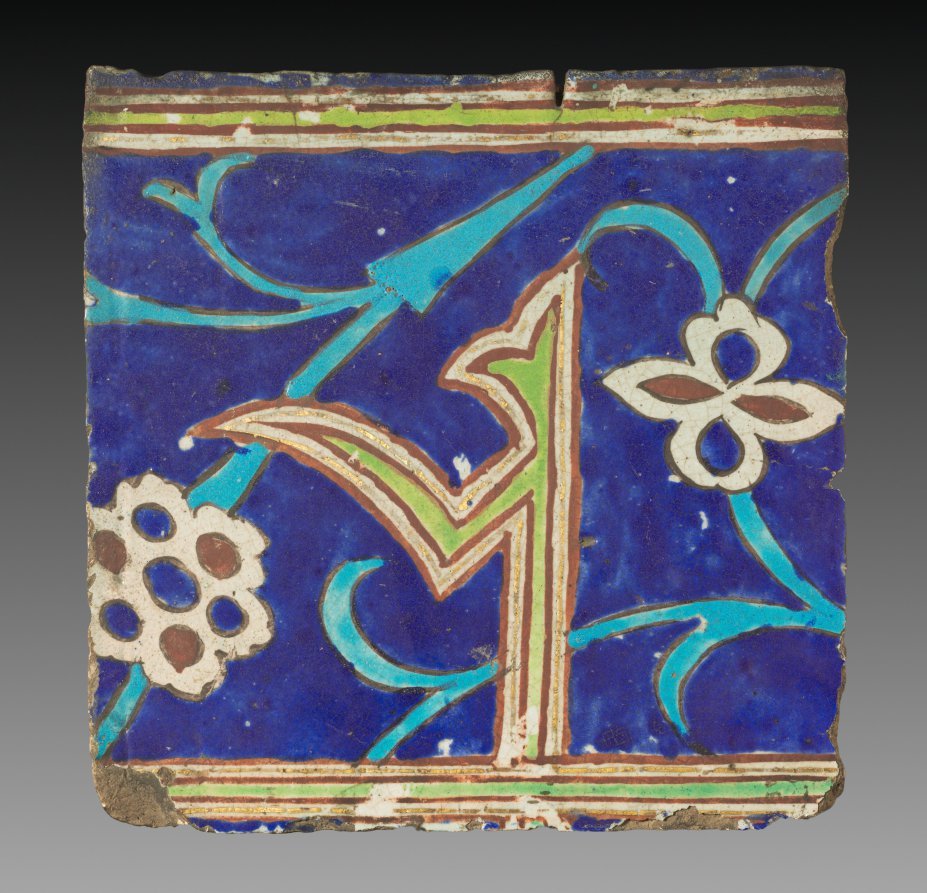
A square tile at the Cleveland Museum of Art, made by outlining each color so the glazes could not run together. Its deep blue ground photographs as about #393779, darker and more violet than the web code, with turquoise stems, cream flowers and red-brown outlines.
#393779#3EA8B2#D6CCB2#806457
Source: Cleveland Museum of Art
Source
Sampled from the tile face in the Cleveland Museum of Art’s photograph (1915.650), released as CC0 (public domain). The museum lists it as faience in the cuerda seca technique, Safavid period. Colors in a photo shift with the lighting, so read the codes as close, not exact.
#3B3A58#9C876B#806043#B4ABA0
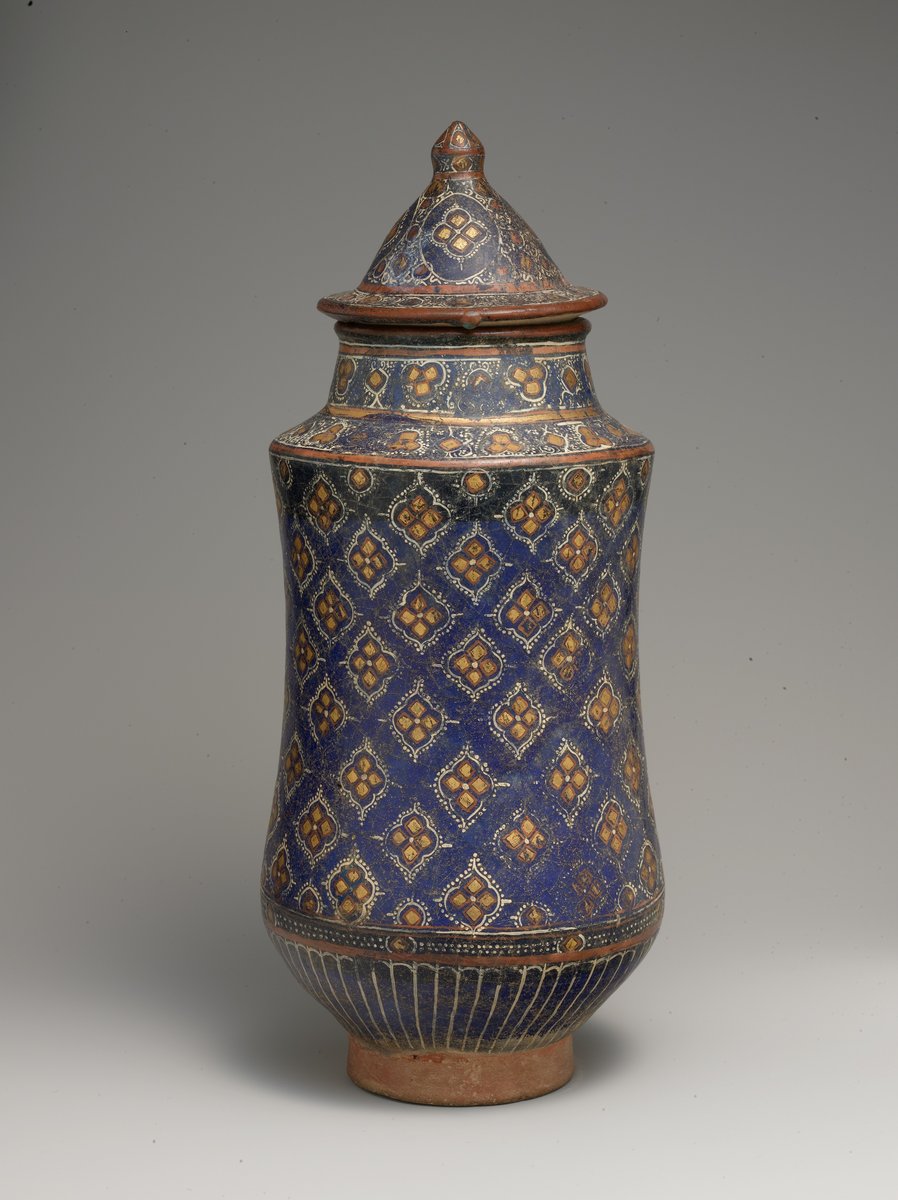
CeramicCovered jar (albarello) with lajvardina glaze, Iran (1200s–1300s)
A tall jar at the Metropolitan Museum of Art, glazed in the deep blue its name compares to lapis lazuli and set with squares of gold leaf. Seven centuries of wear and fine crackle have grayed the blue in the photograph to about #3B3A58.
#3B3A58#9C876B#806043#B4ABA0
Source: Metropolitan Museum of Art
Source
Sampled from the jar’s body in the Metropolitan Museum of Art’s photograph (57.61.12a, b), an open access image released as CC0 (public domain). The meaning of lajvardina comes from the same page. Colors in a photo shift with the lighting, so read the codes as close, not exact.
#3643BA
BrandingDecathlon
Decathlon’s blue, #3643BA, is lighter and softer than this page’s code, with a slight violet lean.
#3643BA
Source: Decathlon logo file
Source
The blue is the fill in Decathlon’s own logo file, served on its website. The logo shown is that file.
Logos belong to their owners and are shown unaltered, only to show where each palette comes from. Palettes are sampled in-house.
Questions
What color is Persian blue?
A strong, vivid blue with a slight violet lean. The usual web code is #1C39BB (RGB 28, 57, 187). Older color standards used the name for very different blues, from pale blue to a dark grayish indigo.
Is Persian blue named after Persia?
Nobody knows for sure. Many color lists say it is named for the blue tiles and pottery of Iran. Maerz and Paul, in their 1930 color dictionary, argued that it grew out of pers, an old French word for blue cloth, and had nothing to do with Persia, though they admitted it might.
What is the difference between Persian blue and Prussian blue?
The names sound alike, but the colors do not. Persian blue (#1C39BB) is a vivid, slightly violet blue. Prussian blue (#003153) is a very dark, slightly greenish blue named after an iron-based pigment first made in Berlin around 1706.
Why are the tiles of Iranian mosques blue?
Iranian potters had cobalt and copper glazes that fire to deep blue and turquoise. The deep blue lajvardina ware of the 1200s and 1300s took its name from lapis lazuli, but its color came from cobalt oxide. In the Shah Mosque in Isfahan, most of the tiles are blue.
Is Persian blue the same as lapis lazuli or ultramarine?
No. Lapis lazuli is a stone and ultramarine the pigment made from it, usually shown as #120A8F, darker and more violet. Persian blue is a color name. Iranian pottery called lajvardina was named after lapis but colored with cobalt.
What colors go with Persian blue?
Turquoise, cream, gold and terracotta, the colors of Iranian tilework, all pair well with it. White text reads clearly on Persian blue, and saffron yellow makes a bold contrast.