Peacock blue

A deep greenish blue, named after a bird whose feathers hold no blue pigment.

Overview

Peacock blue is a deep greenish blue, the color of a peacock’s shimmering neck. The code used here, #016795, is mostly blue with some green and almost no red: brighter and bluer than teal.

The bird hides a surprise: its feathers have no blue pigment. The only pigment inside is dark melanin, laid down in rods that form a regular lattice in each tiny barbule. Rods about 140 nanometers apart reflect blue light, so the color comes from structure and shifts as the bird turns. In 1665, Robert Hooke saw the colors vanish when he wet a feather.

That makes peacock blue hard to pin to one code. #016795 is people’s average peacock blue in the xkcd color survey. Color dictionaries describe it darker and greener: the 1955 ISCC-NBS dictionary files Maerz and Paul’s peacock blue as a dark greenish blue, around #004958, and Merriam-Webster calls it a moderate greenish blue.

Peacock blue is strong enough for accents and dark enough to carry white text. It is at home with gold, bronze and green, as in the bird itself and in Whistler’s Peacock Room.

HEX#016795
RGBrgb(1, 103, 149)
HSLhsl(199, 99%, 29%)
HSV199°, 99%, 58%
CMYK99, 31, 0, 42
OKLCHoklch(48.8% 0.108 237.9)
Every code converts from the HEX value #016795. #016795 is the average color people called “peacock blue” in the xkcd color survey (2010), released as CC0 data. Dictionaries describe a darker, greener color: the 1955 ISCC-NBS dictionary files Maerz and Paul’s peacock blue (1930) as dark greenish blue (#004958), and Merriam-Webster defines peacock blue as a moderate greenish blue. CMYK is a screen-based estimate; print results vary.
Peacock blue color card, hex #016795: “All show, no blue pigment”

Peacock blue on the color map

All three dictionary versions sit to the left of the reference: greener than people’s average. Maerz and Paul’s is also much darker and falls below the outline. The other two sit inside it, a little lighter. The outline is an approximate range, not a measured one.

Shades and tints

Tints with white

Shades with black

Tones with gray

Peacock blue sits in the middle. Tints add white, shades add black and tones add gray, in 10% steps out from it. Tap any swatch to copy its code.

Light and dark peacock blue

#67A4BF
Light peacock blueMixed 40% with white. A soft, airy greenish blue.
#239EBA
Bright peacock blueISCC-NBS brilliant greenish blue, where the 1955 dictionary files the bright peacock blue of a 1950 color names dictionary.
#016795
Peacock blueThe reference color.
#004958
Dark peacock blueISCC-NBS dark greenish blue, where the 1955 dictionary files Maerz and Paul’s peacock blue and the same 1950 dictionary’s dark peacock blue.

Colors that go with peacock blue

Pairings that work in rooms, outfits and interfaces.

Peacock blue and gold

Blue and gold, as in Whistler’s Peacock Room. Rich and decorative.

Peacock feather

Blue, green and bronze, straight from the tail. Lush and lavish.

Peacock blue and coral

Near-opposites: cool and warm. Bright and summery.

Peacock blue and cream

Light and fresh. Good for packaging and long text.

Peacock blue and plum

Jewel tones. Deep and dramatic for evening.

Peacock blue and saffron

Warm against cool, with strong contrast. Let saffron be the accent.

Color-wheel palettes

Pick a palette to see where its colors sit on the color wheel. The caret marks peacock blue. Tap a band to copy its code.

Similar colors

Petrol blue65%Cerulean69%Peacock blueFrench blue68%Denim blue64%Azurite78%YInMn blue67%

Lined up by hue around peacock blue. Hover a color to see how similar it is.The bar under each name shows how similar it is. Similarity comes from the distance between the two colors in OKLab, a model of how we see color.

Peacock blue vs teal

Peacock blue#016795 · hue 199°
  • Leans blue, with more blue than green
  • Named after a peacock’s feathers
  • Its code comes from a color survey
Teal#008080 · hue 180°
  • Exactly between green and blue
  • Named after a duck
  • One of the 16 original web colors

Meaning

  • Peacock
  • Structural color
  • India
  • Tiffany glass
  • Design

Peacock blue feels rich, exotic and a little showy, like the bird. It is tied to the peacock’s display, to India, where the Indian peafowl is the national bird, and to design around 1900, from Whistler’s Peacock Room to Tiffany’s peacock lamps. Mood studies test broad hues, not peacock blue, so the claims below are about the bird and its history.

Blue without blue pigment

Well established

Peacock feathers contain no blue pigment. In a 2003 study of a green peacock’s tail feather, the colors came from a lattice of melanin rods in each barbule: rods about 140 nanometers apart reflected blue, and wider spacings gave green and yellow.1, 2
Hooke and Newton saw it first

Historical record

In 1665 Robert Hooke found that wetting a peacock feather destroyed its colors, and that against the sun its fibers looked darkish red. In 1704 Isaac Newton noted that the feathers change color with the angle of view, as thin films do, and put the colors down to their fine structure.3, 4

India’s national bird

Official symbol

The Indian peafowl, whose male has a long blue neck, is the national bird of India. It appears widely in Hindu art and myth: the war god Kartikeya rides a peacock.5

Sources (5)
  1. Zi, J., Yu, X., Li, Y., Hu, X., Xu, C., Wang, X., Liu, X. & Fu, R. (2003). Coloration strategies in peacock feathers. Proceedings of the National Academy of Sciences, 100(22), 12576–12578. doi:10.1073/pnas.2133313100
  2. Wikipedia, “Indian peafowl”, citing Blau, S. K. (2004), “Light as a feather: structural elements give peacock plumes their color”, Physics Today, 57(1), 18–20.
  3. Hooke, R. (1665). Micrographia, Observation XXXVI, “Of Peacocks, Ducks, and other Feathers of changeable colours”. Project Gutenberg.
  4. Newton, I. (1704). Opticks, Book II, Part III. Project Gutenberg.
  5. Wikipedia, “Indian peafowl”, description and in culture, citing the Government of India’s national symbols page.

History

The peacock’s blue puzzled scientists for more than three centuries before anyone could measure what makes it. The color name arrived in the 1880s and spread through design, printing and color dictionaries.

  1. 1665

    Robert Hooke studies peacock feathers in Micrographia. Water destroys their colors, and against the sun the fibers look darkish red.1

  2. 1704

    Isaac Newton’s Opticks notes that peacock feathers change color with the angle of view, like thin films, and credits the colors to the fineness of their parts.2

  3. 1876–77

    James McNeill Whistler paints a London dining room as Harmony in Blue and Gold: The Peacock Room. It is now at the Freer Gallery of Art in Washington.3

  4. 1881

    First known use of “peacock blue” as a color name in English.4

  5. 1907

    The second edition of Albert Munsell’s A Color Notation says his blue-green hue is “popularly called peacock blue”.5

  6. 1912

    Robert Ridgway’s Color Standards and Color Nomenclature includes a Peacock Blue.6

  7. 1924

    A printing trade journal describes the blue of four-color process printing as peacock blue.7

  8. 1930

    Maerz and Paul’s A Dictionary of Color calls the Standard Color Card of America’s Peacock Blue “an excellent average of the colors seen under this name”.8

  9. 2003

    Physicists at Fudan University in Shanghai show how peacock barbules make their colors: a lattice of melanin rods whose spacing sets the hue.9

Sources (9)
  1. Hooke, R. (1665). Micrographia, Observation XXXVI. Project Gutenberg.
  2. Newton, I. (1704). Opticks, Book II, Part III. Project Gutenberg.
  3. Wikipedia, “The Peacock Room”.
  4. Merriam-Webster, “peacock blue”, definition and first known use.
  5. Munsell, A. H. (1907). A Color Notation, 2nd ed., paragraph 58. Project Gutenberg.
  6. Kelly, K. L. & Judd, D. B. (1955). The ISCC-NBS Method of Designating Colors and a Dictionary of Color Names. NBS Circular 553, color-name lists for groups 168–174 (greenish blues), citing Ridgway (1912), Maerz and Paul (1930), the Plochere Color System (1948), Taylor, Knoche and Granville (1950) and the Standard Color Card of America (1941). NIST PDF.
  7. Wikipedia, “Shades of cyan”, Peacock blue, quoting St. John, E. (1924), “Some practical hints on presswork”, The Inland Printer, 72(5), 805.
  8. Maerz, A. & Paul, M. R. (1930). A Dictionary of Color. New York: McGraw-Hill. Note on “Peacock Blue”. Internet Archive.
  9. Zi, J. et al. (2003). Coloration strategies in peacock feathers. Proceedings of the National Academy of Sciences, 100(22), 12576–12578. doi:10.1073/pnas.2133313100

Peacock blue in use

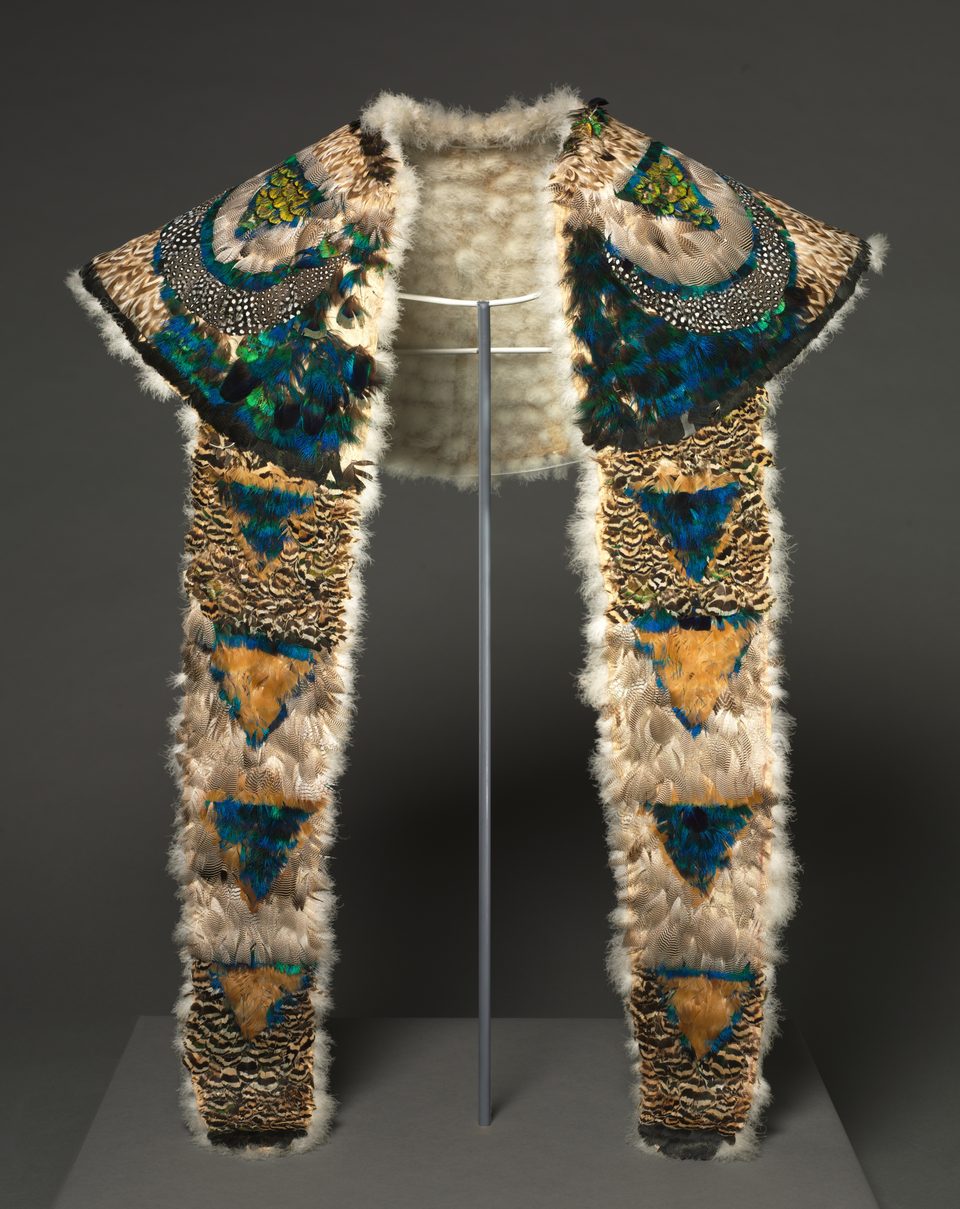
A feather collar with long front panels, covered in iridescent blue-green peacock feathers, speckled guinea fowl feathers and tan duck feathers, edged with white down
#0E4050#104B50#1D2A25#998C76#D5C9B2
TextileFeather collar (about 1830–60)

A collar covered in real peacock, guinea fowl and duck feathers, at the Cleveland Museum of Art. Experts still debate whether a Great Lakes Native artist or a European feather worker made it. In the photo its peacock feathers read as a dark greenish blue, close to the dictionaries’ peacock blue. As on the living bird, their color depends on the angle of the light.

#0E4050#104B50#1D2A25#998C76#D5C9B2
Source: Cleveland Museum
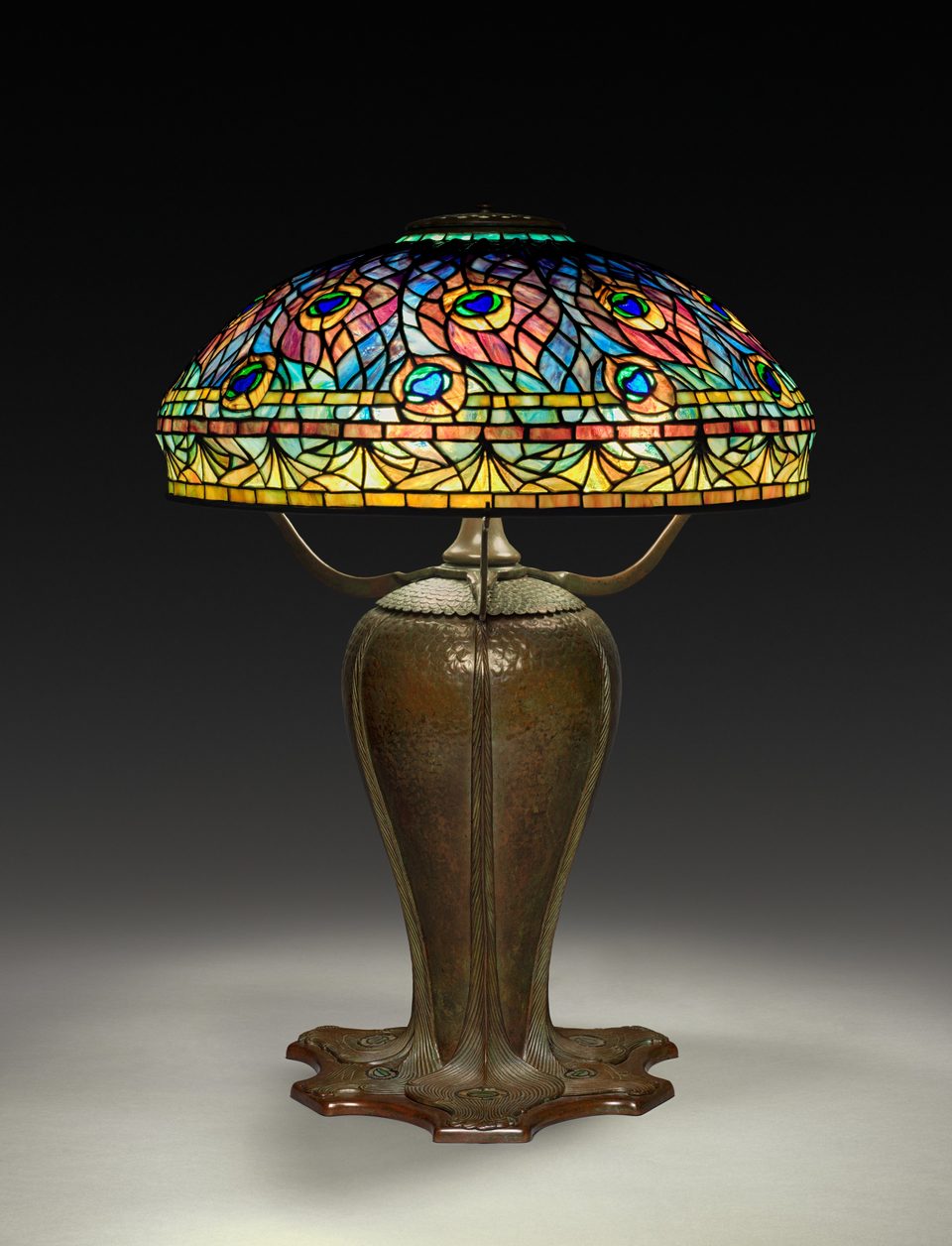
A Tiffany table lamp with a domed leaded-glass shade patterned with peacock-feather eyes in blue, green, gold and red, on a bronze base shaped like gathered feathers
#295B6B#427899#5CADB6#B06B4E#E4AF76
GlassPeacock table lamp, Tiffany Studios (about 1902)

A leaded-glass lamp at the Cleveland Museum of Art, probably designed by Clara Driscoll, Tiffany Studios’ chief lamp designer. The peacock was one of Louis Comfort Tiffany’s favorite motifs. The shade repeats the eyes of a peacock’s train, with blues that run from deep peacock to pale aqua against gold and copper glass.

#295B6B#427899#5CADB6#B06B4E#E4AF76
Source: Cleveland Museum

Palettes are sampled in-house.

Questions

What color is peacock blue?

A deep greenish blue, named after the peacock. The code used here is #016795 (RGB 1, 103, 149), people’s average peacock blue in the xkcd color survey.

Why are peacock feathers blue?

Not because of pigment. Inside each feather barbule, rods of dark melanin form a regular lattice. Its spacing reflects blue light in the blue parts and green or yellow light elsewhere, so the colors shift with the angle of view.

What is the difference between peacock blue and teal?

Teal (#008080) sits exactly between green and blue. Peacock blue (#016795) leans blue and is a little brighter. Both are named after birds with shimmering feathers: the peacock and the teal duck.

Is peacock blue blue or green?

A blue with a green lean. Dictionaries call it a greenish blue, and Albert Munsell wrote that his blue-green hue was popularly called peacock blue.

What colors go with peacock blue?

Gold and bronze, as in the bird and in Whistler’s Peacock Room. Coral and saffron give warm contrast, cream a softer look, and plum a jewel-toned one.

When was peacock blue first used as a color name?

In 1881, according to Merriam-Webster. Color dictionaries listed it from the early 1900s.