International Klein Blue

The deep ultramarine blue that Yves Klein made his own, and the code screens use for it.

Overview

International Klein Blue, or IKB, is a deep, intense blue. Online it is usually shown as #002FA7: no red, a little green and strong blue. That code is only a screen stand-in, because IKB is a paint.

The French artist Yves Klein developed it in 1956 with Edouard Adam, a Paris color merchant. Klein felt that oil made raw pigment look dead, so Adam stirred ultramarine powder into a clear synthetic resin, Rhodopas M, thinned with alcohol and ethyl acetate. In January 1957 Klein showed eleven identical blue canvases in Milan, and blue became his signature.

The real thing varies. Klein rolled the paint on, and its surface is matte and velvety in a way no screen can show. A 2007 conservation study of one of his paintings found that the roller, the number of coats, the strength of the resin and the type of ultramarine all change the color: “There is no one true IKB pigment.” In 1960 Klein registered the formula in a sealed, dated envelope at France’s industrial property office. That proved the date, but it was not a patent, and anyone may use the color.

On screen, #002FA7 works as a bold accent or a deep background with white text. It pairs well with white, gold, pink and orange.
HEX#002FA7
RGBrgb(0, 47, 167)
HSLhsl(223, 100%, 33%)
HSV223°, 100%, 65%
CMYK100, 72, 0, 35
OKLCHoklch(37.9% 0.195 263.2)
Every code converts from the HEX value #002FA7. #002FA7 is the IKB most color sites use. Wikipedia cites it to an online color converter. There is no standard: IKB is a hand-mixed paint, and conservators have found no single true IKB pigment. CMYK is a screen-based estimate; print results vary.
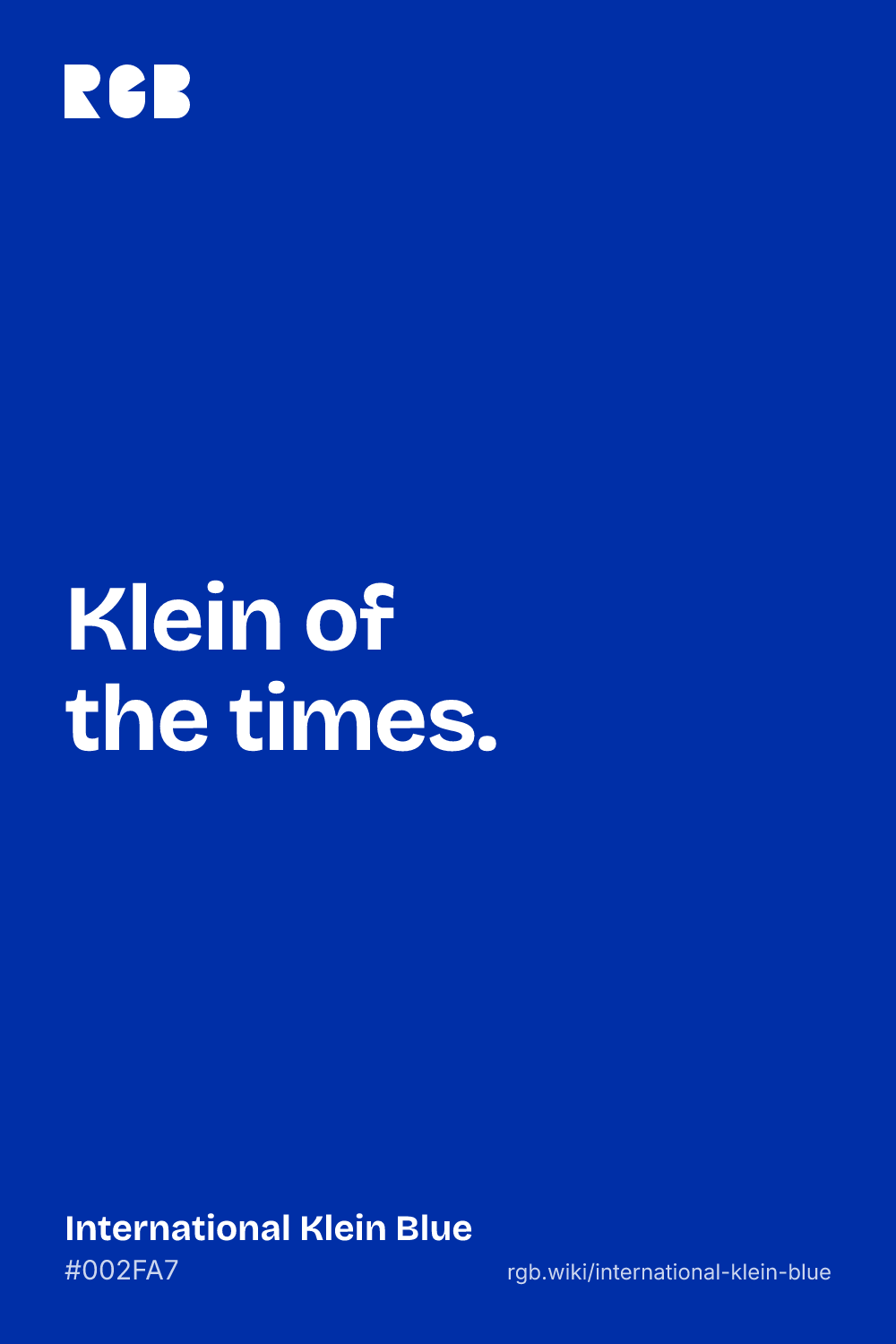
International Klein Blue color card, hex #002FA7: “Klein of the times”

International klein blue on the color map

Both ultramarine averages from the xkcd survey sit a little to the right of the reference, toward violet. Plain “ultramarine” is a little darker; “ultramarine blue” is lighter and more vivid. Klein’s painted surfaces change with the roller and the number of coats, so the outline is an approximate range, not a measured one.

Shades and tints

Tints with white

Shades with black

Tones with gray

International Klein Blue sits in the middle. Tints add white, shades add black and tones add gray, in 10% steps out from it. Tap any swatch to copy its code.

Light and dark international klein blue

#B2C1E5
Pale IKBMixed 70% with white. A soft, cool blue for backgrounds.
#6682CA
Light IKBMixed 40% with white. A clear mid blue.
#002FA7
International Klein BlueThe reference color.
#120A8F
UltramarineThe pigment IKB is made from, with a page of its own. See ultramarine
#001C64
Dark IKBMixed 40% with black. Close to navy.

Colors that go with international klein blue

Pairings that work in rooms, outfits and interfaces.

IKB and white

The gallery look: one strong blue on bare white walls.

IKB, pink and gold

Klein paired his blue with pink and gold. Rich and ceremonial.

IKB and rose

Soft pink calms the blue. Fresh and modern.

IKB and orange

Near-opposites. Loud, sporty and full of energy.

IKB and black

Stark and graphic. Good for posters and night themes.

IKB and concrete

Blue against raw gray. Calm, architectural and modern.

Color-wheel palettes

Pick a palette to see where its colors sit on the color wheel. The caret marks international klein blue. Tap a band to copy its code.

Similar colors

Cobalt blue72%Smalt88%International klein blueZaffre79%Egyptian blue92%Persian blue77%Ultramarine63%

Lined up by hue around international klein blue. Hover a color to see how similar it is.The bar under each name shows how similar it is. Similarity comes from the distance between the two colors in OKLab, a model of how we see color.

International Klein Blue vs ultramarine

International Klein Blue#002FA7 · hue 223°
  • Klein’s paint: ultramarine in a clear resin
  • Matte, velvety surface
  • Screen code with no standard
Ultramarine#120A8F · hue 244°
  • The pigment itself
  • First ground from lapis lazuli
  • Deeper and more violet on screen

Meaning

  • Modern art
  • The infinite
  • Paint roller
  • Soleau envelope
  • Resin binder

IKB belongs to one artist and one idea. Klein saw in blue a color that suggests the infinite, and from about 1956 until his death in 1962 he worked almost only in it, in paintings, sponges, sculptures and performances. Its meaning comes from his work, not from studies of color and emotion, which test basic words like “blue”.

Registered, not owned

Official records

On 19 May 1960 Klein deposited his formula at France’s industrial property office in Soleau envelope no. 63471. Such an envelope proves the date a creation existed, but it gives no intellectual property right, so IKB was never a patent or a trademark.1, 2

A binder to keep pigment bright

Conservation study

Klein said colors ground in oil “seemed to be dead” and wanted the glow of loose powder. Adam’s medium used Rhodopas M, a clear polyvinyl acetate resin whose low refractive index changes the look of the pigment very little.1

No single true IKB

Conservation study

Conservators who made test panels found that the roller, the number of coats, the strength of the binder and the type of ultramarine all change the color. Klein’s formula names “pure ultramarine blue, reference 1311”, but its source can no longer be traced.1

Sources (2)
  1. Haiml, C. (2007). Restoring the immaterial: study and treatment of Yves Klein’s Blue Monochrome (IKB 42). In T. Learner et al. (eds.), Modern Paints Uncovered, pp. 149–156. Getty Conservation Institute. Getty Publications (free PDF).
  2. Institut national de la propriété industrielle (INPI), “Se préparer au dépôt d’une e-Soleau” (in French).

History

IKB took shape in a few years in the 1950s, between a Paris paint shop and galleries in Milan and Paris. Klein died young, and his works are still in copyright, so none are pictured here.

  1. 1954

    Klein publishes Yves Peintures, a small book of single-color paintings and his first public showing of monochromes.1

  2. 1956

    Paris color merchant Edouard Adam works out a binding medium for Klein: Rhodopas M resin from the chemical firm Rhône-Poulenc, thinned with ethyl alcohol and ethyl acetate, with ultramarine stirred in by hand.2

  3. January 1957

    Proposte monocrome, epoca blu opens at the Galleria Apollinaire in Milan: eleven identical blue canvases, each 78 × 56 cm, hung away from the wall.3 Each was priced differently.1

  4. 1957

    At the Galerie Colette Allendy in Paris, Klein shows a low trough of loose ultramarine powder that visitors can rake.2

  5. 1959

    Klein’s huge blue murals for the new opera house in Gelsenkirchen, Germany, are unveiled when it opens in December.1

  6. 19 May 1960

    Klein registers the formula as International Klein Blue in Soleau envelope no. 63471 at France’s industrial property office. The envelope dates the formula; it is not a patent.2, 4

  7. 1960

    In his Anthropometries, models covered in blue paint press their bodies onto canvas as “living brushes”.1

  8. 1962

    Klein dies of a heart attack in Paris on 6 June, aged 34.1, 3

Sources (4)
  1. Wikipedia, “Yves Klein”.
  2. Haiml, C. (2007). Restoring the immaterial: study and treatment of Yves Klein’s Blue Monochrome (IKB 42). In T. Learner et al. (eds.), Modern Paints Uncovered, pp. 149–156. Getty Conservation Institute. Getty Publications.
  3. Pierron, S. (2025). “The untold story of the International Klein Blue (IKB) of Yves Klein”. Centre Pompidou magazine.
  4. Institut national de la propriété industrielle (INPI), “Se préparer au dépôt d’une e-Soleau” (in French).

International Klein Blue in use

All brand colors

Logos belong to their owners and are shown unaltered, only to show where each palette comes from. Palettes are sampled in-house.

Questions

What color is International Klein Blue?

A deep, intense ultramarine blue. On screens it is usually shown as #002FA7 (RGB 0, 47, 167), but the real paint changes with how it was applied.

Did Yves Klein patent IKB?

No. In 1960 he deposited the formula in a Soleau envelope at France’s industrial property office. That proves the date of a creation but grants no patent, trademark or other ownership, so anyone may use the color.

What is IKB made of?

Ultramarine pigment in a binder made from Rhodopas M, a clear synthetic resin, thinned with ethyl alcohol and ethyl acetate. The resin holds the powder in place without dulling it the way oil does.

Is #002FA7 the official IKB code?

No. There is no official code. #002FA7 is the value most color sites copy. Conservators have found that IKB itself changes with the roller, the number of coats and the pigment used.

What colors go with International Klein Blue?

White for a gallery look, pink and gold as Klein used them, orange for contrast, and black or concrete gray for something stark.

Where can I see Klein’s blue paintings?

His blue monochromes are in museums around the world. Tate in London owns IKB 79 (1959), and the Menil Collection in Houston owns Blue Monochrome (IKB 42) (1960).