A clear mid blue whose name has meant a pigment, a flag, a king’s arms and a crown diamond.
Overview
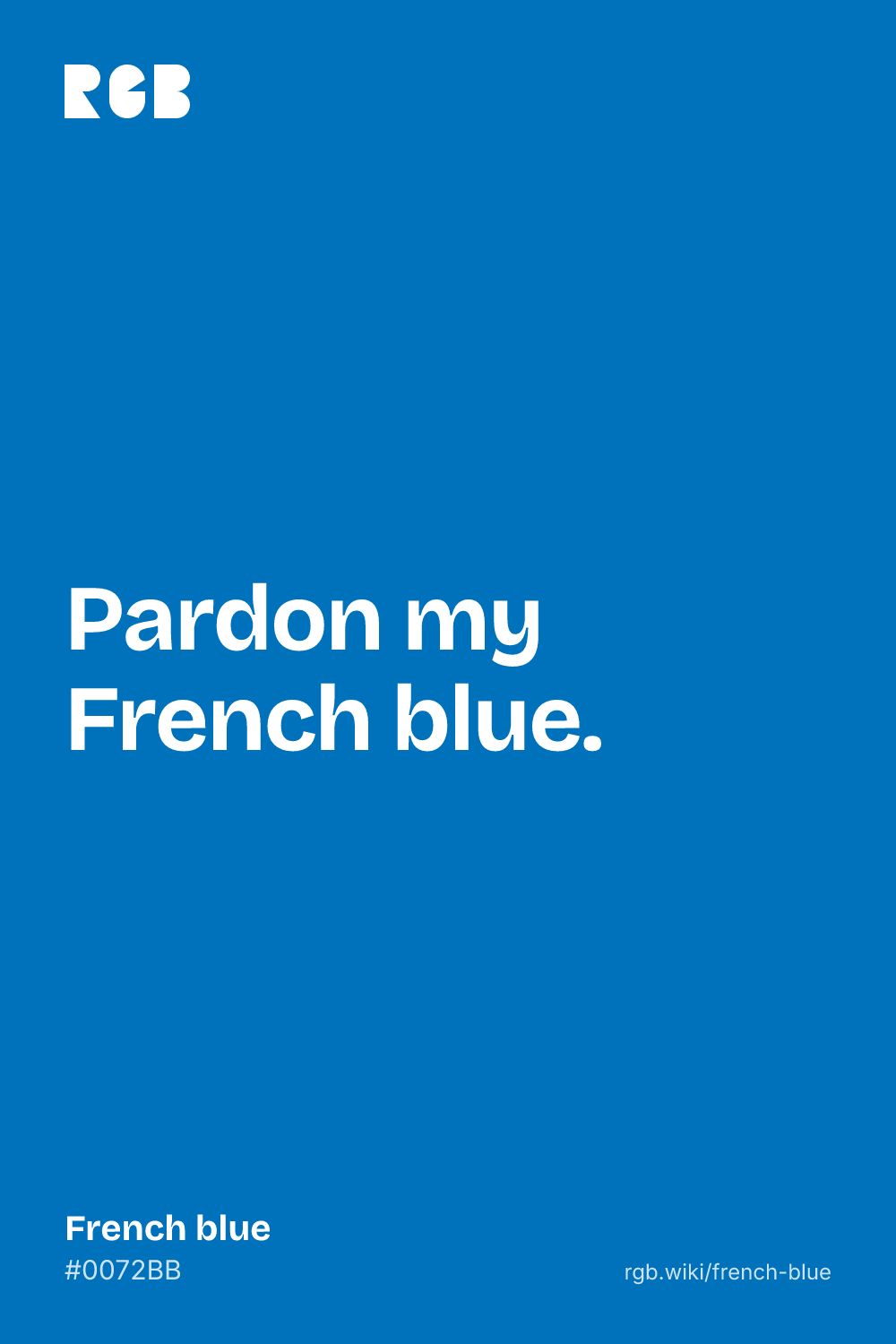
French blue is a strong, clear mid blue. Its usual code is #0072BB: no red, green at 45% and blue at 73%. That makes it a near twin of ocean blue and a little deeper and bluer than cerulean.
The name means different blues to different people. For eight centuries blue has stood for France: the field behind the gold lilies of the old royal arms, the stripe of the tricolor, the paint of French racing cars and the shirts of national teams known simply as Les Bleus. The flag’s blue has mostly been a dark navy, and the French government’s own brand blue, Bleu France, is #000091. Shirtmakers use the name for their own range of clear blues.
The code follows none of these. It comes from the color dictionaries, where French blue is a pigment name. Maerz and Paul’s A Dictionary of Color (1930) lists French blue as another name for artificial ultramarine, the synthetic version of the lapis pigment first made in France in the 1820s, and Wikipedia gives #0072BB as its match for that entry. Merriam-Webster agrees on the meaning: “a strong purplish blue that is the color of ultramarine prepared artificially”. The code itself is greener than that. The 1955 ISCC-NBS dictionary files the sample on the line between strong blue and strong purplish blue, and #0072BB sits on the strong blue side.
On screens, #0072BB carries white text at about 5.1 to 1, enough for body text. It looks crisp with white and red, formal with gold, and businesslike with navy and gray.
HEX
#0072BB
RGB
rgb(0, 114, 187)
HSL
hsl(203, 100%, 37%)
HSV
203°, 100%, 73%
CMYK
100, 39, 0, 27
OKLCH
oklch(53.8% 0.142 247.2)
Every code converts from the HEX value #0072BB. #0072BB is the French blue in Wikipedia’s list of blues, credited to Maerz and Paul’s A Dictionary of Color (1930), which lists French blue as a name for artificial ultramarine. The ISCC-NBS dictionary (1955) files that entry as strong blue, centered on #0067A5, and strong purplish blue, #545AA7. It is not the flag’s blue or the government’s: the French State’s 2020 graphic charter gives Bleu France as #000091. CMYK is a screen-based estimate; print results vary.
French blue on the color map
LighterDarker
The dictionary’s strong blue sits just below the code, inside the outline: the same hue, a little darker. People’s average French blue in the xkcd survey also sits inside, to the right: about as light, but more violet. The dictionary’s purplish side, the one that matches Merriam-Webster’s definition, lies outside the outline to the right. The government’s Bleu France is far darker and more violet, near the bottom of the view. The outline is an approximate range, not a measured one.
Shades and tints
Tintswith white
Shadeswith black
Toneswith gray
French blue sits in the middle. Tints add white, shades add black and tones add gray, in 10% steps out from it. Tap any swatch to copy its code.
Light and dark french blue
#99C7E4
Pale French blueMixed 60% with white. A soft, clear blue for backgrounds.
#0072BB
French blueThe reference color.
#0067A5
Dictionary French blueThe ISCC-NBS strong blue, the first group where the 1955 dictionary files Maerz and Paul’s French blue.
#545AA7
Ultramarine French blueThe ISCC-NBS strong purplish blue, the dictionary’s second group, nearer the synthetic pigment the name first meant.
#004470
Deep French blueMixed 40% with black. A dark blue for headings and text.
#000091
Bleu FranceThe French State’s brand blue in its 2020 graphic charter, also used in the government’s design system.
Colors that go with french blue
Pairings that work in rooms, outfits and interfaces.
Tricolor
French blue with white and the State’s red, Rouge Marianne. A brighter blue than the flag’s, for a fresh national look.
Fleur-de-lis
Gold on blue, like the lilies of the old royal arms. Formal and rich.
Shirt and suit
A blue shirt under navy and gray, the way menswear uses the name. Crisp and businesslike.
Racing blue
Blue has been France’s racing color since 1900. White numbers and dark carbon gray keep it fast.
French blue and terracotta
Warm clay against the cool blue. Sunny and relaxed.
Bleu France
The State’s deep Bleu France and two of its tints from the government design system, with French blue as the brighter accent.
Color-wheel palettes
Pick a palette to see where its colors sit on the color wheel. The caret marks french blue. Tap a band to copy its code.
Lined up by hue around french blue. Hover a color to see how similar it is.The bar under each name shows how similar it is. Similarity comes from the distance between the two colors in OKLab, a model of how we see color.
French blue vs ultramarine
French blue#0072BB · hue 203°
A clear mid blue, leaning slightly green
Code from a 1930 dictionary entry
Takes white text at 5.1 to 1
Ultramarine#120A8F · hue 244°
A deep blue with a violet lean
First made from lapis lazuli
Its synthetic form was sold as French blue
Meaning
Synthetic pigment
Royal arms
National flag
Crown jewel
Blue has stood for France for eight centuries: behind the royal lilies, in the tricolor, on racing cars and on the shirts of its national teams. As an English color name, though, French blue began with a pigment: dictionaries define it as the blue of synthetic ultramarine, first made in France. The name also belongs to one of the most famous diamonds in history. Studies of color and emotion test broad words such as blue, not French blue itself.
Named for a French-made pigment
Dictionary definition
Merriam-Webster defines French blue as “a strong purplish blue that is the color of ultramarine prepared artificially” and lists French ultramarine, Guimet’s blue and permanent blue among its other names. Maerz and Paul’s A Dictionary of Color (1930) files French blue under artificial ultramarine and dates that use to 1862. The pigment itself is the story of ultramarine.1, 2
The royal color of France
Historical record
From the early 1200s until 1792, the arms of the French kings were gold fleurs-de-lis on a blue field. The historian Michel Pastoureau describes how the royal arms helped lift blue from a minor color to a royal one in medieval Europe.3, 4
The flag’s blue was never fixed
Official record
France’s constitution names the flag’s colors, blue, white and red, but no text has ever fixed their shades. The French Society of Vexillology describes a dark navy in established use since at least the 1850s and a lighter blue from about 1974. In July 2020, President Macron quietly returned the Élysée Palace’s flags to navy. For its own communications, the government’s 2020 graphic charter sets Bleu France at #000091.5, 6, 7, 8
A crown jewel called the French Blue
Historical record
Louis XIV’s great blue diamond, listed in royal inventories as the blue diamond of the Crown, is known in English as the French Blue. It was stolen in 1792, and a lead cast of it found in the Paris natural history museum confirmed that the Hope Diamond was cut from it.9, 10
Pastoureau, M. (2000). Bleu: Histoire d’une couleur. Paris: Seuil, pp. 51–52 (English edition: Blue: The History of a Color, Princeton University Press, 2001), as summarized in Wikipedia’s “Blue”.
Service d’information du Gouvernement (2020, February). Charte graphique de l’État, “Les couleurs principales”, p. 46 (copy hosted by the Normandy regional health agency). The same values are on the government’s “Les couleurs” page.
Wikipedia, “Hope Diamond”, sections on the French Blue and its theft.
French blue has named a royal field, a diamond, a pigment and a flag stripe. The English name is about two centuries old; the blue of France is much older.
Early 1200s
The arms of the French kings, gold fleurs-de-lis scattered on a blue field, are first documented. They stay in use until 1792.1
1670s
Louis XIV has the court jeweler Jean Pitau recut the great blue diamond he bought from the merchant Jean-Baptiste Tavernier. Royal inventories call it the blue diamond of the Crown of France; English-speaking historians later name it the French Blue.2
1792
During the Revolution, thieves break into the royal storehouse in Paris and take most of the crown jewels. The French Blue is never seen again in its old form.2, 3
1802
The Oxford English Dictionary’s first example of “French blue” in English comes from The Times, decades before synthetic ultramarine.4
1862
The earliest date Maerz and Paul record for French blue as a name for artificial ultramarine, the synthetic pigment first made in France in the 1820s.5
1900
At the first Gordon Bennett Cup, run from Paris to Lyon, each nation’s cars are painted one color: blue for France. Blue stays France’s racing color.6
1930
Maerz and Paul’s A Dictionary of Color lists French blue under artificial ultramarine, and complains that makers were giving the old pigment name to other blues: “a deliberate creation of misunderstanding and confusion”.5
1933
In June, the Massachusetts State Police trade their forest green uniforms for French blue shirts and electric blue trousers. The colors later move onto the cruisers, so troopers can be recognized even inside their cars.7
1974
President Valéry Giscard d’Estaing is said to have lightened the flag’s navy to make it less martial. No text makes it official, but flags grow clearly lighter from then on.8
2020
In February, the government’s new graphic charter sets Bleu France at #000091.9 On July 13, President Emmanuel Macron quietly returns the flags of the Élysée Palace to navy blue.10, 8
Service d’information du Gouvernement (2020, February). Charte graphique de l’État, “Les couleurs principales”, p. 46 (copy hosted by the Normandy regional health agency). The same values are on the government’s “Les couleurs” page.
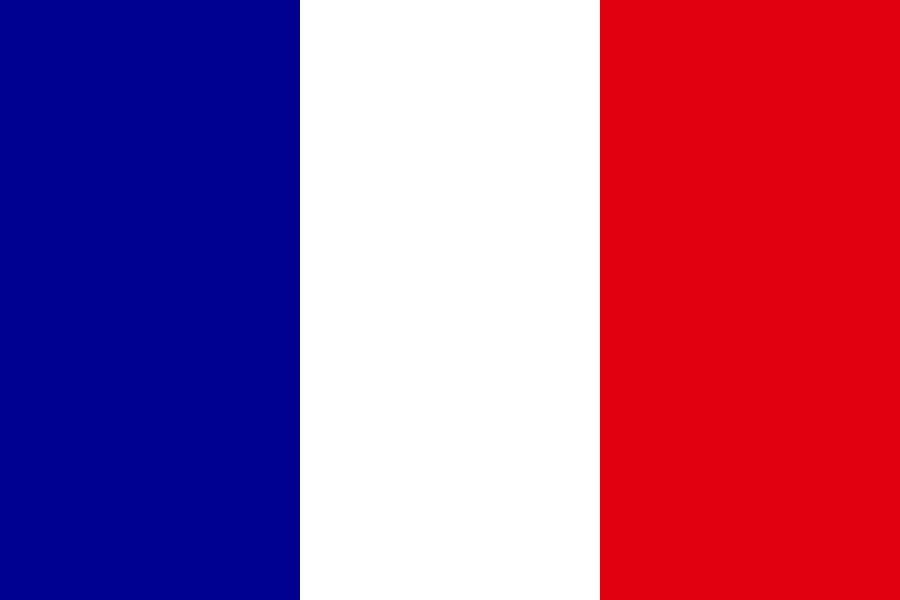
No law fixes the tricolor’s shades, but the French government’s 2020 graphic charter gives its Bleu France as #000091 and its Rouge Marianne as #E1000F. That blue is far darker and more violet than the web’s French blue, #0072BB.
#000091#FFFFFF#E1000F
Source: State graphic charter
Source
The codes are the screen values (RGB 0, 0, 145 and 225, 0, 15) on the colors page of the Service d’information du Gouvernement’s Charte graphique de l’État (February 2020), p. 46, and in the State’s design system. The French Society of Vexillology notes that no text has ever fixed the flag’s shades. The flag is drawn in-house: three equal vertical stripes in a 2:3 flag.
Palettes are sampled in-house.
Questions
What color is French blue?
A strong, clear mid blue. The usual code is #0072BB (RGB 0, 114, 187). Dictionaries define French blue as the color of synthetic ultramarine, which is more purplish than this code.
Where does the code #0072BB come from?
From Wikipedia’s list of blues, which credits it to Maerz and Paul’s A Dictionary of Color (1930). There, French blue is a name for artificial ultramarine. No flag law or government standard uses #0072BB.
Is French blue the blue of the French flag?
Not this code. No law fixes the flag’s shades. The flag has mostly been a dark navy, with a lighter blue common from about 1974 to 2020, and the government’s 2020 graphic charter sets its Bleu France at #000091, much darker than #0072BB.
What is the difference between French blue and ultramarine?
French blue began as a name for synthetic ultramarine, the cheap version of the lapis pigment. As web codes they differ: French blue (#0072BB) is a clear mid blue, while ultramarine (#120A8F) is deep and leans violet.
What was the French Blue diamond?
A large blue diamond owned by Louis XIV, listed as the blue diamond of the Crown in royal inventories and called the French Blue in English. It was stolen in 1792, and the Hope Diamond was cut from it.
What is a French blue shirt?
Shirtmakers use the name for a range of clear, medium blues. No standard fixes the shade, so one maker’s French blue shirt can differ a lot from another’s.
Can you put white text on French blue?
Yes. White on #0072BB reaches about 5.1 to 1 contrast, enough for body text under web accessibility guidelines, which ask for 4.5 to 1. Black text reaches only about 4.1 to 1.
What colors go with French blue?
White and red for a tricolor look, gold for a royal one, and navy and gray as in menswear. Warm terracotta makes a sunny contrast.