True blue

A clear, steady blue named after a word for loyalty that is almost four hundred years old.

Overview

True blue is a strong, clear mid blue. Its usual code is #0073CF: no red, green at 45% and blue at 81%. That makes it a near twin of French blue and ocean blue, and deeper, with more green in it, than royal blue.

The words are far older than the code. Since the 1630s, “true blue” has meant loyal: someone who never changes sides. Blue had stood for constancy since the Middle Ages. A popular story credits Coventry, whose woad-dyed blue cloth and thread were said to keep their color, as in “as true as Coventry blue”, though word historians doubt the link. In the 1600s the phrase belonged to Scottish Presbyterians and their Whig allies, who wore blue ribbons. It later passed to the Tories, which is why British Conservatives are still called true blue.

The code comes from a sports team. In 2003, UCLA’s athletics department and its kit maker gave all 22 varsity teams one shade, called True Blue, between the old powder blue and royal blue. #0073CF is the value Wikipedia once gave for it. Wikipedia now gives #2D68C4, and UCLA’s teams have since moved to the university’s own UCLA Blue, #2774AE. People in the xkcd color survey had something else in mind: their average true blue, #010FCC, is a deep, pure blue.

On screens, #0073CF carries white text at about 4.8 to 1, enough for body text. Black text reaches only 4.35 to 1, so keep it for large type. True blue looks sporty with gold, crisp with white, warm next to coral and calm with soft gray.
HEX#0073CF
RGBrgb(0, 115, 207)
HSLhsl(207, 100%, 41%)
HSV207°, 100%, 81%
CMYK100, 44, 0, 19
OKLCHoklch(55.3% 0.166 252.1)
Every code converts from the HEX value #0073CF. #0073CF is the value an archived 2017 copy of Wikipedia’s “True Blue (color)” article gave for UCLA’s athletic True Blue. Wikipedia’s list of blues now gives #2D68C4, citing a 2017 UCLA Athletics style guide that is no longer online; UCLA’s own brand guide lists no True Blue, and no color dictionary defines one. CMYK is a screen-based estimate; print results vary.
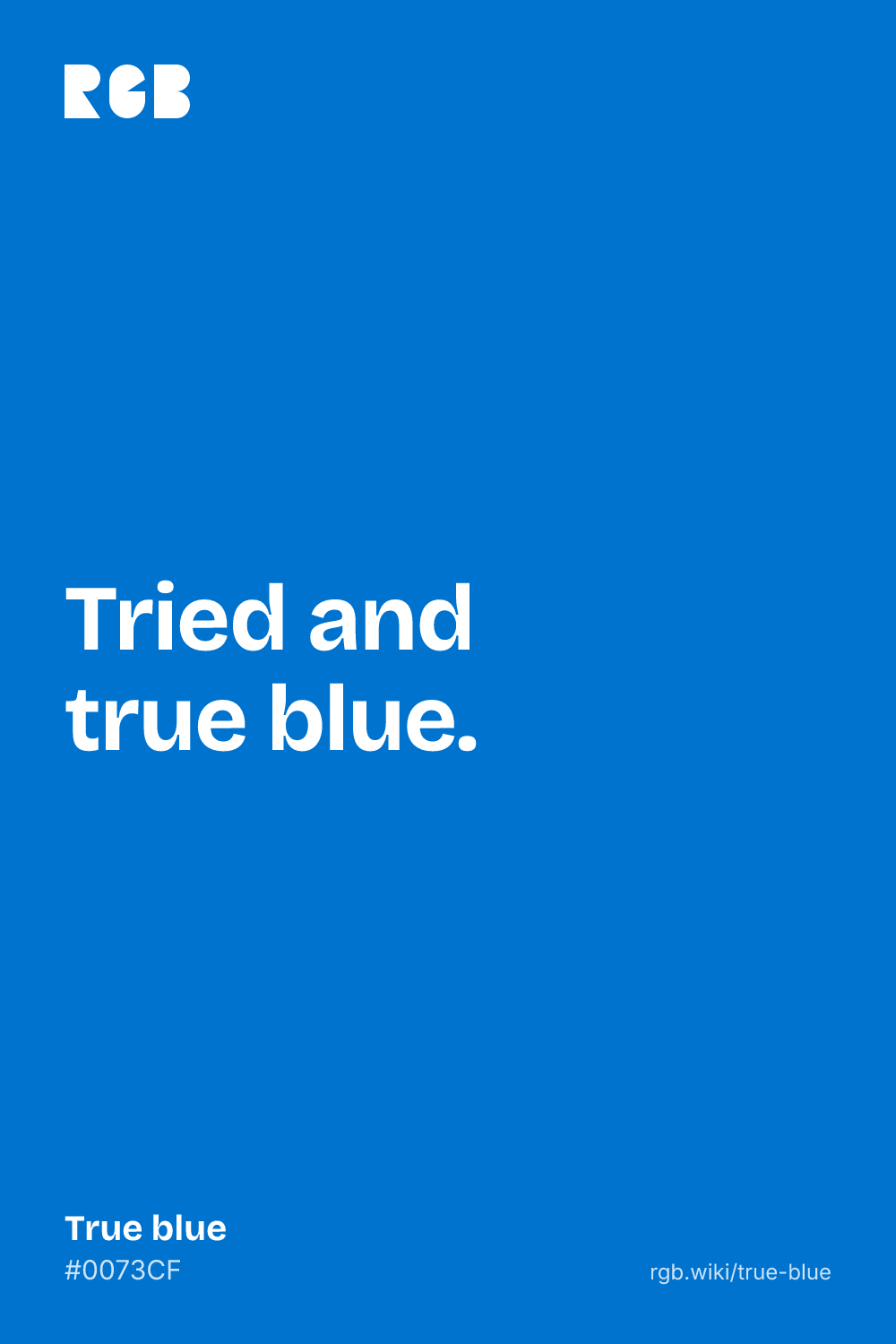
True blue color card, hex #0073CF: “Tried and true blue”

True blue on the color map

Wikipedia’s current UCLA value sits just below the reference and a little to the right: slightly darker and more violet. UCLA Blue sits close by on the left, about as light but grayer. People’s average true blue in the xkcd survey is far below the outline and to the right, a much darker, purer blue, so it is pinned to the edge. The outline is an approximate range, not a measured one.

Shades and tints

Tints with white

Shades with black

Tones with gray

True blue sits in the middle. Tints add white, shades add black and tones add gray, in 10% steps out from it. Tap any swatch to copy its code.

Light and dark true blue

#99C7EC
Pale true blueMixed 60% with white. A soft sky tint for backgrounds.
#66ABE2
Light true blueMixed 40% with white. Light enough for dark text.
#0073CF
True blueThe reference color.
#2D68C4
UCLA True Blue (Wikipedia)The value Wikipedia now gives for UCLA’s athletic True Blue.
#00457C
Deep true blueMixed 40% with black. For headings and dark buttons.
#010FCC
Survey true blueThe xkcd survey’s average true blue, deeper and purer than the code.
#5A7BA6
WoadThe grayish mid blue of woad-dyed cloth, the dye behind Coventry blue. See woad

Colors that go with true blue

Pairings that work in rooms, outfits and interfaces.

True blue and white

Clean and dependable, for forms, banks and health sites.

Blue and gold

The team pairing UCLA made famous. Bright gold on deep blue reads from the stands.

Coventry woad

True blue with the softer blues of woad-dyed wool and undyed cream. Crafted and quiet.

True blue and coral

Near-opposites on the wheel. Warm and friendly, good for calls to action.

Night blue

A dark theme where a lighter true blue carries links and buttons.

True blue and slate

Cool grays let the blue lead. Calm and businesslike.

Color-wheel palettes

Pick a palette to see where its colors sit on the color wheel. The caret marks true blue. Tap a band to copy its code.

Similar colors

Cerulean64%Ocean blue85%Steel blue62%French blue84%True blueDenim blue73%Royal blue75%

Lined up by hue around true blue. Hover a color to see how similar it is.The bar under each name shows how similar it is. Similarity comes from the distance between the two colors in OKLab, a model of how we see color.

True blue vs royal blue

True blue#0073CF · hue 207°
  • Greener and a little deeper
  • Named after a word for loyalty
  • Once UCLA’s team blue
Royal blue#4169E1 · hue 225°
  • Brighter, leaning violet
  • The CSS keyword royalblue
  • Named for royal livery and flags

Meaning

  • Loyalty
  • Fast dye
  • Party color
  • Team color

True blue is a color named after a meaning. The phrase has meant loyal since the 1630s, drawing on blue’s much older link with constancy. It was a badge of Scottish Presbyterians and Whigs before it became the Tories’ word, and in Australia it came to mean genuinely Australian. The story that it began with a Coventry dye is popular but unproven.

Loyal since the 1630s

Word history

Merriam-Webster dates true-blue, meaning loyal and unwavering, to about 1636, and the noun, a loyal person, to 1647. The Oxford English Dictionary, as Wiktionary reports it, builds the phrase from true, loyal, and blue, which already meant steadfast. Blue’s link with faithfulness goes back at least to a 15th-century poem that sets blue for constancy against green for fickleness.1, 2, 3

The Coventry story is unproven

Tradition

Coventry was famous for blue cloth and thread dyed with woad, and its court guarded the reputation of “Coventry blue” in the 1500s. Tradition says the dye never faded, giving “as true as Coventry blue”. Word historian Michael Quinion doubts Coventry had anything to do with the phrase, and the exact shade is unknown: surviving samples are too faded to show it.3, 4, 5

A Presbyterian and Whig badge

Historical record

In Samuel Butler’s satire Hudibras (1663) the hero’s religion is “Presbyterian true blew”. During the Exclusion Crisis of 1678–83 the Whigs wore blue ribbons, and their opponents said the ribbons copied the Covenanters and Parliamentarians of the 1630s to 1650s.2, 6

Then the Tories took blue

Historical record

By the 1800s true blue meant Tory: Thackeray’s Vanity Fair (1848) has “a staunch old True Blue Tory”. Blue is now the usual color of conservative parties around the world, a custom that began with the British Tories.2, 7

Australia’s true blue

Word history

In 19th-century Australia, letters backing conservative causes were signed True Blue. By 1890 striking shearers were called true blue for standing firm, and in the 20th century a true blue Australian came to mean a loyal, typical one.3

Sources (7)
  1. Merriam-Webster, “true-blue”, first known use.
  2. Wiktionary, “true blue”, citing the Oxford English Dictionary and quoting Butler’s Hudibras and Thackeray’s Vanity Fair.
  3. Michael Quinion, World Wide Words, “True blue”.
  4. A History of the County of Warwick, vol. 8 (Victoria County History, 1969), “The City of Coventry: Crafts and industries”, pp. 162–189.
  5. The Weaver’s House, Coventry, “As true as Coventry blue”.
  6. Edward Legon, “Bound up with Meaning: The Politics and Memory of Ribbon Wearing in Restoration England and Scotland”, Journal of British Studies 56, no. 1 (2017): 27–50, doi:10.1017/jbr.2016.119.
  7. Wikipedia, “Political colour”, citing BBC News, “Why is the Conservative Party blue?” (2006).

History

True blue was a promise of loyalty for centuries before it was a code. Its color has moved from woad-dyed cloth to party ribbons to a college uniform.

  1. About 1450

    A poem once attributed to Chaucer, Against Women Unconstant, tells a fickle lover “In stede of blew, thus may ye were al grene”: blue for faithfulness, green for change.1

  2. 1529

    Coventry’s court, the leet, steps in to protect the city’s name for dyeing, “particularly for its ‘Coventry blue’”. Anyone may dye in woad, but only proved colors may be used.2

  3. About 1636

    The earliest known use of true-blue for a loyal, unwavering person. A proverb of the same decade runs “True blue will never stain”.3, 1

  4. 1649–1660

    Coventry blue ribbons, long used in the rosemary bride-laces worn by wedding guests, fall out of use when the Puritans suppress such festivities. The recipe is later said to be lost.9

  5. 1663

    Samuel Butler’s Hudibras mocks its hero’s faith as “Presbyterian true blew”.4

  6. 1678–1683

    In the Exclusion Crisis, Whigs wear blue ribbons and Tories red. The Whigs’ enemies say the blue ribbon copies the Covenanters.5

  7. 1848

    Thackeray’s Vanity Fair describes Mr. Wenham as “a staunch old True Blue Tory”. The phrase has changed sides.4

  8. 29 September 1890

    Adelaide’s Advertiser quotes a telegram from a New South Wales shearers’ strike: “The men are true blue, and will rather be imprisoned than yield.”1

  9. 2003

    UCLA’s 22 varsity teams wear True Blue for the first time, a shade between powder blue and royal blue developed with the school’s kit maker. An athletics official says it “looks richer, and makes the numbers easier to read”.6

  10. 2021

    After a return to powder blue in 2017, UCLA’s athletics blue is aligned with the university’s UCLA Blue, #2774AE on screens.7, 8

Sources (9)
  1. Michael Quinion, World Wide Words, “True blue”.
  2. A History of the County of Warwick, vol. 8 (Victoria County History, 1969), “The City of Coventry: Crafts and industries”, pp. 162–189.
  3. Merriam-Webster, “true-blue”, first known use.
  4. Wiktionary, “true blue”, citing the Oxford English Dictionary and quoting Butler’s Hudibras and Thackeray’s Vanity Fair.
  5. Edward Legon, “Bound up with Meaning: The Politics and Memory of Ribbon Wearing in Restoration England and Scotland”, Journal of British Studies 56, no. 1 (2017): 27–50, doi:10.1017/jbr.2016.119.
  6. Adam Foxman, “In with the TRUE blue”, Daily Bruin, 24 August 2003.
  7. Wikipedia, “UCLA Bruins”, team colors section.
  8. UCLA Brand Guidelines, “Colors”.
  9. Wikipedia, “Coventry blue”, citing J. R. Planché, A Cyclopaedia of Costume (1876).

True blue in use

All brand colors
#2774AE#FFD100#005587#003B5C
UniversityUCLA

UCLA’s teams wore True Blue from 2003. Today the university and its teams share UCLA Blue, #2774AE, and UCLA Gold, #FFD100, with darker blues #005587 and #003B5C. UCLA’s brand guide gives no code for True Blue.

#2774AE#FFD100#005587#003B5C
Source: UCLA brand guide

Logos belong to their owners and are shown unaltered, only to show where each palette comes from. Palettes are sampled in-house.

Questions

What color is true blue?

True blue is a strong, clear mid blue. Its usual hex code is #0073CF, which is RGB 0, 115, 207.

What does true blue mean?

Loyal and unwavering. The phrase has meant a faithful person since about the 1630s, building on blue’s older link with constancy. In Britain it also means a staunch Conservative, and in Australia a genuine Australian.

Does true blue come from Coventry blue?

Maybe, but it is not proven. Coventry was famous for woad-dyed blue cloth and thread said to keep its color, and “as true as Coventry blue” was a saying. Word historians think the phrase more likely grew from blue’s general meaning of faithfulness.

Why is true blue linked to the Conservatives?

In the 1600s blue was worn by Scottish Presbyterians and the Whigs. By the 1800s the Tories had taken the color and the phrase, and blue is still the Conservative Party’s color.

Is true blue UCLA’s color?

It was. UCLA’s teams wore True Blue from 2003. They have since moved to the university’s UCLA Blue, #2774AE, and UCLA’s current brand guide does not list True Blue.

What is the difference between true blue and royal blue?

True blue, #0073CF, is deeper and has more green in it. Royal blue, #4169E1, the CSS keyword, is brighter and leans toward violet.

Can I use white text on true blue?

Yes. White on #0073CF has a contrast of about 4.8 to 1, enough for body text. Black text reaches about 4.35 to 1, so use it only for large type.

What colors go with true blue?

White and navy for a clean look, gold for a sporty one, coral for warmth, and soft slate gray for a calm, businesslike page.