Ocean blue

The clear blue of the open sea, where the water is emptiest.

Overview

Ocean blue is a strong, medium-dark blue with a hint of green, the color of deep open water on a sunny day. #0077BE has no formal source, but it is the code most color lists give. People who named colors in the xkcd survey chose a darker, greener ocean blue, #03719C.

The sea looks blue because water soaks up red light and leaves the blue behind. The aqua page explains why water itself is faintly blue. Floating particles and living things can tint the sea green, brown or red.

Oceanographers know a less obvious rule: the bluest water is the emptiest. Phytoplankton, the drifting plants at the base of the sea’s food web, carry green chlorophyll, so rich water turns green. The clearest, bluest water on Earth lies in the centers of the great subtropical gyres, where so few nutrients reach the surface that scientists call them deserts of the sea.

That is why ocean color became a science. Since 1890, observers have matched the sea against a scale of 21 tinted vials, from indigo blue to cola brown. Since the late 1970s, satellites have measured its color from orbit to count plankton.

HEX#0077BE
RGBrgb(0, 119, 190)
HSLhsl(202, 100%, 37%)
HSV202°, 100%, 75%
CMYK100, 37, 0, 25
OKLCHoklch(55.1% 0.141 245.7)
Every code converts from the HEX value #0077BE. No color standard defines ocean blue. #0077BE is the code most color lists use. The nearest point in the ISCC-NBS color system is strong blue, #0067A5, the same hue a little darker. CMYK is a screen-based estimate; print results vary.
Ocean blue color card, hex #0077BE: “Shore thing”

Ocean blue on the color map

The survey’s ocean blue sits inside the outline, to the left and a little lower: greener and darker. The survey’s plain “ocean” lies beyond the left edge, toward teal. ISCC-NBS strong blue sits straight below the reference, the same hue but darker. Monet’s sea sits on the left edge, much grayer. The outline is an approximate range, not a measured one.

Shades and tints

Tints with white

Shades with black

Tones with gray

Ocean blue sits in the middle. Tints add white, shades add black and tones add gray, in 10% steps out from it. Tap any swatch to copy its code.

Light and dark ocean blue

#99C9E5
Pale ocean blueMixed 60% with white. A soft, airy blue for backgrounds.
#0077BE
Ocean blueThe reference color.
#03719C
Survey ocean blueThe average of what people called ocean blue in the xkcd survey: darker and greener.
#007BA7
CeruleanA close neighbor, a little greener and less intense. See cerulean
#004772
Deep ocean blueMixed 40% with black. Dark enough to carry white text at any size.

Colors that go with ocean blue

Pairings that work in rooms, outfits and interfaces.

Ocean blue and sand

Sea and beach. The pale sand keeps the blue bright and clean.

Ocean blue and coral

A reef pairing: warm coral against cool blue. Use the coral sparingly.

Nautical

Navy, white and a flag red around ocean blue. Classic and crisp.

Blue water, green water

Open sea and plankton bloom side by side. A calm, natural pair.

Ocean blue tones

One hue from pale to deep. Easy to use for charts and layered screens.

Deep sea

A near-black blue background, with ocean blue and a lighter blue as accents.

Color-wheel palettes

Pick a palette to see where its colors sit on the color wheel. The caret marks ocean blue. Tap a band to copy its code.

Similar colors

Cerulean80%Ocean blueSteel blue72%French blue93%True blue85%Woad65%Denim blue69%

Lined up by hue around ocean blue. Hover a color to see how similar it is.The bar under each name shows how similar it is. Similarity comes from the distance between the two colors in OKLab, a model of how we see color.

Ocean blue vs cerulean

Ocean blue#0077BE · hue 202°
  • Bluer and more intense
  • Named for the sea
  • No standard code
Cerulean#007BA7 · hue 196°
  • Greener and a little softer
  • Named after the sky
  • Also a painter’s pigment

Meaning

  • Open sea
  • Plankton
  • Forel-Ule scale
  • Ocean satellites

Ocean blue is named for the open sea, and the real sea comes with a lesson: its blueness shows how little lives in it. Oceanographers have read the sea’s color for more than a century, first with vials of tinted liquid and now with satellites. The claims below are about real seawater, not about the web code.

Water filters out red

Well established

The ocean is blue because water absorbs light at the red end of the spectrum and leaves blue behind. Floating sediments and particles can give it green, red or other tints. Hardly any sunlight gets below about 656 feet (200 meters), and none below 3,280 feet (1,000 meters), so most of the ocean is completely dark.1
The bluest water is the emptiest

Well established

Phytoplankton carry green chlorophyll, so productive water looks green and water with little in it looks blue. The South Pacific Gyre holds the clearest, bluest water of any ocean basin; a NASA scientist crossing it in 2017 called that blueness the visible sign of its “dearth of ocean life.” Few nutrients reach the sunlit surface there, which is why gyres are called deserts of the sea.3, 2, 4

Read with 21 vials since 1890

Historical record

François Alphonse Forel’s 1890 color scale, extended by Willi Ule in 1892, uses 21 tinted solutions from indigo blue to cola brown. The observer compares the water above a sunken white disc with the scale and picks the closest tube. Measured with modern instruments, Atlantic Ocean water matches tube 1, the bluest, and the open North Sea is close to tube 3. Hundreds of thousands of these readings, from about 1890 to 2000, are stored in a U.S. ocean database.5

Bluer deserts or greener seas?

Mixed evidence

The trend is not settled. NASA’s Earth Observatory reports that the least productive gyres grew in area over a decade, apparently because surface water is warming. A 2023 study of 20 years of satellite data found significant changes in ocean color over 56% of the world’s surface ocean and concluded that low-latitude oceans have, on the whole, become greener. They measure different things over short records, so neither settles the question.4, 6

Sources (6)
  1. NOAA National Ocean Service. “Why is the ocean blue?” Ocean Facts.
  2. NASA Science (2017, September 20). “Searching for the Bluest”. Notes from the Field blog.
  3. NASA Earthdata. Ocean Biology Distributed Active Archive Center, section on ocean color.
  4. NASA Earth Observatory. “What are Phytoplankton?”
  5. Wernand, M. R. & van der Woerd, H. J. (2010). Spectral analyses of the Forel-Ule ocean colour comparator scale. Journal of the European Optical Society: Rapid Publications, 5, 10014s.
  6. Cael, B. B., Bisson, K., Boss, E., Dutkiewicz, S. & Henson, S. (2023). Global climate-change trends detected in indicators of ocean ecology. Nature, 619, 551–554.

History

Ocean color was a measurement long before it was a hex code. Each step below made the sea’s blue easier to read, and to read as a sign of life.

  1. 1890

    François Alphonse Forel proposes a color standard for lakes and seas: tubes of blue copper sulfate solution with rising amounts of yellow potassium chromate, running from blue to green.1

  2. 1891–1893

    On a German expedition to Greenland, scientists are among the first to take the scale to open sea.1

  3. 1892

    Willi Ule adds blue-green to brown tints. The combined set of 21 colors becomes the Forel-Ule scale.1

  4. Late 1970s

    NASA begins measuring the color of the oceans from satellites, experimentally at first, to estimate how much microscopic plant life they hold.2

  5. 2010

    A spectral study of the Forel-Ule tubes finds that Atlantic Ocean water matches tube 1, the bluest. Readings taken with the scale from about 1890 to 2000 form one of the oldest ocean data sets.1

  6. 2017

    A NASA team crossing the South Pacific Gyre on the icebreaker Nathaniel B. Palmer samples the clearest, bluest water of any ocean basin to check what satellites see.2

  7. 2023

    A study of 20 years of satellite data finds significant changes in ocean color over 56% of the surface ocean, with low-latitude seas turning greener.3

  8. 2024

    In February, NASA launches PACE (Plankton, Aerosol, Cloud, ocean Ecosystem), a satellite meant to show how climate change is affecting blooms of ocean phytoplankton.4

Sources (4)
  1. Wernand, M. R. & van der Woerd, H. J. (2010). Spectral analyses of the Forel-Ule ocean colour comparator scale. Journal of the European Optical Society: Rapid Publications, 5, 10014s.
  2. NASA Science (2017, September 20). “Searching for the Bluest”. Notes from the Field blog.
  3. Cael, B. B., Bisson, K., Boss, E., Dutkiewicz, S. & Henson, S. (2023). Global climate-change trends detected in indicators of ocean ecology. Nature, 619, 551–554.
  4. NASA Science. PACE mission page.

Ocean blue in use

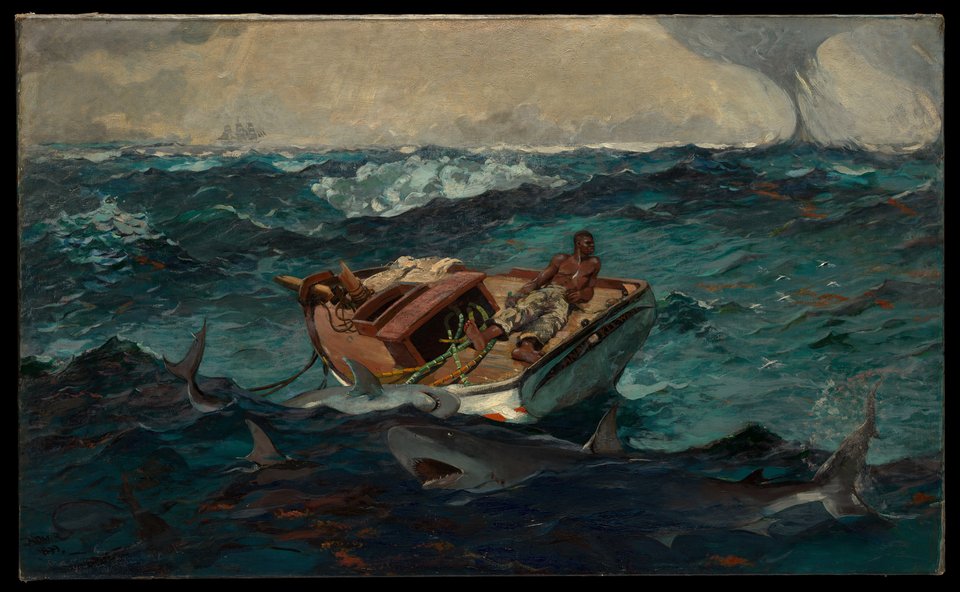
Homer’s painting of a man lying on the deck of a small dismasted boat in rough dark green water, with sharks around it and a waterspout on the horizon
#2F4D48#405C56#152627#A59779
PaintingThe Gulf Stream (1899)

Winslow Homer painted a lone man on a dismasted boat, with sharks circling and a waterspout behind him. His sea is not ocean blue at all. Sampled, it is a dark green-gray, much closer to teal than to the web code.

#2F4D48#405C56#152627#A59779
Source: The Met
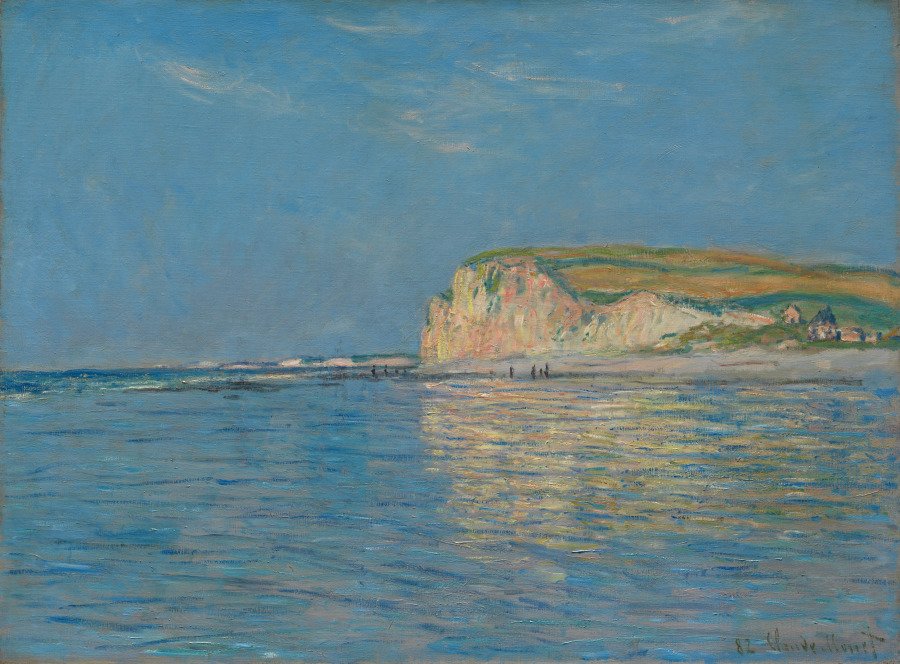
Monet’s painting of a calm blue-gray sea at low tide under a pale blue sky, with sunlit cliffs on the right
#5D7E8A#497284#5B8AA0#B7A384
PaintingLow Tide at Pourville, near Dieppe (1882)

Claude Monet painted the shore at Pourville, a fishing village in Normandy, with its cliffs catching the light. His calm sea is a grayed blue that mirrors the sky, softer and greener than ocean blue. The tiny black strokes at the foot of the cliff are bathers.

#5D7E8A#497284#5B8AA0#B7A384
Source: Cleveland Museum of Art

Palettes are sampled in-house.

Questions

What is the hex code for ocean blue?

#0077BE (RGB 0, 119, 190) is the code most color lists use. No color standard defines it.

Why is the ocean blue?

Water absorbs red light and leaves blue light behind, so deep, clear water looks blue. Particles, sediment and plankton can tint it green, brown or red.

Why is the sea green in some places?

Usually because of phytoplankton. Their green chlorophyll colors water that is rich in nutrients, as along many coasts and in upwelling zones. Sediment and dissolved matter can also turn coastal water green or brown.

Where is the bluest ocean water?

In the centers of the subtropical gyres. NASA describes the South Pacific Gyre as holding the clearest, bluest water of any ocean basin, because so little lives in it.

Is ocean blue the same as cerulean?

Close, but no. Cerulean (#007BA7) is a little greener and softer. Ocean blue (#0077BE) is bluer and more intense.

What colors go with ocean blue?

Sandy beige, white and navy are natural partners. Coral or a warm orange makes a lively accent, and a deep sea green keeps things calm.