Deep pink

A pink at full strength, closer to what people call hot pink than the web’s own hotpink.

Overview

Deep pink is a vivid, saturated pink with a cool lean toward purple, like a highlighter pen or a bright azalea. Its code is #FF1493: red at full strength, blue at about 58% and almost no green. That puts its hue at 328°, between red and fuchsia, at full saturation.

By the dictionary, deep pink is a contradiction. Merriam-Webster defines pink as colors of medium to high lightness and low to moderate saturation, and deep, for a color, as high saturation and low lightness. The color dictionaries keep their deep pink in that narrow overlap: the ISCC-NBS system’s “deep pink” is a muted rose coral, about #E4717A, nothing like the web color. Maerz and Paul’s 1930 Dictionary of Color has no deep pink at all.

The name is the CSS keyword deeppink. It isn’t in the X Window System’s first color list, from 1986. Paul Raveling added it in his 1989 revision, tuned on his HP monitor, next to a medium pink and a pale pink, with four numbered steps from DeepPink1 to a dark DeepPink4, #8B0A50. The merged list in X11 Release 4, in December 1989, kept deep pink, dropped his other two pinks and added hot pink. The web adopted that list in 2001.

On screens, deep pink takes black text: black on it has a contrast of about 5.8:1, enough for body text, while white reaches only about 3.6:1, fine for large headings only. It glows next to black and navy, pairs well with teal and clashes happily with orange.
HEX#FF1493
RGBrgb(255, 20, 147)
HSLhsl(328, 100%, 54%)
HSV328°, 92%, 100%
CMYK0, 92, 42, 0
OKLCHoklch(65.5% 0.261 356.9)
Every code converts from the HEX value #FF1493. #FF1493 is the CSS keyword deeppink, rgb(255, 20, 147), defined in the CSS Color Module Level 4 and first listed among the web’s color names in SVG 1.0 (2001). It comes from Paul Raveling’s 1989 revision of the X Window System’s color list (raveling.txt, 255 20 147), shipped in X11 Release 4. No color dictionary defines this exact value. CMYK is a screen-based estimate; print results vary.
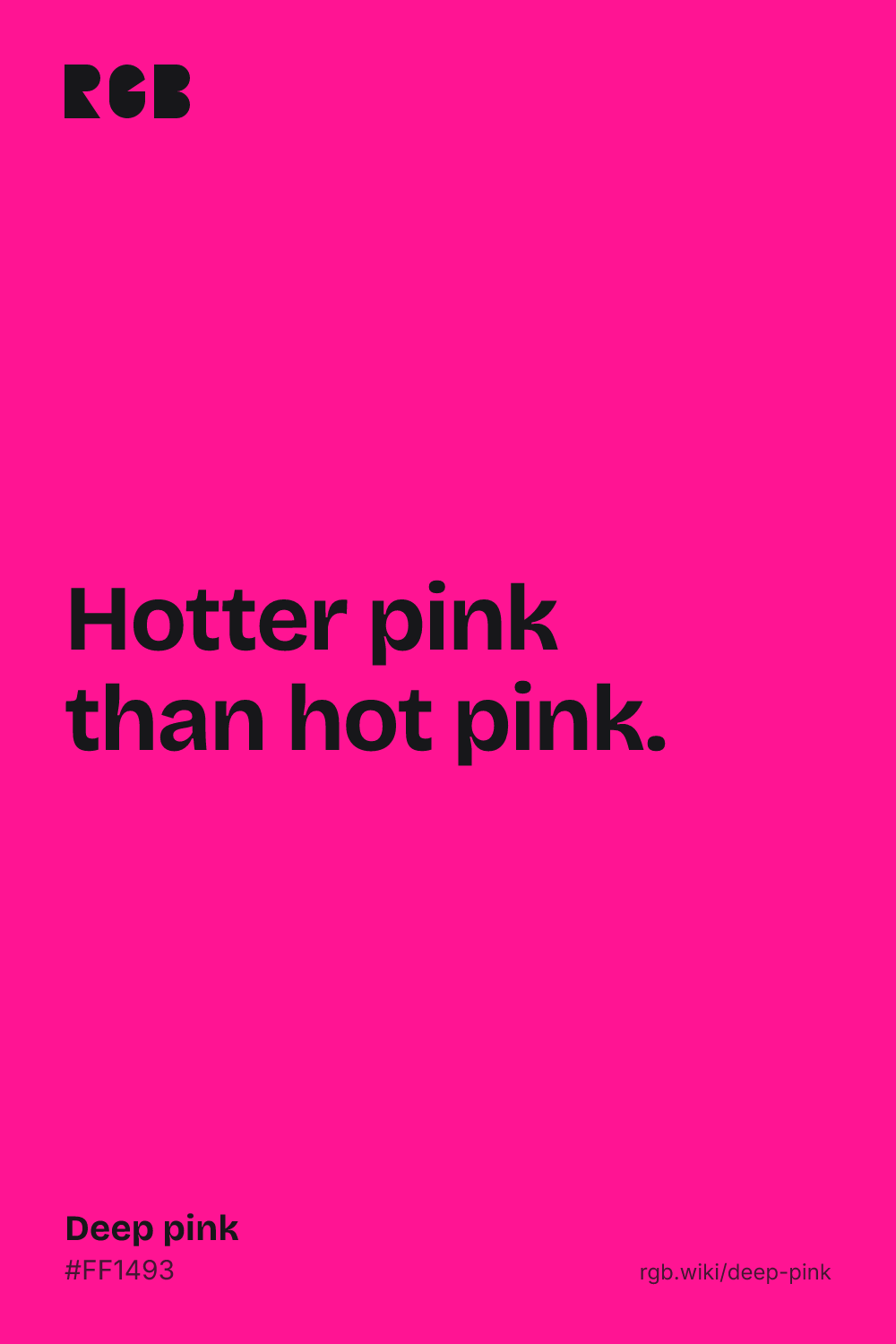
Deep pink color card, hex #FF1493: “Hotter pink than hot pink”

Deep pink on the color map

People’s average hot pink sits almost on top of the code; their average deep pink is the same hue but much darker, closer to DeepPink3 and DeepPink4. The ISCC-NBS deep pink, #E4717A, is far outside this range. The outline is an approximate range, not a measured one.

Shades and tints

Tints with white

Shades with black

Tones with gray

Deep pink sits in the middle. Tints add white, shades add black and tones add gray, in 10% steps out from it. Tap any swatch to copy its code.

Light and dark deep pink

#FF72BE
Light deep pinkMixed 40% with white: a bright bubblegum pink.
#FF1493
Deep pinkThe reference color, and also DeepPink1, the brightest numbered step, on the edge of the color cube.
#EE1289
DeepPink2The second numbered step in Raveling’s 1989 list.
#CD1076
DeepPink3The third numbered step, nearly identical to deep pink mixed 20% with black (#CC1076).
#8B0A50
DeepPink4The darkest numbered step: a deep berry red.
#E4717A
ISCC-NBS deep pinkThe center of the “deep pink” category in the ISCC-NBS color names, a muted rose coral.

Colors that go with deep pink

Pairings that work in rooms, outfits and interfaces.

Deep pink on black

A night-club neon look. Deep pink buttons and headings glow on near-black.

Deep pink and navy

Bold but tidy. Navy carries the text; deep pink is the single accent.

The X11 pinks

Deep pink with three neighbors from the same 1989 list: hot pink, pale violet red and medium violet red.

Deep pink and teal

Near complements. Dark teal steadies the pink, with a pale mint background.

Deep pink and orange

A loud, happy clash, for a festival poster or a summer sale. Dark brown keeps the text readable.

Deep pink as background

Full strength, for a banner. Use very dark text, never white, for anything smaller than a heading.

Color-wheel palettes

Pick a palette to see where its colors sit on the color wheel. The caret marks deep pink. Tap a band to copy its code.

Similar colors

Shocking pink65%Barbie pink74%Deep pinkMagenta97%Rose86%Strawberry60%Raspberry54%

Lined up by hue around deep pink. Hover a color to see how similar it is.The bar under each name shows how similar it is. Similarity comes from the distance between the two colors in OKLab, a model of how we see color.

Deep pink vs magenta

Deep pink#FF1493 · hue 328°
  • A touch of green, a little more blue
  • The CSS keyword deeppink
  • From a 1989 X11 color list
Magenta#FF0090 · hue 326°
  • No green at all
  • Not CSS magenta, which is #FF00FF
  • A screen version of printing ink

Meaning

  • CSS keyword
  • Tuned on a 1989 monitor
  • Not deep by the dictionary
  • Survey’s hot pink

No study has looked at what deep pink means to people. Color research tests broad words such as pink, never deep pink, so the claims below are about the name, the dictionaries and how the code came about.

Added in 1989

Historical record

Deep pink isn’t in the X Window System’s first color list of 1986, whose only pink was a grayish 188 143 143. Paul Raveling at USC’s Information Sciences Institute added it in his 1989 revision, tuned on his HP monitor, as 255 20 147, with DeepPink1 to DeepPink4. He wrote that reddish colors were “VERY hard to reproduce” on his screen. The merged list in X11 Release 4 kept deep pink but not his medium pink and pale pink; no note says why.1, 2

Too vivid to be a deep pink

Color dictionaries

Merriam-Webster defines pink as colors of medium to high lightness and low to moderate saturation. The ISCC-NBS color names, built for paints and fabrics, put their “deep pink” at about #E4717A, a muted rose coral. Wikipedia files the web’s deep pink under a different ISCC-NBS name, vivid purplish red. Maerz and Paul’s 1930 dictionary has no deep pink; the 27 of its names that the ISCC-NBS dictionary files under deep pink include watermelon, geranium pink and sweet william, itself a pink of the genus Dianthus.3, 4, 5

What people call hot pink

Online survey

In Randall Munroe’s 2010 color survey, where people named colors shown on their own screens, the average hot pink was #FF028D, almost indistinguishable from deep pink. The web’s own hot pink, #FF69B4, is much lighter and softer.6

People’s deep pink is darker

Online survey

The same survey’s average deep pink was #CB0162, the same hue as the CSS color but far darker, between DeepPink3 and DeepPink4. For most people, “deep” means dark, as the dictionary says.6, 3

Sources (6)
  1. The X Window System’s color lists, hosted by Aubrey Jaffer, MIT CSAIL: the first list (1986–88), old-rgb.txt (pink 188 143 143, no deep pink); Paul Raveling’s raveling.txt (deep pink 255 20 147, medium pink 255 125 179, pale pink 255 170 200); and the merged list of the X11 Release 4 archive (deep pink 255 20 147, hot pink 255 105 180).
  2. Aubrey Jaffer, “Color-Name Dictionaries”, MIT CSAIL, quoting the X11 README and the notes of Paul Raveling.
  3. Merriam-Webster, “pink” (noun 3, sense 1) and “deep” (sense 4a, of color); “sweet william”.
  4. Kenneth L. Kelly and Deane B. Judd, Color: Universal Language and Dictionary of Names, NBS Special Publication 440 (1976); centroids as converted by John Foster in Jaffer’s nbs-iscc.txt (Deep_Pink #E4717A); Wikipedia, “Shades of pink”, deep pink infobox (ISCC-NBS name: vivid purplish red).
  5. A. Maerz and M. Rea Paul, A Dictionary of Color (1930), names and ISCC-NBS groups as listed by Aubrey Jaffer, “Dictionary of Color (M)”.
  6. Randall Munroe (2010), “Color Survey Results”, and the survey’s 954 most common color names (hot pink #ff028d, deep pink #cb0162), CC0.

History

The word pink began as a flower. The color’s story runs from English gardens to a 1989 computer list where three new pinks competed and one survived, and on to the web standards.

  1. 1566

    First known use of “pink” for the flower, a Dianthus. The word is first recorded as a color name about a century later, around 1669.1

  2. 1976

    Kenneth Kelly and Deane Judd publish the ISCC-NBS dictionary of color names, in which “deep pink” is one of 267 color categories, a muted rose coral.4

  3. 1986

    The X Window System’s first color list, shipped with X10 Release 3, has a single pink, a grayish 188 143 143, and magenta, but no deep pink.2

  4. 1989

    Paul Raveling’s revision of the list, tuned on his HP monitor, adds deep pink, 255 20 147, with DeepPink1 to DeepPink4, plus a medium pink and a pale pink.2, 3

  5. 1989

    The merged list for X11 Release 4, dated December 7 and released later that month, keeps deep pink, drops medium pink and pale pink, adds hot pink, 255 105 180, and retunes pink to 255 192 203.2

  6. 2001

    SVG 1.0 lists “deeppink”, rgb(255, 20, 147), among the web’s color keywords.5

  7. 2010

    In the xkcd color survey, people’s average hot pink comes out at #FF028D, almost the same as deep pink, and their average deep pink at a much darker #CB0162.6

  8. 2011

    CSS Color Module Level 3 becomes a W3C Recommendation on June 7 and makes deeppink, #ff1493, an official CSS keyword. Level 4 keeps it.7, 8

Sources (8)
  1. Merriam-Webster, “pink”, first known use of noun 2 (the flower, 1566) and noun 3 (the color, circa 1669).
  2. The X Window System’s color lists, hosted by Aubrey Jaffer, MIT CSAIL: old-rgb.txt and raveling.txt; the 1986 list in the X10 Release 3 archive; and the merged mit/rgb/rgb.txt (7 December 1989) in the X11 Release 4 archive.
  3. Aubrey Jaffer, “Color-Name Dictionaries”, MIT CSAIL, quoting the notes of Paul Raveling (ISI).
  4. Kenneth L. Kelly and Deane B. Judd, Color: Universal Language and Dictionary of Names, NBS Special Publication 440 (1976), as cited by Aubrey Jaffer, “Color-Name Dictionaries”; centroids in nbs-iscc.txt.
  5. W3C (2001). Scalable Vector Graphics (SVG) 1.0, recognized color keyword names.
  6. Randall Munroe (2010), “Color Survey Results”, and the survey’s color names, CC0.
  7. W3C (2011). CSS Color Module Level 3, extended color keywords, W3C Recommendation, June 7, 2011.
  8. W3C, CSS Color Module Level 4, named colors: deeppink, #ff1493, 255 20 147.

Questions

What color is deep pink?

A vivid, fully saturated pink with a slight purple lean. Its code is #FF1493 (RGB 255, 20, 147), the CSS keyword deeppink.

What is the difference between deep pink and hot pink?

On the web, hot pink (#FF69B4) is much lighter and softer than deep pink (#FF1493). Oddly, the color most people call hot pink is closer to deep pink: the average hot pink in the xkcd color survey was #FF028D, almost the same.

Is deep pink the same as magenta?

Very nearly. The magenta often used on screens to stand in for printing ink, #FF0090, is hard to tell apart from deep pink. But the CSS keyword magenta is #FF00FF, the same as fuchsia, which is much purpler.

Is deep pink a CSS color?

Yes. deeppink is one of the CSS named colors. deeppink, #FF1493 and rgb(255, 20, 147) all give exactly the same color.

Why is it called deep pink if it isn’t dark?

No record says why Paul Raveling chose the name in 1989. In dictionary terms, deep means saturated and dark, and the web color is fully saturated but not dark. The color dictionaries’ deep pink, about #E4717A, is a muted rose coral.

What text color works on deep pink?

Black or very dark text. Black on deep pink has a contrast of about 5.8:1, fine for body text. White reaches only about 3.6:1, enough for large headings but not for small text.

What colors go with deep pink?

Black or navy for a bold, clean look, dark teal as a near complement, other X11 pinks such as hot pink and medium violet red for a tonal set, and orange for a loud, cheerful clash.