Flamingo pink

A light, rosy pink named after a bird that gets its color from its food.

Overview

Flamingo pink is a light, rosy pink. The code used here, #FC8EAC, has red almost at full strength, green at about 56% and blue at about 67%. That makes a soft pink, lighter and gentler than hot pink.

The color is named after the bird. The word flamingo reached English in 1565 from Portuguese or Spanish, and probably goes back to the Old Provençal word for flame. Merriam-Webster gives another story: an old Spanish word for a Fleming, since people from Flanders were thought of as ruddy-faced.

A flamingo’s pink is borrowed. Chicks hatch in white-gray down and take several years to turn pink, because the color comes from carotenoids, red and orange pigments made by algae. Flamingos eat the algae and the brine shrimp that feed on it. Salmon get their color from their food in the same way. Zoo flamingos can fade without those pigments, so zoos add them to the feed.

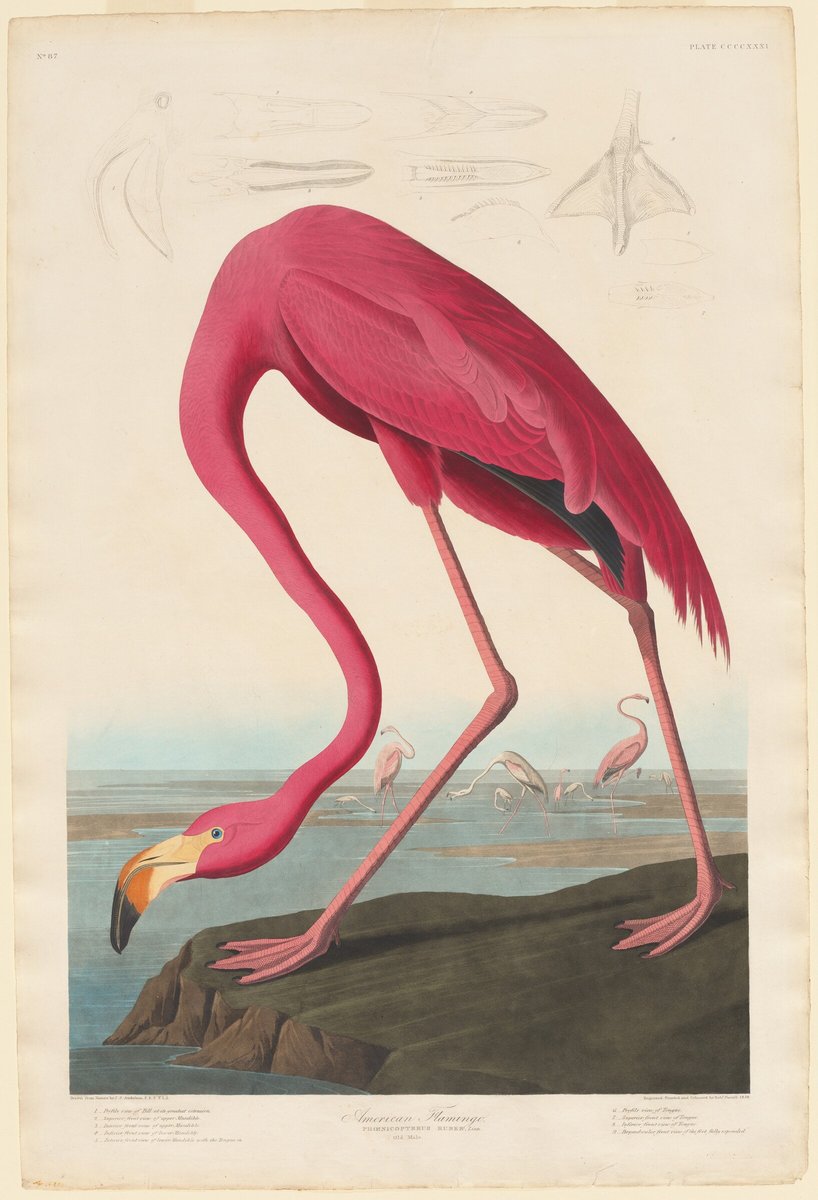
Real flamingos cover a wider range than one code. Greater flamingos are much paler, while American flamingos are the brightest, a deep rose like the bird in Audubon’s 1838 print, about #CA5669. On screen, #FC8EAC is practically the same color as Baker-Miller pink. Black text reads well on it; white text does not.

HEX#FC8EAC
RGBrgb(252, 142, 172)
HSLhsl(344, 95%, 77%)
HSV344°, 44%, 99%
CMYK0, 44, 32, 1
OKLCHoklch(77.2% 0.136 3.3)
Every code converts from the HEX value #FC8EAC. No color standard defines flamingo pink. #FC8EAC is the code most color lists use, and Wikipedia’s list of colors gives it without a source. Dictionaries mean something else by flamingo: the American Heritage Dictionary calls it “a moderate reddish orange”, and the 1955 ISCC-NBS dictionary files the flamingo of Maerz and Paul’s A Dictionary of Color (1930) there too, about #CB6D51. In HP Labs’ online color naming experiment, people’s flamingo pink averaged a more vivid #FF66BB. CMYK is a screen-based estimate; print results vary.
Flamingo pink color card, hex #FC8EAC: “One leg up on the other pinks”

Flamingo pink on the color map

HP Labs’ flamingo pink sits inside the outline, below and to the left: a little darker, more purple and much more vivid. The bird in Audubon’s print sits straight below the outline, a far deeper rose. The dictionary flamingo sits below the outline and well to the right: a darker, duller reddish orange. The outline is an approximate range, not a measured one.

Shades and tints

Tints with white

Shades with black

Tones with gray

Flamingo pink sits in the middle. Tints add white, shades add black and tones add gray, in 10% steps out from it. Tap any swatch to copy its code.

Light and dark flamingo pink

#FED2DE
Pale flamingo pinkMixed 60% with white. A soft blush for backgrounds.
#FC8EAC
Flamingo pinkThe reference color.
#FF91AF
Baker-Miller pinkThree steps higher in red, green and blue. On screen, practically the same color. See baker-miller pink
#FF66BB
Survey flamingo pinkWhat people named flamingo pink in HP Labs’ online color naming experiment (2007). Brighter and more purple.
#CA5669
Audubon’s flamingoSampled from the bird’s body in Audubon’s American Flamingo (1838). A deep rose, as the print colors an American flamingo.
#CB6D51
Dictionary flamingoThe ISCC-NBS moderate reddish orange, where the 1955 dictionary files Maerz and Paul’s flamingo.
#975567
Dark flamingo pinkMixed 40% with black. A dusky rose that holds white text.

Colors that go with flamingo pink

Pairings that work in rooms, outfits and interfaces.

Flamingo and palm

Pink and deep green, like flamingos under palm trees. Fresh and tropical.

Audubon’s flamingo, 1838

Sampled from the print: deep rose, lagoon gray-blue and olive shore on old paper.

Flamingo and navy

Soft pink on deep blue. Calm, smart and easy to read.

Flamingo and turquoise

Pink and blue-green, like a flamingo in shallow Caribbean water. Bright and beachy.

Flamingo and black

Bold and graphic, like a flamingo’s pink plumage against its black flight feathers.

Soft flamingo

A tonal set from pale to dusky, for a gentle, all-pink look.

Color-wheel palettes

Pick a palette to see where its colors sit on the color wheel. The caret marks flamingo pink. Tap a band to copy its code.

Similar colors

Bubblegum pink71%Carnation pink71%Baker-Miller pink95%Flamingo pinkWatermelon63%Light coral68%Salmon63%

Lined up by hue around flamingo pink. Hover a color to see how similar it is.The bar under each name shows how similar it is. Similarity comes from the distance between the two colors in OKLab, a model of how we see color.

Flamingo pink vs hot pink

Flamingo pink#FC8EAC · hue 344°
  • Lighter and softer
  • A little closer to red
  • Named after a bird
Hot pink#FF69B4 · hue 330°
  • Brighter and more vivid
  • Leans toward purple
  • A CSS keyword since 2001

Meaning

  • Algae and brine shrimp
  • Gray chicks
  • Flamingo make-up
  • Lawn flamingos

Flamingo pink brings to mind the bird, the tropics and the plastic flamingo on a suburban lawn. Its meanings come from the bird, whose color is borrowed. Flamingos hatch gray, turn pink from what they eat, give some of that color to their chicks and even touch up their feathers with tinted oil. Research on color and emotion tests basic words like pink, not flamingo pink, so the claims below are about the birds.

Pink from algae and brine shrimp

Well established

Flamingos can’t make their own pink. Carotenoids, the red, orange and yellow pigments of carrots and ripe tomatoes, are made by microscopic algae, and brine shrimp eat the algae. A flamingo eats both, and its body changes the pigments and lays them down in its feathers. In greater flamingos, canthaxanthin makes up more than 60% of the feather pigment.1, 2, 3
Chicks hatch gray

Zoo records

A flamingo chick hatches in white-gray down, with a straight pink bill and pink legs that turn black within a week. It takes several years and several molts for a young flamingo to turn pink and grow its hooked bill.1, 4, 5

Parents give their color away

Two zoos report

Flamingo parents feed their chicks crop milk, made in the throat. It is bright red, colored by the same pigments as the feathers, so a messy feeding can make a chick look as if it is bleeding. Over a breeding season the parents fade, at times almost to white, while their chicks grow pinker.6, 5

Flamingos wear make-up

A few studies

Greater flamingos spread oil from a gland near the tail over their neck feathers. The oil carries the same pigments and makes the plumage redder, and redder birds breed earlier. In a 2021 test on neck feathers from 30 birds that died in a cold spell, feathers left in the sun without fresh oil faded, while feathers kept in the dark did not. In a zoo flock of 34, redder males were more likely to have a main social partner.3, 7

Zoos add pigment to the feed

Zoo practice

Captive flamingos can fade to pale pink if their food lacks carotenoids. The San Diego Zoo feeds its flock pellets made for zoo flamingos, with a pigment that keeps them “in the pink”. A study of one German zoo flock compared two complete flamingo diets that differed especially in their canthaxanthin.8, 5, 9

Sources (9)
  1. Smithsonian’s National Zoo and Conservation Biology Institute (2021, June 29). “Why Are Flamingos Pink? And Other Flamingo Facts”.
  2. Brush, A. H. (1990). Metabolism of carotenoid pigments in birds. FASEB Journal, 4(12), 2969–2977. doi:10.1096/fasebj.4.12.2394316
  3. Chiale, M. C., Rendón, M. A., Labaude, S. et al. (2021). The color of greater flamingo feathers fades when no cosmetics are applied. Ecology and Evolution, 11(20), 13773–13779. doi:10.1002/ece3.8041
  4. Smithsonian’s National Zoo and Conservation Biology Institute, “American flamingo”, fact sheet.
  5. San Diego Zoo Wildlife Alliance, “Flamingo”, Animals and Plants.
  6. Smithsonian’s National Zoo and Conservation Biology Institute (2026, July 17). “Practical Tips for Anyone Currently Raising Nine Flamingo Chicks at the Same Time”.
  7. Freeman, H. D., Valuska, A. J., Taylor, R. R. et al. (2016). Plumage variation and social partner choice in the greater flamingo (Phoenicopterus roseus). Zoo Biology, 35(5), 409–414. doi:10.1002/zoo.21321
  8. Wikipedia, “Flamingo”, on plumage color in captivity, citing Grazian, D. (2015), American Zoo: A Sociological Safari, p. 35.
  9. Leineweber, C., Gohl, C., Lücht, M., Dobenecker, B. & Marschang, R. E. (2022). Plasma vitamin and mineral concentrations in captive greater flamingos (Phoenicopterus roseus) as influenced by diet change. Journal of Zoo and Wildlife Medicine, 53(3), 561–572. doi:10.1638/2021-0104

History

The word flamingo came to English as a bird’s name in 1565. As a color, dictionaries still call flamingo a reddish orange, while the web’s flamingo pink is a light pink.

  1. 1565

    First known use of the word flamingo in English. Merriam-Webster traces it to obsolete Spanish flamengo, “a Fleming”, as people from Flanders were thought of as ruddy-faced. The American Heritage Dictionary traces it to Old Provençal flamenc, from flama, “flame”.1, 2

  2. 1838

    Robert Havell Jr. engraves, prints and hand-colors John James Audubon’s American Flamingo, plate 431 of The Birds of America. Audubon’s bird, labeled an old male, is a deep rose.3

  3. 1930

    Maerz and Paul’s A Dictionary of Color includes flamingo among its color names.4

  4. 1955

    The ISCC-NBS dictionary files Maerz and Paul’s flamingo as a moderate reddish orange, about #CB6D51. The same year, Denis L. Fox reports the carotenoid astaxanthin in the American flamingo.4, 5

  5. 1957

    Don Featherstone, a sculptor at the plastics maker Union Products in Leominster, Massachusetts, designs the pink plastic lawn flamingo, working from photos in National Geographic.6

  6. By 2007

    In HP Labs’ online color naming experiment, people’s average flamingo pink is #FF66BB, brighter and more purple than the usual code.7

  7. 2011

    Researchers in Spain report that greater flamingos use pigmented preen oil as make-up, spreading it over their neck feathers to look redder.8

  8. 2021

    A follow-up study shows that flamingo feathers fade in sunlight unless fresh make-up is applied.8

Sources (8)
  1. Merriam-Webster, “flamingo”, definition, etymology and first known use.
  2. The American Heritage Dictionary of the English Language, “flamingo”, definitions and etymology.
  3. National Gallery of Art, Washington, “American Flamingo”, Robert Havell Jr. after John James Audubon, 1838 (1945.8.431).
  4. Jaffer, A. “(M) Dictionary of Color”, the ISCC-NBS placements of Maerz and Paul’s color names (1955 dictionary), with centroids from “Color-Name Dictionaries”, MIT CSAIL.
  5. Fox, D. L. (1955). Astaxanthin in the American flamingo. Nature, 175(4465), 942–943. doi:10.1038/175942a0
  6. Perkins, L. (2015, June 23). “Man Who Created The Pink Plastic Lawn Flamingo Dies”. NPR.
  7. Moroney, N. HP Labs online color naming experiment, results as of 2007, as compiled in Jaffer, A., “Color-Name Dictionaries”, MIT CSAIL.
  8. Chiale, M. C., Rendón, M. A., Labaude, S. et al. (2021). The color of greater flamingo feathers fades when no cosmetics are applied. Ecology and Evolution, 11(20), 13773–13779, describing Amat, J. A. et al. (2011), “Greater flamingos Phoenicopterus roseus use uropygial secretions as make-up”, Behavioral Ecology and Sociobiology, 65, 665–673. doi:10.1002/ece3.8041

Flamingo pink in use

A hand-colored print of a deep pink flamingo bending its long neck down toward shallow blue water, with smaller pale flamingos in the distance and sketches of its bill and foot along the top
#D77377#CA5669#B83E53#89303D
PrintAmerican Flamingo, after John James Audubon (1838)

Plate 431 of The Birds of America, engraved, printed and hand-colored by Robert Havell Jr. from Audubon’s drawing of an old male. The bird’s body samples at about #CA5669, deepening to #B83E53 and #89303D in the wing, with softer #D77377 legs: a deep rose, far darker than the web’s flamingo pink.

#D77377#CA5669#B83E53#89303D
Source: National Gallery of Art

Palettes are sampled in-house.

Questions

What color is flamingo pink?

A light, rosy pink. The code used here is #FC8EAC (RGB 252, 142, 172). No color standard defines it, but it is the code most color lists use.

Why are flamingos pink?

Because of what they eat. Microscopic algae make red and orange pigments called carotenoids, brine shrimp eat the algae, and flamingos eat both. Their bodies process the pigments and lay them down in their feathers.

Are baby flamingos pink?

No. Flamingo chicks hatch in white-gray down. It takes several years and several molts for them to turn pink.

Do zoos feed flamingos something to keep them pink?

Yes. Without enough carotenoids, captive flamingos can fade to pale pink, so zoos feed them pellets made for flamingos that include a pigment, such as canthaxanthin.

Is flamingo pink the same as Baker-Miller pink?

Almost. Baker-Miller pink is #FF91AF, three steps higher than flamingo pink in red, green and blue, so the two look the same on screen. They have different names and stories.

What is the difference between flamingo pink and hot pink?

Hot pink (#FF69B4) is brighter, more vivid and leans toward purple. Flamingo pink (#FC8EAC) is lighter and softer, a little closer to red.

What colors go with flamingo pink?

Palm green, turquoise and navy for contrast, black for a bold, graphic look, and lighter pinks for a soft tonal palette. Use dark text on flamingo pink; white text is hard to read.