Baker-Miller pink

The jail-cell pink of 1979, said to calm violent inmates, though later tests disagree.

Overview

Baker-Miller pink is a light, warm pink. Its usual code, #FF91AF, has red at full strength, green at 57% and blue at 69%. It is not a pigment of its own. It began as a can of paint: one pint of red semi-gloss outdoor trim paint stirred into one gallon of pure white indoor latex.

On March 1, 1979, two officers at the U.S. Naval Correctional Center in Seattle, Chief Warrant Officer Gene Baker and Captain Ron Miller, had a holding cell for new inmates painted in that pink, everything except the floor. The idea came from the researcher Alexander Schauss, who named the color after them. A Navy memo later said there had been no hostile incidents in the cell since. The nickname drunk-tank pink followed.

The evidence has not held up well. The Seattle report had no comparison group, and the strength test behind it relied on a researcher pushing down on a subject’s arm. A California jail saw fewer fights for one month and then more. A controlled trial with Swiss prisoners in 2015 found no difference between pink and white cells. Still, pink cells, pink locker rooms and pink hoodies keep the idea alive.

On screen, #FF91AF is practically a twin of flamingo pink, three steps lighter in each channel. Black text reads well on it (contrast about 9.9:1); white text does not.

HEX#FF91AF
RGBrgb(255, 145, 175)
HSLhsl(344, 100%, 78%)
HSV344°, 43%, 100%
CMYK0, 43, 31, 0
OKLCHoklch(78.1% 0.136 3.2)
Every code converts from the HEX value #FF91AF. No color standard defines Baker-Miller pink. #FF91AF goes back to David Byrne’s 2003 essay on pink in Cabinet, which gave the paint as “R:255, G:145, B:175”, and Wikipedia cites it from there. The original was a mix of two house paints, so the real walls varied. Byrne closed the essay with a warning that one of its sentences was fiction, without saying which. CMYK is a screen-based estimate; print results vary.
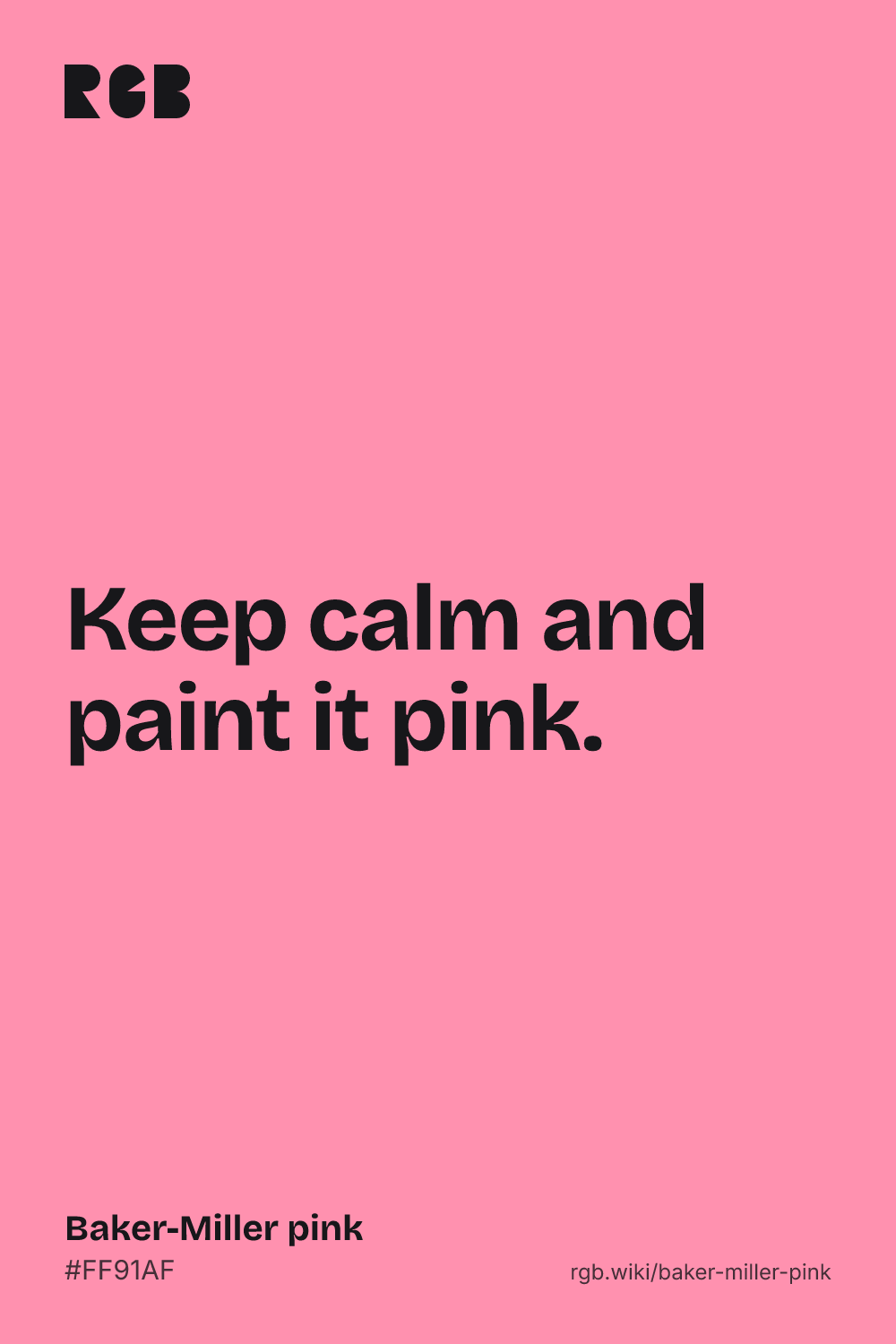
Baker-Miller pink color card, hex #FF91AF: “Keep calm and paint it pink”

Baker-miller pink on the color map

Flamingo pink sits right on top of the reference dot. The ISCC-NBS strong purplish pink sits just below and a little left, inside the outline: a duller, slightly more purple pink. People’s plain pink in the xkcd survey sits to the left, more purple and a touch darker. The outline is an approximate range, not a measured one.

Shades and tints

Tints with white

Shades with black

Tones with gray

Baker-Miller pink sits in the middle. Tints add white, shades add black and tones add gray, in 10% steps out from it. Tap any swatch to copy its code.

Light and dark baker-miller pink

#FFD3DF
Pale Baker-Miller pinkMixed 60% with white. A soft blush for backgrounds.
#FFBDCF
Light Baker-Miller pinkMixed 40% with white. A pastel pink.
#FF91AF
Baker-Miller pinkThe reference color.
#FC8EAC
Flamingo pinkThree steps lower in red, green and blue. On screen, practically the same color. See flamingo pink
#E68FAC
Strong purplish pinkThe ISCC-NBS category Wikipedia files it under. Duller and a little cooler.
#995769
Dark Baker-Miller pinkMixed 40% with black. A dusky rose that holds white text.

Colors that go with baker-miller pink

Pairings that work in rooms, outfits and interfaces.

The pink cell

Pink walls and ceiling over a bare gray floor, as in the 1979 Seattle cell. Stark and institutional.

Pale blue to pink

The Santa Clara jail repainted a pale blue room hot pink in 1979. Together the two are soft and airy.

Pink and charcoal

Light pink on near-black. Graphic and modern, with strong contrast.

Visitors’ locker room

Pink with black and gold, like a pink visitors’ room inside a black-and-gold stadium. Loud and sporty.

Pink and sage

Warm pink with soft green. Calm and natural, for homes and stationery.

Tonal pink

From pale blush to dusky rose. A gentle, all-pink set.

Color-wheel palettes

Pick a palette to see where its colors sit on the color wheel. The caret marks baker-miller pink. Tap a band to copy its code.

Similar colors

Bubblegum pink70%Carnation pink75%Baker-miller pinkFlamingo pink95%Watermelon59%Light coral65%Salmon61%

Lined up by hue around baker-miller pink. Hover a color to see how similar it is.The bar under each name shows how similar it is. Similarity comes from the distance between the two colors in OKLab, a model of how we see color.

Baker-Miller pink vs flamingo pink

Baker-Miller pink#FF91AF · hue 344°
  • Three steps lighter in each channel
  • Named after two Navy officers
  • Began as a mix of house paints
Flamingo pink#FC8EAC · hue 344°
  • Same hue, a hair darker
  • Named after a bird
  • Dictionaries mean a reddish orange by flamingo

Meaning

  • Jail cells
  • A paint mix
  • Contested studies
  • Locker rooms

Baker-Miller pink stands for one idea: that a color on the walls can calm angry people. Unusually, the research tested this exact paint, not just the word pink. The first reports were striking, but they came from the people who ran the cells, without comparison groups. Later, better-controlled tests mostly found no effect on strength, blood pressure or aggression, and one found a small drop in reported anxiety.

The first report had no control

Uncontrolled report

Schauss’s 1979 paper quoted a Navy memo: since the Seattle cell was painted pink, there had been “no incidents of erratic or hostile behavior” among new inmates, and 15 minutes in the cell was enough. There was no comparison cell, and the officers who chose the pink also judged the results.1, 2

The strength test did not hold up

Not replicated

Schauss based the idea on an arm push-down test: a subject looking at a pink card seemed to resist less. Follow-up studies found small strength effects in two tests and none in a third. In 1988, a study of 54 adults looking at pink or white panels found no difference in blood pressure, pulse or grip strength.1, 2, 3

A jail’s pink year

One field study

The Santa Clara County jail in California repainted its strip search room from pale blue to hot pink in 1979. Fights fell in the first month, then rose, peaking in the last months of the pink year. Over the year there was little or no difference. The authors, Schauss among them, suggested that staff belief in the method may explain the early drop.2

Lower anxiety in one small study

One small study

In 1987, 46 students sat for five minutes in a room painted Baker-Miller pink or red. The pink group reported lower anxiety, but their grip strength and steadiness of hand did not differ. The authors called this minimal support. The comparison was with red, not with a neutral color.4

No effect in a controlled prison trial

One controlled trial

In a 2015 study, 59 male prisoners in Switzerland, held in detention for breaking prison rules, were randomly placed in an all-pink cell or a white cell with a gray floor. Guards rated their aggression on arrival and after three days. Aggression fell in both cells, with no difference between them. The authors warned that a pink cell might humiliate inmates instead.5, 6

Pink cells are still in use

News report

Despite the results, some prisons in the United States, Switzerland, Germany, Poland, Austria and the United Kingdom have painted cells pink. In 2015 the BBC reported that 20% of prisons and police stations in Switzerland had at least one pink cell.7
Sources (7)
  1. Schauss, A. G. (1979). Tranquilizing effect of color reduces aggressive behavior and potential violence (PDF). Orthomolecular Psychiatry, 8(4), 218–221.
  2. Pellegrini, R. J., Schauss, A. G. & Miller, M. E. (1981). Room color and aggression in a criminal detention holding cell: a test of the “tranquilizing pink” hypothesis (PDF). Orthomolecular Psychiatry, 10(3), 174–181.
  3. Gilliam, J. E. & Unruh, D. (1988). The effects of Baker-Miller pink on biological, physical and cognitive behaviour (PDF). Journal of Orthomolecular Medicine, 3(4), 202–206.
  4. Profusek, P. J. & Rainey, D. W. (1987). Effects of Baker-Miller pink and red on state anxiety, grip strength, and motor precision. Perceptual and Motor Skills, 65(3), 941–942. PubMed 3438141.
  5. Genschow, O., Noll, T., Wänke, M. & Gersbach, R. (2015). Does Baker-Miller pink reduce aggression in prison detention cells? A critical empirical examination. Psychology, Crime & Law, 21(5), 482–489. doi:10.1080/1068316X.2014.989172 (abstract via Leuphana University).
  6. Jarrett, C. (2014, December 2). “Are prisoners calmer when their cells are painted pink?” British Psychological Society, Research Digest.
  7. Hammond, C. (2015, April 6). “Do colours really warp our behaviour?” BBC Future.

History

Baker-Miller pink was born in a Navy brig in 1979 and spread to jails, locker rooms and living rooms faster than the evidence could follow.

  1. 1978

    Alexander Schauss, of the Institute for Biosocial Research in Tacoma, Washington, demonstrates an arm push-down test with pink and blue paper to classes on corrections, and suggests a pink holding cell as a time-out room.1

  2. March 1, 1979

    Chief Warrant Officer Gene Baker and Captain Ron Miller have a holding cell for new inmates at the U.S. Naval Correctional Center in Seattle painted pink, all but the floor. Schauss names the color after them.1

  3. 1979

    University of Iowa football coach Hayden Fry has the visiting team’s locker room at Kinnick Stadium painted pink, saying the color will make opponents passive.2

  4. September 1, 1979

    The Santa Clara County jail in California repaints its strip search room from pale blue to hot pink and starts a year-long count of violent incidents.3

  5. 1981

    The Santa Clara results are published: a drop in the first month, a peak in the last months, and little or no difference over the year.3

  6. 1988

    A study at the University of Texas at Austin tests a pink study carrel sold to schools as calming. It finds no effect on blood pressure, pulse or grip strength, and records the recipe: a pint of red trim paint in a gallon of white.4

  7. 2003

    David Byrne’s essay on pink in Cabinet gives Baker-Miller pink as R:255, G:145, B:175, the source of the web code #FF91AF.5

  8. 2005

    A renovation at Kinnick Stadium adds pink brick walls, pink lockers, sinks, showers and urinals to the visitors’ locker room.2

  9. 2014

    A controlled trial with Swiss prisoners finds pink cells no calmer than white ones. It appears in print in 2015.6

  10. 2018

    Norwich City Football Club paints the away dressing room at Carrow Road deep pink.7

Sources (7)
  1. Schauss, A. G. (1979). Tranquilizing effect of color reduces aggressive behavior and potential violence (PDF). Orthomolecular Psychiatry, 8(4), 218–221.
  2. Associated Press (2014, August 28). “Iowa pink locker room protested”. ESPN.
  3. Pellegrini, R. J., Schauss, A. G. & Miller, M. E. (1981). Room color and aggression in a criminal detention holding cell (PDF). Orthomolecular Psychiatry, 10(3), 174–181.
  4. Gilliam, J. E. & Unruh, D. (1988). The effects of Baker-Miller pink on biological, physical and cognitive behaviour (PDF). Journal of Orthomolecular Medicine, 3(4), 202–206.
  5. Byrne, D. (2003). “Pink: Not so sweet after all”. Cabinet, 11.
  6. Genschow, O., Noll, T., Wänke, M. & Gersbach, R. (2015). Does Baker-Miller pink reduce aggression in prison detention cells? A critical empirical examination. Psychology, Crime & Law, 21(5), 482–489. doi:10.1080/1068316X.2014.989172
  7. BBC Sport (2018, August 20). “Norwich City paint Carrow Road away dressing room pink”.

Questions

What color is Baker-Miller pink?

A light, warm pink. The usual code is #FF91AF (RGB 255, 145, 175). It began as a paint mix: one pint of red semi-gloss outdoor trim paint in one gallon of pure white indoor latex.

Does Baker-Miller pink really calm people down?

Probably not in any lasting way. The first reports from 1979 had no comparison groups. Later tests found no effect on strength, blood pressure or pulse, a jail saw fights return after one calm month, and a controlled trial with 59 Swiss prisoners found pink cells no calmer than white ones. One small study found lower self-reported anxiety than in a red room.

Why is it called Baker-Miller pink?

After Chief Warrant Officer Gene Baker and Captain Ron Miller, the two officers who had the first pink holding cell painted at the U.S. Naval Correctional Center in Seattle in 1979. The researcher Alexander Schauss named it after them.

Why is it called drunk-tank pink?

A drunk tank is a jail cell where people arrested while drunk are held to sober up. The pink was painted on holding cells like these in the hope of calming new arrivals, and the nickname stuck.

Is Baker-Miller pink the same as flamingo pink?

Almost. Flamingo pink is #FC8EAC, three steps lower in red, green and blue, so the two look the same on screen. They have different names and different stories.

Do prisons still paint cells pink?

Some do. In 2015 the BBC reported pink cells in prisons in the United States, Switzerland, Germany, Poland, Austria and the United Kingdom, and at least one pink cell in 20% of Swiss prisons and police stations.

Why is the visitors’ locker room at Iowa pink?

Coach Hayden Fry had it painted pink in 1979, saying the color would make opponents passive. A 2005 renovation added pink lockers, sinks, showers and urinals. Critics have called it sexist and homophobic; most fans defend it as a tradition.

What colors go with Baker-Miller pink?

Charcoal and black for contrast, pale blue or sage green for a softer look, and lighter pinks for a tonal palette. Use dark text on it; white text is hard to read.