Celeste is a very pale, airy blue that sits exactly between blue and green, like a clear sky low over the horizon. The code here, #B2FFFF, is the one most references use: full green and blue light with a good share of red, which lifts it almost to white.
The word is Italian for sky blue, from the Latin caelestis, “heavenly”, and Spanish and Portuguese use it too. Argentina’s flag is celeste y blanco, sky blue and white, and Uruguay’s football team is known simply as la Celeste.
Real celestes vary widely. Bianchi has painted its bicycles celeste since the early 1900s and says the shade has grown lighter and greener over time. A Spanish color dictionary puts celeste at a much deeper sky blue, and the bleu céleste of 18th-century French porcelain is a rich, dark turquoise.
Because it is so light, celeste needs dark text: navy, charcoal or near-black. Pair it with white for a sporty look, or with coral or gold for warmth. On screens it can read as almost white, so give it a darker partner to hold its shape.
HEX
#B2FFFF
RGB
rgb(178, 255, 255)
HSL
hsl(180, 100%, 85%)
HSV
180°, 30%, 100%
CMYK
30, 0, 0, 0
OKLCH
oklch(95.0% 0.075 196.0)
Every code converts from the HEX value #B2FFFF. There is no single standard celeste. #B2FFFF is the code most references use; Wikipedia traces it to an Italian color dictionary (Fantetti and Petracchi, 2001) that lists celeste as 30% cyan ink, converted directly to screen color. We could not check the book, and we found no code published by Bianchi for its celeste. CMYK is a screen-based estimate; print results vary.
Celeste on the color map
LighterDarker
The Spanish dictionary’s celeste is a deeper, bluer sky blue, outside the outline below and to the right. The Italian dictionary’s grayed celeste velato sits inside, its dull celeste opaco just below. The bleu céleste of French porcelain is far darker and lies off the close view. The outline is an approximate range, not a measured one.
Shades and tints
Tintswith white
Shadeswith black
Toneswith gray
Celeste sits in the middle. Tints add white, shades add black and tones add gray, in 10% steps out from it. Tap any swatch to copy its code.
Light and dark celeste
#E6FFFF
Powder celesteThe Italian dictionary’s celeste polvere: almost white.
#B2FFFF
CelesteThe reference color.
#CCE6E6
Veiled celesteCeleste velato: grayed, like a hazy sky.
#80CCCC
Dull celesteCeleste opaco: a deeper, muted blue-green.
#A5F2F3
Ice blueA close neighbor, a little deeper, with a page of its own. See ice blue
Colors that go with celeste
Pairings that work in rooms, outfits and interfaces.
Celeste and white
The colors of Argentina’s flag and of Lazio in Rome. Fresh and sporty.
Celeste and navy
Deep navy with pale celeste: crisp and easy to read.
Celeste and gold
Gilt and pale blue, a soft take on French porcelain.
Celeste and coral
Cool against warm. Light and summery.
Celeste and charcoal
Pale celeste glows against dark gray. Clean and modern.
Celeste and lilac
Two pastels for a soft, dreamy look.
Color-wheel palettes
Pick a palette to see where its colors sit on the color wheel. The caret marks celeste. Tap a band to copy its code.
Lined up by hue around celeste. Hover a color to see how similar it is.The bar under each name shows how similar it is. Similarity comes from the distance between the two colors in OKLab, a model of how we see color.
Celeste vs sky blue
Celeste#B2FFFF · hue 180°
Very pale, close to white
Exactly halfway between green and blue
Italian and Spanish for sky blue
Sky blue#87CEEB · hue 197°
Deeper and more saturated
Leans clearly toward blue
The CSS keyword skyblue
Meaning
Sky
Bianchi bikes
Football
Porcelain
Heraldry
Celeste is the sky blue of Italy, Spain and South America: the word itself, the color of Argentina’s flag, of Uruguay’s football team and of Bianchi’s bicycles. No study of color and mood tests celeste by name, so the claims below are about its history and use.
Uruguay’s team is la Celeste
Historical record
Uruguay’s national football team has been called la Celeste, “the sky blue”, since 15 August 1910, when it first wore sky-blue shirts and beat Argentina 3–1 in Montevideo. The color honored a recent win by the local River Plate club in the same colors.1
A costly porcelain color
Museum record
Bleu céleste, a deep turquoise ground introduced at the Vincennes porcelain factory in 1753, took repeated layers of powdered pigment and several firings to get even. Pieces in it were among the most expensive the factory made, and it was used on a 1,749-piece dinner service for Louis XV.2
Bianchi’s celeste has drifted
Company history
Bianchi says its celeste was born in the early 1900s and has changed slightly over time, becoming lighter and closer to green. That account comes from the company itself, and we found no code it publishes, so versions on screens vary.3
Celeste is an old word for heaven and a newer word for a color. Its story runs through French porcelain, South American flags and football, and Italian bicycles.
1753
The Vincennes porcelain factory near Paris introduces bleu céleste, a deep turquoise ground, and uses it on a 1,749-piece dinner service for Louis XV.1
1816
On 20 July, the Congress of Tucumán confirms Argentina’s flag in “celeste y blanco”, sky blue and white.2
1900
SS Lazio is founded in Rome. Its white and sky blue honor Greece, home of the ancient Olympic Games.3
1900s
Bianchi’s celeste is born in the early years of the century. The Milan company’s bicycles have worn it ever since.4
1910
Uruguay wears sky blue for the first time and beats Argentina 3–1 on 15 August. The team becomes la Celeste.5
After 1918
Bleu celeste, a rare heraldic tint lighter than the usual azure, starts to appear in English arms and badges linked to the Royal Air Force.6
1949
Fausto Coppi wins the Tour de France in Bianchi’s white and celeste jersey, two years after his 1947 Giro d’Italia win.7
2001
An Italian color dictionary lists celeste as 30% cyan ink, the source of the common code #B2FFFF.8
Sources (8)
Cleveland Museum of Art, “Saucer (Soucoupe)”, Vincennes Porcelain Factory, 1753–54, 1989.188.
Fantetti, S. & Petracchi, C. (2001). Il dizionario dei colori: nomi e valori in quadricromia. Zanichelli. ISBN 88-08-07995-3. As cited in Wikipedia, “Sky blue”; not checked against the book.
Celeste in use
#217494#074961#C2AE85#D2D4CD
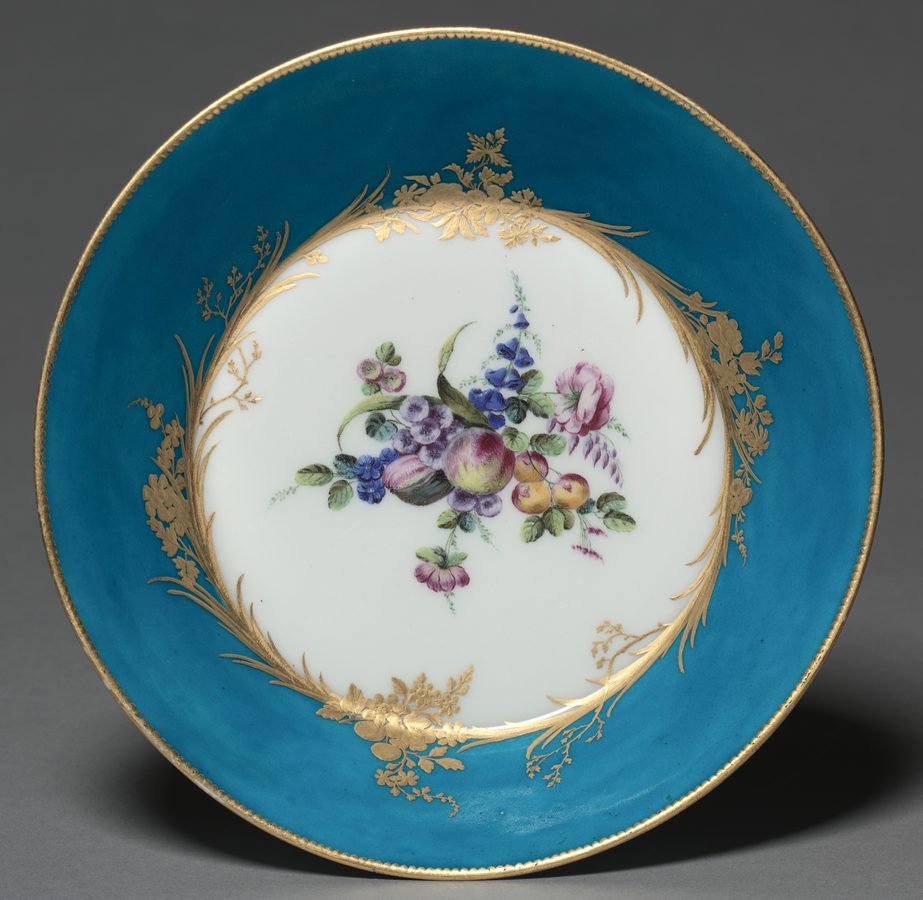
CeramicsSaucer, Vincennes (1753–54)
A saucer in the bleu céleste ground introduced at Vincennes in 1753. The celeste of French porcelain is a deep turquoise, far darker than the pale code on this page.
#217494#074961#C2AE85#D2D4CD
Source: Cleveland Museum
Source
Sampled from the Cleveland Museum of Art’s photograph (1989.188), released as CC0 (public domain). Colors in a photo shift with the lighting, so read the codes as close, not exact.
#036A9B#05598E#B29C78#D9D4D0
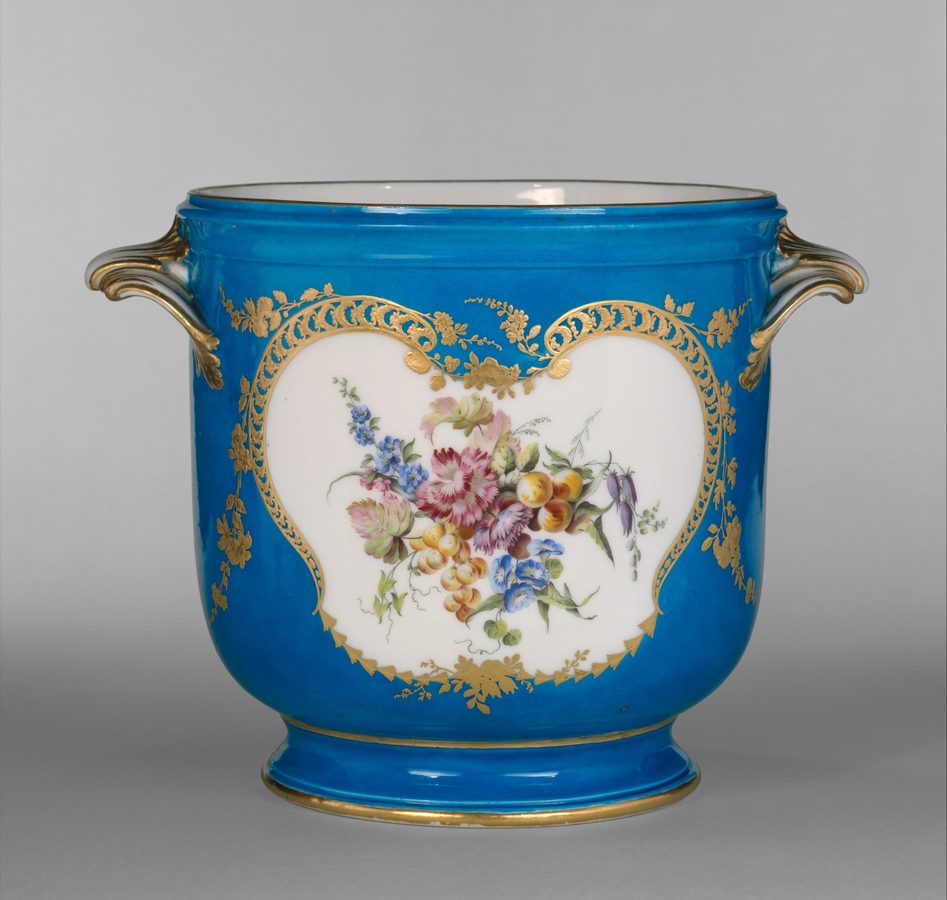
CeramicsBottle cooler, Louis XV service (1754)
A wine bottle cooler from the Vincennes dinner service made for Louis XV, the service that made bleu céleste famous. In this photo the ground reads as a brighter, bluer celeste.
#036A9B#05598E#B29C78#D9D4D0
Source: The Met
Source
Sampled from the Metropolitan Museum of Art’s photograph (1970.230.4), released as CC0 (public domain). Colors in a photo shift with the lighting, so read the codes as close, not exact.
Palettes are sampled in-house.
Questions
What color is celeste?
A very pale, airy sky blue, halfway between blue and green. The code here is #B2FFFF (RGB 178, 255, 255): full green and blue light with some red, which washes it toward white.
What does celeste mean?
It is the Italian word for sky blue, from the Latin caelestis, “heavenly”. Spanish and Portuguese use the same word, and Uruguay’s football team is nicknamed la Celeste.
What is Bianchi celeste?
The pale blue-green of Bianchi bicycles, used since the early 1900s. Bianchi says the shade has changed over time, becoming lighter and greener. We found no official code from the company, so this page does not give one.
Is celeste the same as sky blue?
Celeste means sky blue, but the usual codes differ. Sky blue (#87CEEB) is deeper and bluer. Celeste (#B2FFFF) is much paler and sits exactly between blue and green.
What colors go with celeste?
White and navy for a crisp, sporty look, coral for warm contrast and charcoal for a modern one. Use dark text on celeste; white text on it is unreadable.
What is bleu céleste?
A deep turquoise ground color introduced at the Vincennes porcelain factory in France in 1753. It took several firings to make, and pieces in it were among the factory’s most expensive.