Haint blue

The pale blue-green of Southern porch ceilings, meant to keep ghosts away.

Overview

Haint blue is a pale, soft blue-green, the color painted on porch ceilings across the American South. It names a family of shades rather than one color; the code here, #A9D4D2, is the one most references use, a quiet, grayish aqua.

Haint is a regional form of haunt in its old sense of a ghost; Merriam-Webster dates it to 1912. The custom is traced to the Gullah Geechee people of coastal South Carolina and Georgia, whose culture blends West and Central African traditions. They painted porches, doors and window frames blue so that haints would take it for sky or water they could not cross, and stay away.

Early haint blues were mixed by hand, some with indigo, so they varied a great deal. Some blues thought to be old are not: in Savannah, a conservator found the blue in the Davenport House attic was store-bought paint from the 1890s or later. Many people also say the color keeps wasps from nesting; the evidence for that is thin.

Haint blue is light and calm, so it suits large surfaces: ceilings, walls, shutters and doors. Pair it with crisp white trim, warm wood, and black or charcoal for contrast, and keep text on it dark.
HEX#A9D4D2
RGBrgb(169, 212, 210)
HSLhsl(177, 33%, 75%)
HSV177°, 20%, 83%
CMYK20, 0, 1, 17
OKLCHoklch(83.9% 0.045 192.8)
Every code converts from the HEX value #A9D4D2. There is no standard haint blue: the name covers a family of pale blue-greens, once mixed by hand and now sold in many paint versions. #A9D4D2 is the code most references use, and we did not take a code from any paint maker. CMYK is a screen-based estimate; print results vary.
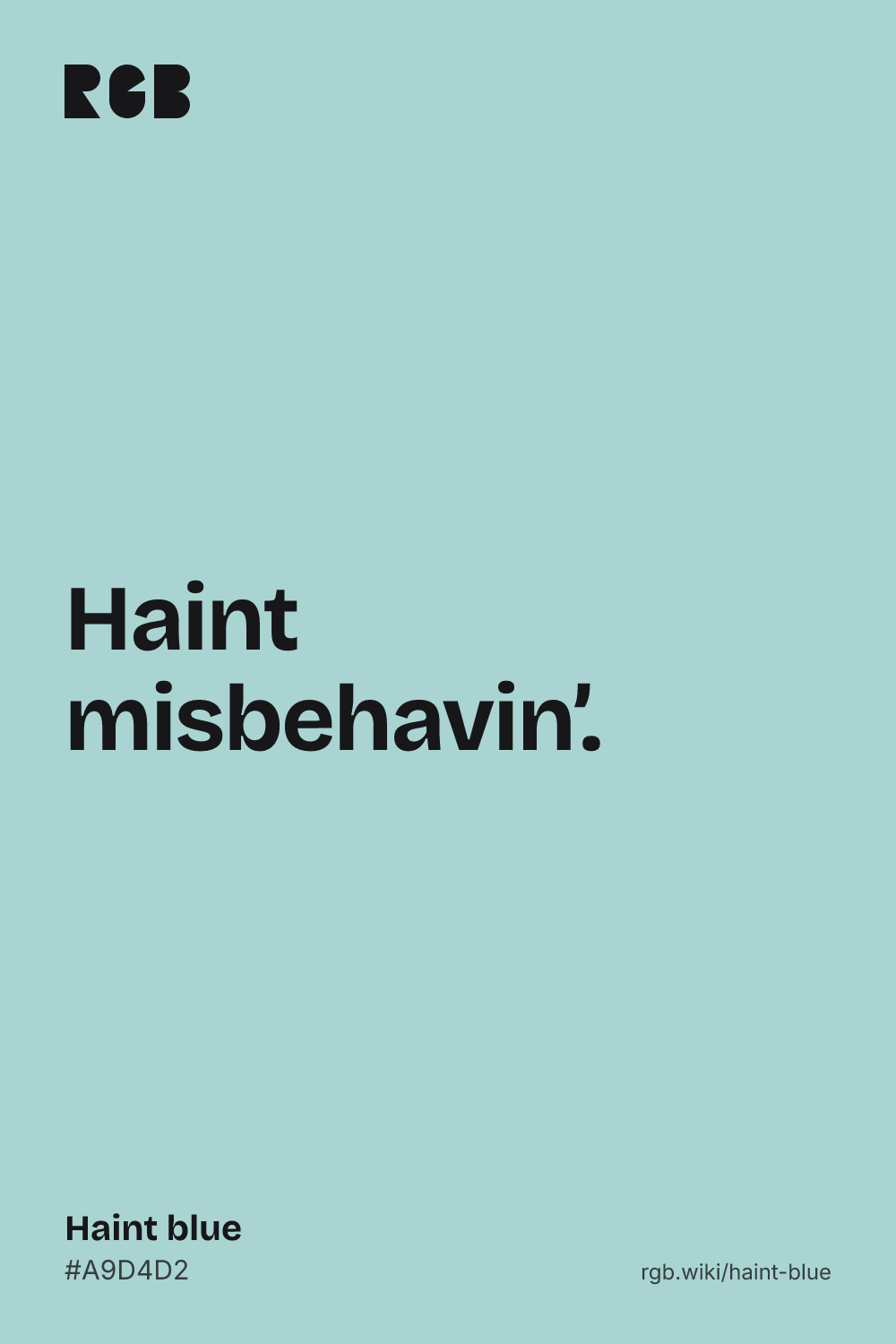
Haint blue color card, hex #A9D4D2: “Haint misbehavin’”

Haint blue on the color map

Robin egg blue, which haint blue is often compared to, sits inside the outline on the greener side. Wikipedia’s example swatch sits inside it too, lighter and a little bluer. Real porch ceilings range more widely than this. The outline is an approximate range, not a measured one.

Shades and tints

Tints with white

Shades with black

Tones with gray

Haint blue sits in the middle. Tints add white, shades add black and tones add gray, in 10% steps out from it. Tap any swatch to copy its code.

Light and dark haint blue

#CBE5E4
Pale haint blueHaint blue with 40% white. Barely there, like a hazy sky.
#A9D4D2
Haint blueThe reference color.
#7F9F9E
Deep haint blueHaint blue with 25% black. A grayer, shadowed version.
#96DED1
Robin egg blueClearer and greener, and often compared to haint blue. See robin egg blue
#B8DED9
Duck egg bluePaler and a touch greener, with a page of its own. See duck egg blue

Colors that go with haint blue

Pairings that work in rooms, outfits and interfaces.

Haint blue and white

The classic Southern porch: blue ceiling, white trim.

Haint blue and warm wood

A blue ceiling over wood floors and rocking chairs.

Haint blue and black

Black shutters and doors make the blue look crisp.

Haint blue and indigo

A nod to the indigo once grown in the Lowcountry.

Haint blue and blush

Soft and romantic. Good for bedrooms.

Haint blue and sage

Garden colors for a calm porch or kitchen.

Color-wheel palettes

Pick a palette to see where its colors sit on the color wheel. The caret marks haint blue. Tap a band to copy its code.

Similar colors

Robin egg blue84%Duck egg blue83%Haint bluePowder blue81%Light blue86%Pastel blue82%Columbia blue79%

Lined up by hue around haint blue. Hover a color to see how similar it is.The bar under each name shows how similar it is. Similarity comes from the distance between the two colors in OKLab, a model of how we see color.

Haint blue vs robin egg blue

Haint blue#A9D4D2 · hue 177°
  • Grayer and softer
  • A little bluer
  • Named after ghosts
Robin egg blue#96DED1 · hue 169°
  • Clearer and more colorful
  • Leans toward green
  • Named after an American robin’s egg

Meaning

  • Haints
  • Porches
  • Water
  • Sky
  • Wasps

Haint blue carries a belief: that blue keeps haints, restless spirits, away from a home. That belief comes from the Gullah Geechee people of the Lowcountry. Newer explanations, such as fooling wasps, have little evidence behind them.

A Gullah Geechee tradition

Documented tradition

Haint blue is traced to the Gullah Geechee people of coastal South Carolina and Georgia. Blue, first made with indigo dye, was meant to look like sky or water that haints could not cross. In Charleston, many people also paint house trim blue to ward off spirits.1, 2

Old haint blue is hard to prove

Building records

Paint analysis can confirm a story or overturn it. In Savannah’s Owens–Thomas House, built 1816–1819, the ceilings of the carriage house slave quarters keep extensive traces of haint blue. At the city’s Davenport House, though, the attic’s blue turned out to be the last layer, not the first, and store-bought paint from the 1890s or later.3, 4

Keeping wasps away is unproven

One small test

Many people say a blue porch ceiling stops wasps and spiders from nesting, and some credit lime in old paints. In 2006 the head of the Smithsonian’s insect zoo said he found no research on it. A small 2009 Texas test saw fewer paper wasp nests under freshly painted light-blue eaves after one month, but the difference faded after that.2, 5, 6

Sources (6)
  1. Schoberth, L. (May 30, 2021). “Haint Blue”. Historic New England.
  2. Norris, M. (August 14, 2006). “Why So Blue? Color Graces Many a Porch Ceiling”. NPR, All Things Considered.
  3. SAH Archipedia, “Owens-Thomas House”, Savannah, Georgia. Society of Architectural Historians.
  4. Credle, J. (March 16, 2020). “Our Haint Blue…Ain’t”. Historic Savannah Foundation.
  5. Schofield, K. (2009). “Painting Eaves to Deter Paper Wasp Nesting, Polistes carolina”. Texas AgriLife Extension Service; research report for the Pest Management Foundation.
  6. Wikipedia, “Haint blue”, on bug and bird nest deterrents.

History

Haint blue grew out of Gullah Geechee beliefs and the indigo fields of the Lowcountry, then spread across Southern porches. Paint analysis is now testing which old blues are really old.

  1. 1747

    South Carolina begins growing indigo commercially. Tended by enslaved people, it is second only to rice in export value until 1800.1

  2. 1816

    Work begins on Savannah’s Owens–Thomas House (1816–1819). The ceilings of its carriage house slave quarters still show extensive traces of haint blue.2

  3. 1912

    First known use of “haint”, a regional form of “haunt” meaning a ghost.3

  4. 2006

    Congress designates the Gullah Geechee Cultural Heritage Corridor. NPR reports that a Smithsonian entomologist found no research on blue ceilings and bugs.4, 5

  5. 2009

    A small Texas test finds fewer paper wasp nests under freshly painted light-blue eaves, but only for about a month.6

  6. 2017

    The Washington Post finds blue porch ceilings still common in the South, some called “dirt dauber blue” for keeping wasps away.7

  7. 2020

    A conservator finds that the blue attic paint at Savannah’s Davenport House is store-bought paint from the 1890s or later, not an early homemade haint blue.8

Sources (8)
  1. Jelatis, V. “Indigo”. South Carolina Encyclopedia.
  2. SAH Archipedia, “Owens-Thomas House”, Savannah, Georgia. Society of Architectural Historians.
  3. Merriam-Webster, “haint”, first known use.
  4. Schoberth, L. (May 30, 2021). “Haint Blue”. Historic New England.
  5. Norris, M. (August 14, 2006). “Why So Blue? Color Graces Many a Porch Ceiling”. NPR, All Things Considered.
  6. Schofield, K. (2009). “Painting Eaves to Deter Paper Wasp Nesting, Polistes carolina”. Texas AgriLife Extension Service; research report for the Pest Management Foundation.
  7. Koncius, J. (June 2017). “It’s a Southern thing: Why so many porch ceilings are blue”. The Washington Post.
  8. Credle, J. (March 16, 2020). “Our Haint Blue…Ain’t”. Historic Savannah Foundation.

Questions

What color is haint blue?

A pale, soft blue-green, used on porch ceilings in the American South. It is a family of shades; the code most references use is #A9D4D2 (RGB 169, 212, 210).

What does haint mean?

A haint is a ghost, a restless spirit. The word is a regional form of haunt, first recorded in 1912.

Why are porch ceilings painted blue in the South?

The custom comes from the Gullah Geechee people of coastal South Carolina and Georgia, who painted porches, doors and window frames blue to keep haints away. Today people also choose it because it looks like the sky, or because they believe it keeps wasps away.

Does haint blue keep wasps and bugs away?

There is little evidence. A Smithsonian entomologist found no research on it in 2006, and a small 2009 test found fewer paper wasp nests under freshly painted light-blue eaves for only about a month.

Is haint blue the same as robin egg blue?

They are close, and haint blue is often described as a robin’s egg blue. Robin egg blue (#96DED1) is clearer and a little greener; haint blue is grayer and softer.

What colors go with haint blue?

Crisp white trim, warm wood, and black or charcoal shutters and doors. Indigo, blush and sage also sit well beside it.