Cyan

The brightest blue-green a screen can show, and one of the three printing inks.

Overview

Cyan is a vivid greenish blue. Its web code is #00FFFF: green and blue light at full strength and no red at all. That makes it the exact opposite of red on the color wheel.

The name comes from the Greek kyanos, “dark blue enamel”. English has used it as a color name since at least 1879, at first as “cyan blue”. In web browsers the same code has two names: cyan and aqua.

Cyan is also one of the three inks of color printing, with magenta and yellow. But printer’s cyan and screen cyan are different colors. On screen, process cyan is usually shown as about #00B7EB, darker and bluer, and the web’s cyan can’t be printed exactly.

Cyan is very light, so it needs dark text; white text on cyan is almost unreadable. It glows against black and navy, and works best as an accent. Mixed with white, it makes a fresh background color.

HEX#00FFFF
RGBrgb(0, 255, 255)
HSLhsl(180, 100%, 50%)
HSV180°, 100%, 100%
CMYK100, 0, 0, 0
OKLCHoklch(90.5% 0.155 194.8)
Every code converts from the HEX value #00FFFF. #00FFFF is the CSS keyword cyan, and also aqua: the CSS Color Module Level 4 gives both names this value. Aqua is one of the 16 colors of HTML 3.2 (1997); cyan comes from the X11 color list, adopted by SVG 1.0 in 2001. CMYK is a screen-based estimate; print results vary.
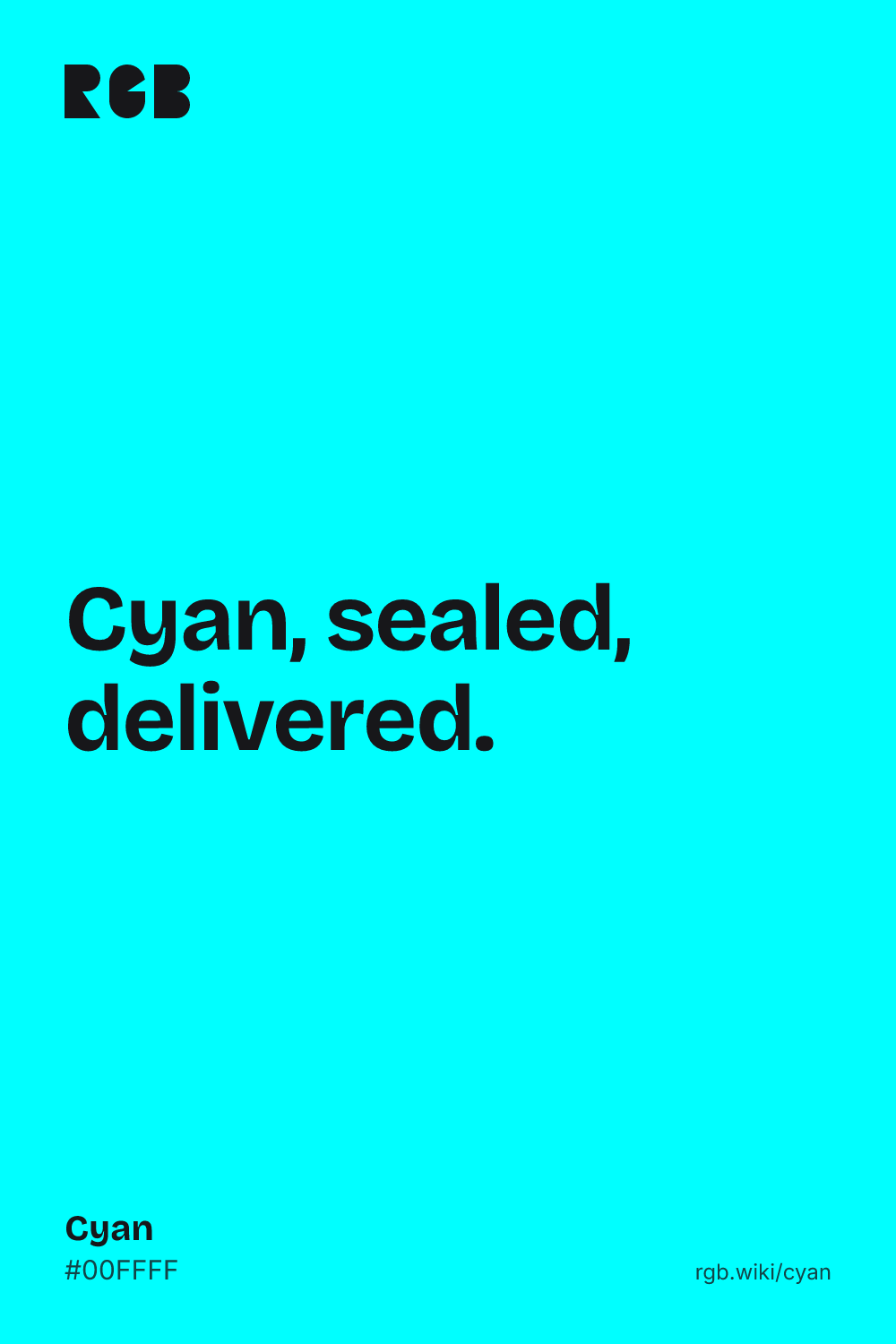
Cyan color card, hex #00FFFF: “Cyan, sealed, delivered”

Cyan on the color map

People’s average cyan in the xkcd survey is exactly the web code, so its dot sits on the reference. Printer’s cyan sits outside the outline, lower and to the right: darker and bluer. The outline is an approximate range, not a measured one.

Shades and tints

Tints with white

Shades with black

Tones with gray

Cyan sits in the middle. Tints add white, shades add black and tones add gray, in 10% steps out from it. Tap any swatch to copy its code.

Light and dark cyan

#E0FFFF
Light cyanThe CSS keyword lightcyan. A barely-there tint for backgrounds. See light cyan
#80FFFF
Soft cyanMixed 50% with white. Bright but easier on the eyes.
#00FFFF
CyanThe reference color.
#00B7EB
Process cyanPrinter’s cyan ink, as usually shown on screen. Darker and bluer than screen cyan.
#008B8B
Dark cyanThe CSS keyword darkcyan, at a little over half strength. Close to teal, and dark enough for white text at large sizes.

Colors that go with cyan

Pairings that work in rooms, outfits and interfaces.

Cyan and black

Neon on night. Electric; suits tech, gaming and music.

Cyan, magenta and yellow

The three printing inks, as screen colors. Playful and very loud.

Cyan and navy

Bright on deep. Clean and sporty.

Cyan and coral

Cool water and warm coral. Tropical and summery.

Soft cyan and white

Cyan softened with white. Fresh and clean, for water and health.

Cyan and slate

Toned down with gray. Modern and calm for interfaces.

Color-wheel palettes

Pick a palette to see where its colors sit on the color wheel. The caret marks cyan. Tap a band to copy its code.

Similar colors

Aquamarine66%Aqua59%Turquoise55%CyanCeleste54%Ice blue60%Electric blue77%

Lined up by hue around cyan. Hover a color to see how similar it is.The bar under each name shows how similar it is. Similarity comes from the distance between the two colors in OKLab, a model of how we see color.

Cyan vs aqua

Cyan#00FFFF · hue 180°
  • Pure green and blue light, no red
  • Named for a Greek word for dark blue
  • One of the three printing inks
Aqua#13EAC9 · hue 171°
  • A little greener and softer
  • Named after water
  • The color people call aqua, on average

Meaning

  • Screens
  • Printing ink
  • Clear water
  • Chemistry

Cyan is more a working color than a symbolic one. Screens make it from green and blue light, printers use it as one of their three inks, and it is the color of shallow water over sand. Its Greek root also gave chemistry the word cyanide and photography the cyanotype. Mood research tests broad words such as blue or green, not cyan itself, so this section sticks to documented facts.

A printing primary

Printing practice

Color printing builds most colors from three inks, cyan, magenta and yellow. Inks work by taking light away from white paper. In theory the three together make black; real inks are not perfect, so black ink is added as a fourth, the K in CMYK.1, 2
Screen cyan and ink cyan differ

Color science

Screens mix light and printers mix ink, and each can show colors the other can’t. The web’s #00FFFF is too vivid to print exactly, and printer’s cyan falls partly outside what a standard screen shows. On screen, process cyan is usually given as about #00B7EB.1, 2

The blue that named cyanide

Word history

Chemists first got hydrogen cyanide from Prussian blue, a dark blue pigment. Joseph Louis Gay-Lussac named its key part cyanure, from kyanos, because of that link. In English it became cyanide: the same Greek root as cyan.3

Sources (3)
  1. Wikipedia, “Cyan”, cyan on the web and in printing, and process cyan.
  2. Wikipedia, “CMYK color model”, citing Stone, M. C. (2003), A Field Guide to Digital Color.
  3. Wikipedia, “Hydrogen cyanide”, history and name.

History

Cyan’s Greek root meant dark blue, and it reached English through chemistry and photography before it named a bright greenish blue. The code came last, with the first web color lists.

  1. About 1706

    Johann Jacob Diesbach, a paint maker in Berlin, probably makes Prussian blue for the first time. The pigment later gives its name to cyanide.1

  2. 1810s

    Joseph Louis Gay-Lussac isolates pure prussic acid, made from Prussian blue, and works out its formula. He names its key part cyanure, from the Greek kyanos.2

  3. 1842

    John Herschel publishes the cyanotype, a photographic print made with iron salts: where light falls, Prussian blue forms. He names it from the Greek kyaneos, dark blue.3

  4. 1843

    Anna Atkins begins British Algae: Cyanotype Impressions, generally credited as the first book illustrated with photographs.4

  5. 1879

    First recorded use of cyan as a color name in English.5

  6. 1997

    HTML 3.2 lists aqua, #00FFFF, among its 16 color names.6

  7. 2001

    SVG 1.0 adds the X11 color names, with both aqua and cyan at RGB 0, 255, 255. CSS still uses them.7

Sources (7)
  1. Wikipedia, “Prussian blue”, history.
  2. Wikipedia, “Hydrogen cyanide”, citing Gay-Lussac (1811, 1815), Annales de Chimie.
  3. Wikipedia, “Cyanotype”, citing Herschel, J. F. W. (1842), Philosophical Transactions of the Royal Society.
  4. Cleveland Museum of Art, Anna Atkins, Scolopendrium Vulgare, artist biography.
  5. Wikipedia, “Cyan” (revision of December 2019), citing Maerz and Paul, A Dictionary of Color (1930), p. 194.
  6. W3C (1997). HTML 3.2 Reference Specification, BODY colors.
  7. W3C (2001). Scalable Vector Graphics (SVG) 1.0 Specification, recognized color keyword names.

Cyan in use

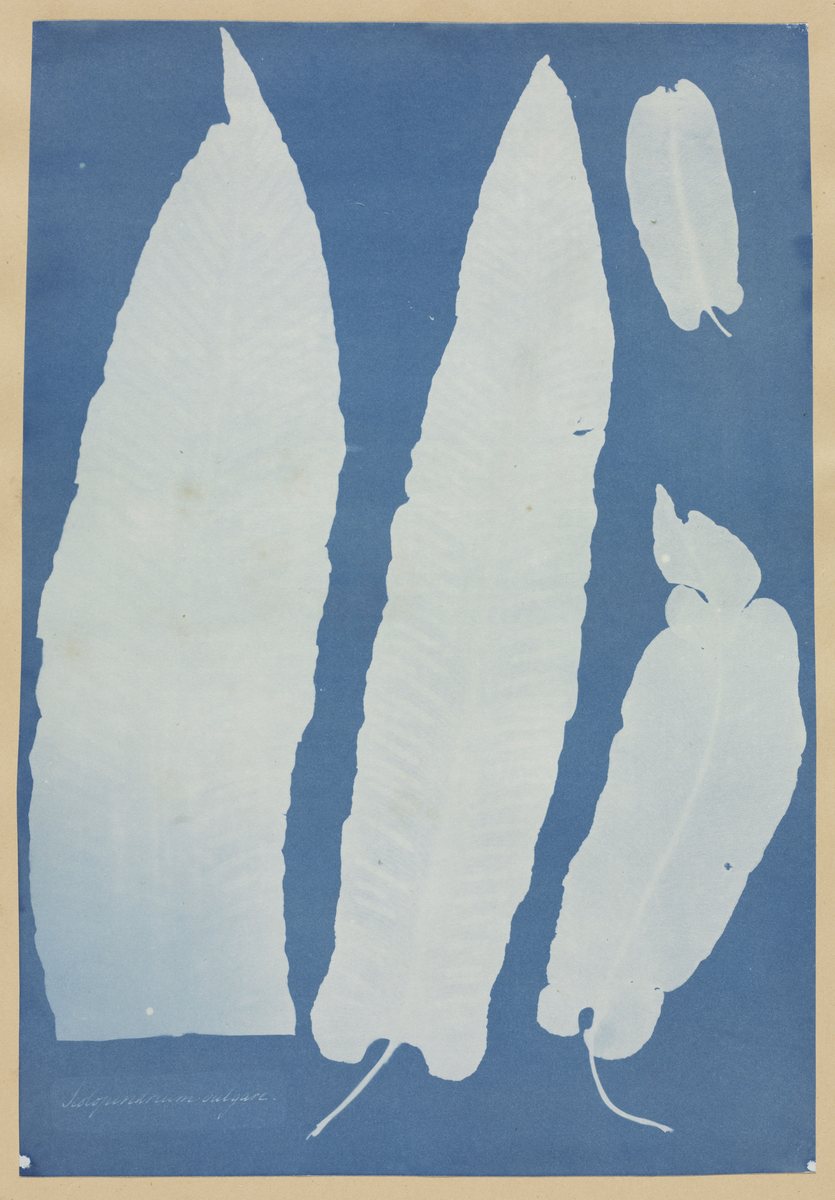
A cyanotype of four broad, tongue-shaped fern leaves in pale white silhouette on a mid-blue ground, with the plant’s name handwritten at lower left
#557394#7990A5#A4B5BD#C7CEC9
PhotographScolopendrium Vulgare (1852–54)

Anna Atkins made this print of hart’s-tongue fern by laying the leaves on light-sensitive paper and exposing it to light, with no camera. It is at the Cleveland Museum of Art. The cyanotype shares cyan’s Greek root, but its blue is Prussian blue: sampled, much darker and grayer than the web’s cyan.

#557394#7990A5#A4B5BD#C7CEC9
Source: Cleveland Museum of Art

Palettes are sampled in-house.

Questions

What color is cyan?

A vivid greenish blue, made on screens from full-strength green and blue light. The web code is #00FFFF (RGB 0, 255, 255).

Is cyan the same as aqua?

In CSS, yes: the keywords cyan and aqua are both #00FFFF. In everyday use, people mean something a little greener by aqua. In the xkcd color survey, their average aqua was #13EAC9, the code on this site’s aqua page.

Is cyan blue or green?

Both, equally. On screen it is green and blue light in equal parts, and it sits halfway between them on the color wheel. Dictionaries describe it as a greenish blue.

Why does printed cyan look different from screen cyan?

Screens mix light and printers mix ink, and each can show colors the other can’t. The web’s cyan is too vivid to print exactly, and printer’s cyan, usually shown as about #00B7EB, is darker and bluer.

What is the opposite of cyan?

Red. Cyan is made of green and blue light, which is everything except red, so the two are opposites on the color wheel.

What is the difference between cyan and teal?

Teal (#008080) is cyan at half brightness: the same hue, much darker. Cyan is light and vivid; teal is deep and calm.

What colors go with cyan?

Black or navy to make it glow, coral for warmth, and gray or slate to calm it down. Magenta and yellow make a loud, playful set.