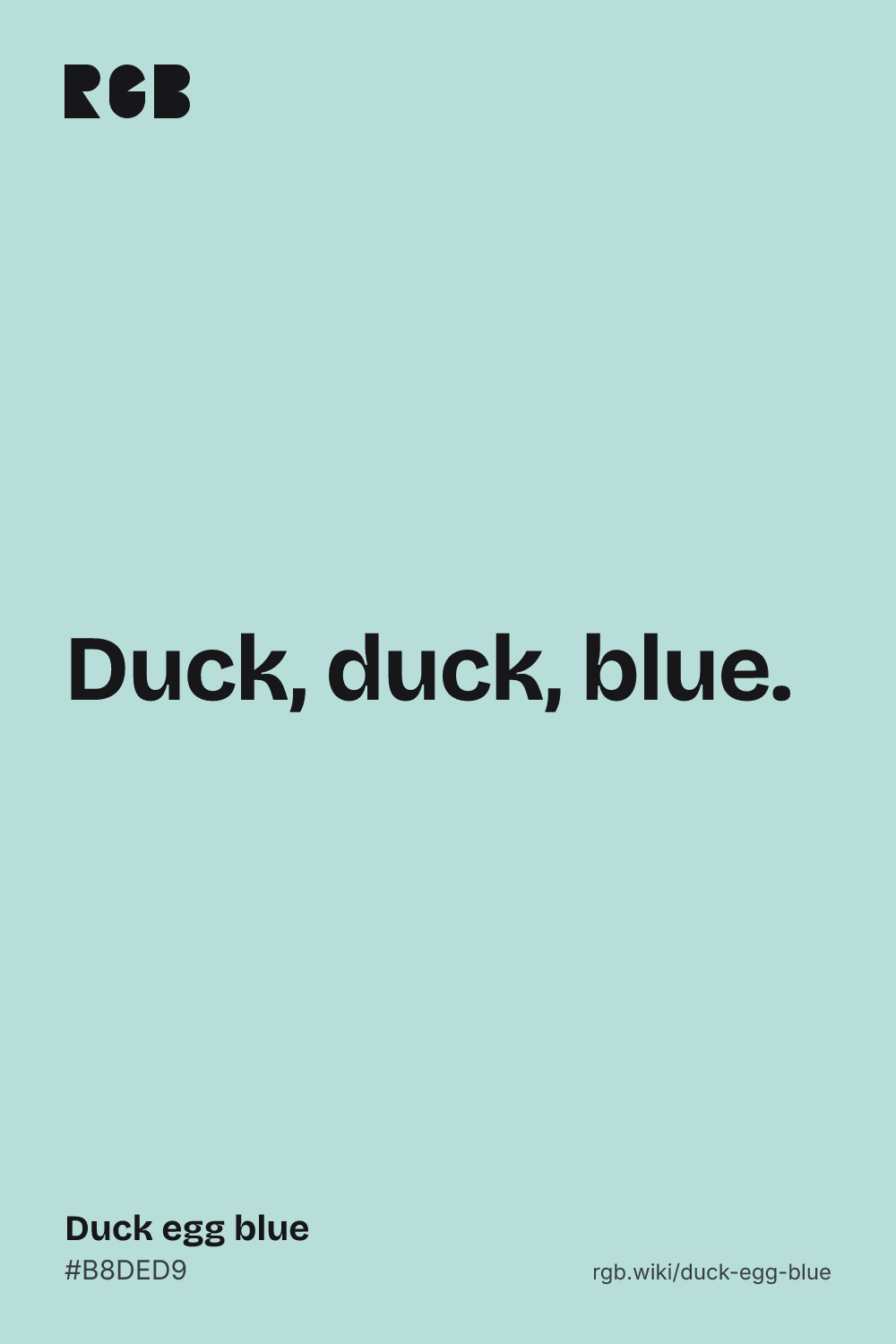
A pale, grayish blue-green named after the shells some ducks lay.
Overview
Duck egg blue is a pale blue-green with a soft gray cast. The code most color lists use is #B8DED9: green and blue both high, with enough red to quiet them. It is lighter and grayer than robin egg blue, its American cousin.
The name is at home in British design. At the Victoria and Albert Museum in London, curators use it for the blue-washed insides of Wedgwood teaware made between 1810 and 1830, for an English silk ribbon of the 1890s, and for a llama-wool coat from 1950s Cornwall dyed “a fashionable duck egg blue”.
Real duck eggs are less predictable than the paint chip. Wild mallards lay creamy to grayish or greenish eggs, while the Pekin, a white farm duck of the same species, lays white ones. Geneticists have traced blue shells to a single gene that most likely moves biliverdin, the same bile pigment that colors robin eggs, into the shell.
On screens, #B8DED9 is a background color. It is far too light for white text, so pair it with charcoal, plum or deep brown, and warm it with brass, terracotta or soft pink.
HEX
#B8DED9
RGB
rgb(184, 222, 217)
HSL
hsl(172, 37%, 80%)
HSV
172°, 17%, 87%
CMYK
17, 0, 2, 13
OKLCH
oklch(87.2% 0.040 186.7)
Every code converts from the HEX value #B8DED9. No color standard defines duck egg blue. #B8DED9 is the code most color lists use. In the ISCC-NBS color system it falls between very pale green and very light greenish blue, and people’s average duck egg blue in the xkcd color survey, #C3FBF4, is lighter and brighter. CMYK is a screen-based estimate; print results vary.
Duck egg blue on the color map
LighterDarker
People’s average duck egg blue in the xkcd survey sits straight above the reference, lighter but the same hue, and far more saturated, which this map of hue and lightness doesn’t show. The two nearest ISCC-NBS centers bracket the code: very pale green sits inside the outline on the green side, and very light greenish blue just outside it on the blue side. The outline is an approximate range, not a measured one.
Shades and tints
Tintswith white
Shadeswith black
Toneswith gray
Duck egg blue sits in the middle. Tints add white, shades add black and tones add gray, in 10% steps out from it. Tap any swatch to copy its code.
Light and dark duck egg blue
#E3F2F0
Pale duck eggMixed 60% with white. A barely-there tint for walls and backgrounds.
#B8DED9
Duck egg blueThe reference color.
#8AA6A3
Deep duck eggMixed 25% with black. A soft gray-green for trim and borders.
#5C6F6C
Dark duck eggMixed 50% with black. A muted slate green that holds white text.
#96DED1
Robin egg blueClearer and more colorful, with a page of its own. See robin egg blue
#A9D4D2
Haint blueA little darker and bluer, with a page of its own. See haint blue
Colors that go with duck egg blue
Pairings that work in rooms, outfits and interfaces.
Duck egg and brass
Warm metal against cool blue-green. A classic for kitchens and hallways.
Duck egg and terracotta
Earthy and warm, like a clay pot on a pale windowsill.
Duck egg and charcoal
Quiet and modern. Charcoal carries the text.
Duck egg and dusty pink
Two soft tones for a gentle, vintage look.
Duck egg and plum
Deep plum warms the pale blue-green. Rich but calm.
Duck egg night
A dark theme where the pale blue-green does the glowing.
Color-wheel palettes
Pick a palette to see where its colors sit on the color wheel. The caret marks duck egg blue. Tap a band to copy its code.
Robin egg blue80%Duck egg blueLight gray80%Haint blue83%Powder blue91%Light blue85%Columbia blue84%
Lined up by hue around duck egg blue. Hover a color to see how similar it is.The bar under each name shows how similar it is. Similarity comes from the distance between the two colors in OKLab, a model of how we see color.
Duck egg blue vs robin egg blue
Duck egg blue#B8DED9 · hue 172°
Paler and grayer
A touch bluer
A mostly British name
Robin egg blue#96DED1 · hue 169°
Clearer and more colorful
Leans a little toward green
Named after the American robin’s egg
Meaning
Eggshell
China
Interiors
One gene
Duck egg blue is a domestic color, named after a farm egg and recorded on British china and clothes. Its meaning starts with the egg: biologists have worked out why some ducks lay blue-green eggs and others white ones. No study tests what this color means to people, so the claims below are about the eggs and the records.
Wild eggs are buff, not blue
Well established
Wild mallards lay unmarked eggs that run from creamy to grayish or greenish buff. The Pekin, a white farm breed of the same species, lays white eggs. So a real duck egg is often grayer or greener than the color named after it.1, 2
One gene makes the shell blue
Genetic studies
Two genetic studies in China traced blue and green shells to small changes beside one gene, ABCG2. Ducks with the blue version make more of its protein in the shell gland, and the protein most likely pumps biliverdin, a blue-green bile pigment, into the shell as it forms.2, 3
Prized by duck breeders
Weak evidence
Duck researchers in China call the blue shell an important economic trait and link it to stronger shells and eggs that keep longer. Those links are stated in the papers’ background sections rather than tested in them, so treat them as claims.4
Duck egg or robin’s egg?
Museum records
The two names overlap even in museums. The V&A’s gallery label for a set of Wedgwood drabware, made in Staffordshire around 1810 to 1830, says some insides are glazed with a duck-egg blue finish; its catalog entry for the same ware calls the wash robin’s egg blue.5
Liu, H., Hu, J., Guo, Z. et al. (2021). A single nucleotide polymorphism variant located in the cis-regulatory region of the ABCG2 gene is associated with mallard egg colour. Molecular Ecology, 30(6), 1477–1491. doi:10.1111/mec.15785
Chen, L., Gu, X., Huang, X. et al. (2020). Two cis-regulatory SNPs upstream of ABCG2 synergistically cause the blue eggshell phenotype in the duck. PLoS Genetics, 16(11), e1009119. doi:10.1371/journal.pgen.1009119
Wang, D., Bao, Y., Li, B. et al. (2026). CTCF knockdown reduces ABCG2 expression and intracellular biliverdin accumulation in primary uterine epithelial cells of blue-shelled ducks. Poultry Science, 105(12), 107996. doi:10.1016/j.psj.2026.107996
Victoria and Albert Museum, “Plate”, drabware, Josiah Wedgwood and Sons, 1810–1830 (WE.4446-2014), gallery label and summary.
History
Duck egg blue turns up in British design records long before color codes. Science caught up with the egg itself only in the last few years.
1810–1830
Wedgwood makes drab, olive-brown tableware at its Etruria works in Staffordshire. The V&A describes some of the cups and jugs as glazed inside with a duck-egg blue finish.1
1890s
A silk ribbon, probably made in England, is woven in duck egg blue satin with stripes of brown, tan and beige. It is now at the V&A.2
1955–1960
Ormdale, a garment factory near Redruth in Cornwall, makes a llama-wool coat dyed what the V&A calls “a fashionable duck egg blue colour”.3
2010
In the xkcd color survey, people’s average duck egg blue comes out as a lighter, brighter #C3FBF4.4
2020
Researchers in China report that two small changes beside the ABCG2 gene cause the blue eggshells of domestic ducks.5
2021
A study of 352 ducks bred from mallards, which lay greenish eggs, and white-egged Pekins maps the difference to the same gene.6
Sources (6)
Victoria and Albert Museum, “Plate”, drabware, Josiah Wedgwood and Sons, Etruria, 1810–1830 (WE.4446-2014), gallery label (2008).
Victoria and Albert Museum, “Ribbon”, silk satin, probably England, 1890s (T.397-1984).
Victoria and Albert Museum, “Coat”, llama wool, Ormdale, 1955–1960 (T.77-2013).
Munroe, R. (2010). “Color survey results”. xkcd blog. The survey’s color averages are released as CC0 data.
Chen, L., Gu, X., Huang, X. et al. (2020). Two cis-regulatory SNPs upstream of ABCG2 synergistically cause the blue eggshell phenotype in the duck. PLoS Genetics, 16(11), e1009119. doi:10.1371/journal.pgen.1009119
Liu, H., Hu, J., Guo, Z. et al. (2021). A single nucleotide polymorphism variant located in the cis-regulatory region of the ABCG2 gene is associated with mallard egg colour. Molecular Ecology, 30(6), 1477–1491. doi:10.1111/mec.15785
Questions
What color is duck egg blue?
A pale blue-green with a soft gray cast. The code most color lists use is #B8DED9 (RGB 184, 222, 217). No standard defines it.
Is duck egg blue blue or green?
Both. It sits between the two, a touch closer to green. The ISCC-NBS color system would call it very pale green or very light greenish blue.
Are duck eggs really blue?
Some are. Wild mallards lay creamy to grayish or greenish eggs, Pekin ducks lay white ones, and some farm breeds lay blue-green eggs. One gene makes the difference by moving a blue-green bile pigment into the shell.
What is the difference between duck egg blue and robin egg blue?
Duck egg blue (#B8DED9) is paler and grayer. Robin egg blue (#96DED1) is clearer and more colorful. Duck egg blue is the more British name; robin egg blue is named after the American robin.
Is duck egg blue the same as haint blue?
Close, but not quite. Haint blue (#A9D4D2) is a little darker and bluer, and it is named after a Southern custom of painting porch ceilings blue to keep spirits away.
What colors go with duck egg blue?
Brass and warm wood, terracotta, dusty pink and plum for warmth, and charcoal or navy for text. It is too light to carry white text.